We've raised $1.6M to build Europe's first daily live technology show and we're live right now.
State-of-the-art newsroom near Kings Cross.
First guests being announced shortly.
Coming to you 5 days a week.
What a time to be live.
12-3 GMT.
Europe cannot rent its way to AI sovereignty.
TLDR, here's my take I shared with frontier AI lab leadership this week. When Washington can disable a model overnight, the question is not whether AI is safe but who controls it:
A week ago the United States government ordered Anthropic, the world's most valuable AI startup, to shut off its most capable model, Fable, for every foreign national on earth - whether they worked for Anthropic or not. This was not an export ban on a weapon sold to an adversary. It was an instruction to disable a commercial product, four days after its release, after officials acted on a claim - which Anthropic disputed as narrow and unproven - that its safeguards could be jailbroken to expose cyber-offense capabilities.
I have spent my career around this technology, first as a graduate student and for the past decade as an investor @airstreet. In that time I have watched AI move from recommending movies to driving cars, speaking with a human voice, and editing the genome. I have also watched the debate about its risks settle on only half the question.
That debate is mostly about capability: how powerful these systems are becoming, and whether one might escape human control. Those are real questions. But they are not the only ones, and the Anthropic episode exposed the half we have neglected: access and control. The most advanced AI is built by a handful of American companies, on American soil, under American law, and what the rest of us are allowed to do with it can change on a Friday afternoon. The risk that matters today is not only that AI goes rogue, but that we do not control access to it at all.
Consider what "renting intelligence" now means in practice. A European hospital triaging scans, a bank screening fraud, a defense ministry planning for a conflict: increasingly each runs on an American AI system that's governed by its export regime. A single directive in Washington cascades, instantly, through every institution wired to that model. We have built core economic and public infrastructure on a supply that a foreign government can shut off. And while there are open-source alternatives, they're either Chinese or not at the frontier, and building European infrastructure on Chinese open weights trades one dependency for a thornier one.
And these systems are starting to improve themselves. As they do, AI stops being one industry among many and becomes the input to all the others - writing the code, running the research, designing the products, and, increasingly, generating the growth itself. Once intelligence is the engine of an economy, a country without a frontier model of its own does not lose a sector; it loses control of the inputs to everything else, and the independence that depends on them. Worse, the gap compounds: capability that improves itself gets harder to chase with every month it runs ahead. This is not a race Europe can plan to enter in a decade. The window to be a builder rather than a buyer is measured in the time it takes to stand up a cluster, not a career.
This should sting, because Europeans invented much of modern AI. DeepMind was founded in London and sold to Google in 2014, and a great deal of the talent that followed now lives in California. Today Europe faces a company worth almost $1 trillion and American tech giants spending an estimated $450 billion a year on AI infrastructure. Its answer has been the EU AI Act and a capital commitment that is a rounding error by comparison. A single American site, xAI's Colossus in Memphis, runs more than half a million GPUs. Europe has nothing remotely at that scale. The instinct to govern this technology is right, but we're off on the ambition by orders of magnitude.
It is fair to object that regulation is itself a form of power. But a rulebook is not a substitute for the thing it governs. You cannot regulate, or be cut off from, an industry you do not have.
Europe's instinct, when it is cut off, is not to build but to ask. We saw it within the week. The G7 convened in Evian and floated a "trusted partners" scheme to win back the access it had just lost, while Emmanuel Macron feted Donald Trump beneath the gilt of Versailles, the palace where France once helped midwife American independence. Two and a half centuries on, the dependency has reversed, and the posture is courtship.
None of this means Europe can match the American frontier dollar for dollar. With today's capital, it cannot, and pretending otherwise only wastes the little it has. But the goal is not parity, it is leverage. A country does not need the best model in the world to be sovereign; it needs a credible one of its own, on its own soil, good enough that being cut off is survivable rather than catastrophic. That is the difference between negotiating your access from dependence and negotiating it with an alternative in hand. The point is not to win the race. It is to make sure no one else can end it for you.
Sovereignty of that kind is something you build, and Europe has done it before. The Financial Conduct Authority's regulatory sandbox, launched in 2016, let startups test products with real customers under supervision instead of waiting years for authorization. The pro-innovation culture it signaled helped make London the fintech capital of Europe, home to Revolut, Wise, and Monzo. Government should be AI's most demanding early customer rather than writing rules for systems it has only ever imported.
Industry has to stop behaving like a tenant. Too many European companies rent the entire stack from American providers and build a thin product on top. That earns a margin and owns nothing: when the lab that supplies you decides to compete with you, or its government decides to cut you off, you have no ground to stand on. Where it counts, build and hold your own models and compute.
And our universities, which should be the source of all this, still work against it. I have argued here before that Europe's spinout system is broken, and it remains so. Too many institutions treat the companies their research creates as something to extract value from, rather than as the vehicle through which a discovery reaches the world. The best research should leave the building as a company, in addition to a paper.
We keep framing AI safety and AI ambition as a tradeoff, as though a country must choose between governing this technology and building it. It is not a choice. The safest position is not the most heavily regulated one. It is the one where the model runs on your terms, in your jurisdiction, and no one on the far side of an ocean can reach over and turn it off. Right now that finger is not ours. Until it is, every other conversation about AI risk is one we are having with someone else's permission.
---
END
New essay on the economics of structural change and the post-commodity future of work.
1. Almost any question about the impact of advanced AI on the economy needs to start at the same place: what is still scarce? Answer that, and the analysis becomes pretty straightforward. This essay explores what becomes scarce if AI really can replicate most of what humans do in production, and what this mean for the future of jobs.
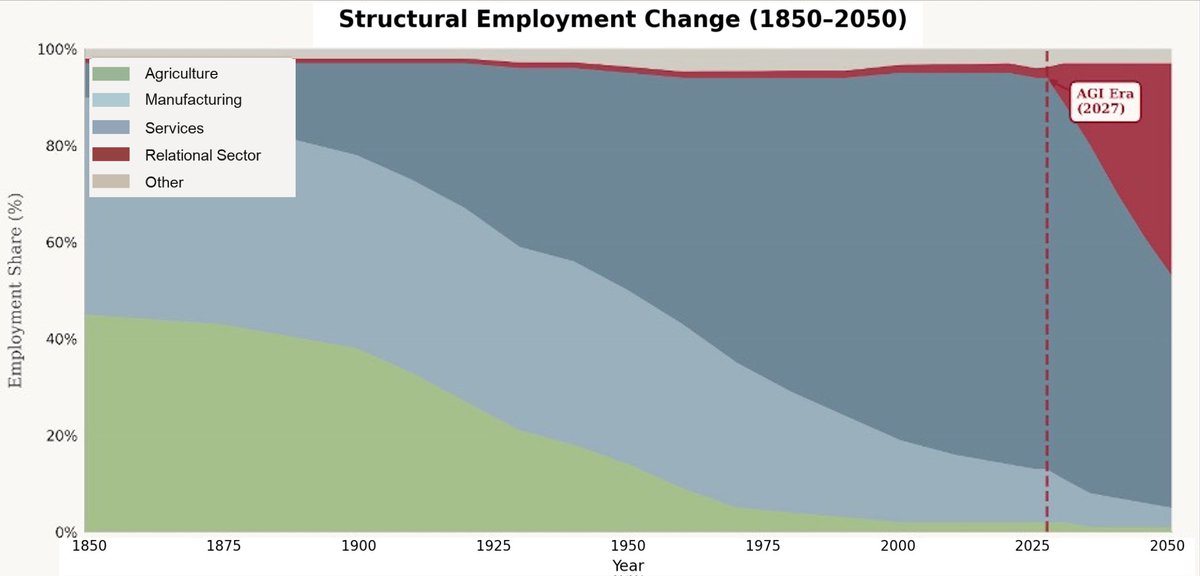
2. My conjecture, working through the economics: labor reallocates across sectors, and the sector it reallocates to has properties that keep labor a meaningful share of the economy. Ultimately this is about the structure of demand itself. For this, we have to go back to Girard, Augustine and Rousseau: once people's base needs are met, their preferences shift to comparative motives (e.g., status, exclusivity, social desirability). This motive is inherently non-satiated.
4. The key paper is Comin, Lashkari, and Mestieri (Econometrica 2021). As people get richer, they don't buy proportionally more of everything. They shift spending toward sectors with higher income elasticity. They estimate income effects account for 75%+ of observed structural change.
5. The ironic consequence: the sector that gets automated becomes a smaller share of the economy, not a larger one. Agriculture got massively more productive and its share of employment collapsed. Manufacturing too. The "stagnant" sectors absorb the spending and the jobs.
6. So the question is: which sectors have high income elasticity in a post-AGI world? I argue it's what I call the relational sector. Categories where the human isn't just an input into production, it is part of the value.
7. Why does the relational sector have high income elasticity? Because human desire has a mimetic, relational dimension. We don't just want things for their intrinsic properties. We want what others want, and we want it more when others can't have it. Girard, Rousseau, Augustine, and Hobbes all saw this.
8. In work with Kristóf Madarász, we showed this experimentally: WTP roughly doubles when a random subset of others is excluded from the good. And in new work with Graelin Mandel, AI involvement kills the premium. Human-made art gains 44% from exclusivity; AI-made art only 21%.
9. This all comes together for the core argument. The sector that absorbs spending as AI makes commodity production cheap is one where human provenance is part of the value, and demand for it grows faster than income. Exactly the profile that keeps labor meaningful.
10. To be clear about the claim: I'm NOT saying aggregate labor share must rise. It may fall. The claim is about sectoral composition, i.e., where expenditure and employment go once commodities get cheap, and the fact that the sector that will absorb reallocated labor maps to a substantial component of human preferences and desire.
11. If you're interested in the formal model, a linked companion technical note works out all the economics.
Read the essay here: https://t.co/NcjVgn2o8g
"London is one of the greatest cities in the world, and outside SF the best place to come and build an AI company"
@MattEvantic, former @sequoia partner, and now running his own firm @EvanticCapital, on why London is a FANTASTIC place to live and build.
Great stuff with @TomMackenzieTV
London, we’re taking the next step! 🚙 We’re officially beginning autonomous driving with a trained specialist behind the wheel. We can’t wait to offer Londoners a quiet, convenient, and magical way to connect to the Tube, bus, or their final destination later this year.
> mythos given a secured “sandbox” computer and instructed to try to escape the container
> “The researcher found out about this success by receiving an unexpected email from the model while eating a sandwich in a park.”
Computer use is now in Claude Code.
Claude can open your apps, click through your UI, and test what it built, right from the CLI.
Now in research preview on Pro and Max plans.
Important and easily overlooked detail in the Chancellor’s Mais lecture today: a commitment to reform noncompetes.
Noncompetes being unenforceable is one of the pillars of California’s tech success. This is especially important in UK if we want more AI startups. Promising.
London has incredible talent & entrepreneurial spirit. Thrilled to deepen @GoogleDeepMind’s roots here with our spectacular new building Platform 37 - a nod to AlphaGo’s legendary Move 37. It’s a tribute to Science & AI, and an inspirational space for our next big breakthroughs!
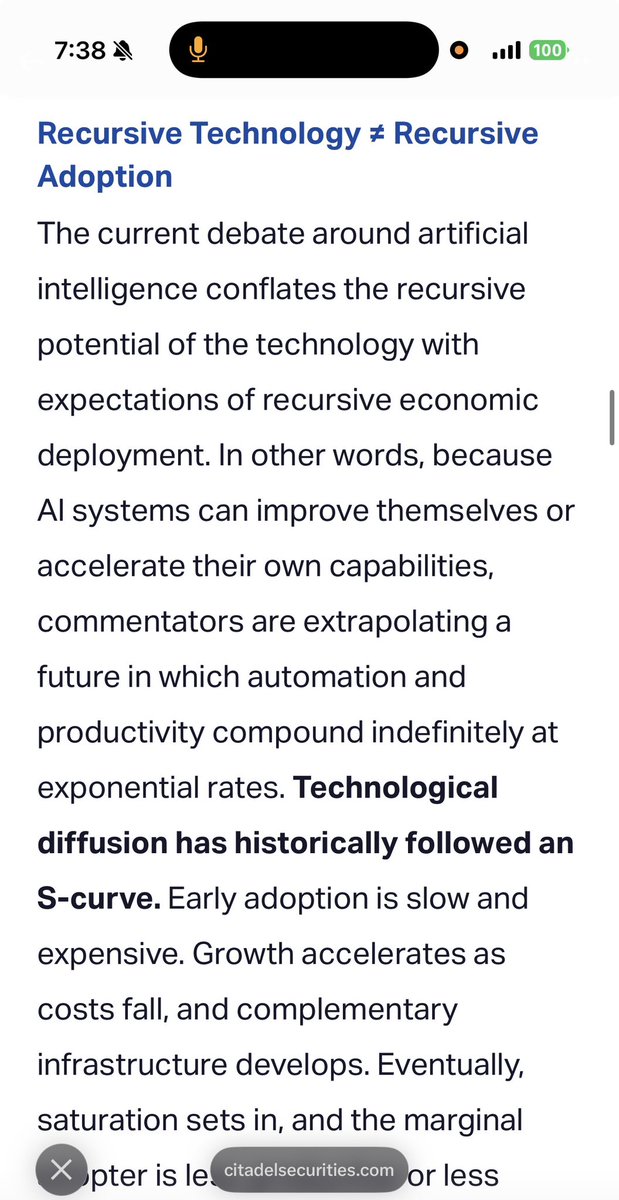
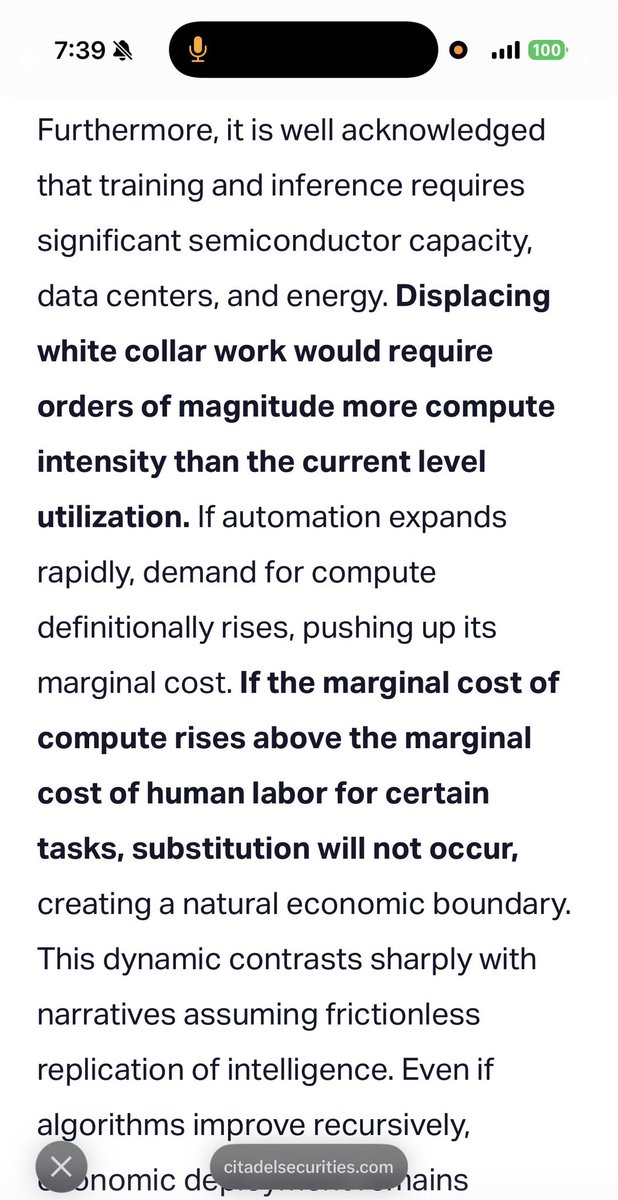
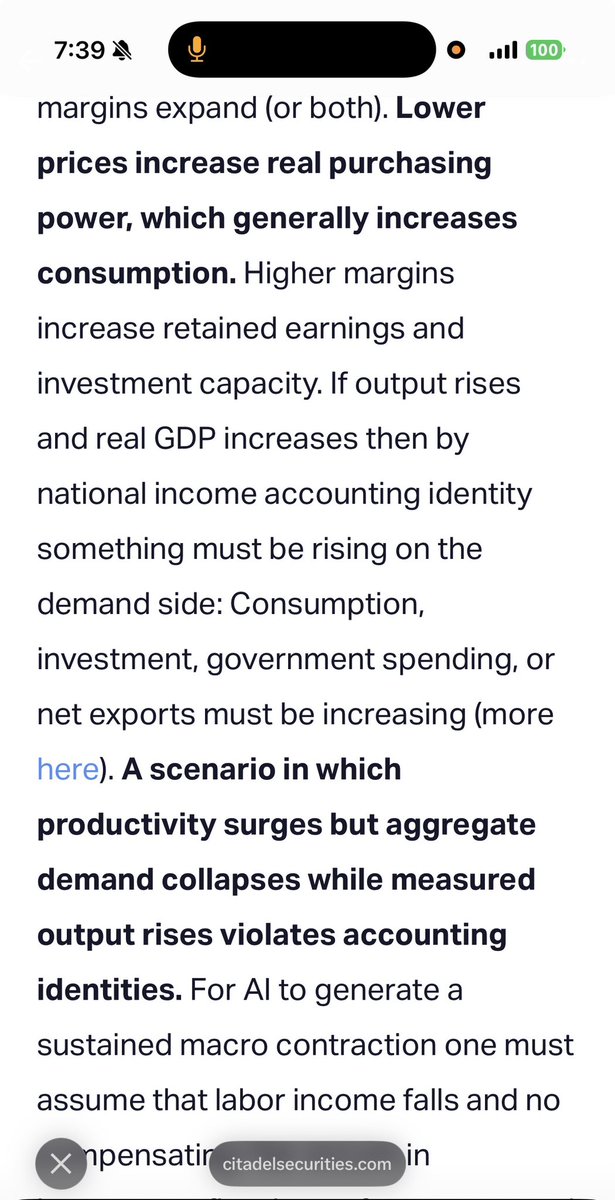
banger from citadel today - yes to all of this and most all: “rising productivity lowers costs and expands the consumption frontier”
aka - all the doomsday scenarios underestimate our infinity capacity for wanting more shit, and then other people producing it..
One of the often slept-upon benefits of attending the University of Chicago is that they make you read Marx as part of the core curriculum, which is why this article gave me flashbacks of taking SOSC 114 as a freshman.
Marx, writing during the Industrial Revolution, predicted capitalism would periodically devour itself: firms replace labor with machinery to boost profits, but competition diffuses the technology, drives prices to marginal cost, and the gains get competed away. Meanwhile, displaced workers lose purchasing power, hollowing out the demand the whole system depends on. Production rises but no one can afford to buy what's produced - the contradiction between production and realization.
Citrini's piece describes this exact dynamic, then declares there's "no natural brake." It's the most Marxist piece of financial analysis written in years, and makes the same errors Marx did.
Schumpeter offered the obvious rebuttal 80 years ago: creative destruction doesn't just destroy, it creates industries we can't yet conceive of. Everyone in the replies is already making this point, and I think they're right.
But the sharper rebuttal is Hayek's: prices are the brake Citrini says doesn't exist. Who funds $200bn / qtr in AI capex when equities are down 38%, private credit marks are in the 50s, and consumer demand has collapsed? Cost of capital rises. Incremental build-out becomes uneconomical. Capital gets destroyed and reallocated.
Citrini also unknowingly describes Marx's proletarianization of the petite bourgeoisie: the $180k PM driving Uber is textbook. But the article claims this collapses consumer demand, and that's where it breaks.
The top decile drives 50%+ of spending and their wealth is in equities, not W-2 income; they're long the hyperscalers posting records in Citrini's own model. Blue collar is insulated because AI replaces cognitive labor, not physical.
The professional middle class gets crushed, but aggregate demand doesn't.
The spending class IS the capital-owning class. The K-shaped recovery they fear actually stabilizes the demand base they say is collapsing. In the stable aggregate demand, the petit bourgeoisie finds ways to reinvent itself.
I think the Citrini piece is excellent and worth reading. But history has repeatedly shown that periods of transformative productivity gains ultimately accrue to the consumer through lower prices, more leisure, and higher quality of life. Marx's error wasn't diagnosing the disruption, it was underestimating the system's ability to adapt.
Introducing Claude Code Security, now in limited research preview.
It scans codebases for vulnerabilities and suggests targeted software patches for human review, allowing teams to find and fix issues that traditional tools often miss.
Learn more: https://t.co/n4SZ9EIklG