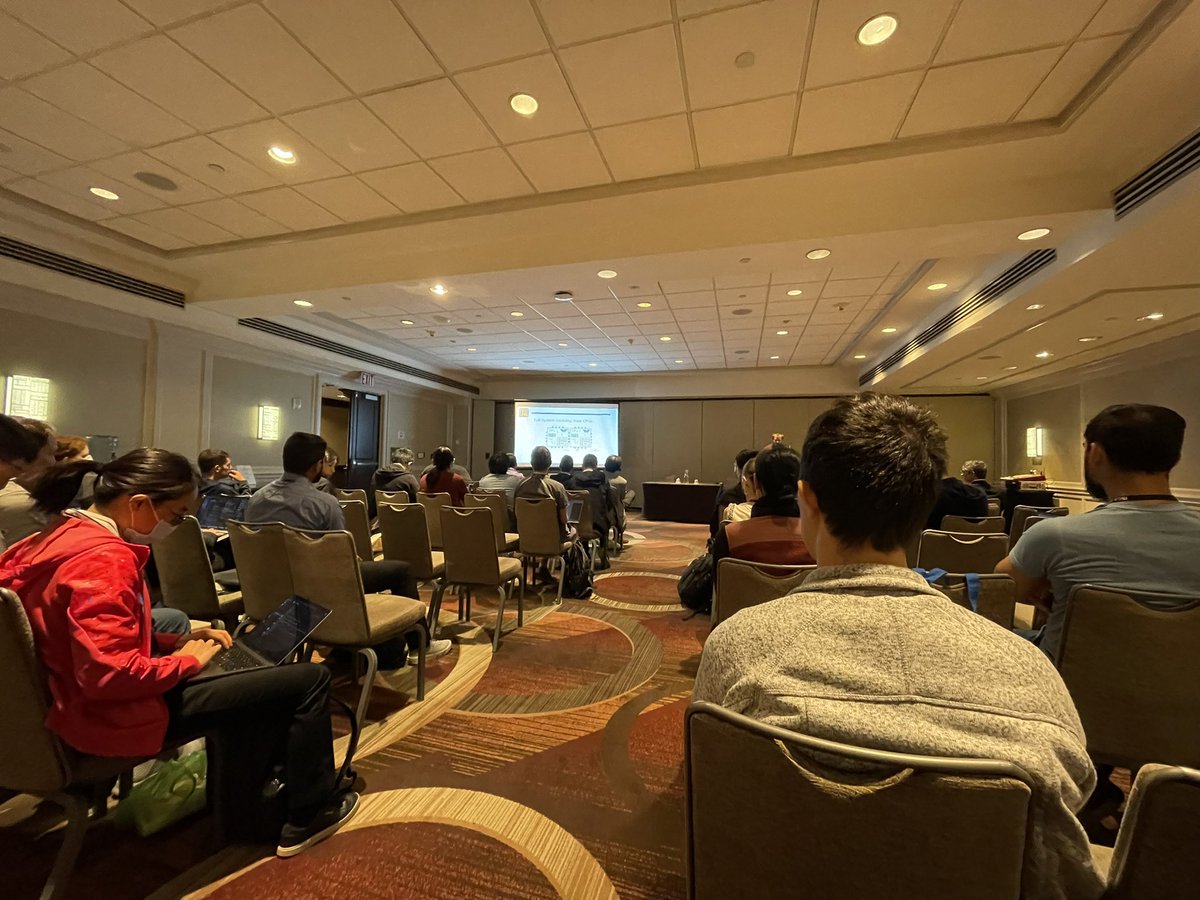
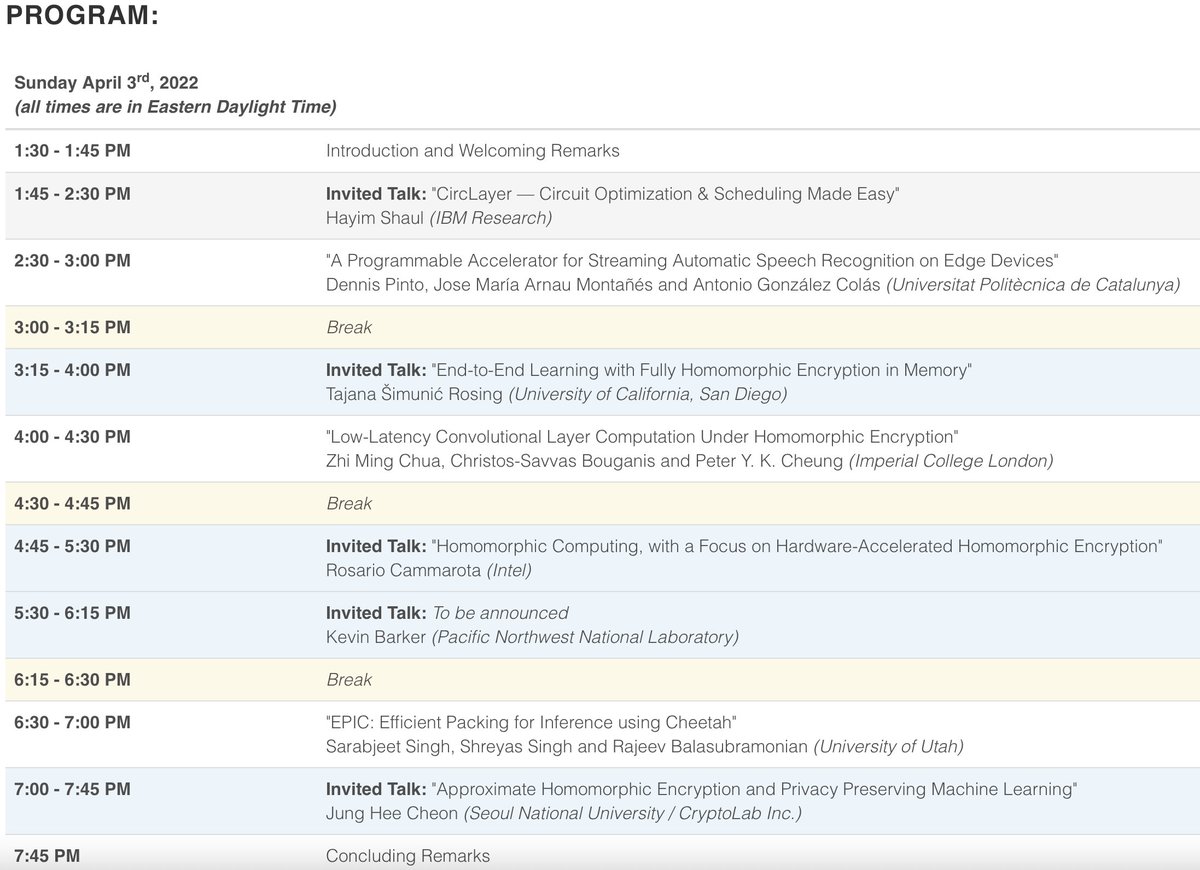
📣 The 8th Workshop on Cognitive Architectures (CogArch) to be held at the historic edition of ISCA in Buenos Aires 🇦🇷 is around the corner‼️
This year, CogArch will be centered around the topic of AI 🤖 for hardware design 💻
More info 👉 https://t.co/oT03kPI74c
📣 The 8th Workshop on Cognitive Architectures (CogArch) to be held at the historic edition of ISCA in Buenos Aires 🇦🇷 is around the corner‼️
This year, CogArch will be centered around the topic of AI 🤖 for hardware design 💻
More info 👉 https://t.co/oT03kPI74c
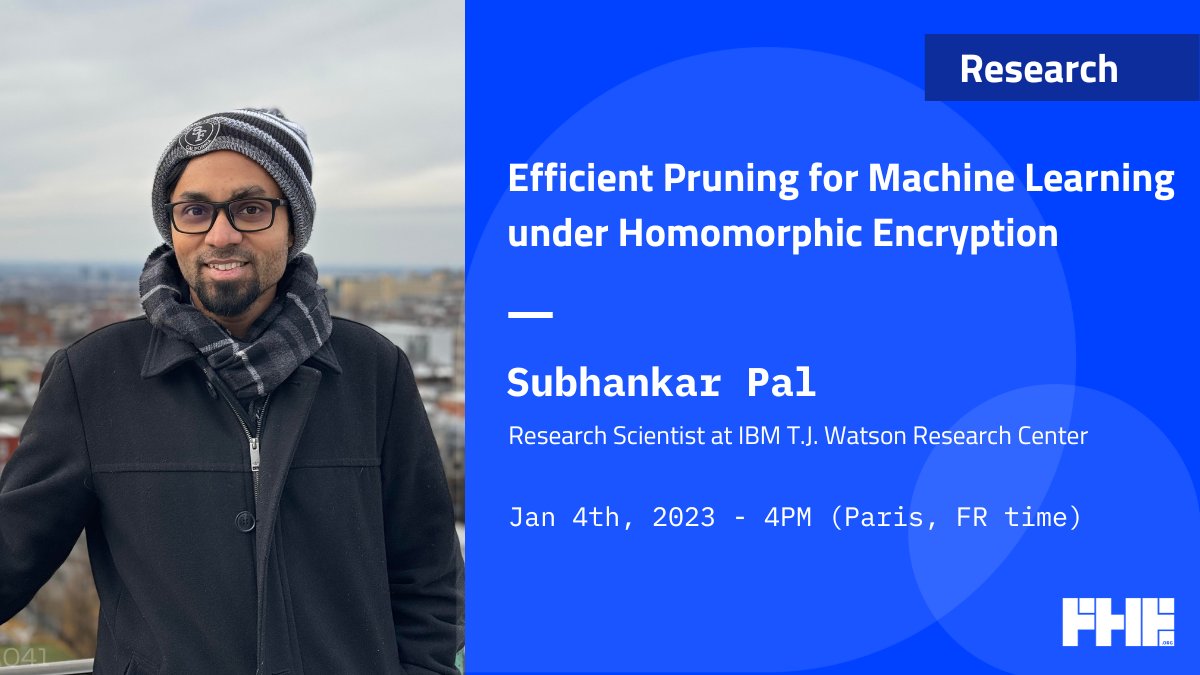
🗓️ Register for the next Meetup on Jan 4th 4PM CEST — we'll have Dr. Subhankar Pal, a research scientist at IBM T.J. Watson Research Center presenting Efficient Pruning for Machine Learning under Homomorphic Encryption. Don't miss it! https://t.co/XJPsk9ckoM
Thrilled to announce that our paper on efficient pruning techniques for #MachineLearning under #HomomorphicEncryption is accepted to appear at ESORICS 2023! I’m particularly thrilled as this is my first paper at a #ComputerSecurity conference!
Sad, but inevitable, truth. Even more so considering that the latest-and-greatest #GenerativeAI models most certainly have been trained on StackOverflow content. Is there a solution that can disseminate due credit?
50% of StackOverflow traffic is gone!
Look at the attached chart. It tells a scary story that will not be limited to StackOverflow.
Right now, detecting AI-generated content is impossible.
Last week, OpenAI shut down the tool they created for this purpose. They launched it in January, and it's dead today, less than seven months later.
Their statement: "The AI classifier is no longer available due to its low rate of accuracy."
I'm not surprised about any of these two events.
I don't remember the last time I visited StackOverflow. Why would I when tools like Copilot and ChatGPT answer my questions faster without making me feel bad for asking?
And I'm even less surprised about OpenAI killing their tool: Many believe detecting AI-generated text is impossible. I'm one of them.
Here's what OpenAI had to say about this:
"We are (...) currently researching more effective provenance techniques for text, and have made a commitment to develop and deploy mechanisms that enable users to understand if audio or visual content is AI-generated."
Notice how they differentiate text from audio and visual content. For the latter, they seem confident they'll find a way to recognize humans from AI. For text, they are not and are word-salad'ing us with a vague "researching more effective provenance techniques."
StackOverflow famously banned any AI-generated answers from the site.
That's the wrong move.
Instead, we need to find a way where human and AI-generated content coexist and benefit from each other. There's no putting the genie back in the bottle, so how can we get the most out of it?
Do you think StackOverflow will survive? What can they do to fend off what seems to be a life-threatening event?
📣 The 7th edition of the CogArch workshop is around the corner! Please, consider submitting your work ‼️
This year, CogArch will be centered around the topic of #foundationModels and the architectural implications of scalable #AI 🤖
More info 👉 https://t.co/PMuwo846LC
📣 The 7th edition of the CogArch workshop is around the corner! Please, consider submitting your work ‼️
This year, CogArch will be centered around the topic of #foundationModels and the architectural implications of scalable #AI 🤖
More info 👉 https://t.co/PMuwo846LC
PhotoRoom is able to generate marketing images for any product using stable diffusion, (beta)
Example, capture this car toy & prompt “a photo of this car driving a scenic mountain road”
Try it by posting a photo and a prompt in comment & I will send you generated images back
📣 The first edition of a WORKSHOP ON DATA INTEGRITY AND SECURE CLOUD COMPUTING (DISCC) is around the corner! Please, consider attending if you are attending @MicroArchConf in Chicago, IL‼️
More info 👉 https://t.co/uEUE1ZXkiX
The original problem set in 1954 looked for Solutions of the Diophantine Equation x³+y³+z³=k with k being all the numbers from 1 to 100. This is how researchers solved the final piece for the most elusive number of all, 42: https://t.co/TDyU9Pesfw [video: https://t.co/CuS00B7tHx]
📣The sixth edition of CogArch https://t.co/Sq16h6IjeT, virtually co-located with @sigarch@HpcaArchConf, is around the corner‼️We have a great line-up of keynotes and talks centered around Cognitive Systems with a special focus on Data-Secure #AI. Please consider attending!





![Rainmaker1973's tweet photo. The original problem set in 1954 looked for Solutions of the Diophantine Equation x³+y³+z³=k with k being all the numbers from 1 to 100. This is how researchers solved the final piece for the most elusive number of all, 42: https://t.co/TDyU9Pesfw [video: https://t.co/CuS00B7tHx] https://t.co/4zpQre7Czl](https://pbs.twimg.com/media/FajGsI6X0Agf527.jpg)