Vorrei fare presente a chi sta strumentalizzando la tragedia di #Modena con commenti razzisti contro i migranti che a fermare il colpevole sono stati due ragazzi pakistani impedendogli di accoltellare un altro uomo che a sua volta cercava di fermarlo.
חלקאי פלסטיני בגיל של אבא שלכם סירב להתפנות מאדמתו, לדרישת המתנחל. המתנחל החמוש כפת אותו וכיסה את עיניו. עונש. החיילים, כפי שניתן לראות בסוף הסרטון, עומדים שם ומסתכלים, שומרים על המתנחל. עוד יום בגדה המערבית.
A 21-year-old MIT student wrote a master's thesis in 1937 that Harvard's most famous professor of cognitive science later called "possibly the most important master's thesis of the century."
I read it at 2am and could not believe one paper had quietly built the entire foundation of every computer that exists today.
His name was Claude Shannon. The thesis is called "A Symbolic Analysis of Relay and Switching Circuits."
Every smartphone in your pocket. Every server farm running ChatGPT. Every chip Nvidia ships. Every line of code an engineer has ever written. All of it traces back to a single insight one graduate student had at 21 years old, working on a side project at MIT.
Here is the story almost nobody tells you.
Claude Shannon was born in 1916 in a small town in Michigan. He grew up tinkering. Built a telegraph between his house and a friend's house using barbed wire from a nearby fence. Repaired radios for the local department store. He studied both mathematics and electrical engineering at the University of Michigan because he could not decide which one he loved more. That refusal to choose is what eventually made him.
When he got to MIT for graduate school in 1936, he was assigned to operate a strange machine called the differential analyzer. It was room-sized. Mechanical. Built by Vannevar Bush. It used a tangle of gears, shafts, and electrical relays to solve calculus problems. Most students just operated it.
Shannon did something else. He stared at the relay circuits inside it. The way they clicked open and closed. The way they routed signals through the machine.
He noticed something nobody had noticed before.
The relays inside the machine had two states. Open or closed. On or off. One or zero. And the way the relays were wired together to make decisions looked exactly like a 90-year-old branch of mathematics that almost everyone had forgotten about. Boolean algebra. Invented by a British mathematician named George Boole in the 1850s. Boole had built a system of logic where statements could be true or false, and you could combine them with operators like AND, OR, and NOT to derive new statements.
For 90 years, Boolean algebra had been a curiosity. A philosophical tool. Nobody saw a practical use for it.
Shannon saw it.
He realized that an electrical circuit was not just an electrical circuit. It was a physical implementation of a logical statement. A switch that closed when both A and B were true was an AND gate. A switch that closed when either A or B was true was an OR gate. The entire branch of pure mathematics that Boole had invented as a thought experiment could be built out of wires and relays. And once you could build logic out of wires, you could build anything that could be expressed in logic out of wires too.
This was the insight that quietly created the modern world.
Before Shannon's thesis, electrical engineers designed circuits the way artisans built watches. By feel. By experience. By trial and error. Every new circuit was a craft project. There was no theory underneath it.
After Shannon's thesis, circuit design became a branch of mathematics. You could specify the logic you wanted on paper, and translate it directly into a wiring diagram. You could prove a circuit was correct before you built it. You could simplify a circuit by simplifying the underlying logical expression.
The MIT historian who reviewed his thesis described the shift in one sentence. It transformed circuit design from an art into a science.
Shannon was 21 years old when he wrote it.
That alone would have earned him a place in every computer science textbook on Earth.
But Shannon was not done. He spent the next 11 years working on a problem nobody had even framed properly. He wanted to know what information actually was. Not what messages were. Not what signals were. What information was. Mathematically. Quantitatively. As a measurable thing.
In 1948, while working at Bell Labs, he published a 79-page paper called "A Mathematical Theory of Communication." The paper invented the entire field of information theory in a single shot.
He proved that all information, regardless of whether it was a voice on a phone, a photograph in a magazine, or a chess move on a board, could be measured in a single unit. He named that unit the bit. Short for binary digit. It was the first time anyone had given information a unit of measurement.
The paper proved something that sounded impossible. He showed that you could send a message reliably through a noisy channel, with arbitrarily low error, as long as you encoded it correctly and stayed below a specific limit he called the channel capacity. Every Wi-Fi connection, every satellite signal, every cell phone call, every fiber optic transmission across the floor of the Pacific Ocean operates inside the mathematical bounds that Shannon proved in this single paper.
He did all of this in his spare time while officially working on cryptography for the war effort.
The strangest part of the man is what he did when he was not inventing the future.
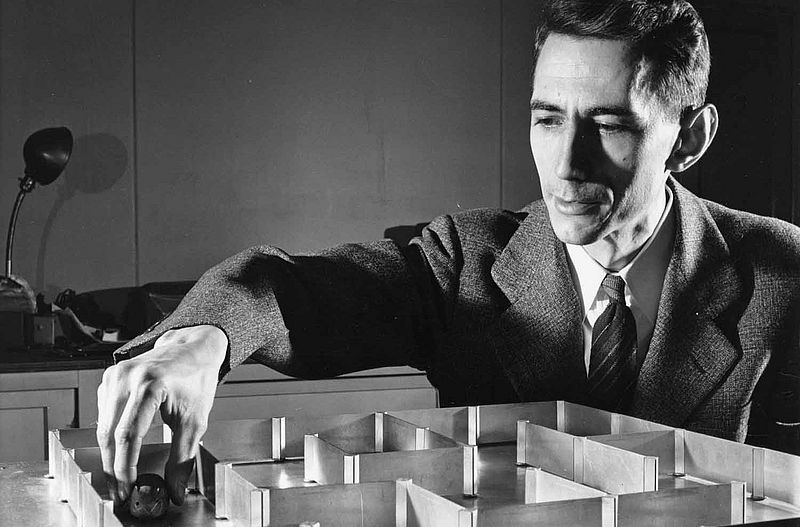
He rode a unicycle through the hallways of Bell Labs at night while juggling. He built a chess-playing machine in 1950 that played a primitive form of chess decades before computers were supposed to be capable of it. He built an electronic mouse named "Theseus" that could solve a maze and remember the solution. It was one of the first machines on Earth that learned. He built a flame-throwing trumpet for fun. He had a closet full of unicycles in different sizes. He installed a chairlift across his backyard so his kids could get to the lake faster.
Marvin Minsky, one of the founders of artificial intelligence, said Shannon was the most genuinely playful great scientist he had ever met. Other people approached research with seriousness. Shannon approached it like a kid who had snuck into the toy store after closing time.
Stevens Institute of Technology called him the least known genius of the 20th century.
That title is exactly correct. Most people have heard of Einstein, Turing, von Neumann. Shannon's name barely registers outside engineering departments. Yet without his master's thesis, there is no digital circuit. Without his 1948 paper, there is no internet. Without his framework, there is no measurement of information at all, which means no compression, no error correction, no cryptography, no machine learning.
He died in 2001 at age 84, after years of Alzheimer's disease that took away his ability to recognize the world he had built. Most newspapers ran a small obituary. The world he had given us did not pause.
His thesis is on the MIT archive. His 1948 paper is on the Bell Labs site. Both are free. Both are short. Both are still readable today by anyone willing to spend an evening with them.
The least known genius of the 20th century is one click away from you.
Most people will never open the file.
America spent $285 billion to LOSE the AI war.
Stanford dropped a 423 page report yesterday and revealed the most damning stat on page 200:
The number of AI researchers moving to the United States has collapsed 89% since 2017.
80% of that collapse happened in the LAST 12 MONTHS.
Let that sink in.
The country that invented the transformer.
The country that built OpenAI, Anthropic, Google DeepMind, and xAI.
The country pouring $285.9 billion of private capital into AI in a single year (23x more than China).
Can no longer attract the people who actually build the technology.
And here's the part that should concern every founder, operator, and investor reading this:
The Trump administration just made it official.
The H-1B visa now costs employers $100,000 PER HIRE.
So OpenAI wants to hire a Chinese postdoc from Tsinghua? $100K before they write a line of code.
Anthropic wants a French ML engineer? $100K.
Google wants the Indian PhD who literally co-authored the paper their entire model is based on? $100K.
And these are the LUCKY ones who even get a visa.
The result was instant.
89% drop over 8 years. 80% of it in the last year alone.
The talent pipeline got destroyed.
Now look at the other side of the chart:
China's top model is now 2.7 percentage points behind Anthropic's best. Down from a 20+ point gap two years ago.
China leads the world in AI publications.
China leads in AI patents.
China leads in industrial robot installations.
US and Chinese models have traded the #1 spot multiple times since early 2025.
Switzerland and Singapore now have more AI researchers per capita than the US.
The US ranks 24TH globally in actual AI adoption. Behind the UAE. Behind Singapore. Behind countries most Americans couldn't find on a map.
And here's the truly insane part:
50% of the world's top AI researchers are Chinese. Jensen Huang said this on a podcast 3 weeks ago.
For 20 years, the US strategy was simple: Let them study at Stanford and MIT, then keep them. Pay them $800K. Give them green cards. Build the future on imported brains.
That deal is dead.
We just told the smartest people in the world: "Pay $100,000 for the privilege of working here, or go home."
And guess what they're doing.
They're going to Zurich, where Anthropic and OpenAI are quietly opening offices because they can't get the talent into San Francisco anymore.
The strategy is the same as building a Ferrari factory and then banning mechanics from entering the building.
You can pour hundreds of billions into data centers.
You can buy 4 million Nvidia chips.
You can sign $300 billion cloud contracts with Oracle.
You can build nuclear reactors to power your GPUs.
None of it matters if the people who write the algorithms aren't allowed in the country.
Wall Street thinks AI is a capex race. But in reality, it's a TALENT race.
Every dollar Microsoft and Meta and Google are spending assumes the same army of researchers will keep showing up to use it. That assumption just broke.
And the smart money already knows:
Why is Anthropic opening a Zurich office?
Why is DeepMind expanding in London instead of Mountain View?
Why is OpenAI hiring in Dublin and Singapore?
Because the math no longer works in America.
The government turned the world's biggest brain magnet into the world's most expensive border wall.
3 years from now, when China launches a frontier model that outperforms anything in the US and the headlines scream "How did we lose the lead?" - remember this post.
The lead wasn't lost in a lab.
It wasn't lost on a benchmark.
It wasn't lost to a smarter algorithm.
It was lost at customs.
FAKEROOM, PIU’ CHE DATAROOM. Oggi Gabanelli sul @Corriere si improvvisa esperta della riforma costituzionale che sarà oggetto di referendum ma finisce per snocciolare una serie di bufale e notizie fuorvianti da far impallidire. Cito le principali:
1) Sulla separazione delle carriere: “Oggi un pm può diventare giudice e viceversa soltanto una volta e cambiando regione, la media dei trasferimenti è una trentina l’anno”. Di nuovo si fa confusione tra separazione delle carriere e separazione delle funzioni per trasmettere il messaggio che la riforma in realtà ha un altro intento (quello di ridurre l’indipendenza dei magistrati). Ma il passaggio tra una funziona e l’altra non ha nulla a che vedere con la separazione delle carriere: pm e giudici oggi rispondono a un unico organo di governo autonomo (il Csm) che decide su tutti gli aspetti delle loro carriere (promozioni, trasferimenti, nomine ecc.) e che è composto sia pm che da giudici, secondo una commistione illogica e assurda che ha ovvie conseguenze.
2) “Per il No i giudici non sono accondiscendenti ai pm, tant’è che le assoluzioni ci sono nel 30% dei casi con punte del 50%”. Dato fuorviante: il punto non è mai stato il tasso di assoluzione in dibattimento, bensì la tendenza del giudice ad appiattirsi alle tesi dell’accusa soprattutto nella fase delle indagini. Recenti statistiche del Ministero della Giustizia dimostrano come le richieste avanzate dai pm durante le indagini (come le intercettazioni) vengono accolte con un tasso di oltre il 90% da parte dei gip.
3) “Con un Consiglio tutto dei pm il rischio è che venga tenuta in piedi l’accusa a tutti i costi, mentre oggi devono cercare le prove anche a favore dell’imputato”. Falso. La riforma non cancella l’articolo 358 del codice di procedura penale, secondo cui il pm deve svolgere anche indagini su fatti e circostanze a favore della persona sottoposta alle indagini.
4) “Con due Csm i costi passano da 50 a 100 milioni di euro l’anno”. Falso. Non essendo ancora stato stabilito dalla legge ordinaria il numero dei componenti dei due futuri Csm è impossibile calcolarne il costo.
5) “I laici saranno sorteggiati dal Parlamento in un elenco di giuristi scelto dalla maggioranza”. Falso. Sarà la legge attuativa a stabilire il quorum richiesto al Parlamento per stilare l’elenco dei giuristi dal quale saranno poi estratti a sorte i membri laici dei Csm. La maggioranza quindi non è ancora stata stabilita, ma secondo la dottrina costituzionalistica più autorevole il quorum non potrà essere la maggioranza semplice: trattandosi di un organo di garanzia (come il Csm) dovrà essere richiesta una maggioranza qualificata, che implica il coinvolgimento delle opposizioni.
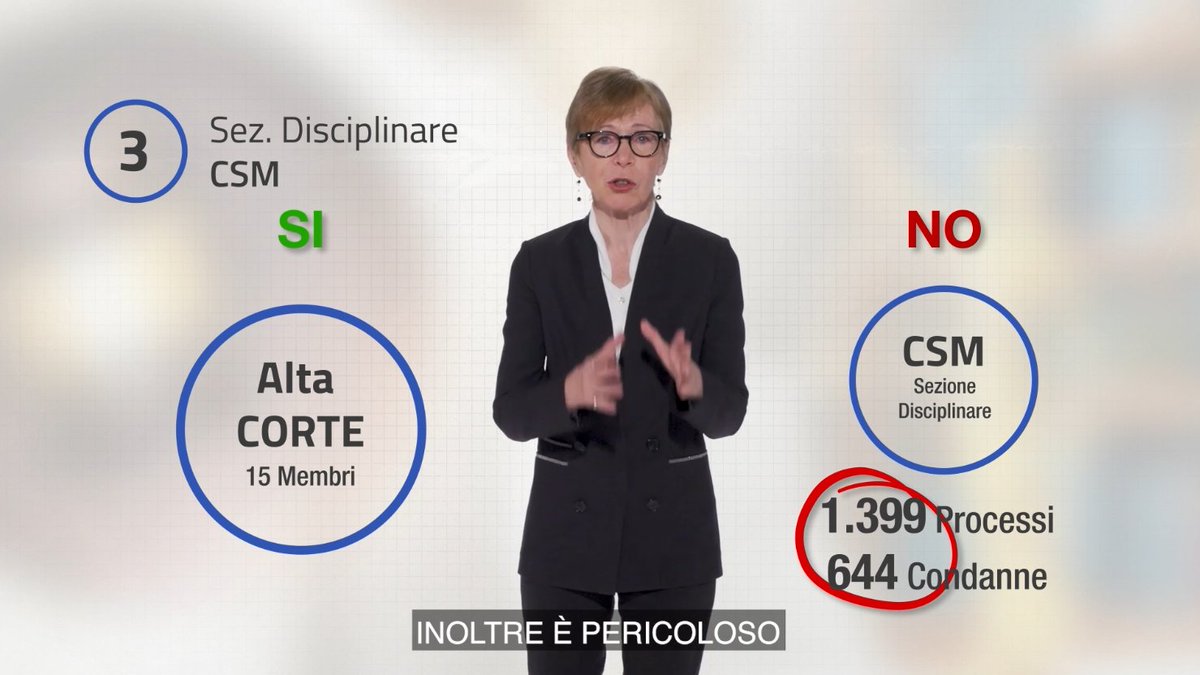
6) “Per il Sì bisogna togliere la sezione disciplinare al Csm perché troppo indulgente e affidare la funzione a un’Alta Corte. Per il No parlano i numeri: in 15 anni su 1.399 processi disciplinari ci sono state ben 644 condanne”. Falso. Qui non si comprende veramente da dove siano stati presi questi numeri. Secondo i dati forniti dalla procura generale della Cassazione, titolare dell’azione disciplinare, dal 2015 al 2025, quindi in 11 anni, i procedimenti disciplinari nei confronti dei magistrati sono stati 1.443 e le condanne 382, quindi il 26% (anziché 46% come riferito da Gabanelli). Senza dimenticare che oltre il 90% degli esposti viene archiviato ancor prima di arrivare a un vero procedimento disciplinare (e senza considerare che nella stragrande maggioranza dei casi la "condanna" irrogata è costituita da sanzioni che non impediscono al magistrato di proseguire la sua attività).
7) “Inoltre è pericoloso, perché il sanzionato non potrà più come oggi fare ricorso in Cassazione, ma soltanto davanti alla stessa Alta Corte”. Falso. Data la natura di sentenza pronunciata dall’Alta Corte non può ritenersi abrogata la possibilità di impugnare il provvedimento in Cassazione per violazione di legge.
8) “Il dato certo, per voce degli stessi promotori della riforma, è che non c’entra nulla con l’efficienza della giustizia e la separazione delle carriere non renderà i processi più veloci. Come dire: i problemi nostri restano tali e quali”. Cara Gabanelli, siamo di fronte a una riforma dell’ordinamento, non a una riforma del processo penale o civile, quindi appare surreale contestare il mancato miglioramento dell’efficienza della giustizia.
Per quanto riguarda “i problemi nostri” direi che non restano affatto “tali e quali”: se non avremo una giustizia più rapida avremo sicuramente una giustizia migliore. La riforma rende pienamente terzo e imparziale il giudice e lo libera da qualsiasi contaminazione con il pm: il giudice non nascerà nella stessa ‘culla’ del pm, non farà lo stesso concorso, non si formerà insieme a lui, non si scambierà più i giudizi di professionalità, sarà più libero di decidere secondo scienza e coscienza. Con la separazione delle carriere avremo un giudice che mette sullo stesso piano le prove dell’accusa con le prove della difesa, come prevede esattamente l’articolo 111 della Costituzione, che sancisce la parità fra le parti. E' dunque ragionevole aspettarsi una riduzione dei casi di ingiusta detenzione e di errori giudiziario.
No, direi proprio che “i problemi nostri” non resteranno “tali e quali”, anzi… Ma con la diffusione di queste bufale la vittoria del Sì è ancora più in salita.
Questo è il Dott. Stefano Scati, presidente del tribunale di Brescia. Con grande onestà spiega perché lui è @ANMagistrati sono contrari al sorteggio. Se i membri del csm saranno scelti con il sorteggio decideranno di testa loro, invece per il Dott. Scati deve rimanere tutto come oggi: la corrente decide chi deve essere eletto e se non fai quello che ti dice la corrente ne dovrai rispondere. Ma voi vi sentite tranquilli ad avere un organo costituzionale gestito in questo modo? Io no. E per questo voto SI al #referendumcostituzionale
Durante la giornata del 31/12 alcuni di voi correranno a comprare botti🧨, fuochi e petardi 💥 spendendo cifre folli, oltre 100€ 💶come apprendo da amici “bombaroli” 💣del capodanno.
Mi sento di suggerirvi un’idea come buon auspicio per un favoloso 2026:
Sostituite qualche petardo con un piccolo bonifico porta fortuna🍀 a un centro anti violenza🌻… perché porta bene, perché il karma vi osserva, perché regalare un sorriso vi garantirà più soddisfazione di un BOTTO.
Provare per credere.
E auguri 🍀 a tutti voi ❤️🥂
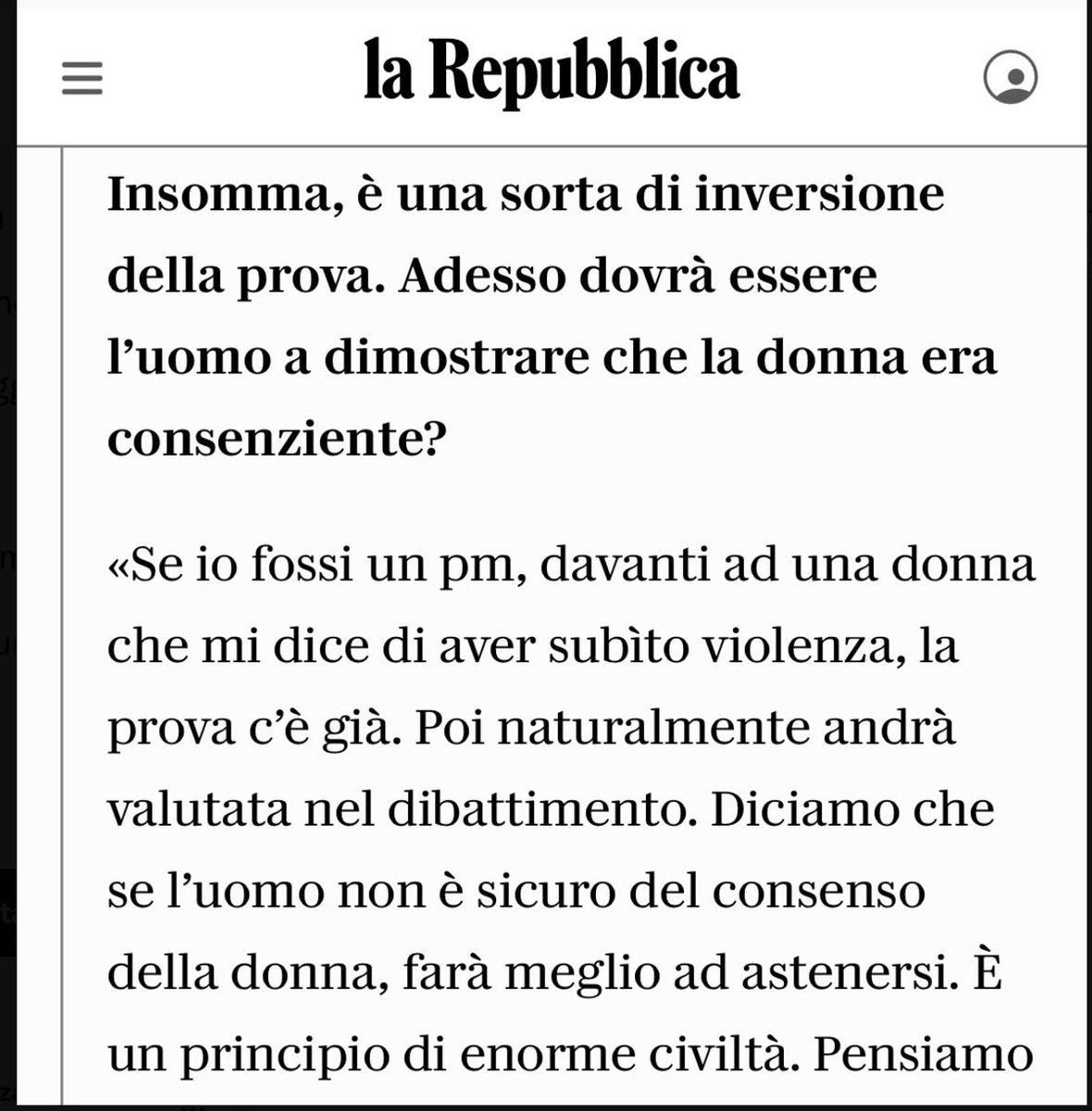
Devo ricordare a mio figlio di girare con un'attestazione di consenso informato da far firmare in presenza di un pubblico ufficiale? O è sufficiente la registrazione del consenso modello contratto telefonico?
Io credo che questa cosa sia pericolosissima, soprattutto perchè la dice il Presidente del Tribunale di Milano. Mi piacerebbe sentire il parere di @gdcaiazza
Il #13ottobre di cento anni fa nasceva Margaret #Thatcher, la lady di ferro che con coraggio e visione ha cambiato il suo Paese e lasciato un’impronta indelebile nella storia.
▶️Oggi la ricordiamo con questo incredibile video!
Domanda in #cisgiordania quale è la legislazione vigente? Quella israeliana? Quella palestinese? Un reato è un reato e deve essere perseguito. Si chiama #democrazia e diritto positivo.
Ciao
Oggi l’account di @OGiannino purtroppo è stato hackerato
Quindi se vedete post strani non sono i suoi, Oscar sta cercando di rientrare in possesso dell’account.
Fate girare per favore
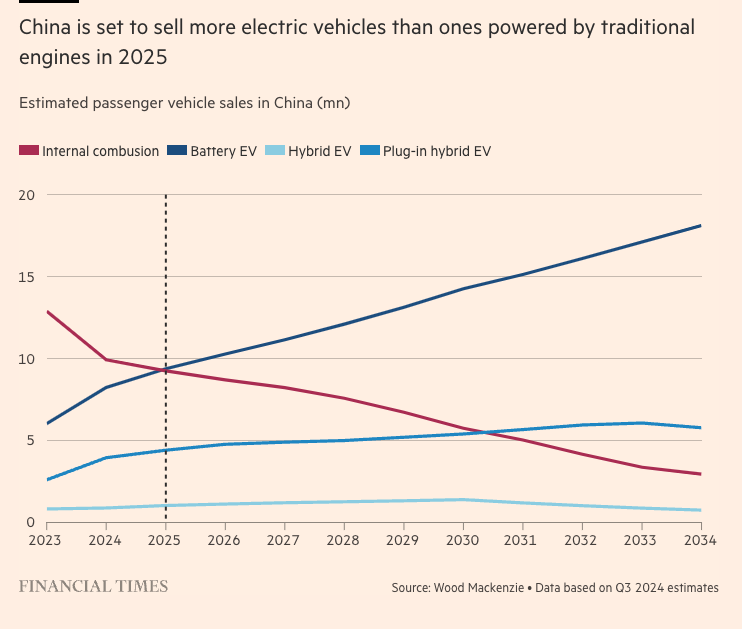
Nel 2025, in Cina si venderanno più auto elettriche (BEV, HEV, PHEV) che a motore termico, dieci anni prima del previsto. Nuovi modelli a raffica, integrazione verticale sinergica a partire da materie prime, case estere travolte. Sugli EV, la Cina ha vinto.
https://t.co/SJ6ek67N5Z
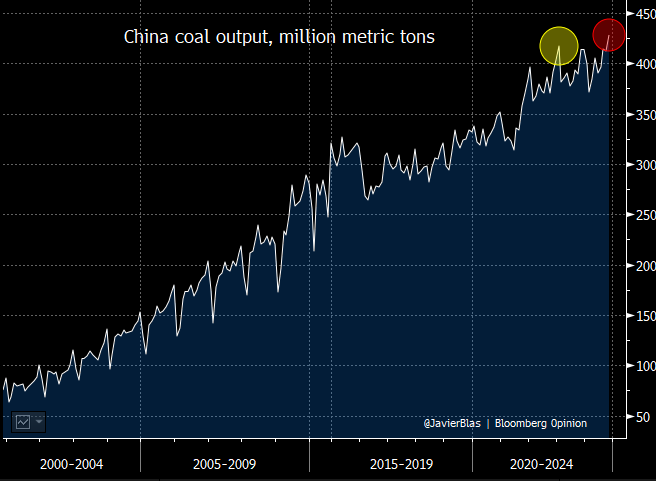
CHART OF THE DAY: China mined a record amount of coal in November, surpassing the previous peak set in early 2023.
Despite large deployment of solar and wind, coal remains the backbone of China's electricity system (with coal-fired generation set to hit a record high in 2024)
Una delle tante storie identiche:
https://t.co/UW81Qa7BS2
Sono tanti gli amici che mi hanno raccontato la stessa storia. Dobbiamo tutti fare kickboxing?
Vado a Messa per la festa di Ognissanti.Dall'altare è sparito il crocifisso. Rubato.Sotto la statua di padre Pio un simbolo di Halloween. Non ho parole.Riflettiamo.