That was software engineers in 2024. We went from “no way a language model can code, it can’t reason and the context window is only 4k” to total disbelief.
We went through the five stages of grief: denial, anger, bargaining, depression, acceptance. Most are still somewhere in that process because humans are terrible at understanding exponentials.
Uber drivers in San Francisco are now saying the same thing: “There’s no reason Waymo should deploy this fast.” But that’s progress. It’s deeply uncomfortable, and it will keep accelerating. Every other field will have this realization sooner or later and it will be terrifying.
People clowning on him don’t understand what he’s saying.
All the wealth of humanity to date supports perhaps 250k living math phds. Roughly the population of St. Louis, Missouri.
The training pipeline for that group has been irreparably shattered in the last month.
A phd is supposed to make an original contribution to their field to graduate.
That’s just…. not possible anymore.
938 years after the founding of the first university in Bologna…
Do universities now reward… teaching ? comprehension of something discovered by a machine? application ? do mathematicians become quotidian (gasp of disgust) engineers?
Tao is upset because he knows none of those outside the field care about its future. He is a horrified gardener watching humanity gorge on its seed corn.
It is irreparable of course. The old way is dead dead.
We live in the short interregnum before the new king is born: a Lean crawler that spawns a billion copies exploring every corner of math latenspace.
So much math to understand that even if 8 billion humans had the ability of the 250k mathematicians alive today, it would still take a million years to comprehend.
It is ironic and sad.. because Tao himself is a pioneer of collaborative math: math that is understood by a combination of minds rather than an pindividual.
The tools that Tao began exploring a few years ago, solving problems through blog posts and using Lean to guarantee each mind’s contribution stood on its own when assembled into the greater truth, have been turned against him.
Math’s path to utilize multiple minds didn’t restrict access to human minds, and now the machines have blitzkrieged themselves into the heart of the matter.
The agents use rudimentary message boards, working 10,000 to a task, tirelessly, using Lean to verify the correctness of each contribution.
It was good while it lasted… and now it’s gone.
@itslueul Grok 4.7 should be roughly on par with Opus 5.0, not 5.1. Better in some ways, worse in others. We need to fix multimodal performance.
Grok 4.8 will be a noticeable improvement.
Grok 4.9 is probably Astra/Fable class.
Grok 5 maybe better than anything. We shall see.
What Comes Next as the Fourth Turning Accelerates?
https://t.co/45YoG3IX76
@DariusDale42 joined @ErikSTownsend and @PatrickCeresna on @MacroVoices to explain why a widening, geopolitically driven supply-demand imbalance in the Treasury bond market is forcing increasingly aggressive policy intervention and pushing the U.S. toward Paradigm D, “Control + Print.”
Register for supporting materials here: https://t.co/CEJ9dDJsEW
A few thoughts on today’s SemiAnalysis TPU report.
1. I am deeply disappointed with the way SemiAnalysis continues to report on these issues. I have raised the same concern before with Micron, CPO delays, SOCAMM, and 8 high HBM4. I do not think they simply fabricate stories out of thin air. The problem is how they communicate them. They often seem too quick to report information that has not yet been confirmed, and even when the underlying facts are directionally correct, the ambiguity in the wording and framing repeatedly creates major misunderstandings in the market.
2. This TPU report is another example. If you actually read the substance, the 2026 AVGO TPU downward revision is explicitly attributed to supply constraints and challenges ramping CoWoS S. The 2027 revision is attributed to greater Broadcom capacity allocation toward other customers such as Meta and OpenAI. The AMD discussion, meanwhile, is about a potential TPU v10 project.
The report does not establish any causal relationship between these two issues. Yet by placing them directly next to each other, it created a framing that could very easily be interpreted by institutional and professional investors quickly scanning the report as a simple
"AMD Long, AVGO Short narrative"
I am not saying that SemiAnalysis intentionally framed it this way. However, if they did not anticipate that kind of market interpretation, then I think this reflects a serious communication and editorial problem. On the other hand, if they did anticipate it, then I have to ask why they did not include even a single clear sentence explaining that the AVGO TPU downward revision was not being attributed to AMD.
3. Anyone who understands the ASIC business even at a basic level should know how dangerous this kind of overinterpretation can be. AVGO signed a long term agreement with Google just this April to develop and supply future generations of TPUs. The claim that AMD is already taking Broadcom’s TPU volume is simply not supported by the information presented in this report.
And if the AMD collaboration they are referring to is related to on package CPU cores, then that is not really a threatening area for AVGO in the first place, because Broadcom is not competing in the x86 CPU market. A much simpler interpretation would be that Google may need x86 cores for specific use cases, such as RL workloads, and AMD could be relevant there.
4. Today I spoke not only with people in the semiconductor industry, but also with a friend who works at a New York hedge fund. He agreed with my view completely, while also pointing out that we cannot ignore either the influence of SemiAnalysis reports or the direction in which capital ultimately moves.
Is this really healthy market behavior? This is the part that concerns me most.
I assume SemiAnalysis understands very well how much influence its reports can have on the market. If so, I believe that influence should come with a much greater degree of care in how information is framed and communicated. This is not the first time this year that I have had concerns about this type of reporting, which is why I felt it was important to call it out directly this time.
5. In the end, I believe the ASIC business comes down to the quality of the IP and the ability to secure sufficient manufacturing capacity. AVGO has competed with Marvell on these fronts for many years and has continued to survive and win. It will continue to face challenges from other competitors on these same fronts, whether that competitor is AMD, Marvell, or someone else.
So let us think again about what we should actually be asking.
Why did AVGO recently enter into such a large strategic MOU with Samsung?
What is AVGO preparing for next in its ASIC business?
From a technical perspective, what are the actual risks facing its ASIC business?
From AVGO’s perspective, in what ways could a more diversified customer base actually become a long term positive?
I believe these are the questions that deserve much deeper analysis.
Why does SemiAnalysis not address them?
I am genuinely disappointed with this report. At this point, I am honestly irritated that I keep having to spend my valuable time rechecking the same facts every time this kind of ambiguous reporting creates another round of confusion in the market.
@HalFiney@draecomino Yeah give the Claude this output and tell it to build an agent for you That can generate this for any company that reports earnings. It will figure everything out quite easily
A Few Observations on the Saudi-Turkish-Pakistani Agreement From an Israeli and Iranian Perspective
1. Israel may be uneasy, but Israel is not the main reason for this agreement.
There will undoubtedly be voices in Israel that interpret the agreement as the emergence of a more assertive Sunni bloc that could eventually pose a challenge to Israel. But that would miss the primary Saudi motivation. For Riyadh, the agreement is first and foremost about a much deeper concern: whether Saudi Arabia can withstand the security challenges surrounding it on its own. The kingdom is looking for additional strategic depth and partners at a time when its regional security environment remains highly uncertain.
2. The real test will come when the agreement carries actual military costs.
The continuing Houthi attacks on Saudi Arabia provide an immediate test. Will they lead to meaningful Pakistani or Turkish involvement against the Houthis? The Houthis have already shot down a Turkish-made Bayraktar drone, although it was apparently operated by Saudi Arabia rather than Turkey itself. That distinction matters. The much bigger question is what happens in a genuine regional escalation. Imagine, for example, that Iran responds to a U.S. strike by attacking Saudi oil infrastructure. Would Turkey and Pakistan actually be prepared to take military action against Iran? That is where declarations of solidarity meet geopolitical reality. Neither Ankara nor Islamabad is eager for a confrontation with Tehran, and Pakistan's traditionally cautious approach toward Iran illustrates just how difficult such a decision would be.
3. The agreement does not close the door on Saudi-Israeli normalization.
From an Israeli perspective, the agreement should not be interpreted as determining the future of normalization with Saudi Arabia. Riyadh's security partnerships and its relationship with Israel operate on related but ultimately separate tracks. If Israel were to make dramatic progress on the Palestinian diplomatic track, it is entirely plausible that Saudi Arabia would once again show interest in advancing normalization. This agreement does not fundamentally change that calculation.
4. The agreement also reflects Saudi doubts about relying exclusively on Washington.
One of the most important drivers behind this development is Riyadh's disappointment and declining willingness to depend exclusively on the United States for its security. Yet Washington may not necessarily view the agreement negatively. An arrangement that contributes to regional stability without requiring additional American military resources could fit comfortably with longstanding U.S. demands that regional partners assume more responsibility for their own security. President Trump, in particular, has repeatedly described Turkey as an important regional actor. There is, however, a significant limitation: resources. Turkey faces serious economic constraints, while Saudi Arabia has its own growing fiscal pressures. This may be an important political and strategic agreement, but building a genuinely integrated military architecture will require considerably more money, capabilities and political commitment than signing one. In that sense, the agreement can also be understood as another consequence of the region's unsuccessful attempts to contain Iran through escalation alone.
5. Tehran may ultimately have more reason to watch this agreement carefully than Jerusalem does.
Turkey, Pakistan and Saudi Arabia are not looking for a war with Iran. But the agreement nevertheless has the potential to alter a regional balance of power that had increasingly been moving in Tehran's favor. Even without producing a formal anti-Iranian alliance, closer coordination among three major Sunni states, each possessing different military, economic and geopolitical assets, complicates Iran's strategic environment. The significance lies less in what the three countries intend to do today than in what they might be capable of doing together during a future crisis.
6. The UAE will also be watching closely.
Abu Dhabi has reasons to be considerably less enthusiastic about a growing Turkish role in Gulf security. The UAE has long viewed Turkish regional influence, particularly Ankara's historical ties to political Islamist movements such as the Muslim Brotherhood , as a strategic challenge. A deeper Turkish role in Saudi security affairs could therefore introduce another source of friction between Abu Dhabi and Riyadh, even as the two remain important partners on many other issues.
Bottom Line
The biggest tests of this emerging partnership are still ahead.
The continuing confrontation between Saudi Arabia and the Houthis is unlikely to disappear, and its potential for escalation remains significant. Saudi Arabia gains meaningful strategic backing at a moment when its security challenges continue to demonstrate the limits of acting alone. Turkey gains a potentially important foothold in Gulf security affairs. Pakistan, meanwhile, may gain the ability to share a burden it has historically faced largely on its own whenever Saudi security is threatened.
But the gap between strategic declarations and military commitments can be enormous.
The key question is therefore not what the agreement says on paper. It is what happens when one of these countries is actually attacked, particularly if responding means confronting Iran.
That will determine whether this becomes a genuine regional security architecture or remains primarily a political declaration of solidarity.
#IranWar
#turkey
#ksa
#Pakistan
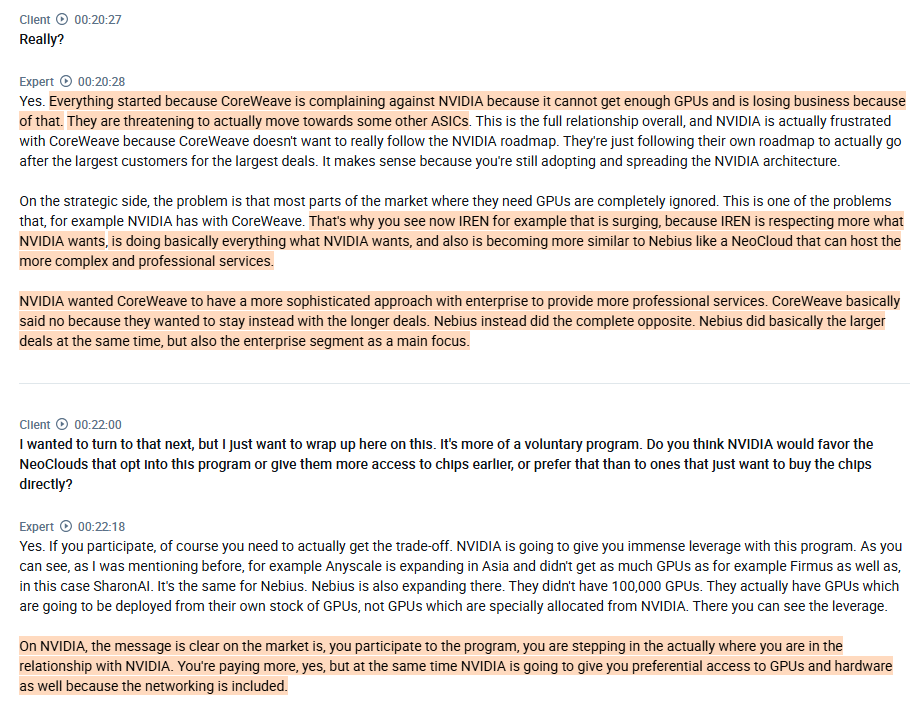
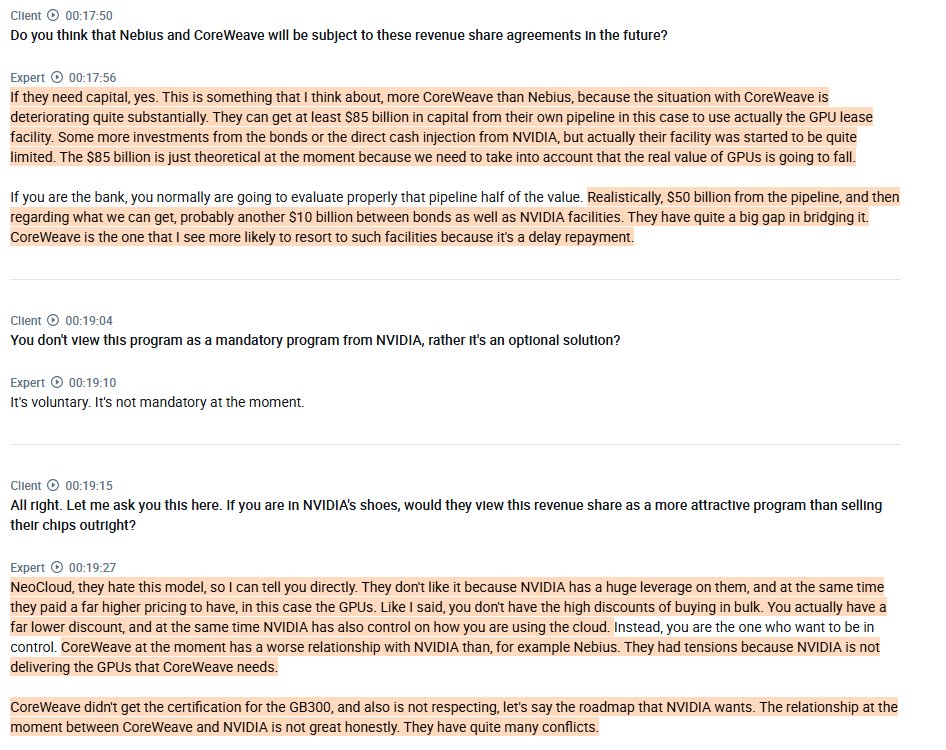
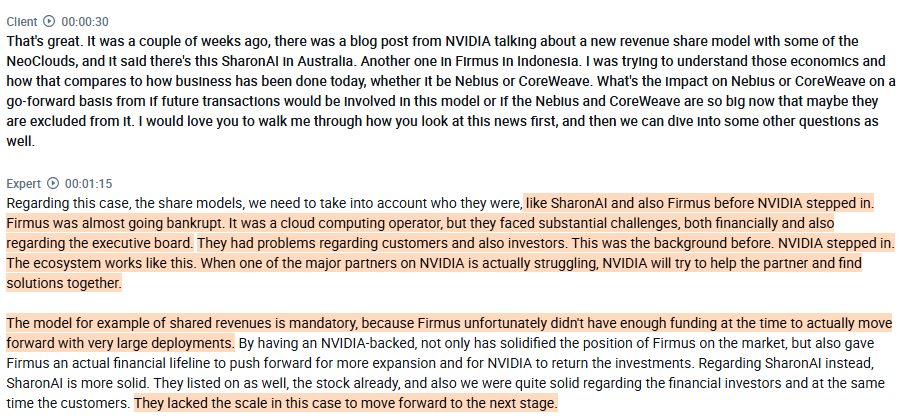
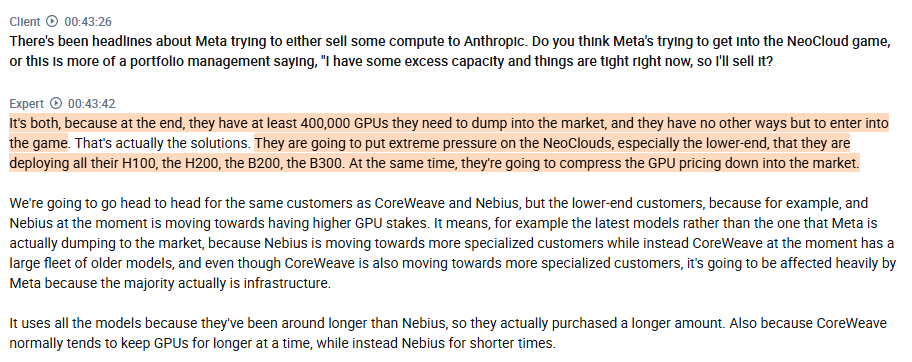
Very interesting interview with a Former $NBIS employee explaining the relationship between $NVDA and the neoclouds and the views on $NVDA's new revenue-share partnership:
1. In his view, the recently announced revenue-share model of $NVDA with neoclouds like SharonAI and Firmus was more a result of Firmus, according to him, having financial trouble and SharonAI having problems regarding customers and investors.
2. He thinks the neoclouds hate this new model by $NVDA, as $NVDA has all the leverage over them; at the same time, they are paying a higher price for GPUs because they don't get the high discounts on buying in bulk.
3. He thinks that $NBIS and $CRWV would do these types of deals if they needed capital. He thinks $CRWV is in a worse position, as they have a significant financial gap given their big deals.
4. He mentions the relationship between $CRWV and $NVDA getting worse as $CRWV was upset that $NVDA didn't deliver the GPUs that $CRWV needed. According to him, they even threatened to go with another ASIC provider. At the same time, $NVDA is, according to him, upset with $CRWV as they are not respecting the roadmap that $NVDA wants. $CRWV wants to go after big clients for large deals, while $NVDA wants $CRWV to adopt a more sophisticated enterprise approach to provide more professional services.
5. According to him, $META has around 400k GPUS (H100, H200, and even some Blackwells) they want to sell as compute on the market, and that is going to put extreme pressure on the neoclouds, especially the lower-end ones that are deploying the older GPUs.
found on @AlphaSenseInc
I guess I should say something about the token
Look. I worked my ass off to the point I got a frozen shoulder and severe health issues from overworking and typing, and it was never enough
We built cool shit but it was completely ignored because number down
It felt like the things I cared about were completely unappreciated by all but a small group who were drowned out by endless complaining, endlessly calling me a scammer and hating on everything
Burwick sued us and we settled with a group of holders for the rest of the treasury and all the money we had. Their claim was ridiculous, but we didn’t have the capital to legally fight it so we settled on giving them the rest of what we had.
I never sold my ai16z, never made money other than a modest salary, making as much as our other engineers from essentially a day job.
Through all I said we’d keep building Eliza. I’m living on savings, building Eliza.
We made some versions of Eliza like Milady, people tokenized, we got some fees, those went back into Eliza.
Along the way we tried to make money and make things people told us they wanted. Those things were incredibly hard to build, with developers quitting to launch tokens, getting addicted to drugs, getting in fights with each other, building their own projects on our payroll and then leaving to make their own startup, I mean I’ve seen it all. I wanted collaborators with high agency, I didn’t want to be a manager, and I leaned a lot of lessons the hard way in human alignment.
My mission has always been the same, unwavering, toward a personal and social agent who could help us do all the things we didn’t want to do, to put the A in DAOs, to enable the internet itself to generate value through open source coordination.
The most expensive thing I own is my MacBook. I don’t own a car, I live in a small bedroom in SF with my wife, I write code and work almost all day every day. I don’t desire luxuries or wealth, and if I had more money I’d put it all back into Eliza and funding other developers. Not to virtue signal, but to give you some perspective— if I am a scammer then I am the dumbest and worst scammer ever, because I had $25m in my wallet and I coulda dumped on all of you and I ran it to to 0.
And now as I post cool free things that I made just to make, just show off with no benefit to myself except some social likes, it’s just hate, pressure, cynicism and complaining dominating the comments.
A bunch of people will surely take this opportunity to point out some hypocrisy or some small grievance, but it all boils down to a culture of people who don’t take responsibility for their gambling habits.
You cannot appease the mob.
So I won’t.
The token is dead. Completely. The foundation is winding down. I am starting over, since I own the IP, and I am never letting a token come close to Eliza again maybe I’ll farm some fees from a 24 hour shitter to feed my team because 5k is 5k but as long as the casino is a bunch of entitled cry babies I’m never going to support an Eliza token.
If you have some, you should either sell or get a cabal to crime it up, but there’s no foundation and no supply coming to save you, there’s no money for buybacks, it’s completely ngmi. A bunch of cry babies killed whatever hope there was left by giving Burwick their name to rape yet another project. The smart traders sold on the heads of the losers and exited long ago, rotating into Trump and such, just leaving the scooters of the world who’s entire business is to complain on the internet about how it’s everyone’s fault but theirs that they lost money.
So yeah it’s done. I don’t own any tokens. I don’t support any of it. I love the technology and I’ll come back one day when the culture has grown past this point. But right now there is nothing in it for me busy wasted time, pressure to do dumb shit, people trying to scam me or get me to help scam others, etc. it’s trash. Absolute trash.
I suggest you buy a token with real fundamentals, like Ansem’s coin. I’m sure he’ll give you the 10x I couldn’t.
We’re still building Eliza and the underlying OS, faster and better than ever, unburdened by all the bullshit and sidequests and pressure to launch launchpad #83837. If that’s not enough for you… I don’t owe you anything. Feel free to complain so I can block you.
We’re still gonna be here in 10 years, pushing at the edge of what agents can do and going where the big corps won’t go. We’ll make sure that local, private, crypto-enabled agents are available for everyone, and if Eliza gets outrun by another open source OS project we’ll probably merge into them and help them. But right now we’re out in front.
Blockchain is a beautiful technology and I hope the industry can move away from the casino and obvious coordination failures and build real stuff instead of larping harder into chasing someone else’s prediction market market and memecoin success.
But I just see more of that, even from the institutional companies, so I’m bearish.
AI has none of these problems. People are optimistic, empowered, building the future instead of cutting everyone down. Those are my people.
And the audience for what we’re building isn’t on here. The people who need this tech the most have no idea what a token is, either kind of token.
So yeah. Gonna keep building no matter what, every single day, and I’m not gonna stop until we live in a world where we each own our own data and we don’t have to pay to be smart. That’s the mission.
Eliza is dead. Long live Eliza.
The 9 skills you should be using daily to get agents to run your marketing team.
Codex and GPT Work for marketing (Masterclass)
00:00 Intro - what is codex?
01:32 #1: Scrape Social Media
05:49 #2: Turning Any Creator to A Skill
09:10 #3: Scrape Competitor Ads
14:05 #4: Build Ad Creatives
15:58 #5: Firecrawl for Scraping Brand Assets
20:57 #6: Schedule Social Posts
23:38 #7: Google Drive Organization
25:28 #8: Calendar Scheduling Links
28:23 #9: Email Drafts at Scale
33:22 Summary of Workflows Covered
Best AI models by use cases (7/18) :
Frontend : Kimi-K3
Backend : Fable
Debug : GPT-5.6-SOL
Image gen : GPT
Translation: Gemini-3.5-Flash
Search : Grok-4.5
Video gen : Seedance 2.0
Best price : Deepseek V4 Pro
Local AI (Large) : GLM-5.2
Local AI (Small, 128gb) : HY-3, DSV4 Flash
Use models accordingly
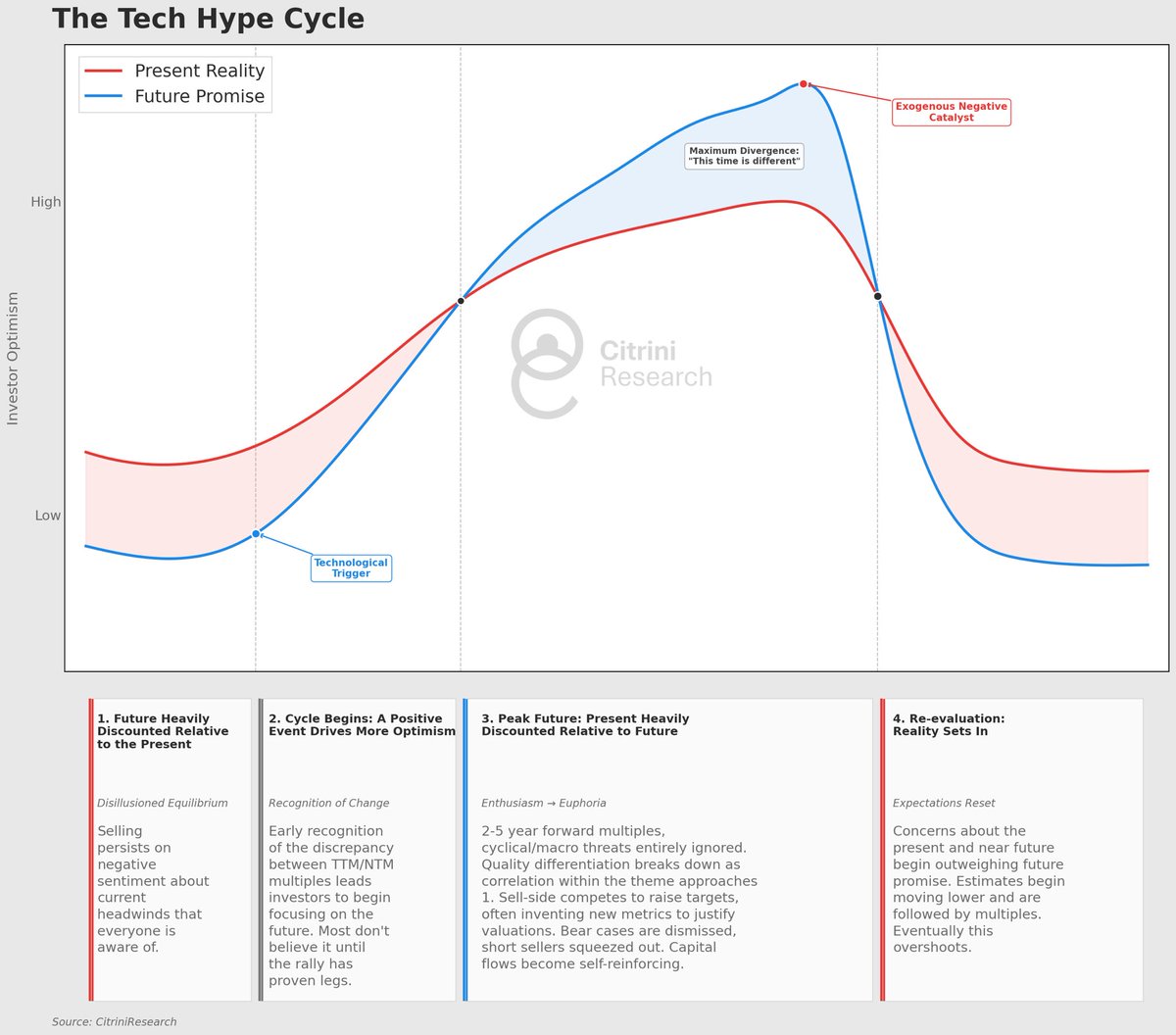
This is how I think about hype cycles in markets. It is basic, but that’s the point (frameworks shouldn’t be overly complex, I think).
Investors are always either discounting the promise of the future or the reality of the present. And they are never equally weighting them.
During the early part of a hype cycle, leading up to and directly following a technological advancement, investors are typically discounting the future while focusing on the present. A good example for this is Nvidia at the end of 2022: investors were solely focused on the headwinds presented by the crypto GPU glut, the anemic gaming PC market and the recent rise in rates causing fears about a near term recession.
Then, as the cycle begins, investors begin to shift to incorporate the future - they stop focusing so much on the present and see the promise. They move out in terms of valuing away from last twelve months current price / current earnings to next twelve months. Then, as price climbs and the technology becomes more exciting, their imagination takes hold. At a certain point they begin discounting the present much more heavily and the future becomes the only thing that matters. Valuation metrics over the next twelve months become useless in favor of 2, 3 or 5 years forward.
At the peak, the present is not considered at all, it is 100% driven by an imagined future (even when that imagination doesn’t necessarily align with a bullish outcome for the stocks driving the rally). Analysts aggressively raise estimates in ways that, at the time, seem fundamentally justifiable (if you take the assumptions at face value - for example, “everyone in the world will have two cell phones” was a good one from the mobile phone hype cycle). Capital is sucked in which ultimately forces performance chasing and crowds stocks with money that doesn’t really believe in the thesis. “A twilight period where people continue to play the game, but no longer believe in the rules” emerges, as Soros put it.
The valuation of SaaS stocks in mid-2021 is a great example of what happens when the future is overvalued relative to the present - nobody cared about climbing inflation, that rates had nowhere to go but up, that these companies were reliant on ZIRP or that software could become more competitive.
Then, a negative catalyst occurs - this can but doesn’t have to be related to the technology, macro, credit, underwhelming earnings. The estimates start to seem unattainable, and the present begins to matter more when the future seems more uncertain. That exact mechanism that drove future optimism to unsustainable heights mechanically reverses, everyone needs out. The future begins to be discounted until it results in a sense of disillusionment with not just the stocks but the technology itself. This overshoots to the downside, investors eventually become disillusioned and seemingly allergic to anything having to do with the technology. This happens in a very asymmetric manner to the climb (“stairs up, elevator down”).
This is the crucible in markets for truly transformative tech. If advancements persist, another opportunity to get long presents itself before capital once again begins flowing into the companies (the internet, for example). If they don’t - not necessarily “the tech goes away” but rather that it ceases to advance once the capital isn’t free or plateaus or the economics prove to be unfavorable - the cycle will still start again, just with a new technology.
Or maybe not…maybe this time is different.
Risk/reward seems attractive again.
Lots of cheap stocks with durable competitive advantages that are going to crush numbers for the next 6-12 quarters.
Time will tell!