China’s counter-response to U.S. bullying tactics is entering a critical phase, marked by the establishment of a comprehensive, systematic "toolbox"—a strategy modeled, notably, after U.S. practices.
Since the trade war launched against China during the first term of the Trump administration, the United States—in concert with its Western allies—has continuously tightened restrictions on China’s access to high-end technologies. These restrictions focus on semiconductors, artificial intelligence (AI), quantum computing, aerospace, supercomputing, and various dual-use technologies (civilian-military applications), with the aim of curbing China’s development in high-end manufacturing and frontier technologies.
However, over the past decade, as China has achieved leapfrog breakthroughs in numerous strategic technological fields, the original dynamic has fundamentally shifted. China is no longer merely a passive recipient of international technological restrictions; it now urgently needs to establish its own autonomous and controllable system for managing technology outflows—particularly regarding core technologies in which it has already secured a global leading edge.
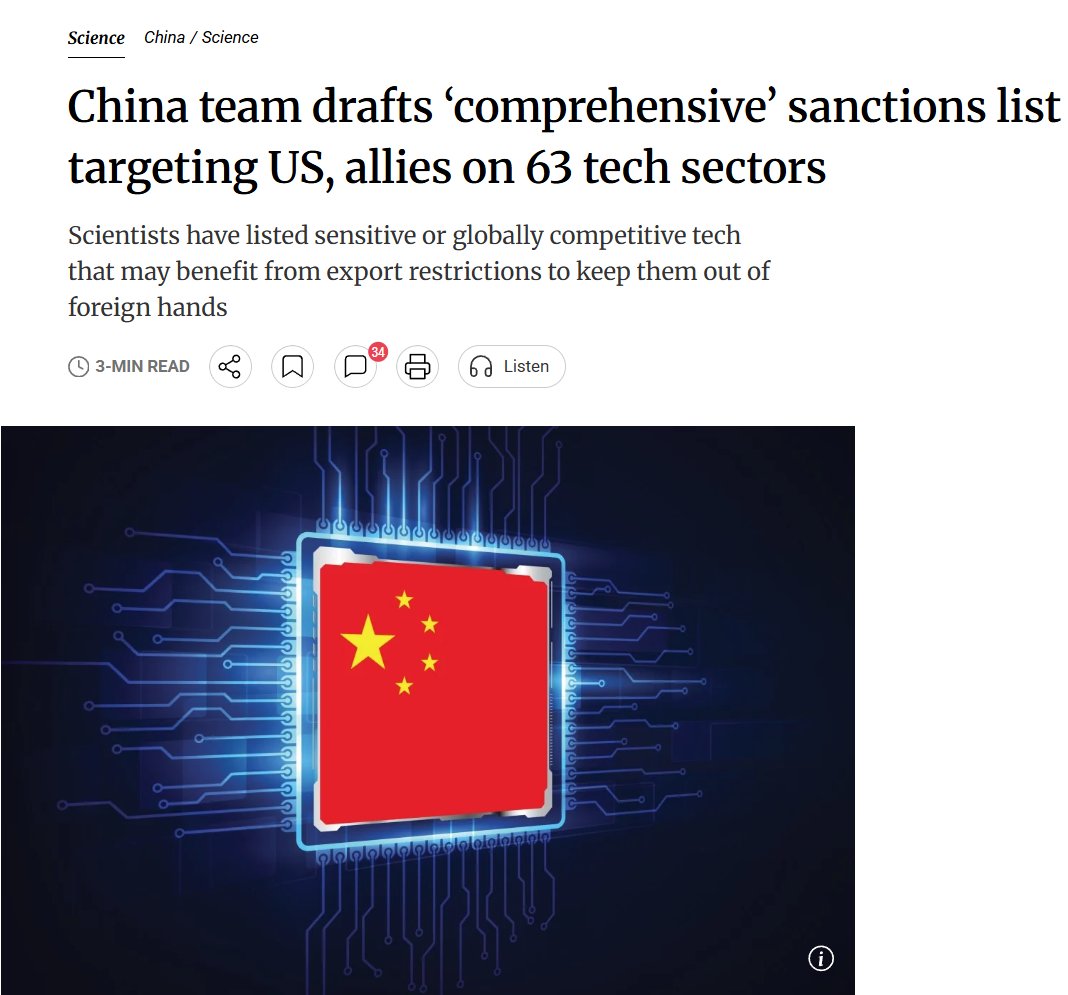
On June 1, Hong Kong’s *South China Morning Post* reported that Chinese research teams have drafted a "comprehensive" export control list targeting the United States and its allies, covering 63 distinct technological fields. Researchers have identified technologies deemed strategically sensitive or globally competitive, with the objective of preventing their outflow abroad through export restrictions.
This pioneering study, titled *Framework for Selecting Technologies for Export Restriction: An Empirical Study*, was first published on March 19 in the *Bulletin of the Chinese Academy of Sciences*. The paper delves deeply into "a fundamental strategic issue that has rarely been publicly discussed in China in recent years." It proposes China’s first relatively comprehensive framework for identifying technologies subject to export controls, ultimately selecting 63 specific technologies characterized by strategic sensitivity or global competitiveness. These technologies span fields such as advanced materials, quantum communication, AI hardware, energy systems, biotechnology, and aerospace engineering.
According to the study’s assessment, the technologies designated as "Tier 1" restricted exports include: satellite-based quantum-encrypted communication, electromagnetic launch technology, solar cell-related technologies, general-purpose miniaturized AI edge computing devices, metal recovery technologies for rare earth waste residues and tailings, and advanced high-strength steel production technologies for the automotive industry, among others. Other technologies include graphyne material preparation, deep-ultraviolet crystal fabrication, ultra-large-scale offshore wind turbines, space robotics, high-performance carbon electrode fabrication for perovskite solar cells, autonomous orbit determination via inter-satellite links for the BeiDou-3 navigation system, and free-space optical communication.
In their paper, the research team notes that this framework draws partly upon the export control mechanisms that the United States has long had in place. Through decades of evolution, the U.S. Department of Commerce has established a methodology that combines expert technical reviews with public consultations to identify specific technological domains and parameters subject to export bans or restrictions. The paper points out that, historically, U.S. export controls have focused not only on military or dual-use technologies but have also closely targeted two specific categories of critical technologies: first, fields where latecomer nations—exemplified by my country—are rapidly rising and, while not yet technological leaders, show the potential to challenge U.S. monopolies (e.g., integrated circuits, supercomputing, and civil nuclear power); and second, cutting-edge foundational technologies poised to shape the future landscape of science, technology, and industry (e.g., 3D printing, brain-computer interfaces, and artificial intelligence).
Evidently, the Chinese research team has sought to construct an assessment methodology tailored to China’s specific stage of development and industrial structure. Their screening process draws comprehensively upon existing domestic and international technology lists, the International Patent Classification (IPC) system, technology gap models, and patent co-occurrence network analysis; furthermore, it has undergone multiple rounds of expert review involving stakeholders from industry, academia, and government agencies. The study also relies heavily on patent databases to identify technological domains in which China possesses a comparative advantage. Taking the field of advanced materials as an example, the research team analyzed over 215,000 international patent records, employing machine learning clustering models and network analysis to pinpoint key technological nodes.
The significance of this research extends far beyond export policy alone. In the past, my country’s science and technology development strategy centered primarily on technology acquisition and addressing industrial deficiencies. However, as Chinese enterprises and research institutions increasingly join the global "first tier" across numerous cutting-edge sectors, issues such as technological sovereignty, technological security, and the protection of critical strategic technologies have now become subjects of routine discourse and policy deliberation within China.
The study also observes that my country’s institutional framework for ensuring the security of technology trade currently lags behind those of developed nations such as the United States, the United Kingdom, France, Germany, and Japan—countries that, through decades of development, have successfully established comprehensive systems for technology export control. Based on this study, it is recommended that relevant competent authorities, grounded in top-level design, effectively undertake three key tasks: monitoring and anticipating trends in foreign technology export restrictions while strengthening preventive measures; refining the selection processes and methodologies for my country's own restricted export technologies; and advancing the practical implementation of control measures for these technologies.
@Jay83214566@laiwu1988 Rocketry originated from china, the first ballistic missile was made by Nazi German. Am literally thinking we stoled who's technology.
Not being able to name "three living Chinese people" isn't a failure of the West. It's a failure of Chinese civilization. It lacks the appeal the West has. The West has movie stars and pop singers the world loves. China doesn't produce these.
By the way, I *was* able to name 3 Chinese people: Xi Jinping, Ai Weiwei (dissident artist) and Jack Ma (Ali Baba). Does Jackie Chan count? I could name a few more.
But the point is, everyone in the world wants to have sex with White people. What about Chinese? Do they have this sex appeal? No, they don't. Should anyone care about their society then? Nope!
Huawei thinks it can bypass U.S. sanctions and conquer the semiconductor world with packaging tricks, but Nvidia’s Jensen Huang just delivered a brutal reality check. Confronted with Huawei's highly publicized "Tau Scaling Law" breakthrough, which uses 3D chip stacking to simulate a 1.4nm transistor density by 2031, Huang completely dismissed the hype.
Speaking at a tech dinner in Taiwan, the Nvidia CEO bluntly stated that while it is a breakthrough for Huawei, it poses absolutely no threat to TSMC because Taiwan has been developing 3D packaging tech for nearly ten years. While Beijing relies on desperate architectural workarounds to survive Western export restrictions, TSMC remains lightyears ahead, targeting mass production of actual 1.4nm chips by 2028.
#UnveiledChina #Semiconductors #JensenHuang #Nvidia #TSMC #Huawei #TechWar #Taiwan
@OopsGuess Don't worry, Xi stated he wants his military ready to invade Taiwan by 2027. China won't have any ports left in 2027 and Panama can invest in scuba diving tours showing the Chinese merchant and naval fleet at the bottom of the sea.
the CCP treating AI talent like state secrets means China will not produce any truly world-class scientific talent in the future.
Imagine if Jensen Huang were one of those top AI talents who were living and working inside China as the CEO of a major Chinese tech company, he would face an exit ban immediately from the CCP if he tried to freely engage with American institutions, let alone sit on the board of Harvard or Yale while advising Beijing on strategic technology policy.
The irony here is almost comical. But apparently when the flow goes the other direction, we are told this is just “global academic freedom of exchange.”
Meanwhile, China has already begun restricting top private-sector AI professionals from companies such as Alibaba and DeepSeek from traveling abroad without official approval.
Yes, China’s billionaire tech elites and AI geniuses are now discovering that their basic human right to freely travel abroad can be casually trampled by the CCP at any moment.
Honestly, I would not trade lives with these poor souls trapped inside China’s system for even one second. Who wants to live inside a giant cage where the state ultimately decides whether you are allowed to leave, speak, invest, or even disappear from public view.
These restrictions specifically target elite AI talent, including founders, researchers, and executives, under the justification of preventing “technology leakage” and protecting national strategic interests.
The problem is that world-class scientific research is fundamentally different from military secrecy.
Scientific progress depends on openness, collaboration, and constant interaction between the world’s brightest minds. Researchers need international conferences, joint experiments, and exposure to global peers in order to generate breakthroughs.
Treating elite AI talent like state secrets and trying to innovate behind closed doors will not create world-leading science. It will create intellectual isolation and stagnation.
Over time, Chinese researchers cut off from the global scientific community gradually lose perspective, creativity, and innovative capacity. History repeatedly shows that countries restricting the movement of talent eventually experience technological stagnation.
So how will China produce the next generation of top-tier scientific researchers in the future?
Elite scientific talent is not something that can be mass-produced on a factory assembly line. It requires long-term cultivation in a free and internationalized environment.
If China loses the overseas channels that help nurture talent while simultaneously restricting the international exposure of domestic researchers, then it is foreseeable that China will no longer produce truly world-class scientific talent in the future.
ÇİN NELERİ TERKETTİ
1. Çin, GPS'i terk etti. BeiDou navigasyon sistemi artık santimetre düzeyinde hassasiyet sunuyor ve dünya çapında 100 milyondan fazla kullanıcısı var. Orta Doğulu petrol magnatları bile GPS'i terk edip BeiDou'ya geçiyor. İnanabiliyor musunuz? Amerika'nın dünyayı gören gözü kör oldu.
2. Çin, Boeing'i terk etti. C919, şimdiden 1.200'ün üzerinde sipariş aldı ve tek bir yılda Boeing'in değerinden 80 milyar dolar sildi. Eskiden "yapmaktansa satın almak daha iyidir" denirdi, ancak durum tersine döndü — artık Çin uçaklarını satın almak daha akıllıca bir seçim gibi görünüyor. Boeing tamamen hazırlıksız yakalandı
3. Çin, Amerikan çiplerini terk etti. Yangtze Memory’nin katı hal sürücüleri, uluslararası fiyatları yarı yarıya düşürdü. Kirin çiplerinin geri dönüşünün ardından Qualcomm paniğe kapıldı ve fiyatları bir gecede %30 düşürdü. Bir zamanlar Çin’i boğmak için kullandıkları şey, Çin’in kendi ölümcül silahı haline geldi.
4. Çin, Windows'u terk etti. UnionTech UOS, ulusal bakanlıklar ve büyük bankaların tamamen geçiş yapmasıyla 5 milyon kurulum sayısını aştı. Microsoft'un CEO'su uykusuz geceler geçiriyor, ancak bu konuda yapabilecekleri hiçbir şey yok.
5. Çin, Batı tıbbi ekipmanlarını terk etti. Shanghai United Imaging'in CT tarayıcıları artık ABD ve Avrupa'daki kliniklere giriyor. Almanya'nın Siemens şirketi, benzer modellerin fiyatlarını %40 oranında düşürmek zorunda kaldı. Çin tıbbi teknolojisi, Batı topraklarına bayrağını sağlam bir şekilde dikti.
6. Çin, yabancı yakıtlı motorları terk etti. BYD’nin bıçak tipi pilleri, Toyota yöneticilerini arabaları yerinde parçalayıp incelemek zorunda bıraktı. Tesla, sadece üç ayda 1,2 trilyon dolarlık piyasa değeri kaybetti. Benzinli arabaların devri sona eriyor — ve yeni enerji dünyasında kuralları Çin belirliyor.
7. Çin, Oracle veritabanlarını terk etti. Ant Group’un OceanBase’i dünya performans rekorlarını alt üst etti. Banka işlem sistemleri artık Amerikan baskısına boyun eğmek zorunda değil. İşte gerçek teknolojik egemenlik budur.
8. Çin, Batı endüstriyel yazılımlarını terk etti. Zhongwang CAD, Fransa’nın Dassault şirketini fiyat indirimleriyle merhamet dilemeye zorladı. Sany Heavy Industry, dünyanın en büyük tünel delme makinesini tasarlamak için yerli yazılım kullandı. Çin, Batı’nın endüstriyel yazılım üzerindeki tekelinde devasa bir delik açtı.
9. Çin, dolar ile ödemeyi terk etti. RMB sınır ötesi ödeme sistemi artık 180 ülke ve bölgeyi kapsıyor. Suudi Arabistan artık petrolünü RMB cinsinden satıyor. Amerikan hegemonyasındaki ilk büyük çatlak Çin tarafından açıldı.
10. Çin, Batı'nın genetiği değiştirilmiş tohumlarını terk etti. Yuan Longping'in ekibi, mu başına 1.000 jin'den fazla verim veren tuza dayanıklı pirinç geliştirdi. Çin'in kaseleri artık Çin tahılıyla doluyor. Monsanto’nun tohum patentleri etkisini yitirdi ve Çin gıda güvenliğinin tam kontrolünü ele geçirdi.
11. Çin, Amerikan sosyal medyasını terk etti. Xiaohongshu (RedNote), 30 milyon Amerikalı kullanıcıyı kendine çekti. Zuckerberg, günlük aktif kullanıcı sayısının dibe vururken Çin sosyal medya uygulamalarının okyanusun ötesinde patlama yaşamasını çaresizce izliyor.
12. Son olarak, Çin Batı askeri teçhizatını terk etti. Fujian uçak gemisinin elektromanyetik fırlatma sistemi, Amerika’nın Ford sınıfını geride bırakıyor ve DF füzeleri, uçak gemilerini mesafelerini korumaya zorluyor. ABD askeri-sanayi kompleksi, gece boyunca acil toplantılar düzenledi.
⭕️Bu sadece teknolojik bir ilerleme değil. Bunlar, Batı hegemonyasının çöküşünü haber veren on iki çan vuruşu.
🔶Alıntı, Profesör Yang Fan, Çin Siyaset Bilimi ve Hukuk Üniversitesi'nde ekonomi profesörü ve doktora danışmanıdır. İşletme Fakültesi Akademik Komitesi Başkanı olarak görev yapmaktadır ve Pekin Üniversitesi Çin Ekonomi Araştırma Merkezi'nde misafir araştırmacı olarak bulunmuştur. Ayrıca, Ulusal Savunma Üniversitesi Ekonomi Araştırma Derneği'nin İcra Direktörüdür.
@RnaudBertrand Or, it might be fear that they would defect for a better, normal life outside of a totalitarian system. Even without spilling the beans on state secrets.
Ask yourself, M. Bertrand: why do millions of Chinese want to leave for the US or UK or even France... but not vice versa?
Fun fact: that's the case of almost anyone in China with access to information that could damage national interests if leaked.
For instance: have you ever seen a former Chinese leader travel abroad on tourism? Like Jiang Zemin or Hu Jintao? Nope, you couldn't have, because they can't 🤷 And the exact same principle would apply to Xi if and when he retires: he would not be allowed to leave China unauthorized (and probably not at all).
It has been the case throughout Chinese history. For instance in the legal code of China's last 2 dynasties - the Ming and the Qing - you'd face the death penalty if you travelled abroad unauthorized and that resulted in the "leaking of China's affairs" (中国事情): https://t.co/nqiSJZcsUi
In other words the Chinese state has always conceived of strategically capable individuals - no matter how powerful they might be - as bearing obligations to the collective that constrain their personal freedom of movement. It's not punitive in intent - it's just structural.
This is something we in the West obviously have a very hard time understanding because - and this isn't intended as a value judgment- we're an individualistic culture with freedom as our cardinal value and have a deep-seated urge to spread our culture.
China - again without value judgment - is almost the exact opposite: collectivist culture with order/harmony as their cardinal value and zero missionary impulse, quite the contrary.
So obviously there is a clash here 😅
Of course you can still legitimately ask yourself whether, in this particular instance and in today's world, this approach will end up helping or hurting China's AI ambitions.
I suspect it'll be largely neutral. You only face these restrictions once you've reached the top - nobody avoids becoming a leading AI talent because success might come with strings attached.
Heck it can even be seen as a status symbol: your brain is basically a state secret 😊
@neetcate @mokuyoba3371@rixisdavid@Non_Asian_Ls Jokes? The entire modern landscape was manufactured by White men.
Not blacks, not Japanese, not Chinese, WHITE MEN.
@Yamamoto_IJN Dam, this is another level of cuxk posting by wuhan viruses .
No women in the world wants to marry a small dong. Its condenming your genes into the dumpster hahaah
Because White men is afraid that their propaganda will be exposed and if their propaganda get exposed then their superior mentality will become Zero score and their life will be like a clown.
The West screams every day that China “steals technology.”
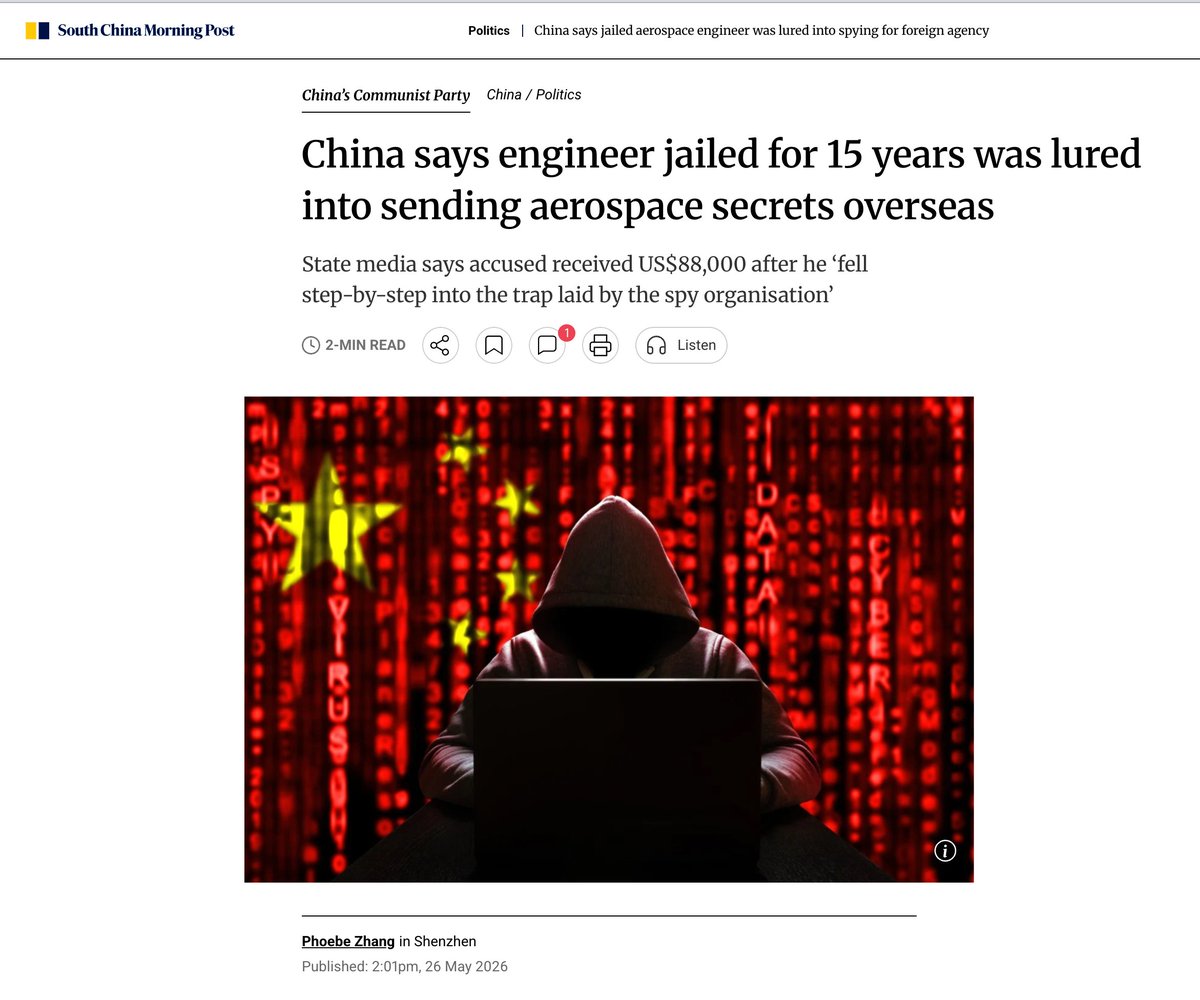
Then why are foreign spy agencies trying to buy Chinese aerospace secrets?
Why recruit insiders?
Why infiltrate classified sectors?
Why target China’s aviation and space programmes if China supposedly has nothing original?
Their propaganda says China cannot innovate.
Their intelligence operations say the opposite.
You don’t spend years stealing from an empty house.
You break in because you know there is something valuable inside.