Thrilled to announced that PLaTITO was accepted as a poster for ICML! Congrats to lead author @panos_anto and to collaborators Beatrice Pavesi and @OleWinther1 An updated version of the pre-print with more results will be posted soon--until then check out: https://t.co/McO4ZBxBps
PLaTITO is coming to Seoul 🇰🇷
Come to our #ICML2026 poster tomorrow to discuss Generative Molecular Dynamics and also get some of our cute stickers.
🗓️ Jul 7, 2026 • 10:30 AM - 12:15 PM KST
📍 HALL A #1214
🌐 Project page: https://t.co/gZHsOkI5GA
Thrilled to announced that PLaTITO was accepted as a poster for ICML! Congrats to lead author @panos_anto and to collaborators Beatrice Pavesi and @OleWinther1 An updated version of the pre-print with more results will be posted soon--until then check out: https://t.co/McO4ZBxBps
@TensorTwerker that's not a fair comparison since BioEmu is a general purpose systems trained to generalize on unseen proteins while LD-FPG is specifically optimized for on the D2R ensemble. feel free to check PLaTITO https://t.co/ot14wX3qyc
This is a wrong and dangerous take imho.
A Ph.D. is a marathon, not a sprint.
Yes, there will be days of a lot of hard work.
But consistency is much more important than sacrificing your work-life balance over 5 years.
@ishaanganti Exactly! PLaTITO speeds up the simulation and in the fast-folders it could sample from the equilibrium distribution in minutes (without any extra MD). I assume that in most challenging/interesting systems, this approach you describe could be useful
Learning molecular dynamics across timescales with generative models
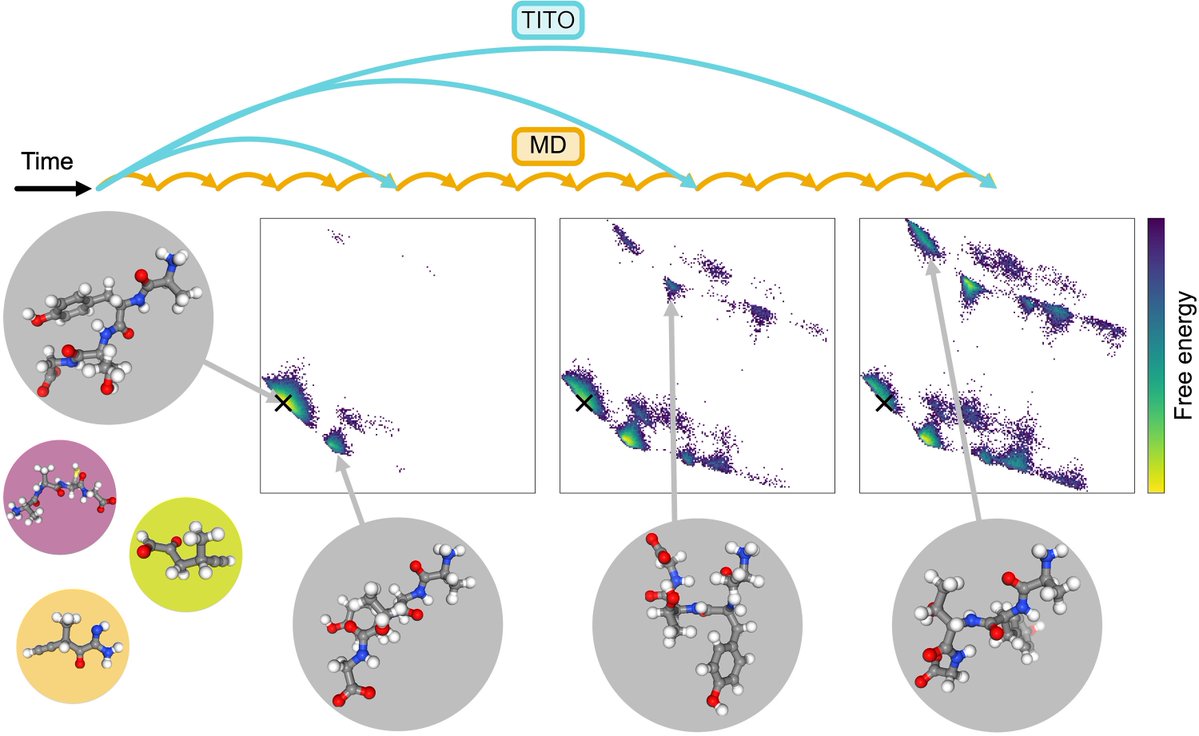
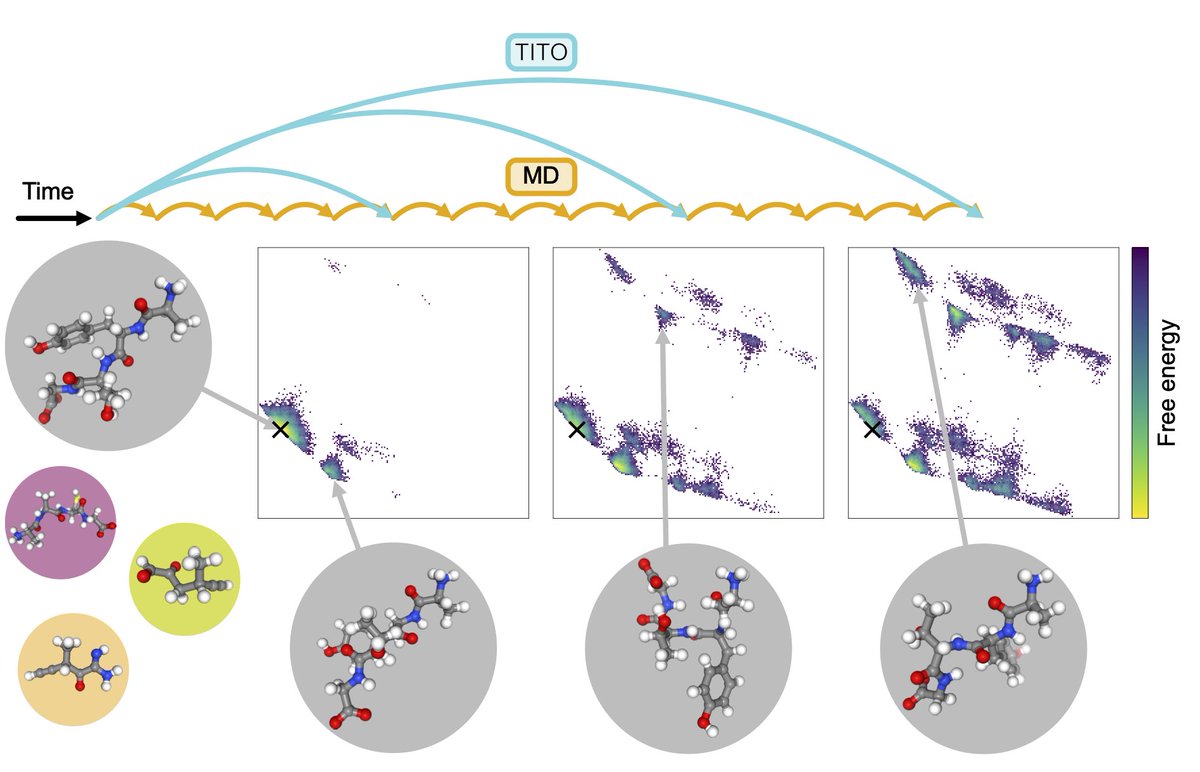
Molecular dynamics (MD) simulations track atoms one by one, step by step, revealing at atomic resolution how molecules fold, bind, and change shape. But there is a fundamental bottleneck: to remain numerically stable, MD must advance in femtosecond increments—even when the processes of real interest, like protein folding or drug unbinding, unfold over microseconds to seconds. Bridging this timescale gap is one of the central challenges of computational chemistry and biophysics.
Juan Viguera Diez, Mathias Schreiner, and Simon Olsson address this with TITO (Transferable Implicit Transfer Operators), a deep generative framework that learns the statistical rules of molecular motion without ever taking a single femtosecond integration step. Instead of simulating trajectories step by step, TITO learns the transition probability distribution between molecular configurations at arbitrary lag times, using equivariant flow matching over a continuous normalizing flow. Trained jointly on small organic molecules and short peptides, the model internalizes both chemistry and timescale—and can then generate new trajectories at whatever time resolution is needed.
The results are compelling. TITO faithfully reproduces Boltzmann equilibrium distributions and relaxation dynamics across hundreds of unseen molecules and peptides. More remarkably, it uncovers metastable conformational states that long conventional MD simulations miss—states later confirmed by replica exchange and ultralong trajectories. Trained only on tetrapeptides, it extrapolates qualitatively to peptides twice as large, guided by a simple physical prior from polymer scaling theory. On a single GPU, it achieves roughly 10 milliseconds of simulated physical time per day, versus a few microseconds for conventional MD—a speedup of four orders of magnitude.
For drug discovery and materials science, this matters concretely. Conformational sampling—understanding which shapes a molecule can adopt—remains a computational bottleneck in hit identification and lead optimization. A transferable generative model that captures both thermodynamics and kinetics at a fraction of the cost of brute-force MD could meaningfully accelerate early-stage screening pipelines and reduce dependence on the most expensive compute infrastructure.
Paper: Diez et al., Science Advances (2026) — CC BY-NC 4.0 | https://t.co/3OcEGxYCii
Protein Language Model Embeddings Improve Generalization of Implicit Transfer Operators
1) PLaTITO achieves state-of-the-art equilibrium sampling for out-of-distribution proteins with nearly 10x less training data and compute than prior methods like BioEmu, demonstrating remarkable data efficiency in generative molecular dynamics.
2) The key innovation is incorporating protein language model (pLM) embeddings from ESM into transferable implicit transfer operators (TITO), which provides powerful inductive biases that boost generalization across diverse protein systems without system-specific fine-tuning.
3) Unlike Boltzmann Emulators that require massive equilibrium datasets, PLaTITO learns from short off-equilibrium MD trajectories across multiple temperatures, leveraging the auto-correlation structure of molecular dynamics data to reduce computational costs.
4) The architecture separates conditioning and velocity prediction through a two-stage transformer design based on Proteina, processing coarse-grained Cα backbone coordinates with residue and pair representations for efficient scaling to larger proteins.
5) PLaTITO-Big, the 19M parameter variant using ESM Cambrian 6B embeddings, not only matches but exceeds BioEmu performance on fast-folding protein benchmarks while training in just 1,100 GPU hours compared to BioEmu's 9,216 GPU hours.
6) Beyond equilibrium sampling, the model captures physically meaningful kinetics including non-Arrhenius temperature-dependent folding rates, consistent with complex rugged free energy landscapes observed in experimental studies.
7) The model generates long-timescale dynamics through iterative rollout, producing trajectories that exhibit repeated folding and unfolding events and converge to stationary distributions from arbitrary initial states.
8) While showing promise for cryptic binding pocket exploration, the approach currently uses coarse-grained representation and lacks formal guarantees of detailed balance or semi-group self-consistency, suggesting directions for future all-atom extensions.
📜Paper: https://t.co/O0A1KZT7rV
#ProteinLanguageModels #MolecularDynamics #GenerativeModels #ComputationalBiology #ProteinFolding #DeepLearning #Bioinformatics #AIforScience
PhD positions in my lab (AI for Science), but with special preference for people who complement our current activities or are enthusiastic about contributing to our on going work. Looking for technically strong, independent and proactive candidates. https://t.co/tAsKyAx7lg
I'm excited to open the new year by sharing a new perspective paper
I give a informal outline of MD and how it can interact with Generative AI. Then, how far the field has come since the seminal contributions, such as Boltzmann Generators, and what is still missing
✨ #EurIPS registration is now open! Get one of the 1,500 tickets available. 500 tickets are discounted for students 🎓.
In Copenhagen 🇩🇰 on Dec 2-7, 2025.
❗ Entrance to the ELLIS UnConference is free with a @EurIPSConf ticket.
Get your ticket now: https://t.co/uhx99QENNB
📢 Present your NeurIPS paper in Europe!
Join EurIPS 2025 + ELLIS UnConference in Copenhagen for in-person talks, posters, workshops and more. Registration opens soon; save the date:
📅 Dec 2–7, 2025
📍 Copenhagen 🇩🇰
🔗https://t.co/2wOfBxeGn7
#EurIPS@EurIPSConf
We are looking for someone to join the group as a postdoc to help us with scaling implicit transfer operators. If you are interested in this, please reach out to me through email. Include CV, with publications and brief motivational statement. RTs appreciated!
Registration for this years CHAIR Structured Learning Workshop is open. Speakers include: Klaus Robert Müller, Jens Sjölund, @AlexanderTong7, @JanStuehmer@ArnaudDoucet1, Marco Cuturi, @MartaBetcke, Elena Agliari, Beatriz Seoane, Alessandro Ingrosso, https://t.co/gd0q1YF3Nr
I have an opening for a PhD student in my lab for a collaborative project on Machine Learning for Proteins with @TheKailaLab at Stockholm Uni. We are looking for a candidate with an applied ML background, preferably with experience in MLFF and/or generative models. 1/2
Congratulations and welcome to the ELLIS community! Following a thorough evaluation process, 120 exceptional young researchers join us as new #ELLISPhD students, ready to collaborate with Europe’s top #AI labs: https://t.co/vI6nzyjc22
@ai_elise@elsa_lighthouse@elias_project