I left X a while ago. I kept my account here, but this is my first tweet in months -- and my last.
You should leave.
I seldom tell others what they should do. And I don't matter.
But I think X has become a loudspeaker for people that are against democracy.
Just leave.
📢Few days left to submit: Workshop on Advancing Methods in Behavioral and Experimental Economics (Barcelona, June 2), co-organizing @Matteo_Galizzi.
Committee: @PaoloCrosetto, A Dreber, L Neyse, @m_serra_garcia, J Stoop, S Toussaert, F Tufano.
Link: https://t.co/VL2dV5mM0q
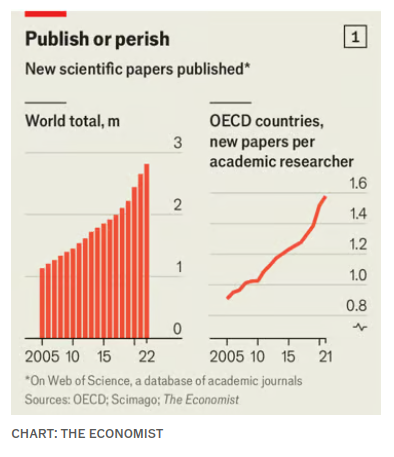
As the volume of published articles outpaces the number of practicing scientists, academics are increasingly overwhelmed. Where does this growth leave researchers? A new study published in @QSS_ISSI assesses the strain on scientific publishing. #OpenAccess https://t.co/kUEQ6BA3Fc
@Ingar30@Prolific (just a note: I am ussually off X, here just to ask this one question to maximize chances of getting a reply, and this tweet just got liked by 3 random porn bots... don't want to overgeneralize, but it's bad, right?)
Social scientist hive mind, data privacy question:
does anyone know if @Prolific provides experimenters directly the prolific ID of subjects or creates a new ID for each experiment?
If I ran 2 experiments & I happened to have the same subject, would I know that by comparing ID?
@Ingar30@Prolific It's what we do, but apparently for a French judge this is not enough as it relies on individual researhcer's good practices; if we just kept the vanilla IDs and then a breach happened at Prolific, we'd know. Or maybe not -- I'll reach out to prolific to see if it's so
@ignaziano@Prolific Not sure I understand -- when Prolific sends you the subject, they have an ID surely, by which you can then tell Prolific "pay subject XYZ this many €". ANd if you tell me this ID is persistent, and I can track subjects across experiments, then how do I not "collect" XYZ?
@Ingar30@Prolific Thanks. I ask because French GDPR authorities are worried by this. If ever the Prolific database filled to the brim with personal data leaked, we could cross our experimental data with that and identify the persons behind it all. This casts legal doubt on using Prolific...
@ignaziano@Prolific Thanks. I ask because French GDPR authorities are worried by this. If ever the Prolific database filled to the brim with personal data leaked, we could cross our experimental data with that and identify the persons behind it all. This casts legal doubt on using Prolific...
#RP_INRAE Quelles politiques pour des achats alimentaires plus sains ? 🛒
Des chercheurs en économie ont mené une étude expérimentale dans une épicerie virtuelle, avec 290 produits testés.
👉 Résultat : le label Nutri-Score seul améliore plus la qualité nutritionnelle du panier d’achats qu’une politique de prix.
👉 En combinant les deux, aucun effet additionnel significatif n’est observé.
▶️Lire le communiqué de presse : https://t.co/XX00aM0qIb
@Afinetheorem Well it's not down to the EU only. EU said Google had to provide links to different map services and not only it's own. Maybe a ridiculous rule, but nobody's but Google forced Google to "comply" by not linking to anything anymore.
Il regime di Assad è crollato.
Non si sa che succederà in Siria nel futuro ma una cosa è certa. La decisione di riaprire l’ambasciata italiana a Damasco il 20/11 è un gigantesco errore di valutazione che devasta la credibilità della nostra politica estera. Tajani deve risponderne
La 46e Conférence internationale de l'@IA4EE a lieu à Paris du 15 au 18 juin 2025 et a pour thème :
Energy Solutions for a Sustainable and Inclusive Future ➡️https://t.co/J4dnMtYES8
#energy#iaee2025paris
Le @LaboratoireGael et l'@UGrenobleAlpes sont partenaires de l'événement.
@phl43 For DE and IT, definitely. There must be some supply side effects too, eg women entering the workforce, that was definitely true for IT. But again it's push-pull, they entered also because there were more flexible contracts allowing it. And shitty pay requiring 2 incomes (in IT).
We churn out more & more papers *per scientist*, at an increasing pace, in a rapidly changing publication landscape.
Why? How? Want to make sense of this?
In a new paper just published in Quantitative Science Studies we dive in & look for answers.
https://t.co/GoCYtL1Snp