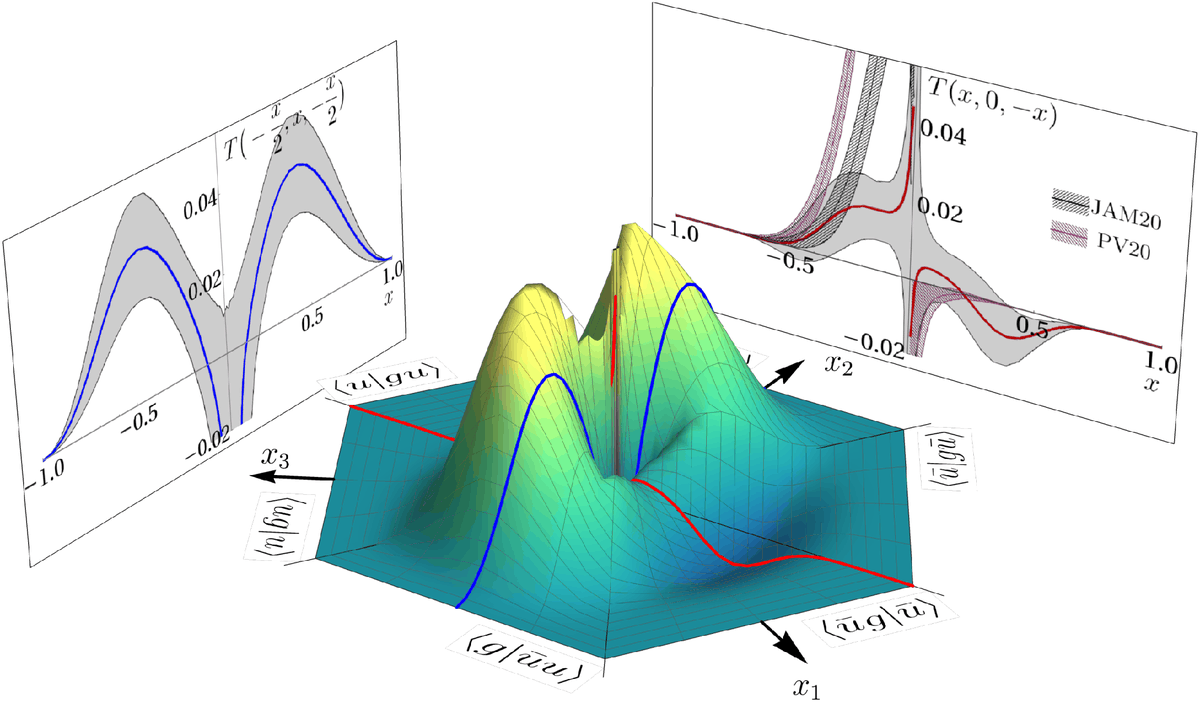
This proof-of-concept study shows evidence of quark-gluon-quark interference inside the proton, suggesting that protons are more quantum in nature than usually assumed.
Read the paper: https://t.co/vButKmX4ZN
The Laplace Transform is a powerful mathematical tool used to transform functions from the time domain into the complex frequency domain. It is widely applied in engineering, physics, and differential equations. The concept is named after the French mathematician Pierre-Simon Laplace (1749–1827), who introduced and developed this transformation in the late 18th and early 19th centuries. Laplace used this method as part of his broader work in probability theory and celestial mechanics. The Laplace Transform is defined as an integral that converts a time-dependent function f(t)f(t)f(t) into a function F(s)F(s)F(s), where sss is a complex number. This transformation simplifies many mathematical problems, especially linear differential equations, by turning them into algebraic equations that are easier to solve. Although Laplace formalized the method, similar ideas had been explored earlier by mathematicians like Leonhard Euler. However, Laplace was the one who systematically applied it and demonstrated its usefulness in physics and engineering. In the 19th and 20th centuries, the Laplace Transform became a standard tool in solving problems related to electrical circuits, control systems, and signal processing. Engineers use it to analyze system behavior, especially in systems involving inputs and outputs over time.
Gauss linked electric flux to charge with a simple rule: the total flux leaving any closed surface matches the charge inside divided by the vacuum permittivity.
Written as ∮ E ⋅ dA = q / ε₀.
Matching Gaussian surfaces to spherical, cylindrical or planar charge symmetries turns the surface integral into easy algebra for finding E.
The cylindrical case is used by power line engineers to map fields around cables, while capacitor designers rely on the planar version for parallel plates.
Lorentz Factor ✍️
Have you ever wondered what would actually happen if you could travel close to the speed of light? Not in a vague science fiction way, but in a precise, measurable, physically real way? The answer is stranger and more beautiful than anything you could imagine, and it all comes down to one remarkable number called the Lorentz factor. This single number, represented by the Greek letter gamma, tells you exactly how dramatically space, time, mass, and energy change for an object moving at extreme speeds. And the story it tells about the universe is one of the most astonishing in all of science.
Here is where everything starts. In 1905, a 26-year-old patent clerk named **Albert Einstein** made two simple but revolutionary observations about the universe. First, the laws of physics work exactly the same way for everyone moving at constant velocity there is no absolute rest, no absolute motion, everything is relative. Second and this is the one that breaks all intuition the speed of light is exactly the same for every observer, no matter how fast they are moving. If you shine a flashlight from a spaceship traveling at half the speed of light, both you on the spaceship and someone standing still outside measure the light moving at exactly the same speed. Not one and a half times the speed of light. The same speed. For both of you. Simultaneously.
This seems impossible. How can two people moving relative to each other measure the same speed for the same thing? The only way it works is if their measurements of space and time are different from each other. Time must stretch. Distances must compress. The geometry of the universe itself must flex to keep the speed of light constant for everyone. And the Lorentz factor is the precise number that tells you by exactly how much.
The Lorentz factor starts at exactly 1 when an object is stationary no effects, classical physics works perfectly, nothing strange happening. As speed increases, it barely budges at first. At 10% of the speed of light, it is still only about 1.005 barely a half percent above 1. But as speed approaches the speed of light, it explodes upward with terrifying ferocity. At 90% of light speed it reaches 2.3. At 99% it reaches 7. At 99.9% it hits 22. At 99.9999% it reaches 707. And as speed approaches light speed itself, the Lorentz factor races toward infinity which is the universe's elegant way of saying that the speed of light is an absolute, uncrossable barrier for anything with mass.
The first thing the Lorentz factor governs is time dilation and this is where the story becomes genuinely breathtaking. Moving clocks run slow. Not because of any mechanical problem, not because of vibration but because time itself flows more slowly for objects in motion. The moving clock runs slower by exactly the Lorentz factor. A clock traveling with a Lorentz factor of 7 ticks at one-seventh the normal rate. Imagine astronauts on a spaceship moving at 99.9% of the speed of light, where the Lorentz factor is about 22. For every year that passes on the spaceship every year the astronauts age 22 years pass on Earth. A five-year journey for the astronauts means 110 years back home. Everyone they knew would be gone. This is not imagination. This is real measurable physics.
The proof is everywhere around us. Tiny particles called muons are created 15 kilometers above Earth's surface when cosmic rays hit the atmosphere. They travel at 99.8% of the speed of light and should decay radioactively long before reaching the ground they only live for about 2.2 microseconds in their own time frame, enough to travel less than a kilometer. Yet we detect them abundantly at Earth's surface. Time dilation saves them. From our perspective, their internal clock runs 15 times slower, so they live long enough to complete the 15-kilometer journey. This happens constantly, every second of every day, all around you.
I am really glad that I took coursework in Random Processes and Detection & Estimation Theory, it really helped with understanding the really math heavy segments of the array radar short course that I took this past week:
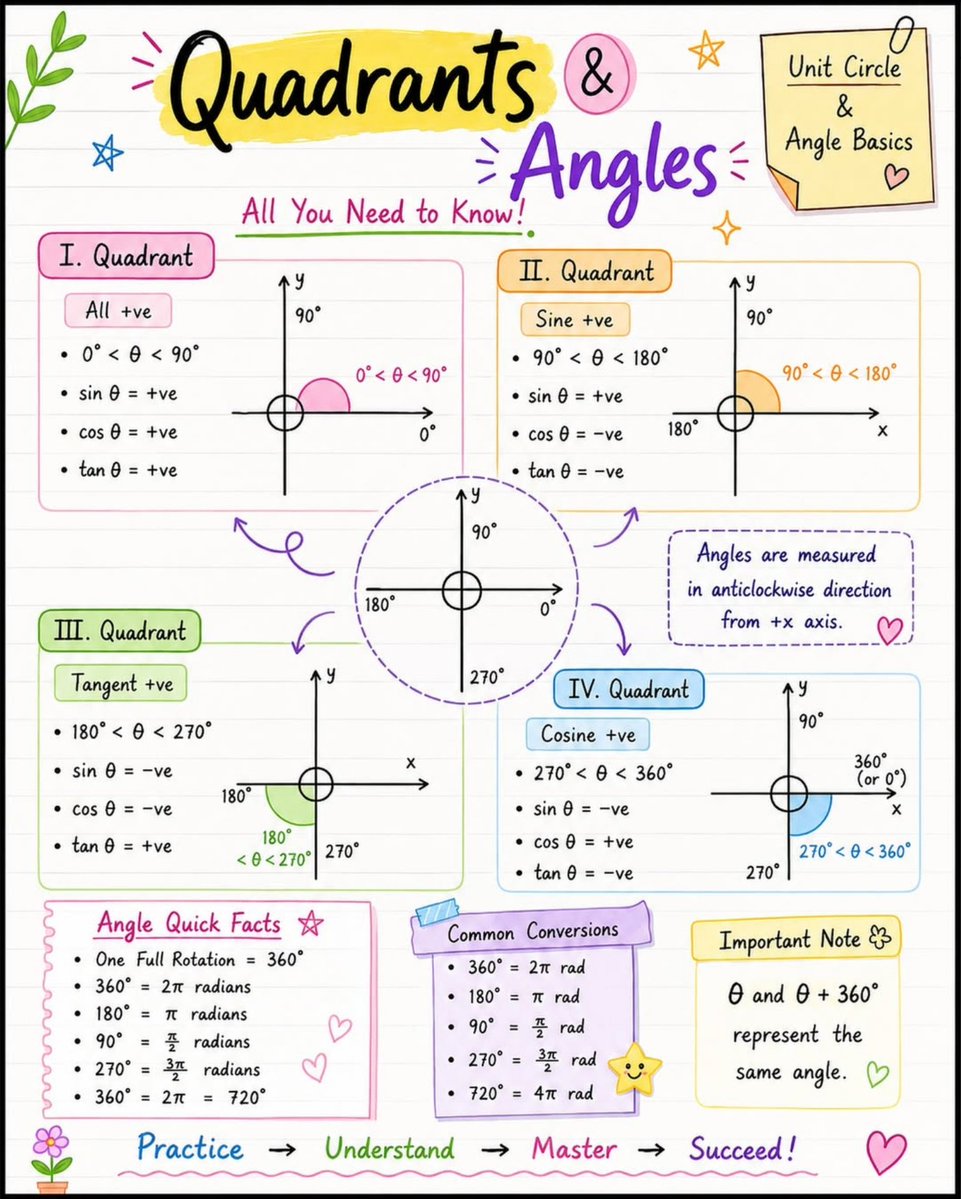
📐 Master Quadrants & Angles in Minutes! 🎯
Struggling to remember which trigonometric function is positive in each quadrant? This colorful cheat sheet makes it easy!