Crypto Project Survival Rates and Why @Bancor Is a True Outlier.
Carnage is the norm.
The vast majority of business-focused initiatives from 2016 to 2018 have all but disappeared. Most never made it past a short initial run.
In fact, fewer than 0.2% of these projects are still active today with ongoing development, healthy token liquidity, and meaningful product revenue.
Its the Forgotten Battlefield of business expeditions:
That figure isn’t about meme coins or speculative tokens. It only includes projects that began with real teams, public technology roadmaps, and a goal of building products or infrastructure. To qualify as a survivor, a project needs:
1. Recent active code development (within the last 3–6 months)
2. Tradeable liquidity
3. Ongoing, measurable revenue from its technology or service
Only a handful of projects still meet all of those standards out of tens of thousands launched during that period.
Even looking at VC-backed crypto startups from 2020 on, the picture is similar: about 41% show no meaningful growth or development, with most that survive falling into a “zombie” category.
Fewer than 1 in 4 achieve true product-market fit.
Most projects, regardless of funding or initial hype, lose relevance, stagnate, or wind down. The common traits among those that survive: consistent technical progress, real user adoption, and steady revenues.
With this context, @Bancor's ongoing operations and product revenue set it apart as one of the very few long-term survivors under these strict, business-focused criteria. The longevity is a signal that hard-earned wisdom is deeply integrated, very hard lessons have been learned, and most crucially survival instincts permeate through the project.
Even more of an outlier is how many of the same engineers and founders of Bancor are still involved in the day to day operations.
Many of the core team and key engineers who launched the original protocol in 2016-2017 are still actively building today. Not only has the project remained operational with real usage and revenue, but it has also maintained team and engineering consistency across nearly a decade. This is almost unmatched, even among projects that are still technically active.
It was a trait that attracted to me to @Bancor during the 2022 carnage. I wrote about it at the time, but I sensed this was a unique group of people, and time has proven that out.
Dr. Mark Richardson (@MBRichardson87) is a force, a true honey badger. In my view his expertise in organic and synthetic chemistry is uniquely suited for the space. You underestimate this at your peril.
Same goes for the engineers that no AI can replicate; ones that have been with Bancor for many years, uniquely tuned to the intricacies of the products like an engineer who built the car.
What happens to people who go through very difficult and trying times? They become hardened, stronger and wiser than those who are taken out. Then that wisdom is the cornerstone to new projects like @CarbonDeFixyz, the correct interpretation of on-chain liquidity and trading. Give me an order book.
My best investments are always on the people involved, to some degree regardless of the product offering, be it blockchain technology or gene-editing therapies, its only as good as the people involved.
Yet I'm struck by how rare of a case @Bancor is, to survive since 2016, change paths when called for, continue on with the same people, and in my view develop products that are truly meaningful.
Through this lens it doesn't take much to see how rare of a case this is, not only in the blockchain space, but in the business world as well.
What unteachable lessons have this group experienced and integrated? My guess is something significant.
@Bancor continues on and is well on the path to thriving.
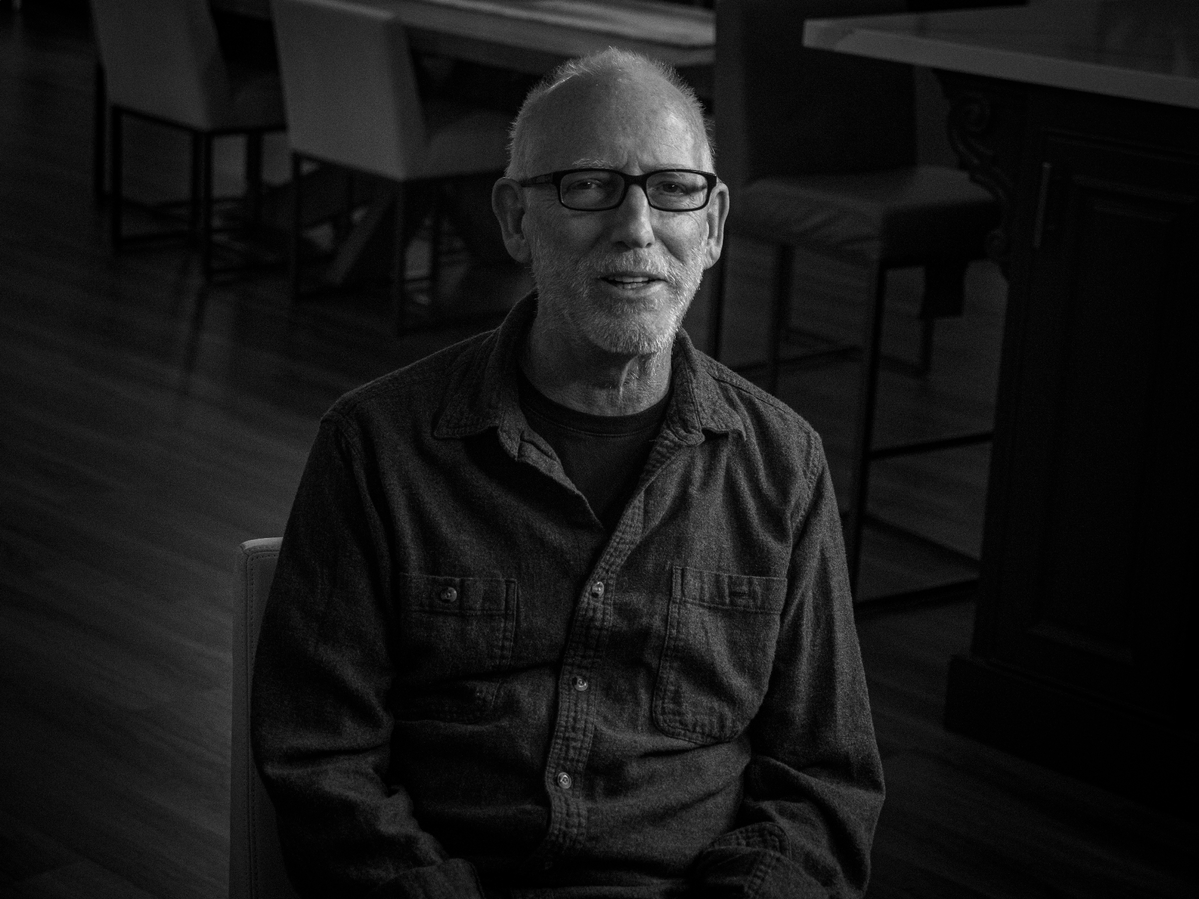
Scott Adams, facing death, shows us how to live.
Someone recommended “How to Fail at Almost Everything and Still Win Big” by Scott Adams. I had burned out on mainstream books, but picked it up, and was hooked. He had put into words a way of living, similar to one I had found, except his approach was systemic and analytical. Better than my own slapdash notes. Outside of religious texts, Adams was and is as close to a “guide to life,” as you’ll ever find. And even if you’re religious, you still live in this world, and would be wise to learn how to navigate it.
Scott is closing in on the end of his life, and even now he is creating new beginnings.
I’d better write this now, I won’t be able to when it’s too late.
After losing Charlie Kirk, a lot of us are wondering how we can possibly write another obituary. While there’s much to complain about the internet and social media, those mediums expanded the sizes of our communities, our influences, and indeed our families. Too often we find new ways to hate people, instead of finding new people to love.
Scott Adams comes up in conversation at every social event I host. “How is Scott Adams doing? Will he make it?” We all talk about streams we watched and lessons learned. It’s a memorial except he’s still alive. Scott would love to hear that, which is why I have said so repeatedly. I’ve lost too many people, via death or fallings-out, to leave feeling unexpressed.
He’s been a surrogate father figure and mentor to millions of people.
Scott Adams is not liked, he is loved.
People don’t “like” Scott Adams, they aren’t “a fan of his.” They love this man. And I do as well. I’m still living in denial of his fate. We all are.
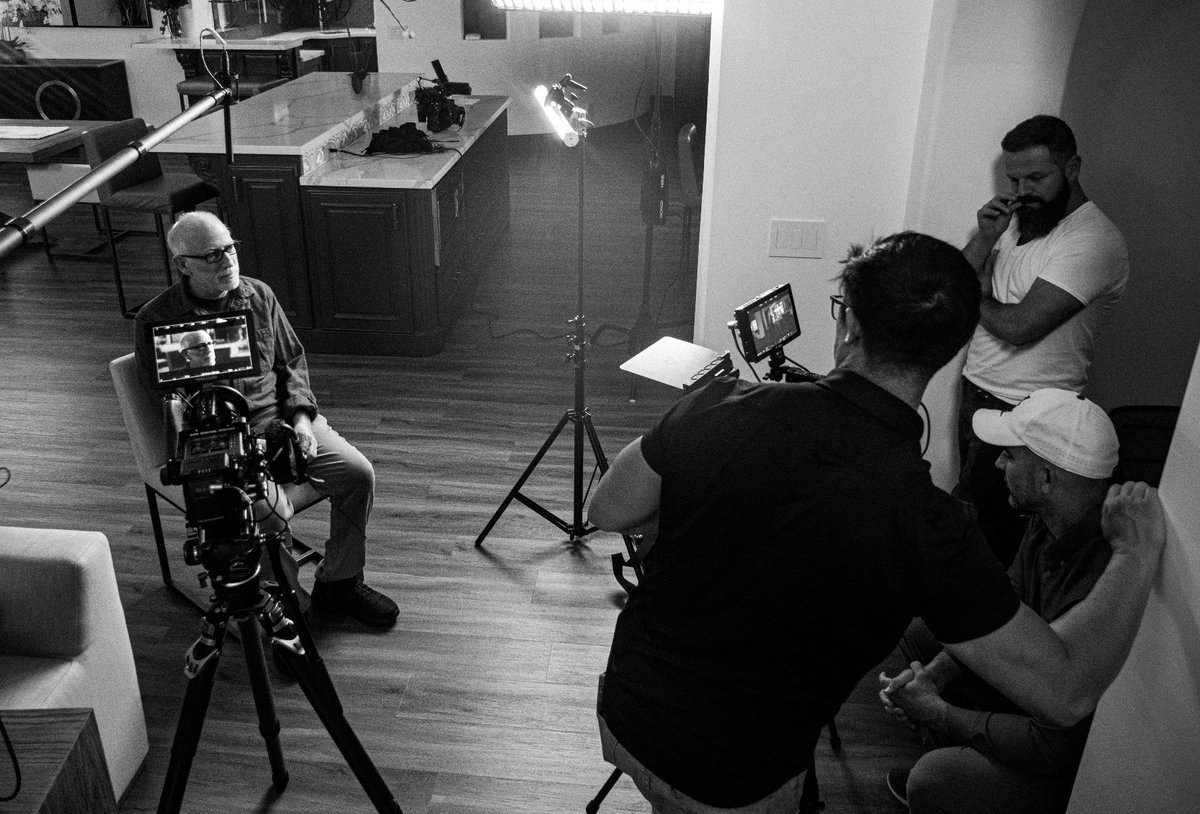
We’d been making a film about the meaning of life, and while Scott Adams had been in both of our other films, we hadn’t booked him for Meaning yet. Then we found out he was going to take the ride of assisted suicide. Foolishly, we had assumed he’d always be around. Nobody ever dies, right? Your dad will be there to take your call the next time you phone home. Your friends aren’t going anywhere. That’s how we too often live. We could book Scott later.
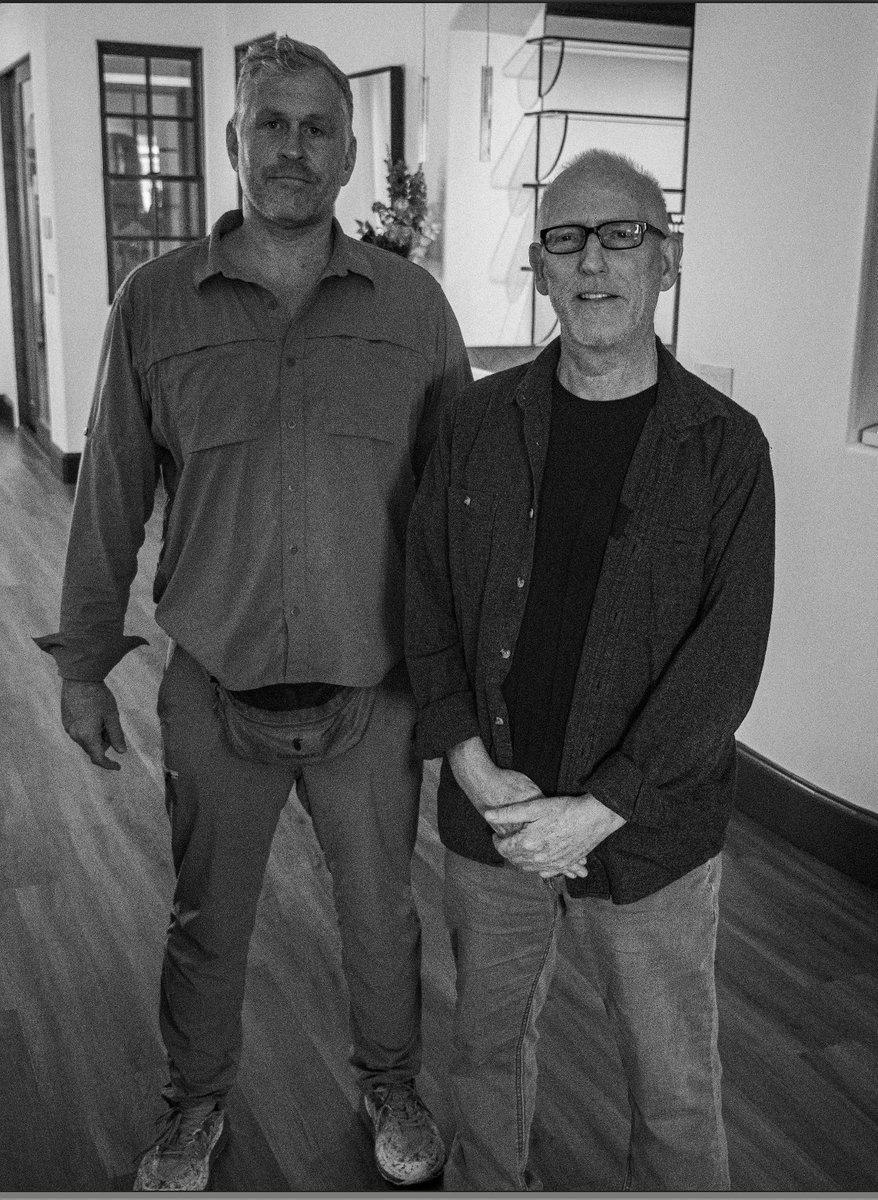
We reached out and he graciously agreed to be interviewed. We all knew it was going to be our last interview together. Scott and I are both efficient with our time. When a moment is over, it’s time to go do something else. Obligations call. The crew pushed this one as long as we could.
After the interview wrapped up and the gear was packed and it was time to go, there was an awkward pause. I broke it.
“Scott, we love you.” He said thank you. “No, Scott, we love you, I mean it, we all do. We love you.”
None of us broke down crying, not that there would have been any shame in that, but we no doubt all soon will.
Well then, what is the lesson of Scott Adams?
On a practical level, the lesson of Scott Adams is the power of showing up. Nobody works harder and on a more regular schedule. You can set your clock to Scott’s show. Too many of us wait for the muse of inspiration or the jolt of information to force us into action. Work, everyday, maybe in obscuring and without tangible benefits for years. Eventually you’ll hit your mark and go beyond.
Scott plugged away with his streams from a small account (after a huge career via Dilbert) and soon became must-watch, and then transcended his role to becoming something much more.
On a spiritual level, we might ask, why do we love Scott? It’s not because he’s so smart (he is). There are not shortage of intelligent, clever, Machiavellian, and rich people with podcasts. When one of them dies, what is lost? All of that Ego and desire for adoration, and does anybody even care? When those people fall while living, who will be there?
Scott is loved because he’s devoted his life to service to humanity. “What is the meaning of life,” is the question we ask every interviewee, and Scott’s answer, “Be useful to humanity.”
Despite pain, sickness, and inevitable death, Scott is doing his daily streams, serving his country and all of humankind until his end.
He’s a light to the world and a mirror for all of us.
What exactly are we doing with the gift of life given to us by God. (Scott believes in the Simulation, but I believe God evens this all out in the Judgment.) Are we doing enough for others? Are we doing anything for others?
Like everyone else, I’m capable of throwing myself a pity party. Sometimes when life is going too well, and I don’t have real problems, I invent some. That’s where the Ego brings you, recursively worshipping itself, and when that fails, tormenting itself, as each path leads to its own attention.
May all of us live more like Scott Adams, and may God bless his immortal soul when he passes.
P.S. I ran this article through Grok for typos. The original version had “immoral” soul where I meant it to read “immortal.” I think Scott would have had a great laugh had that typo been left in.
@Will_Tanner_1 Technological Revolutions and Financial Capital: The Dynamics of Bubbles and Golden Ages by Carlota Perez covers many of the same cycles (railroads included) that may be interesting. Gives a good heuristic on technological changes and stood the test of time in my view.
I've had this album from @GuiltTripMCR on repeat for two weeks now, just non-stop. Can't believe I just found these guys, so incredible. https://t.co/egROkWxgn1
There's so much truth to this, and I've (tried) to make it a habit especially to strangers. There's something really magical when a genuine compliment hits for both people.
Even today, a girl dropped her sunglasses and I helped her pick them up, yet like Scott says, I honestly thought they were a cool style, so I just said it. As innocuous as it seemed, I heard in her voice that it hit home, and I felt good that I went for it.
Such an easy win-win most times, and even if it doesn't feel as good as other times, you still become the person who goes for giving compliments.
The Power of a Compliment
Scott Adams tells the story of a woman in a public speaking class who transforms from terrified to confident through encouraging words from her peers
@ScottAdamsSays “If you withhold a compliment that you’re thinking, it’s almost immoral.
If you’ve got a compliment, just let it out.”
Chasing hype is easy. Being "the flavor of the month" is easy.
The real challenge is building infrastructure that endures — technology that doesn’t just ride cycles, but reshapes how markets function and how value flows through the global economy.
As Project Lead, @MBRichardson87 explains, the work worth doing is transformational. It’s not about short-term popularity, but about redefining what’s possible in finance and proving that Web3 can deliver tools that are stronger, fairer, and built to last.
Web3 has the potential to change the world.
Bancor is building the infrastructure to make it happen.
I think the world would greatly benefit from a collection of your thoughts/views in a book. You may not see it but from this side your X posts consistently touch on things that are genuinely meaningful, especially from the millennial perspective as an adult now from a kid in the 90's (like me). They feel very useful especially from the women/mom views that I don't see much elsewhere and more crucially perspectives that can bridge those of us who knew the world pre-internet. Just some encouragement if you're considering going that route.
Precision in Motion: Bancor’s $BNT Burn and the Art of Mechanical Movement
Much like a Grand Seiko mechanical watch transforms motion into the precise energy that powers its intricate functions, @Bancor has engineered an automated system where every trade across its multi-chain network initiates a reduction of $BNT supply. This mechanism channels genuine economic activity into utility-driven deflation, so each transaction directly strengthens the token’s underlying structure.
Just as the movement in a fine timepiece is designed for endurance and precision, Bancor’s $BNT burning process locks in permanent improvements to supply dynamics with each step, continuously reinforcing the token’s structural soundness over time.
Automatic Fee Capture on Ethereum Mainnet
Trading fees generated on Bancor V2 and V3 are continuously collected in a smart contract as $BNT tokens. When the contract’s balance reaches 1,000,000 $BNT (currently about 912,000 $BNT), the system initiates a batch burn, permanently removing those tokens from circulation; a repeatable process that creates a steady, predictable deflationary cycle.
Multi-Chain Revenue Consolidation
Bancor’s broader ecosystem via @CarbonDeFixyz and the Arb Fast Lane spans ten blockchains, including @SeiNetwork, @Celo, @COTInetwork and more recently @TacBuild. Trading fees from all supported chains are consolidated, bridged back to Ethereum, and directed into the Carbon Vortex contract.
Reverse Dutch Auction Mechanism
Consolidated assets are processed by an Automatic Auctioneer system, which launches Dutch auctions at double the current $BNT market price. As the price decays, arbitrageurs step in. The proceeds are then used to buy $BNT on the open market, and all purchased tokens are burned, further reducing overall supply.
Elegant Movements
This system enables ongoing, predictable value capture for $BNT holders. Every token holder benefits from supply reduction, even those who simply hold tokens in cold storage. Because the process is automated, cross-chain, and repeatable, it continuously supports the long-term soundness of $BNT. In essence, productivity and activity within Bancor’s ecosystem are systematically transformed into concrete benefits for all $BNT holders.
Every trade plays its part, every fee fuels a burn, and every holder gains from the elegance and engineering of this perpetual reduction mechanism.