In Burkina Faso 🇧🇫, an Ethiopian engineer, Bijay Naiker, has signed an agreement with the government to establish what is described as Africa’s first satellite manufacturing facility. The center, planned within an industrial park, is expected to focus on satellite design, engineering, and production for sectors including telecommunications and Earth observation.
If realized, the project could strengthen Africa’s capacity to build its own space technology and reduce reliance on foreign satellite infrastructure, supporting areas such as climate monitoring, agriculture, and digital connectivity.
@Stallionint_@MigunaMiguna I want the fight to be home, if you have an abusive husband, then because your husband has a brother that does not like him, you go to him? The brother is worse.
@MigunaMiguna This is the main that pushes me to dislike this guy.
If we are seeking to make our own democracy, why are you taking us to this form of slavery. For that matter, am out and will never be supportive to this , however much I like to see change, but this change is not welcome
Many young people today feel pressured to become rich instantly because of what they see around them. But remember the Luganda saying: “Ekikula amangu, kifa mangu” — what grows too fast often fades just as quickly.
At a youthful age, one can certainly earn enough to live well; buy a car, build a house, or run a small business. But wealth is something different. Wealth begins when your money starts multiplying itself; when businesses and investments continue to generate income even when you are not actively working, and your role becomes simply to monitor and guide.
My advice to the youth is simple: do not rush the process. When you begin working, focus on building steadily. Learn continuously. Save consistently. Invest wisely.
The enjoyments of life; beaches, vacations, and luxuries, will still be there later. Money is sweet at any age, but it is even sweeter when it is stable, sustainable, and well earned.
Wealth is not a sprint of youth; it is a marathon of patience. Money can come early, but true wealth is patiently built, carefully protected, and enjoyed for a lifetime.
@essiebabe48@namarahills@Joe__Bassey How I wish we could look at these differences and work as a whole. Most of. The people arguing did not even know this was done, but when someone posted, immediately, went into the ethnicities, not even celebrating this reveal at all
In 1879, Ugandan healers were performing cesarean sections with a survival rate that stunned European doctors—while much of the "civilized" world still saw the procedure as a death sentence.
British explorer Robert Felkin documented the operation in detail. The surgeon used banana wine as an antiseptic, herbal anesthetics to manage pain, and cauterization with a hot iron to control bleeding. The mother survived. The baby survived. The technique worked.
This wasn't primitive luck. It was sophisticated medical knowledge passed down through generations—refined, systematic, life-saving.
Yet the dominant narrative tells us modern medicine arrived in Africa with colonizers and that before European intervention, the continent had no science, no innovation, no expertise.
But here's the contradiction: if African medical practices were so "backward," why were European observers documenting them with awe? Why were these techniques—rooted in empirical observation and botanical knowledge—producing outcomes that Europe itself struggled to achieve until the late 19th century?
The Buganda Kingdom had what the British Empire didn't: working cesarean sections that saved lives.
So what else were we doing that got erased, ignored, or rebranded as "discovered" by someone else?
Sources:
- Felkin, R. W. (1884). "Notes on Labour in Central Africa." Edinburgh Medical Journal
- Ajayi, J. F. (1965). Christian Missions in Nigeria 1841-1891. Northwestern University Press
Credit: African Echo
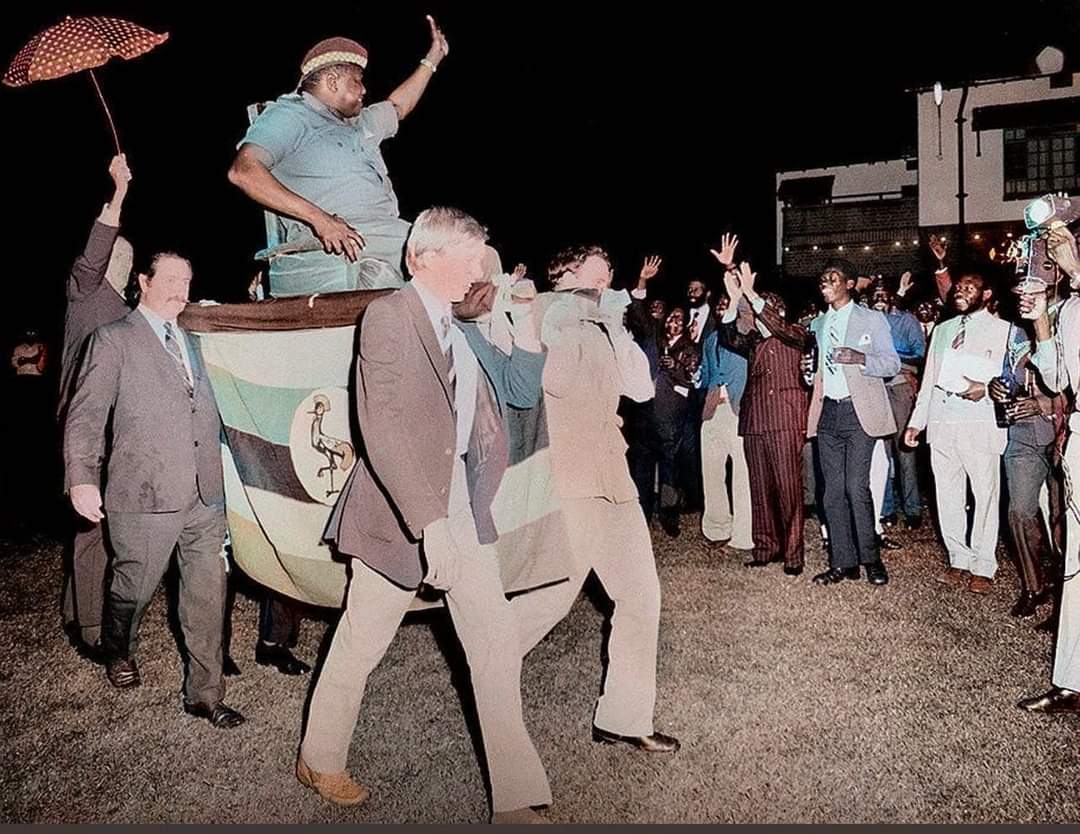
A rare picture of Idi Amin being carried in a chair by four British business men in July 1975, in Kampala, Uganda 🇺🇬
This picture will never be in our History books!
Overcoming debt is a slow, intentional journey. You don’t escape it by rushing or borrowing more, you do it by paying off small portions consistently, adjusting your lifestyle, and staying disciplined. Every payment, no matter how small, weakens the debt’s grip. @NButeraba shares more in this clip. Sign up for the NSSF Financial Literacy program today and start your journey to a life of financial freedom.