AI market colour:
TLDR; Two paths forwards:
1. If stocks keep falling - HFs still hold big positions on both sides so they'd have to dump their longs and buy back their shorts at the same time. Messy messy situation.
2. If stocks turnaround higher - HFs have a large amount of AI shorts on rn, so they'd have to buy those back = short squeeze territory.
So the current situation with AI stocks is that hedgies have pushed overall net exposure to the lowest level all year (latest GS PB data) with the L/S ratio for AI names near its lows.
Basically, that means there's a lot of room for them to get more long (cope, but true).
Across the entire book, HFs have mostly shorted against their longs rather than completely selling them, with short sales running at ~5x long buys in October MTD. That said, Tech has been hit from both sides with the record selling coming from long sales AND new shorts. FWIW, I don’t think there’s reason to panic since I highly doubt many funds out there are short the entire AI theme.
A lot of the longs are now concentrated in Mag 7 which is now a record ~22% of US net exposure. So in essence, the trade has been long stable megacaps, short the rest of the AI supply chain.
Funds don’t really have much room to add new long risk right now with gross already fairly elevated, so the way back for semis is by them covering shorts. A lot of the shorts recently have been put on in memory, photonics and the neoclouds, as well as Asian semis, so upside headroom is probably most significant in those areas.
Time will tell. Would not try to time bottoms here.
Don, there is a missing term in your equation.
The crunch spread is not: Token Price - GPU rental price.
Rather it is: (Token Price * Token Volume) - GPU rental price.
More simply: Revenue per GPU - GPU rental price.
Continuous throughput improvements for the same exact token mean that volume growth can more than offset token price declines for the exact same model/token
i.e. Kimi K3 token throughput per GPU has recently been improving at a 37% annualized rate driven by inference engine optimizations.
GPU prices are vertical because:
1) Mix is shifting from higher margin frontier tokens to lower margin open-weight tokens. $10 in Claude revenue requires $1 of inference compute. $10 of of open-weight revenue requires $3 to $7 of inference compute given competition between inference providers leads to lower margins. Open-weight tokens taking share is positive for AI infrastructure demand given lower margins at the model layer. The reverse is also true in that frontier tokens taking share is negative for AI infrastructure demand. Open-weight models have been taking share since early summer.
2) Throughput is steadily improving for each individual token type such that GPU compute becomes more valuable even as true like for like token prices decline.
Recommended reading for the weekend:
1. @jpmorgan — Credit markets look for AI’s weak links
2. @BernsteinPWM — Climbing the Wall of Worry | 3Q Macro & Markets Insights
3. @gdb — Towards securing the internet
4. @AswathDamodaran — From Eyeballs to ARR: Buzzy Pricing Metrics and the AI Trade!
5. @UBS — Higher oil and AI concerns drive risk-off move
6. @neil_shah — NVIDIA GTC Berlin 2026 – Containers, Safety and Sovereignty
Rough week in the markets. Hope this weekend serves as some welcome respite!
Why do Semiconductor stocks keep falling even though fundamentals remain strong?!
Here's why:
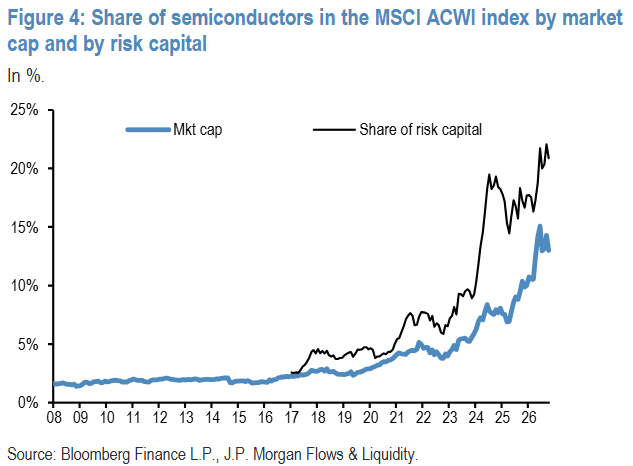
TLDR; The Semiconductor industry consumes a massive 20% of the total risk capital in the global equity markets.
The current share of risk capital for the Tech sector in the broader Global MSCI ACWI index is 40% vs. its 28% market cap weight. Of this, Semiconductors account for 20% vs. their 13% market cap weight.
Semis' market cap weight has risen rapidly in 2026 and because they're more volatile than the broader market, their share of risk runs well ahead of that weight. Therefore, investors are far more exposed to the Semis industry than even the index weights suggest.
This concentration then changes how the entire sector trades, where most of these selloffs are positioning events - not fundamental-driven.
Steady inflows into equities and thin net equity supply have kept realised vol low. Funds that size positions off VaR or vol-targeted risk budgets respond to low vol by running bigger gross exposure. When vol picks up, the same models force them to cut positions.
Then like a snowball rolling down a hill...that selling lifts vol further which forces the next round of cuts. (It works the opposite way too).
So with ~20% of the global risk budget sitting in Semis, these stocks are the first thing sold whenever risk models flag any shocks...even if fundamentals remain robust.
Data: JPM Global Markets Strategy
Various near-term risks - Fed, War, Midterms etc.
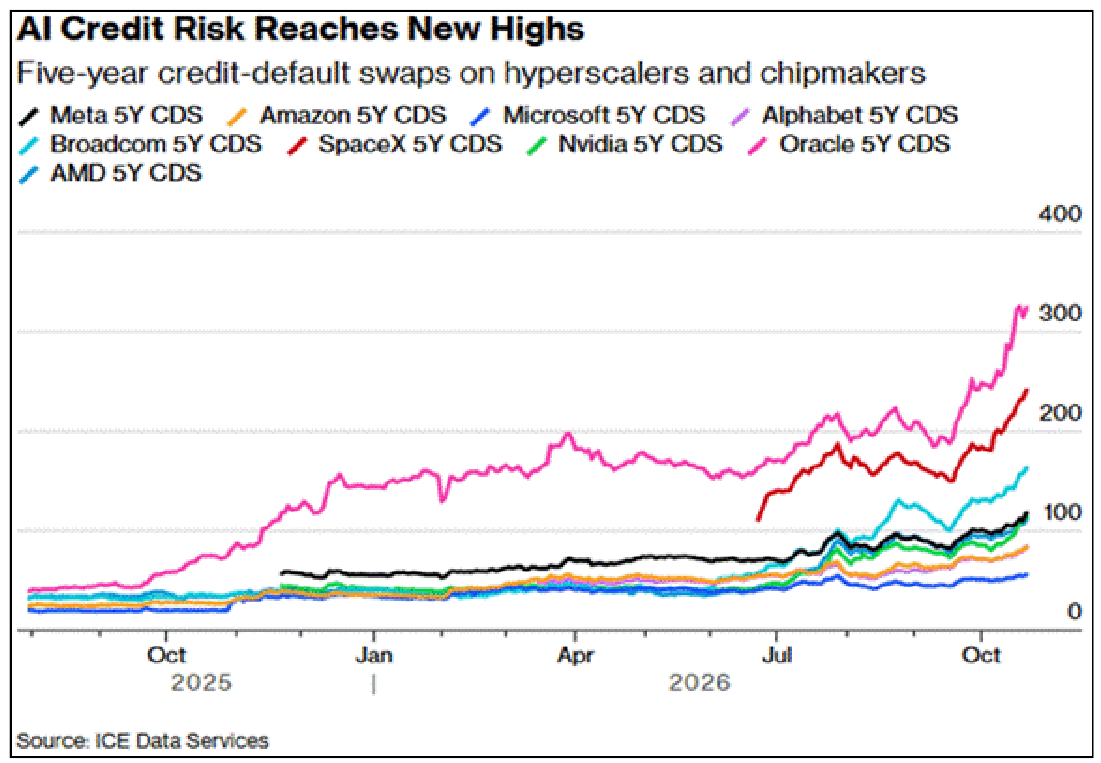
But it now seems like financing concerns are the main risk when it comes to AI stocks specifically which is driving the rotation to Defensives currently.
E.g. SPY ex-AI is outperforming SPY by >6% so far in October. Wild considering most of the index's EPS growth comes from AI names.
There's no easy way to say it...but institutional confidence has been absolutely decimated this week.
Today: plenty of long and short selling but extremely low levels of long demand for the hyperscalers, neoclouds and photonics.
Even the past few days showed more long demand than today, so it almost feels like no one wants to be the first to pull the trigger despite some positive demand-side signals from SpaceX, Meta, Bloom and Western Digital's earnings reports.
Following on from my earlier post - it now seems like cost of capital / financing concerns are the biggest bottleneck in this entire AI trade.
@vanyn_ The more upstream you go, the lower confidence seems to be.
My position from a few months ago was that the bottleneck trade was exhausted.
https://t.co/yJ0oz16PUC
I believe that only the highest quality AI stocks should be considered going forwards.
The easy money has been made.
Random AI shitcos went up >100% in weeks from Q1-Q2 due to the entire supply chain going through a broad re-rating off of depressed valuations. Most of that pricing-in has been done now, and those exponential moves up (mainly driven by sentiment) won't return any time soon barring any genuine catalysts. Macro is too unstable.
In my opinion, it makes sense to be a little more cautious after the July de-leveraging. In practise, that would be: concentrating tech allocations into the highest quality AI compounders, and diversifying outwards slightly into non-tech sectors...depending on individual risk tolerance. (I am still heavily in tech due to a high pain threshold).
In fact, I'm already hearing that institutions are favouring such an approach heading into Q4, with financials and healthcare stocks being bought up instead of U.S. and European AI microcaps. (European funds in particular are double-y cautious).
Time will tell whether or not this is longer-term / tactical positioning.
Fun story - IRENted a POETry book from the library and I saw a WOLF outside.
AI market colour:
TLDR; Two paths forwards:
1. If stocks keep falling - HFs still hold big positions on both sides so they'd have to dump their longs and buy back their shorts at the same time. Messy messy situation.
2. If stocks turnaround higher - HFs have a large amount of AI shorts on rn, so they'd have to buy those back = short squeeze territory.
So the current situation with AI stocks is that hedgies have pushed overall net exposure to the lowest level all year (latest GS PB data) with the L/S ratio for AI names near its lows.
Basically, that means there's a lot of room for them to get more long (cope, but true).
Across the entire book, HFs have mostly shorted against their longs rather than completely selling them, with short sales running at ~5x long buys in October MTD. That said, Tech has been hit from both sides with the record selling coming from long sales AND new shorts. FWIW, I don’t think there’s reason to panic since I highly doubt many funds out there are short the entire AI theme.
A lot of the longs are now concentrated in Mag 7 which is now a record ~22% of US net exposure. So in essence, the trade has been long stable megacaps, short the rest of the AI supply chain.
Funds don’t really have much room to add new long risk right now with gross already fairly elevated, so the way back for semis is by them covering shorts. A lot of the shorts recently have been put on in memory, photonics and the neoclouds, as well as Asian semis, so upside headroom is probably most significant in those areas.
Time will tell. Would not try to time bottoms here.
Very nice info and really objective
Unlike me
If I were the one who post this
I will only write:
Hedge funds are getting crowded on the short side. The question isn't just what happens if stocks fall. It's what happens if they don't.
If the bearish thesis works, shorts profit.
If it doesn't, crowded positioning itself can become fuel for the upside