UP: Four accused (Shivendra Singh, Abhishek Tiwari, Chhotu Singh and Ashu Kharwar) were arrested for alleged Cow Smuggling from Uttar Pradesh to Chattisgarh. 16 Cattle rescued in Varanasi during the operation. Further investigation is underway.
Ankit Sharma was not the only one murdered and thrown into a drain during the Delhi riots. Five other men — all Muslim — suffered the same fate.
Their stories hardly got attention. But here's one. Reported this over 3 weeks with @Basantrajsonu in 2020.
https://t.co/N9PYnBX9MC
Online Link: https://t.co/5VoBzcMzaf
____________________________
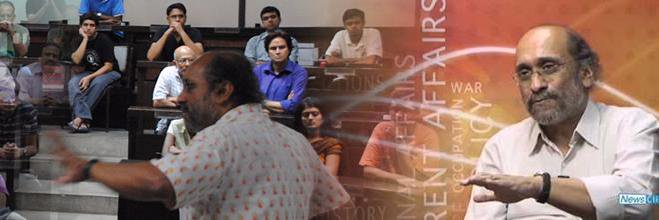
Demolition of CSDS has begun, due process can wait
Yogendra Yadav
Bulldozer justice reaches academia. That could be the headline for an Indian Express report last week (‘Think tank CSDS likely to face funding cuts from Centre’, IE, July 10) on the government’s move to cut its grant to the Centre for the Study of Developing Societies (CSDS), which amounts to 90 per cent of the institution’s salary bill. No doubt, this is a demolition exercise.
As in bulldozer justice, the modus operandi involves turning the rule of law upside down. Criminal justice follows a prescribed sequence: An incident leads to evidence, evidence to suspicion, suspicion to trial and the trial leads to indictment and punishment. Here the process begins with public indictment of a culprit identified in advance. Pretext and paperwork follow to manufacture justification for the punishment pre-decided, if not already delivered. An exemplary punishment that echoes deep and wide.
The CSDS has been to Indian social science what the Tata Institute of Fundamental Research (TIFR) or the Indian Institute of Science (IISc) is to the world of Indian sciences. Founded in 1963 by Rajni Kothari, the faculty roll of CSDS reads like the Who’s Who of the first two generations of Indian social scientists, barring economists. Excluding the present faculty, the list includes Ashis Nandy, D L Sheth, Ramashray Roy, Gopal Krishna, Bashiruddin Ahmed, Giri Deshingkar, Sudhir Kakar, Shiv Visvanathan, Harsh Sethi, Suresh Sharma, D R Nagaraj, V B Singh, Rajeev Bhargava, Shail Mayaram, Aditya Nigam and Abhay Dube. Add to this list scholars who have been a part of the extended family of CSDS — Sukhmoy Chakravarty, T N Madan, Deepak Nayyar, J P S Uberoi, Manoranjan Mohanty, Patricia Uberoi and Suhas Palshikar — and you know why CSDS has been at the centre of Indian and global debates on politics, society and culture. A special issue of Seminar magazine (November 2012), titled “The CSDS Experience” captures something of the story of this extraordinary institution. (Full disclosure: The present author served on the CSDS faculty for two decades, before leaving it in 2013 and formally resigning in 2016.)
On the face of it, the CSDS is a rather odd target for demolition. During the days of ideological Cold War, the CSDS was known as a non-Marxist, if not anti-Marxist, school of thought. The scholars at the Centre were among the first ones to articulate the agenda for decolonisation of the social sciences. The Centre was also the pioneer in advancing social sciences in Indian languages. A far cry from the deracinated, westernised, leftist intellectuals the present regime loves to hate. Unlike the Emergency, when the CSDS did serve as a node for resistance to the authoritarian regime, the institution has kept a low political profile since 2014. The Lokniti programme, its research initiative that carries out electoral and political surveys, has maintained a scrupulous record of political non-partisanship and has given up election forecasting. On balance, its election surveys over the last decade have overestimated, not underestimated, the BJP’s electoral performance.
The reason for choosing CSDS for the present assault is thus hard to fathom. Here is my guess: The three-decade old Lokniti programme is arguably the only trustworthy political barometer in the country that continues to adhere to scientific protocols of survey and transparent reporting, a barometer that cannot be “adjusted” to suit the demands of the rulers. This is one thing authoritarian regimes do not like, especially when they face allegations of electoral malpractices amidst rising public disquiet. Or, maybe, as in the case of Centre for Policy Research (CPR) earlier, the prestige of CSDS makes it the perfect example to send a message to an entire community of academics and intellectuals: Nobody is safe if CPR and CSDS can be targeted.
Once the target was selected, a provocation had to be discovered. The trigger was trivial, bordering on the ridiculous. On August 17, 2025, Professor Sanjay Kumar posted data around an unusual decline and increase in the number of electors in four assembly constituencies in Maharashtra on his personal X account. The calculation was wrong. Within 48 hours, he deleted the post and apologised for the error. Mind you, the posts were a bland presentation of data with no political interpretation or insinuation. The data did not fit into the Opposition’s narrative of “vote chori”. This was not institutional reporting of a research project. In any case, this was a trivial error, immediately rectified. The other supposed provocation was also a non-issue. A few days earlier, the CSDS had published the findings of an opinion poll on the SIR and reported a decline in the level of popular trust in the Election Commission. There was no error nor any element of surprise in this data that was hardly noticed. The BJP’s ecosystem smartly conflated the two and pounced upon the CSDS. The troll army was afire, as were the darbari channels, demanding exemplary punishment.
Official indictment closely followed the troll army’s insinuation. On August 19, the Indian Council of Social Science Research (ICSSR), the official body through which grants to all social science institutions like CSDS are funnelled, took to X, saying it was taking “serious cognizance of the data manipulation by CSDS and its attempt to create a narrative with the intention of undermining the sanctity of the Election Commission of India. This is a gross violation of the Grant-in-Aid rules of ICSSR”. The verdict had been delivered before the trial began.
Then came the paperwork. As in bulldozer justice, the formal justification is an act of post-facto creativity. Once the target, the punishment and the excuse were fixed, the ICSSR appointed a committee to prepare grounds for what had already been decided and carried out. As reported in The Indian Express, the committee has indicted the CSDS for everything other than what the ICSSR had accused it of. Apparently, the proposed punishment is now not for “data manipulation” but for the age-old charges that can be used to implicate anyone in the sarkari system: Fine print of appointment rules, payment or non-payment of allowances to employees, conduct of meetings and recording of minutes, and so on. This is especially odd since all these questions had been raised earlier by the ICSSR and already settled to its own satisfaction.
The committee’s report is not yet released. But the ICSSR had stopped the CSDS grant with immediate effect. For the last one year, the institution has been struggling to pay salaries for the entire faculty, most of whom do not work on elections. The worst victims are the non-academic staff, who have nothing to do with all this.
Who cares for collateral damage? Demolition has begun. The trial can wait.
Why has ANI taken this story down. The story says that @bhupeshbaghel names Navneet Sehgal & Hiren Joshi & asks that the ED investigate them in the Mahadev app case. Vikas Garg the chairman of the economic cell of Delhi BJP has been arrested in the case
ABHIJEET EXPOSES HOW MEDIA SILENCE IS PROTECTING PRADHAN 🚨
SUMIT: Anna Hazare’s fast ended on the 11th day. This is day 17. Has any talk opened with the government?
ABHIJEET 🎯: Anna’s fast was shown 24x7, so the government bent. Today Sonam Wangchuk and 25+ students are fasting, but media won’t even run a ticker.
SUMIT: Why does that matter?
ABHIJEET 🔥: If media shows this protest properly, this government will also bend. Silence is helping power.
SUMIT: Dharmendra Pradhan says NEET re-exam was successful.
ABHIJEET ⚡️: Tell that to the families of students who died by suicide. A re-exam won’t bring their children back. Who takes responsibility?
⚡ 🚨 BREAKING: Files tied to India's largest nuclear power plant Kudankulam have surfaced on the dark web -- including purported blueprints of its ventilation systems and a control room floor layout....
What's in the data leak? Nearly 19,000 files tied to Kudankulam are part of a larger 858,000-file cache ransomware group World Leaks says it stole from Anil Ambani's Reliance Group. The files include vendor proposals and records of a joint inspection between the plant's operator and Reliance, with photos of equipment.
Why did Reliance have these docs? Reliance Infrastructure won a contract in 2018 to build support infrastructure for the plant's Unit 3 and Unit 4. Reliance says there was a "partial breach" of its data on a server hosted by Yotta Data Services Private Limited. Yotta says it caught suspicious activity on that server on May 29 and Reliance flagged the leak claims to Yotta in late June.
Significance? "The exposure of such data could show an adversary not just who has access to the project but which systems that access reaches," Nickolas Roth of the Nuclear Threat Initiative told us.
World Leaks context? In June, World Leaks told Reuters it had sought $1.5 million in ransom for Tata Group files that contained confidential component designs of clients Apple and Tesla, adding that it posted the data after Tata "ignored" its demand.
Nuclear Power Corporation has been communicating with Reliance about the breach and India's main cybersecurity agency CERT-In is looking into the incident, a source said.
Story with @MunsifV. Read here https://t.co/xe4StYf5X8
A facial recognition technology deemed too dangerous for European citizens has been deployed in Delhi’s Tihar prison, Ram Mandir in Ayodhya and railway stations. Our faces are being constantly scanned, stored through CCTV networks we have never signed up for.
Has India become a trial room for such tools?
A global investigation with @journomayank@nico_schmidt for @investigate_eu Ignacio for @_infoLibre and @snigspeak@reporters_co@nit_set
https://t.co/TuMzPVNNm8
Baat toh Sahi hai @nitin_gadkari ji. If you don't want E-20, You have to pay more. That is, Rs. 170 per liter.
Now stop comparing prices of 100% Petrol in India, Pakistan, Nepal, Bangladesh, Sri Lanka and China. Only Soros funded Anti Nationals will do such cheap comparisons.
Reason why Godi Anchor Arnab is not discussing about 'Mahadev Online betting app is because, his friend, Vikas Garg associated to the illegal betting app was arrested and is a from BJP. Convenor of its economic cell in Delhi BJP