The Polkadot Products Devnet is live.
Devnet is a public environment where developers can build and test against @Polkadot's new product stack. Real tools and workflows without real money. Breaking things is the point.
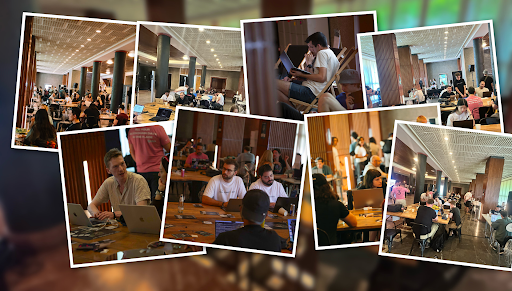
The same stack that 900 people used at @Web3summit is now open to developers globally, anywhere, anytime. Paying, chatting, and proving their humanity without knowing it was running on a blockchain.
Start here: https://t.co/XDSXMlZqGh
Built seven apps on @Polkadot Products this past week.
Will reveal soon and share all the details.
TL;DR:
- Streaming payments: lock funds once, they unlock to the recipient every second
- A trustgraph rep system where addresses vouch for each other, public and revocable
- One call that deploys an entire NFT collection, art rendered by a contract
- A shared pixel canvas where 25 cents buys 25 pixels to paint on
- King of the hill with exactly one crown where longest total reign wins
- A hot takes leaderboard where the community votes on what stays up top
- Status board for six key core devnet systems
Nine contracts, seven .dot domains, zero servers.
More coming.
Aren't we all tired of the gazillion logins, installs, and new accounts demanded by every single service we use?
Gavin Wood recently presented a paradigm shift in how everyday technology could look:
Owned by yourself, smooth and simple UX, app previews before you download, and no logins.
In the next step, Gavin Wood will lead the technical side of delivery directly at @paritytech, taking the proofs of concept the Parity team has laboured over and hardening them into robust, open-source software that people can actually use.
Learn more about the Polkadot and Human Web3 vision below. 📺
Every app on @Polkadot is built from the same open-source building blocks.
No servers. No proprietary infrastructure. A .dot domain and a live app on decentralized storage.
Every layer is open source and composable. Developers inherit the full stack without building it from scratch, so they can focus on the application while the infrastructure takes care of itself.
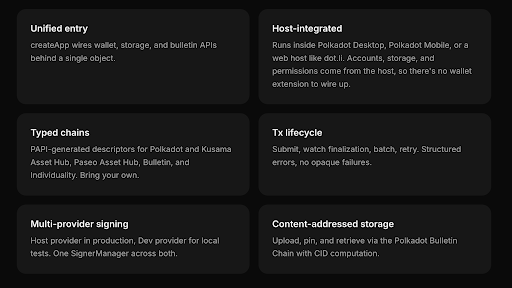
The Product SDK is an experimental TypeScript SDK for building apps on @Polkadot
One createApp call gives you wallet, storage, Levity access, and typed chain interactions without hand-wiring PAPI clients, signer bridges, or CID computation for every project.
Open-source proof-of-concept. Built for developers who want to experiment.
🔗 https://t.co/TxMDkeMHzE
Accessing my Claude bot through the Polkadot app and letting it deploy stuff to Web3 😎
I know that the Polkadot App is all about personhood, but I personally think that bots will be a good UX and we should have them.
(video sped up, original code from @shawntabrizi)
@paritytech I’ve already used several of these capabilities in my own application.
They are clearly explained, modular, and surprisingly easy to integrate. This is what product infrastructure should feel like: powerful underneath, simple for developers.
Every developer building a decentralized app rebuilds the same things from scratch.
Chain reads. Transaction signing. Content-addressed storage. Real-time pub/sub. Key management. Local persistence.
The Product SDK packages each of those into focused modules. One createApp call wires wallet, storage, and Levity access without hand-wiring PAPI clients, CID computation, and signer bridges for every project.
An experimental, open-source proof-of-concept for developers to explore and build on.
Looks like @alice_und_bob is making me revisit the @Polkadot ecosystem again for the first time in a long time.
My Saturday night is a vibe-coding session anyhow, so might just fit Polkadot Products devnet into it as well.
Ngl, the ecosystem is pretty much ded bc they literally never managed to make any app mobilize users at scale + a lot of the gud tech stayed a cool concept with no real traction.
But when I entered crypto back in 2019/20 Polkadot's vision for a cohesive multichain network of app-specific chains, its vision for heterogenous sharding and cross-chain interoperability/composability was one of the things that rly got my nerdy mind hooked on web3.
Also laid the foundation for my mental model to understand the rollup-centric roadmap, the modular thesis and generally blockchain scaling/architecture topics in the years after that.
Not a believer or holder anymore tbh (too many things went very wrong over there), but will always have a soft spot for Polkadot.
Should be fun anyhow and who knows, maybe they finally bring smth to market here that will matter to a real audience of users.
The Polkadot Product DevNet is independently operated by the Polkadot Community Foundation. All questions, support requests, complaints or other issues relating to its availability, operation or use should be directed to the Polkadot Community Foundation.
https://t.co/GyFYiEW6LE
The Polkadot Products Devnet is live.
Devnet is a public environment where developers can build and test against @Polkadot's new product stack. Real tools and workflows without real money. Breaking things is the point.
The same stack that 900 people used at @Web3summit is now open to developers globally, anywhere, anytime. Paying, chatting, and proving their humanity without knowing it was running on a blockchain.
Start here: https://t.co/XDSXMlZqGh
The Polkadot Product DevNet is independently operated by the Polkadot Community Foundation. All questions, support requests, complaints or other issues relating to its availability, operation or use should be directed to the Polkadot Community Foundation.
https://t.co/GyFYiEW6LE
On the Polkadot Products Devnet, a Product is a static web app published to a decentralized stack.
The host provides wallet, signing, storage, and chain access. Mobile, Desktop, or Web. Your app gets a .dot name. The bundle publishes to the Devnet and opens through the @Polkadot app or the web gateway.
One app. Every platform. No server to run.
https://t.co/XDSXMlZqGh
Most "decentralized" apps store their files on S3 and host their front ends on Vercel. IPFS gets closer but content disappears when nobody is pinning it.
Levity is @Polkadot's decentralized hosting and storage layer for Products, comprising Bulletin Chain and HOP Content addressed by hash. Authorized writes. Peer-to-peer reads. No CDN. No central host decides what stays up.
Web3 apps cannot compete with Web2 on experience if the infrastructure beneath them is centralized. Levity is the missing layer.
https://t.co/qIdqryZwrp
Surveillance is creeping into everyday life. Even in Berlin, police are pushing for broader camera powers, and new surveillance laws are being rushed through.
So I built 𝐤𝐚𝐦𝐞𝐫𝐚𝐟𝐫𝐞𝐢 (dot com): a walk/bike route planner that avoids cameras, fully offline on your device!
The best thing about Playground . dot at @Web3Summit was not the deployments.
It was watching people help each other debug. Explain their ideas to strangers. Fork someone else's work and make it their own.
Less technology. More people.
did you know you can now download the polkadot app for development? chatbots, decentralized hosting, smart contracts that features and everything together and in between - check it out. and you can also message birdo
@paritytech@Polkadot@Web3summit I feel as excited the times I discovered blockchain development on Ethereum.
Last time I felt this excitement was during the Protocol builders program at @AcademyPolkadot. I was introduced to the « triangle stack ». I can’t wait now this devNet is live !
Let’s Build !!! 💜