🚨 Public scholarship alert! 🚨
Have you seen prediction markets in the news? In the 18 months since prediction markets on elections were legalized in the U.S., it seems like Polymarket and Kalshi can't stop making news and making money.
https://t.co/tq3AoSkHdA
This week, I wrote an article for The Conversation explaining the rapid rise of prediction markets and some of the questions it has raised. Consider it a sneak preview of my dissertation-in-progress. 😉
🚨 Public scholarship alert! 🚨
Have you seen prediction markets in the news? In the 18 months since prediction markets on elections were legalized in the U.S., it seems like Polymarket and Kalshi can't stop making news and making money.
https://t.co/tq3AoSkHdA
When prediction markets aren't the subject of news articles (for their surging popularity and concerns about insider trading), they are often providing forecasts about the likely odds of elections, Supreme Court decisions, military action, and more.
Today's empowered far right uses less ambiguity. But when they do, the best thing to do is not to let them get away with it.
What are they saying? To whom? How are they trying to hide it? And what do they stand to gain? We fight ambiguity with clear-eyed analysis. End/🧵
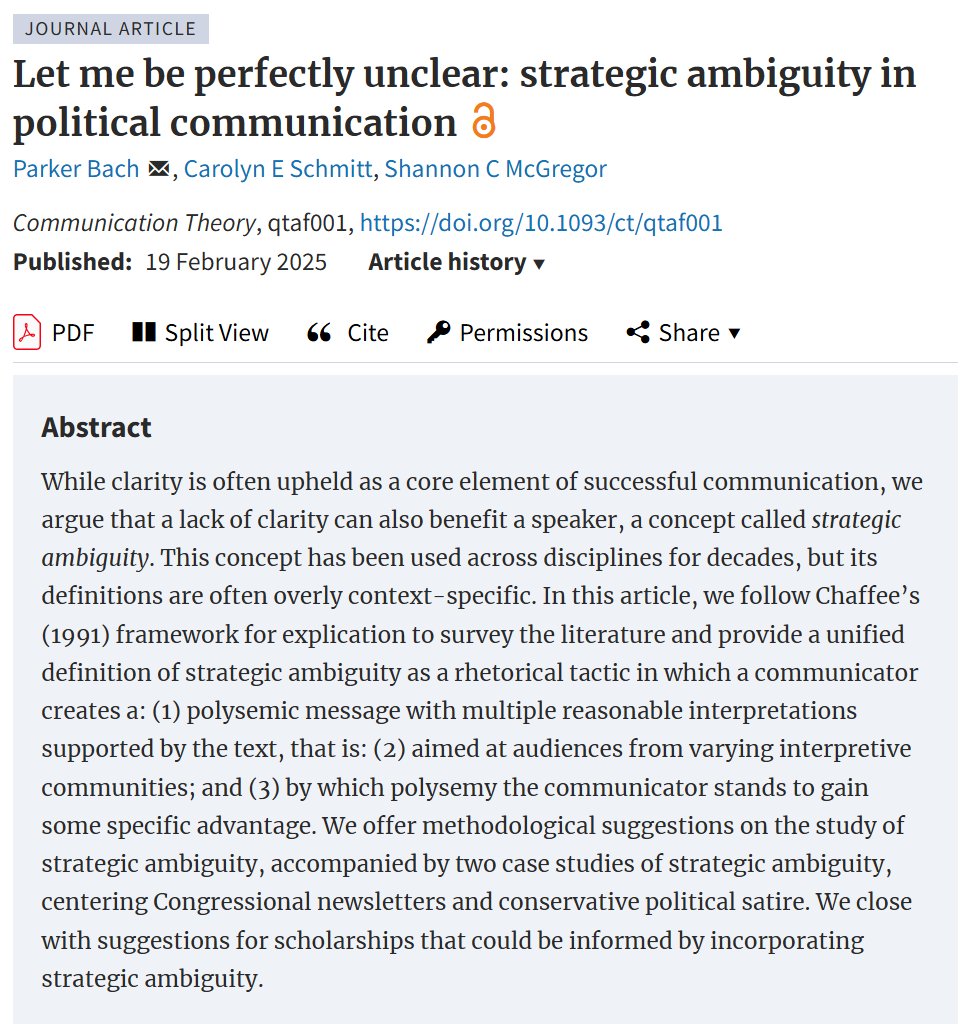
🗣️ New Communication Theory article! With @CESchmitt and @shannimcg
Communication can benefit from clarity, but what about a tactical lack of clarity? Here, e explicate "strategic ambiguity" and argue for its importance in political communication. https://t.co/jvD9NHGqfJ 1/🧵
Ambiguity is an apt tool for populists. Who are "the people"? Who are "the elites" or "the enemy"? We want "change," but what kind?
Strategic ambiguity allows communicators to let audiences hear the meaning they want to hear. 4/🧵
Please note that you need to be over >= 18 y.o. for the survey.
If you have any questions, please contact us at [email protected]. We are happy to answer any queries you may have.
Microsoft Privacy Statement available here: https://t.co/saqhTacg6B
(end)
Do you read the web comic xkcd?
@zephoria and I (at Microsoft Research) are trying to understand the role that xkcd plays in the scientific/technical community, and we would greatly appreciate your thoughts in our short survey (< 10 mins).
https://t.co/kh4QEkVhs9
(1/3)
Please RT & forward to others! We are not looking for a representative sample; we want to understand the wide array of thoughts folks have about xkcd. Of course, we might have a secret agenda to see which scientific/technical community has the greatest xkcd fandom 👀
(2/3)
Returning to the hell site for some brief self-promotion for my newest paper! 🎆
🐝 The Babylon Bee is now bigger than The Onion, but too many people still think of conservative satire as an oxymoron. I aim to remedy that.
https://t.co/9IikcHsv8D
Two more arguments:
If satire can drive political information seeking and learning, why not (mis)information seeking?
The Bee justifies targeting marginalized groups by claiming to critique powerful institutions. But they seem to be OK punching down... https://t.co/KQUhaVBrjI
Imo the most interesting finding is how The Bee handles Trump, namely with enough irony that it is unclear whether they are framing him as savior or buffoon. Whatever your take, the text supports it.
In other work with @shannimcg and @CESchmitt, we call this strategic ambiguity.
TikTok is claiming to have had “more than 60” applications to their Research API since it opened which seems… low, even given the restriction to North American researchers.
I chalk it up to the stringent terms of service and the limited data available.
https://t.co/NIxbiNoIGE