Tokenized securities need competition, not gatekeepers.
In a new @CoinDesk op-ed, former House Financial Services Chair & Ondo Vice Chairman @PatrickMcHenry lays out how different tokenization models can compete to make U.S. markets stronger.
Innovation thrives when investors have choices. Tokenized securities should not be treated as a single category.
“Tokenized securities are not one thing. They can and do take different forms, and carry different rights. Treating them all the same will lead to bad policy and worse products for investors and issuers alike.”
He outlines three models taking shape in parallel:
→ Customer-driven tokenization
→ Issuer-sponsored tokenization
→ Market infrastructure tokenization
Each serves a different need and deserves a path.
McHenry chaired the committee that wrote the rules for U.S. capital markets. The regulatory framework now taking shape around tokenization will define the next era of financial markets.
“For years, I argued in Congress that digital asset policy needs clear rules of the road. That remains true. Clarity protects consumers and investors. It also keeps innovation in the United States.”
The conversation in Washington is no longer whether tokenization is coming. It's how the United States leads it.
Clear distinctions over gatekeepers, real competition over single-model mandates, and room for the best ideas to win. That is how American markets have always led, and how they will lead the next chapter of capital markets.
Financial privacy will become more important as digital assets integrate with the traditional financial system
Foundry is launching a $ZEC mining pool to bring institutional-grade infrastructure to Zcash
USD1 market cap has surpassed $3B. This is a big moment for our team and WLFI community.
But milestones aren’t the goal — building the future of financial rails is.
And we are just getting started. 🦅☝️📈
Many believe they have full self-custody simply because they hold their own keys, but that belief fades once they realize how easily their entire history can be traced, and RAILGUN restores the missing half by giving custody of assets and custody of information at the same time.
“@Maya_Protocol now supports receiving shielded $ZEC on mainnet with a shielded memo design that preserves privacy while keeping everything auditable.
The ZEC pool already surpassed ETH and RUNE, and it’s now closing in fast on BTC, ready to take the #1 spot.”
It’s not Zcash vs XMR.
It’s privacy blockchains vs private smart contracts. One has bridging and liquidity risks. The other has private trading on any chain, on any protocol.
Let me put is this way:
North Korea DOES NOT use Zcash.
They use @RAILGUN_Project
Why? Bc private smart contracts are the future and @chainlink is the next iteration of that narrative. 🍌
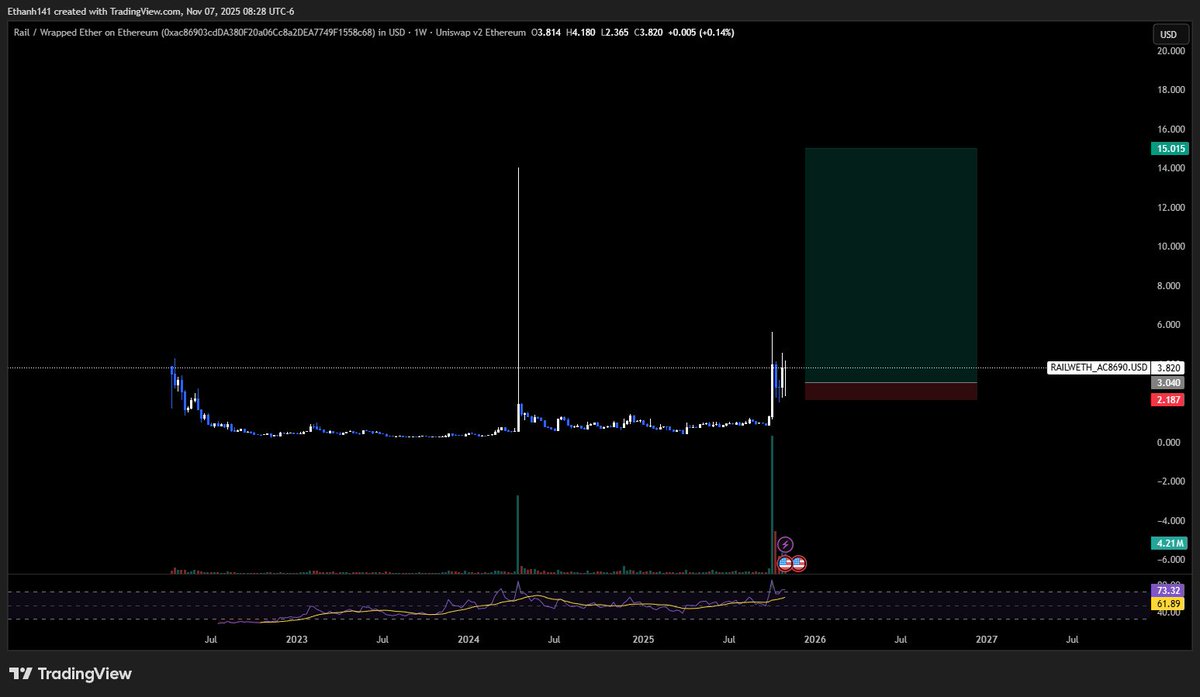
$RAIL investment thesis - Why I think this is a $20 coin priced at just under $4
@RAILGUN_Project enables privacy for onchain transactions with the ability to be used in DeFi, built on Ethereum and has been around since 2021
Users can shield funds, send, receive, swap, and interact with DeFi smart contracts with complete privacy all while having the ability to be compliant to any regulations with the power of Zero Knowledge proofs
The market has recently tipped its hand with the $ZEC outperformance that people do care about privacy, but what makes $RAIL stand out is that it allows you to interact with the largest DeFi ecosystem (Ethereum), that all the other privacy coins cannot
The upcoming Ethereum upgrade (Kohaku) that is being developed by @VitalikButerin and the ETH core devs, has a focus on privacy and in the code base is being set up with complete $RAIL integration
This has the potential to give every EVM wallet the ability to interact with the Rail Gun protocol natively. (A live demo is expected at ETH DevCon Nov 17-20)
Now, let's get into some math about the true magnitude of how $RAIL can benefit from this:
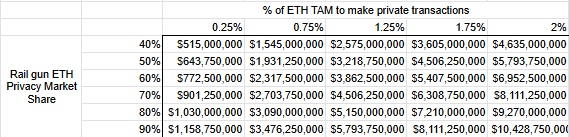
With the potential of every wallet on Ethereum to have Rail gun functionality, the TAM is massive. For my math I'm using the total bridged TVL onto Ethereum at $515 billion
The next question then becomes, "What % of the TAM would like to make private DeFi transactions?"
I think this number can range anywhere from 0.1% to 10% in the long run but below is a sensitivity with some conservative estimates coupled with Railgun's market share of this slice of the pie
Here we can estimate with a 70% market share, and 1.25% of the TAM making private transactions a potential TVL of $4.5 billion (Currently at $100 mill)
$RAIL charges a 0.25% fee on every shield and unshield into the protocol, so is revenue generating and also returns the revenue fully to $RAIL stakers (77% of the supply is staked currently with a 30 day unlock)
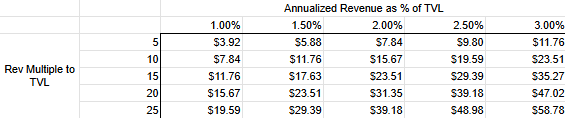
As @AvgJoesCrypto has noted, historically around 4% of the TVL has been Railgun's annualized revenue, with this number likely compressing as TVL grows. And currently sits at ~17x Price to revenue ratio
Based on these we can estimate a future price assuming our long term TVL above
This is how we get to our $20 price prediction and although there a lot of assumptions at play, I could see this going much higher assuming complete EVM wallet integration
Some of the biggest risks:
-timeline for EVM wallet integration being delayed heavily/doesn't happen
- another competitor comes in and dominates market share
- the DAO votes to reduce fees tremendously
- UX issues don't get resolved
Biggest tailwinds/catalysts:
- $ZEC pump indicating market desire for privacy
- DeFi growing exponentially over the coming months and years as institutions get onboarded
- Funds/institutions will require privacy solutions to actively trade in DeFi while also being compliant
- Being shilled by Vitalik
- Ability to expand to other chains
TL;DR regardless of what assumptions you go with, this to me feels like a billion dollar coin larping at just over $200 million
I don't think I've ever seen an asset as mispriced as $RAIL.
Kohaku, a wallet SDK that directly integrates with @RAILGUN_Project, is being developed by the @ethereumfndn. This project is being co-led by none other than @VitalikButerin.
Read that again.
Vitalik, the literal founder of Ethereum, believes that Railgun is so critical to the long-term success of Ethereum that he is personally working on a project to bring Railgun to every single Ethereum user.
And yet, despite this:
- $RAIL is only at a $162m FDV.
- No CEX listings
- No major funds hold it
- Few (if any) Ethereum thought leaders own it
Opportunities like this don't come around often.
Privacy is normal 🔐
@Zcash $ZEC helps make private, on-chain transactions possible.
Grayscale Zcash Trust (Ticker: $ZCSH) is the only U.S publicly listed fund providing exposure solely to @Zcash $ZEC through certain brokerage accounts.
See important disclosures and learn more about $ZCSH: https://t.co/8pnj9vxF8L
현재 Lockbox에는 68,785 $ZEC(약 1,300만 달러, 한화 약 182억 원)이 보관되어 있습니다.
https://t.co/6bVKLpPmix
$ZEC 의 가격이 상승할수록 지캐시 개발을 위한 장기 자금이 더욱 탄탄해져, 프로젝트의 미래 지속 가능성도 높아질 것입니다.
Privacy is normal.
#지캐시#Zcash $ZEC