The pension funds used by millions of Chileans are racing to close out bets on US interest rates that backfired after the Iran war unleashed a global inflation shock. https://t.co/kuvY9PIAbX
2026 economic sciences laureates Robert E. Hall’s and Michael Woodford’s research has made us better equipped to manage economic downturns.
They laid the foundation of the New Keynesian paradigm, in which models are built upon microfoundations, which means from the bottom up. Economic outcomes are the result of millions of decisions made at the microlevel by households and businesses. Using models based upon this approach, rather than simply studying the economy from a macro perspective, like a bird’s eye view, Hall’s and Woodford’s research has generated a paradigm shift in the theory of stabilisation policy.
#NobelPrize
BREAKING NEWS
The Royal Swedish Academy of Sciences has decided to award the 2026 Sveriges Riksbank Prize in Economic Sciences in Memory of Alfred Nobel to Robert E. Hall and Michael Woodford “for microeconomic foundations of macroeconomic stabilisation.”
#NobelPrize
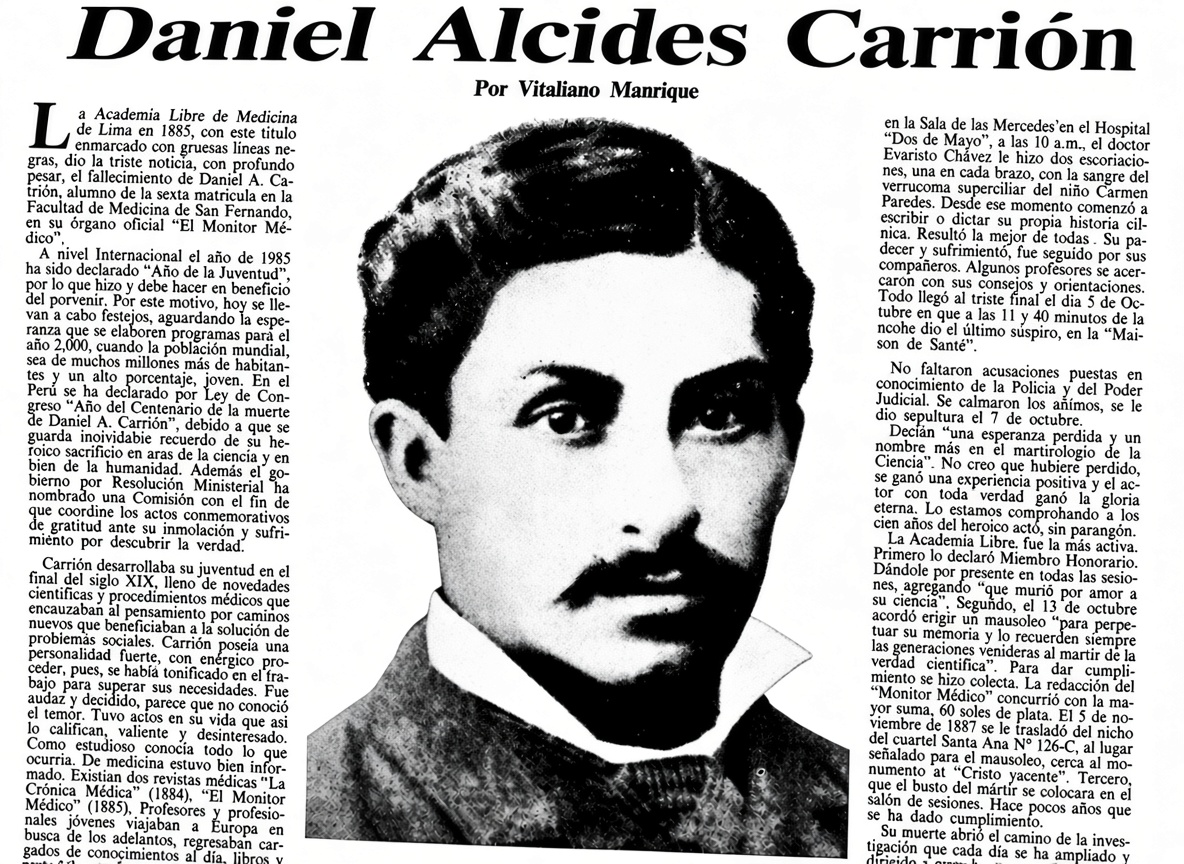
Cada 5 de octubre, el Perú recuerda a Daniel A. Carrión, el joven que entregó su vida en 1885 para ampliar el conocimiento médico y salvar otras. Su legado de valor, vocación y servicio sigue latiendo 141 años después. Lee👉: https://t.co/8ZVYBL1Sbq 🇵🇪❤️ #DíaDeLaMedicinaPeruana
I agree with Dario that we need to pace the frontier. This has been a primary topic of discussions we've had at OpenAI in recent weeks.
Committing to having independent evaluators with employee-like access is a great idea, and we will do the same. We'll have more to share soon.
I resigned from Anthropic today. I spent the last three years doing pretraining research at both OpenAI and Anthropic. Neither company is acting responsibly. They are racing straight to self-improving superintelligence and gambling with our lives. More thoughts below.
Reading underpins all learning.
That makes its continued decline one of the most concerning findings from the latest #OECDPISA.
The ability to find, evaluate, interpret and reflect on information matters in an increasingly digital and #AI-driven world.
📢 Abrimos la convocatoria a SICSS-Uruguay 2026 sobre procesamiento computacional de archivos históricos
Un día de paneles (abierto) + una semana de talleres hands-on (15 participantes).Gratuito
📍FCS-Udelar, 29/10 al 6/11
📎 https://t.co/x7UrTvFkaS
✍🏽 https://t.co/PYyQvpAt9n
Last week I posted a new paper with Patrick Norrick: “Terra Incognita: The Economics of a Shrinking World.”
We chose the title deliberately. No society in history has experienced the fertility levels now seen in South Korea, China, Thailand, Colombia, Chile, and many other countries. Our knowledge of the causes (and of the economic consequences) remains far more limited than most public discussion acknowledges. Much of what we write is, at best, educated conjecture.
The paper also struggles against a space limit. We wrote 20,000 words, far from the 250,000 or so we would need to address some issues in more detail (if I had the time and resources to hide away for a year, I could do that, but not now). That means some ideas are only sketched.
Nonetheless, we emphasize several important points.
First, fertility has fallen very fast everywhere: rich and poor countries, east and west, north and south, conservative and liberal societies, religious and non-religious societies (with the exception of the Jewish population of Israel; fertility has also collapsed among the Muslim population within the pre-1967 borders), you name it. Even in sub-Saharan Africa we see fast and unprecedented drops in fertility (alas, from a high initial level).
Second, and this is really interesting, the fertility collapse has been concentrated in poor and lower-middle-income countries much more than in rich countries. By now, income per capita and fertility are positively correlated within OECD countries. We conjecture this will hold globally in a few decades.
Third, and related to the second point, the fertility collapse has been concentrated among poor and lower-middle-income women within countries. In countries such as the U.S., the rich and highly educated now have more children than the poor and less educated.
Fourth, we document why we do not understand the data from the U.N. World Population Prospects. See, for example, Tables A.1 and A.2.
Fifth, we explain why some proposed mechanisms struggle when confronted with the data.
A more subtle point is at work here. Many commentators do not seem to understand the difference between proximate causes and ultimate causes. Yes, births might have gone down because fewer women are in long-run relationships. That is the proximate cause. But you need to explain why fewer women are in long-run relationships (the ultimate cause), and saying that they spend more years in school, to take one example, does not get us very far. Why do they spend more years in school? Once you start down the whole chain of reasoning, things become much harder than they seem.
The paper can be found here:
https://t.co/VrCHr0lBPa
Comments always welcome!
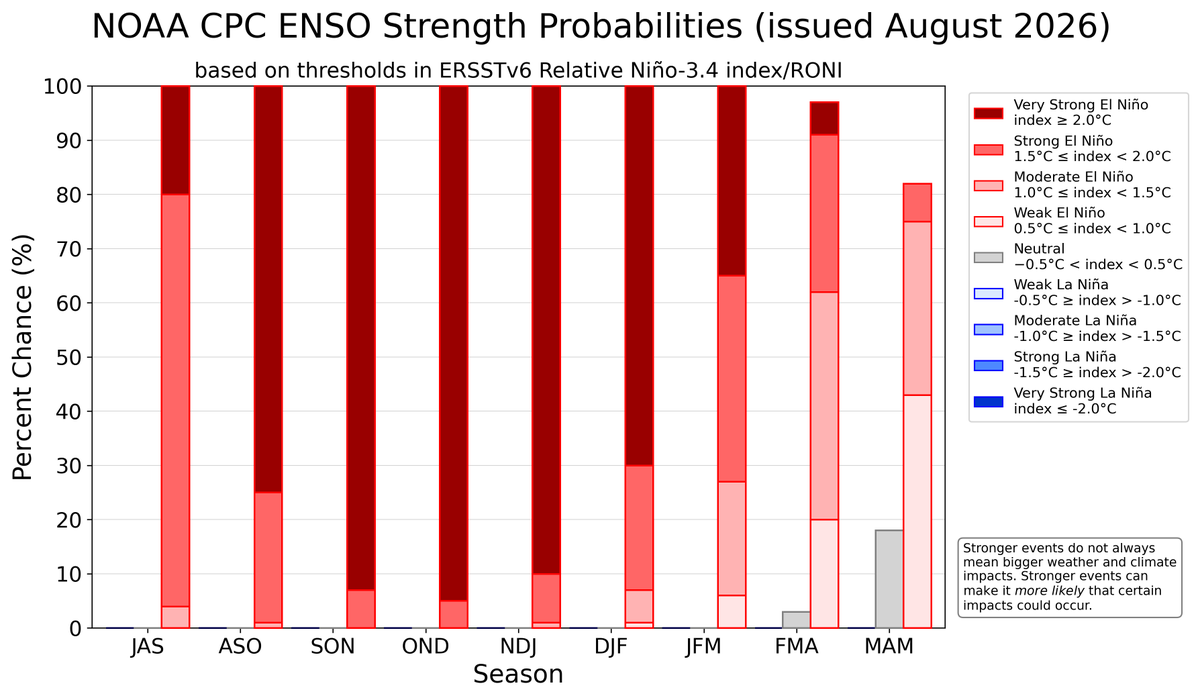
El Niño is strengthening, with a greater than 90% chance of a very strong event during the Northern Hemisphere fall and winter 2026-27. An #ElNino Advisory remains in effect. #ENSO https://t.co/5zlzaZ0D9Z
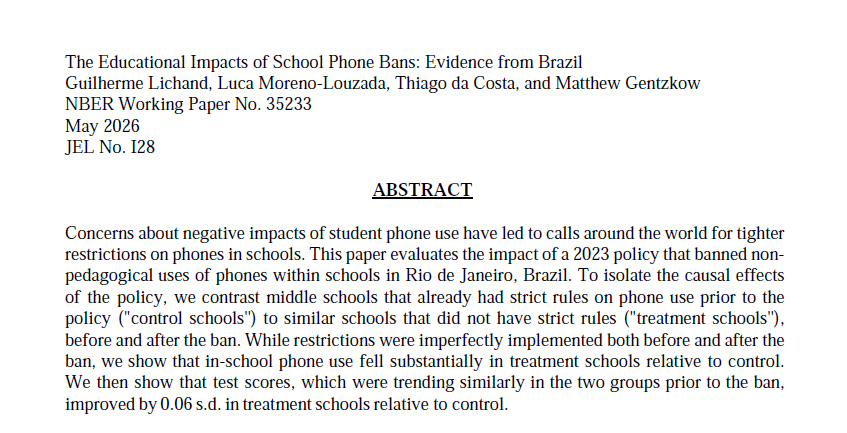
¿Efecto de prohibir celular? Guilherme Lichand @Stanford y colegas publicaron en @nberpubs el primer estudio a gran escala en país no desarrollado: estudian caso de Río de Janeiro, el distrito escolar más grande de LATAM.
En video-episodio 26 de https://t.co/dbHkNdhoc5 lo resumo
📢 Hiring a Research Assistant Consultant for the Poverty Group at the @the_IDB in DC!
Work on rigorous, data-driven research to reduce poverty & promote inclusive growth in Latin America & the Caribbean.
🗓️ Apply by July 2:
https://t.co/EfToxxqTmG
No podemos considerar la #IA como moralmente neutra. En realidad, todo artefacto técnico lleva consigo decisiones y prioridades: lo que mide, lo que ignora, lo que optimiza y el modo en que clasifica personas y situaciones. El discernimiento ético no se puede limitar a preguntarse si usamos un determinado sistema para un fin bueno o malo, sino que debe interrogarse también sobre el modo en el que está diseñado y qué idea de persona y de sociedad queda inscrita en los datos y en los modelos que lo guían. #MagnificaHumanitas
Si la IA hace la tarea de tu hijo, el cerebro de tu hijo no participó en eso. Y ese uso de la IA es un problema. Un estudio de Stromberg, Lei y Wu (https://t.co/8QHcVapdup) siguió a 26,000 estudiantes de secundaria en China durante 30 meses. Muestran que el uso de IA elevó las notas de las tareas en 18% y redujo el tiempo que dedicaban a esas tareas en 30%. Al mismo tiempo, las notas en los exámenes a libro cerrado cayeron 20% luego de seis meses. Analizando un efecto de largo plazo, las notas en los exámenes de ingreso a la universidad cayeron hasta 24%. Como se ve en la figura, mas eficiencia para hacer las tareas, pero menos menos aprendizaje. Por otro lado, los estudiantes que usaron IA pero igualmente dedicaron el mismo tiempo que sus compañeros sin IA obtuvieron en los exámenes notas casi idénticas a las de quienes no usaron IA. Pero los que "externalizaron" su tarea completamente, terminando más rápido y posiblemente poniendo menos esfuerzo, que cualquier estudiante sin IA, solo sacaron notas altas en los ejercicios. La diferencia fue el esfuerzo cognitivo: si el cerebro hizo el trabajo, o simplemente observó cómo la IA lo hacía en su lugar.
La IA es una herramienta. Un bisturí en manos de un cirujano salva vidas. El mismo bisturí en las manos equivocadas hace daño. La misma IA que puede ser un tutor efectivo, desafiando al estudiante a pensar, explicar, luchar productivamente con el problema, se vuelve dañina si elimina el esfuerzo que el aprendizaje requiere. Esto no es grave si le pasa a pocos estudinates. Pero cerca del 80% de los estudiantes que usaban IA cayeron en lo que el estudio llama "tercerización de tareas" (homework outsourcing).
Esto conecta directamente con la clasificación que hacíamos con mis colegas Ezequiel Molina y Maria Barron, (https://t.co/ygsaXKPVfR) de tres grupos de estudiantes, los Empoderados por la IA, que la usan para pensar con más profundidad; los Dependientes de la IA, que la usan para evitar pensar; y los Excluidos de la IA, que no tienen acceso. Nos preocupaba que el grupo de los Dependientes pudiera crecer. Ya creció. Es, con mucho, el grupo más numeroso en este estudio. Completar una tarea no es lo mismo que aprender. El cerebro no construye conocimiento observando cómo trabaja la IA sino equivocándose, esforzándose y resolviendo las cosas por sí mismo. Ese esfuerzo cognitivo es esencial para el aprendizaje .
🇵🇪 📲 A sus 21 años, Daira Velásquez Fonseca es la única latinoamericana que integra la primera promoción del programa ChatGPT Futures 2026 de OpenAI. Fue seleccionada gracias a su innovador proyecto "Crece AI", un chatbot de WhatsApp diseñado para la gestión financiera de vendedores ambulantes. Conoce más en esta nota https://t.co/1CGVXaVx7m
Por: ✍ María Fernández Arribasplata
En este episodio conversamos con Guillermo Arcay y Fernando García, investigadores asociados de la Harvard Kennedy School, para analizar la radiografía macroeconómica de Bolivia.
https://t.co/64GWQckXEj
1/3
📣 Trabaja con nosotros | Oportunidades en Chile y Guatemala
J-PAL LAC está buscando nuevos perfiles para apoyar proyectos de investigación aplicada en la región, con foco en datos, trabajo con socios públicos y generación de evidencia rigurosa.