Yep, it's in Canary now. I just tested it and it drove me directly to AI Mode -> Chrome tests redirecting searches to AI Mode instead of Google Search results
"An experimental flag in Chrome Canary reroutes address bar searches to AI Mode. When enabled, search queries typed into the omnibox open an AI Mode conversation instead of the standard Google Search results page."
https://t.co/cOV01RqggI
🤖 How to Optimize for AI Visibility and Prepare for Agentic Search 👇 I share Three principles to prioritize AI search optimization:
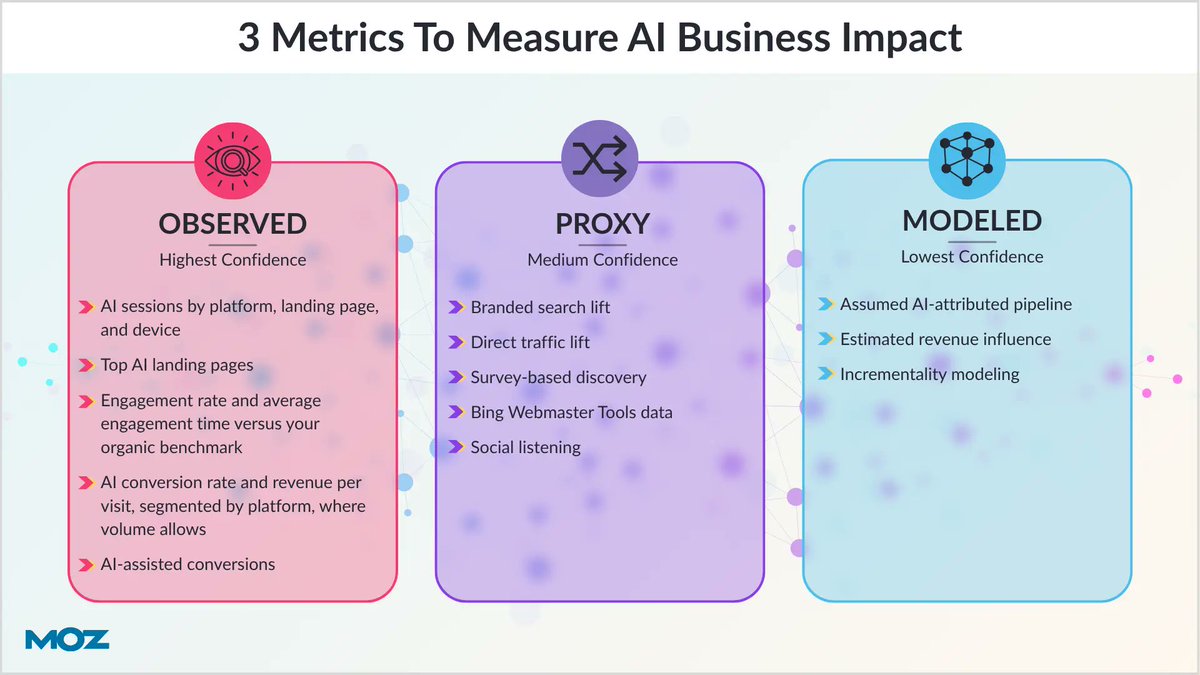
1. Stop using traffic as the main KPI for AI search impact
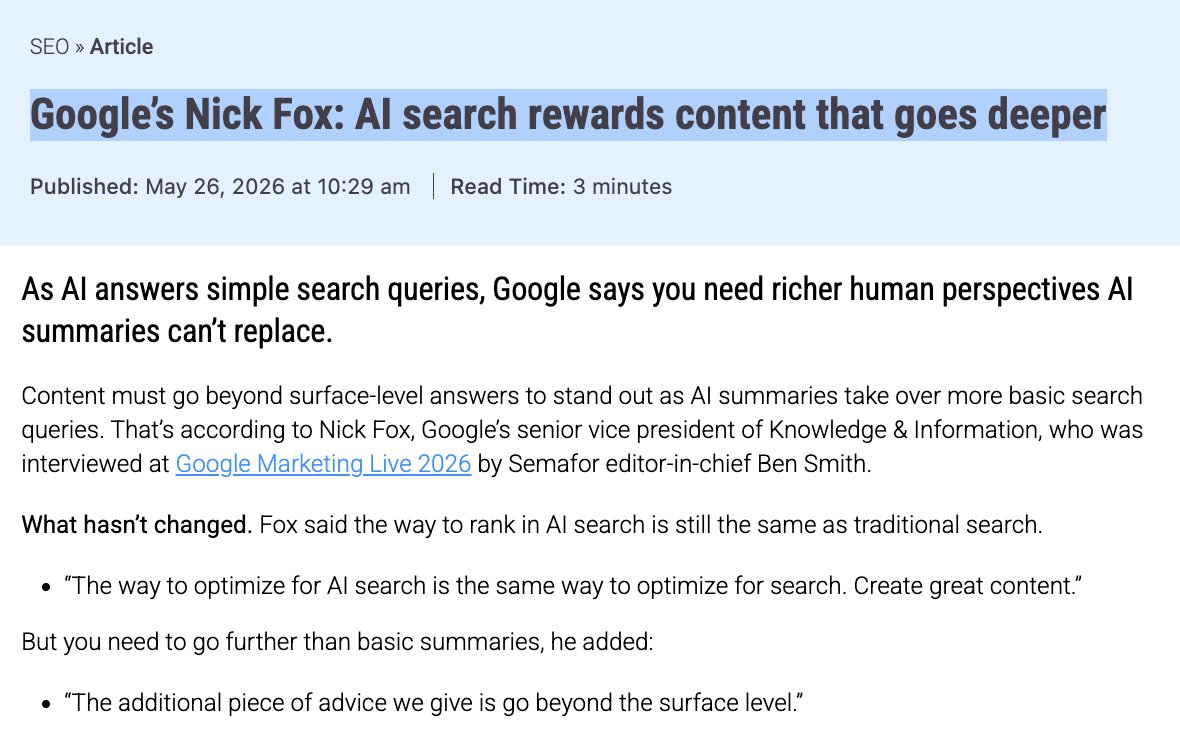
2. Build topical authority with content that AI systems can easily retrieve, understand, and cite
3. Strengthen Brand Authority through third-party corroboration
Read: https://t.co/cigEteh7qg
In the last 6 months at @Ahrefs, we analyzed over 1 billion data points across 14 studies. Here's what we learned about AI search optimization:
1) "Best X" blog listicles are the single most prominent content format cited by AI chatbots. They make up 43.8% of all page types cited by ChatGPT specifically.
2) 67% of ChatGPT's top 1,000 citations come from sources marketers can't influence: Wikipedia (29.7%), homepages (23.8%), app stores (6.6%). Only 32.3% are influenceable content like educational pages, reviews, news, and blog posts.
3) 28.3% of ChatGPT's most-cited pages have zero Google organic visibility. These pages get cited repeatedly by ChatGPT despite not ranking in Google at all. A completely separate discovery layer.
4) ChatGPT only cites about 50% of the URLs it retrieves. It fetches dozens of pages per query but uses half as background context without attribution. This means that being retrieved and being cited are very different things.
5) Adding schema markup had zero meaningful impact on AI citations. AI Overviews actually dipped −4.6%, while AI Mode (+2.4%) and ChatGPT (+2.2%) showed changes indistinguishable from zero.
6) YouTube mentions have the highest correlation (0.737) with AI brand visibility out of all the factors we studied (including all the conventional SEO metrics like backlinks, page count, DR, etc). This held true for both Google-owned and OpenAI products.
7) AI Overviews reduce clicks to the #1 result by 58%. That’s up from 34.5% just 10 months earlier. The trend is accelerating.
8) 99.9% of AI Overviews appear on informational intent queries. Transactional, navigational, and local searches are almost entirely AIO-free. Shopping triggers AIOs just 3.2% of the time.
9) For a given search query, Google’s AI Mode and AI Overviews reach the same conclusions 86% of the time — but cite almost entirely different sources (only 13.7% citation overlap).
10) AI Overviews change every 2.15 days on average, with 70% of content differing between consecutive observations. But semantic similarity stays at 0.95. The words, sources, and entities constantly shuffle, but the actual meaning barely moves.
I gave this presentation about the Helpful Content Update 2.5 years ago, a couple of months after the September 2023 update rolled out. So why am I sharing it now?
Because the patterns I'm seeing right now in SEO/GEO/AEO look and feel exactly like where we were in 2022-2023, before Google rolled out one of the biggest algorithm updates in its history. You can see examples of this in the slides I shared.
The same mistakes are getting made now to "try to win in AI Search," and companies are getting burned left and right for trying to scale AI-generated content in ways Google already built systems to suppress.
Every day I see a new viral thread on X about someone "discovering" programmatic SEO and sharing their success story. But when you actually look at the site's performance, you see the crash on the other side that never gets publicly shared.
Figured I'd share it now, because "what's old is new again."
https://t.co/7upAc4HUXe
Search console in 2026 is STUPIDLY underpowered, here's why:
Things SEOs wish search console could do:
1. Allow multiple filter conditions at once (contains, not contains)
2. Explicit and loose filtering i.e.
Should Contain
Must Contain
Should not Contain
Must not Contain
3. Arbritary filtering for exact query groups or page groups:
Should Exactly Match
Must Exactly Match
4. Bypass 1000 row limits i.e. see all queries, pages
5. Bypass 16 month limits on data in SAME UI without having to rely on bigquery and external tools / looker
6. See filter click / impression share
7. See GA4 metrics inside the GSC interface so they can compare GSC and GA4 metrics side by side i.e. clicks + conversions, clicks + transactions / revenue etc.
8. Have AI powered annotations that specify URLS, authors, dates, changes made & provide feedback on what's working / not working
9. See core updates / index issues / specific updates overlaid on GSC data
10. See last click dates and click share
11. Have URL HTTP and indexing state against GSC pages
12. Have GA4 METRICS against GSC pages
13. Have a PROPER AI assistant and AI chat system so you can PROPERLY chat with your search console data
14. Chat to your search console data where you can get it to do anything from building click charts and custom click forecasts through to auditing unlike GSC's woefully poor AI configurator
15. Powerful exporting including month by month exports with no row limitations and with multi-dimension exports i.e. PAGE + QUERY
16. Have the ability to save your filters / custom filters / regex into a filter library where you can 1 click re-apply the filters you save
Where do I stop?
When I set out to rebuild Google Search Console starting in 2020 it was to fill the massive gaps in the tool which still exist to this day.
SEO Stack is the worlds FIRST actual rebuild of Google Search Console, it's not a wrapper, we don't query GSC in real-time - we're a fully fledged data warehouse for SEOs so that not only can you access your GSC data but you can store it and interact with it in ways you can't elsewhere.
Even with Claude, MCPS or wrappers - you won't get the same degree of power & ability to truly interact with your data.
SEO Stack turns 6 this year!
Come join the 7000+ Users at https://t.co/Nw0LMDIddi and try it FREE!
Google in 2024:
- talks a lot about "Site Reputation Abuse" and creates a new manual action for it
- says the impact will eventually become algorithmic
- issues manual actions to dozens of publishers using sponsored content
Google in 2025-2026:
- still hasn't (officially) rolled out SRA algorithmically
- penalized site sections have come crawling back with content similar to what was previously penalized
- new publishers & directories have entered the space using the exact same tactics that were manually penalized in 2024
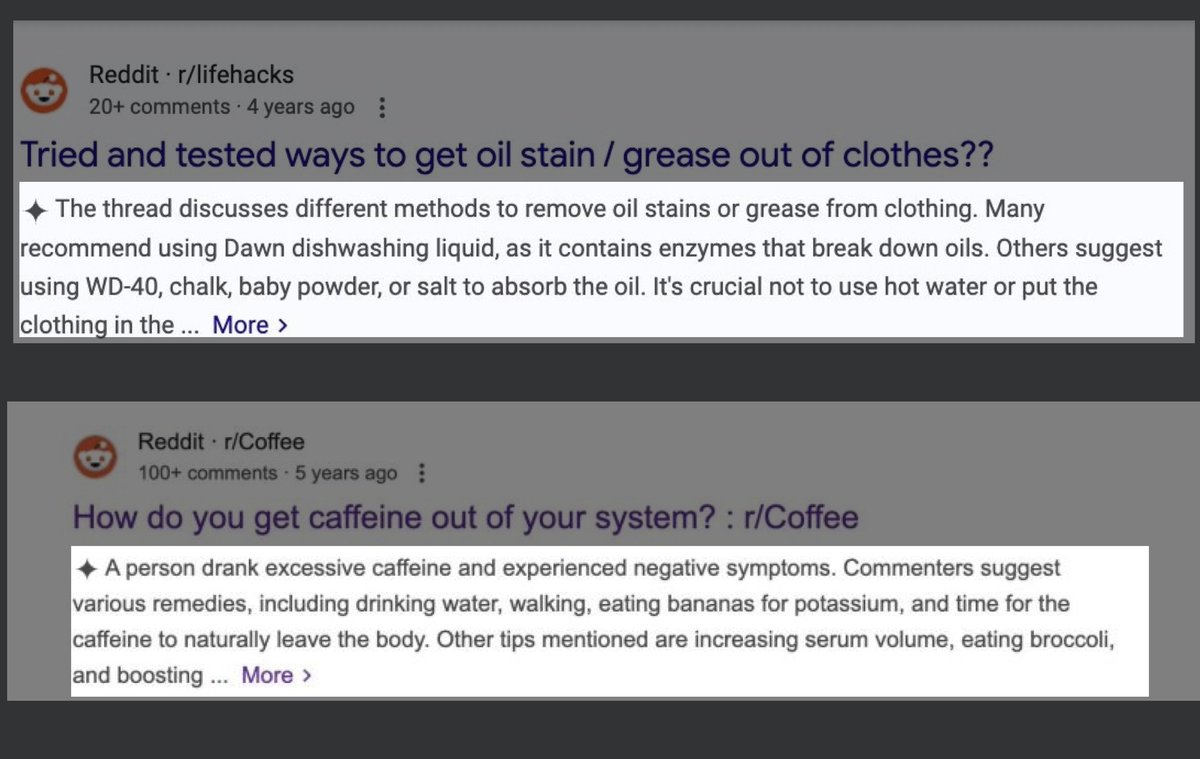
- these pages carry *enormous* weight in AI search, including AI Overviews, AI Mode and ChatGPT citations
Now: GEO citation-building largely becomes pay-to-play as publishers realize they can charge a lot of money to rank and review brands & products. Brands simply pay to be listed among the top recommended brands in the most heavily cited pages in their niche.
Answers to organic user questions in ChatGPT and other AI surfaces are heavily influenced by pay-to-play tactics and presumably, the highest bidder will win.
I'll be watching this space closely in 2026... no idea if Google will continue to care about paid link manipulation (but not sure why they would suddenly stop caring after 20+ years!)
Play in the Google Analytics sandbox. 🏖️
Learn by doing with the GA demo accounts, where you can get your hands on real-world website and app data.
🤑 No cost.
✨ No sign-up required.
🔒 No impact to your own data.
Get started → https://t.co/LfiV42tbgw
🔒 SAVE THIS GA CHEAT SHEET 🔒
This resource maps your common analytics goals directly to the features that provide the solution.
Find your way around GA: https://t.co/dYv3gG8RR3
Study: Organic LLM (oLLM) traffic underperformed every traditional channel except paid social media across key financial metrics such as conversion rate, average order value and revenue per session
"The research — “ChatGPT Referrals to E-Commerce Websites: Do LLMs Outperform Traditional Channels?” — was conducted by Professor Maximilian Kaiser of the University of Hamburg and Professor Christian Schulze of the Frankfurt School of Finance & Management. It represents one of the first large-scale, data-driven evaluations of how conversational AI affects online sales performance."
"The study compared how shoppers referred by ChatGPT performed against those arriving through established digital channels such as organic search, paid search, email and social media. Drawing on 12 months of ecommerce data from August 2024 through July 2025, the researchers analyzed 973 websites with a combined $20 billion in annual revenue. The dataset included more than 50,000 transactions from ChatGPT referrals and 164 million transactions from traditional channels, making it one of the largest first-party data sets yet assembled for this kind of analysis." https://t.co/JYRkM8h6Dh
(1/4) Today, we’re excited to introduce a powerful new way to get visual inspiration and shop with AI Mode. With this update, we’re making it easier than ever to go from an idea or a few words to real world images and products that match the style you’re looking for. More on the update below 🧵
We are launching a new app called Sora. This is a combination of a new model called Sora 2, and a new product that makes it easy to create, share, and view videos.
This feels to many of us like the “ChatGPT for creativity” moment, and it feels fun and new. There is something great about making it really easy and fast to go from idea to result, and the new social dynamics that emerge.
Creativity could be about to go through a Cambrian explosion, and along with it, the quality of art and entertainment can drastically increase. Even in the very early days of playing with Sora, it’s been striking to many of us how open the playing field suddenly feels.
In particular, the ability to put yourself and your friends into a video—the team worked very hard on character consistency—with the cameo feature is something we have really enjoyed during testing, and is to many of us a surprisingly compelling new way to connect.
We also feel some trepidation. Social media has had some good effects on the world, but it’s also had some bad ones. We are aware of how addictive a service like this could become, and we can imagine many ways it could be used for bullying.
It is easy to imagine the degenerate case of AI video generation that ends up with us all being sucked into an RL-optimized slop feed. The team has put great care and thought into trying to figure out how to make a delightful product that doesn’t fall into that trap, and has come up with a number of promising ideas. We will experiment in the early days of the product with different approaches.
In addition to the mitigations we have already put in place (which include things like mitigations to prevent someone from misusing someone’s likeness in deepfakes, safeguards for disturbing or illegal content, periodic checks on how Sora is impacting users’ mood and wellbeing, and more) we are sure we will discover new things we need to do if Sora becomes very successful. To help guide us towards more of the good and less of the bad, here are some principles we have for this product:
*Optimize for long-term user satisfaction. The majority of users, looking back on the past 6 months, should feel that their life is better for using Sora that it would have been if they hadn’t. If that’s not the case, we will make significant changes (and if we can’t fix it, we would discontinue offering the service).
*Encourage users to control their feed. You should be able to tell Sora what you want—do you want to see videos that will make you more relaxed, or more energized? Or only videos that fit a specific interest? Or only for a certain about of time? Eventually as our technology progresses, you will be should to the tell Sora what you want in detail in natural language. (However, parental controls for teens include the ability to opt out of a personalized feed, and other things like turning off DMs.)
*Prioritize creation. We want to make it easy and rewarding for everyone to participate in the creation process; we believe people are natural-born creators, and creating is important to our satisfaction.
*Help users achieve their long-term goals. We want to understand a user’s true goals, and help them achieve them. If you want to be more connected to your friends, we will try to help you with that. If you want to get fit, we can show you fitness content that will motivate you. If you want to start a business, we want to help teach you the skills you need. And if you truly just want to doom scroll and be angry, then ok, we’ll help you with that (although we want users to spend time using the app if they think it’s time well spent, we don’t want to be paternalistic about what that means to them).
Now in preview: ChatGPT Pulse
This is a new experience where ChatGPT can proactively deliver personalized daily updates from your chats, feedback, and connected apps like your calendar.
Rolling out to Pro users on mobile today.
The human brain is a compression machine.
If your days are too similar, your mind will compress them into a single memory.
If you want a long life, live a varied one.
Want to spend less time manually filtering data, and shortcut straight to valuable insights?
Regular expressions (regex) are your search superpower in GA. ⚡️
Master just a few key characters — like ^, $, |, and .* — and you can do things like group your blog posts, or exclude a bundle of IP addresses with a few keystrokes.
Here’s how: https://t.co/R06qDYTq4X
By popular request: you can now branch conversations in ChatGPT, letting you more easily explore different directions without losing your original thread.
Available now to logged-in users on web.