Donald Trump is hosting a cage fight at the White House to celebrate America’s 250th birthday… and his 80th birthday.
What could be more MAGA than dudes fighting in a cage… as millionaires cheer them on?
It’s as old as empires.
Same stuff Nero did. And Caligula. And Commodus.
Hunger games at the Capitol.
Bread and circuses.
Gladiatorial games.
A White House cage fight.
It’s nothing new.
Theatrics of empire.
Empires gonna do what empires do.
Rebuke it.
We will not bow down.
In 1943, the Gestapo finally caught Raymond Aubrac — one of France's most wanted Resistance leaders. He was sentenced to death. His execution was days away.
His wife Lucie was six months pregnant.
Most people would have hidden. Would have grieved quietly and prayed for a miracle. Lucie Aubrac did something else entirely. She obtained forged identity papers, constructed a cover story, and walked straight into the office of Klaus Barbie — the man history would remember as the Butcher of Lyon — and convinced him to grant her a visit with the condemned man.
She wasn't there to say goodbye.
She was memorizing guard positions. Counting minutes. Mapping the route the prison truck would take.
On October 21, 1943, that truck rolled through the streets of Lyon carrying Raymond and other prisoners toward what should have been the end. Lucie had spent weeks quietly assembling a team of Resistance fighters, planning an ambush with the precision of a military operation. When the truck reached the ambush point, the team struck — fast, coordinated, and without hesitation.
In the chaos of gunfire and confusion, Raymond Aubrac was pulled free.
Lucie — visibly, unmistakably pregnant — had organized every detail of his liberation.
They went into hiding. Weeks later, Lucie gave birth to their daughter in a safe house while German forces searched for them across France. When liberation finally came, the Aubracs didn't merely survive — they rebuilt.
Raymond became a celebrated engineer and entered public life. Lucie became a historian, pouring decades into ensuring that the women of the French Resistance — so often unnamed, so easily forgotten — were written permanently into the record. They raised three children. They traveled the world. They argued and laughed and grew old together.
When journalists asked Lucie, years later, what had compelled her to risk everything that October day, she didn't hesitate.
"He was my husband. What else would I do?"
Lucie Aubrac passed away in 2007 at the age of 94. Raymond — who had once needed a commando team to be freed from a German prison — lived on until 2012, reaching 97 years old. In his final years, he continued speaking publicly about the Resistance, about memory, about the obligation to tell the truth.
They had been married for 64 years.
Not a love story built on grand gestures or perfect circumstances. A love story built in occupied France, in safe houses and forged documents and a prison truck ambush on a Lyon street — forged in fire, and never broken.
True love doesn't wait for rescue. Sometimes, it does the rescuing
Nobelprijswinnaar Krugman noemt Trump de meest openlijke corrupte leider. "We weten dat Putin zich met miljarden heeft verrijkt, dat haalde hij niet direct uit de schatkist. Er was altijd verhulling. Zelfs dictators uit derdewereldlanden proberen hun diefstal te verdoezelen."
Tonight, the Premier of Alberta opened the door to one of the most reckless and dangerous political projects in modern Canadian history.
Let there be no confusion, separatism is catastrophic for Alberta.
It threatens jobs, investment, pensions, trade, treaty relationships, national stability, and the economic future of an entire generation.
If successful it would inject chaos into every sector of the economy at the precise moment Albertans need certainty, confidence, and responsible leadership.
No serious government should be legitimizing the breakup of Canada to survive politically.
Albertans are frustrated, and many feel ignored by Ottawa, those concerns are real, but responsible leaders channel frustration into solutions, not into a constitutional crisis designed to divide people, destabilize the economy, and undermine confidence in Alberta itself.
The Premier is gambling with Alberta’s future.
And for what?
A separatist movement built on anger, grievance, and political theatre, a movement that if successful would leave Alberta weaker, poorer, and more isolated.
Alberta has helped build Canada, and the strength of our people and industries continues to help power this country. Alberta’s future is strongest as part of a united, strong, and bold Canada.
And no government should ever treat the future of this province, or this country, as a political weapon.
Will @ABDanielleSmith have the decency to resign along with her @UCPCaucus when she loses her separation referendum?
Will @PierrePoilievre take a side or continue to evade the question of his loyalties?
Трамп заявил, что США останавливают поставки оружия на Тайвань и не будут его защищать. Он также добавил, что тайваньцы сами стремятся начать войну против Китая🙈🙈
В общем, история с Украиной и «Зеленским, который зачем-то напал на страну, которая в несколько раз больше» повторяется.
Предавший один раз – всегда предаст и в другой.
So Trump’s ambassador to Canada actively promoted an app built by a Michigan MAGA group called 10xVotes. That same app is now at the centre of one of the biggest privacy scandals in Canadian history.
The Centurion Project, Alberta’s separatist group, used it to scrape personal data on nearly 3 MILLION Albertan voters. Now Elections Alberta, the Privacy Commissioner, and the RCMP are all investigating.
Hoekstra says he “wasn’t aware” of the connection. But the guy running the Centurion Project said publicly, on a podcast, that 10xVotes has been advising him behind the scenes for over a year. Hoekstra personally knows the app’s founder.
So the US ambassador to Canada promoted a voter ID tool, that tool ended up in the hands of a group trying to break up Canada, and that group illegally obtained private data on millions of Canadians.
This isn’t a conspiracy theory. It’s confirmed by PressProgress, CBC, and Elections Alberta’s own investigation.
Foreign interference in Canadian democracy!!
If you pitched this as a screenplay every studio would reject it for being too on-the-nose.
A 73-year-old architect walks to confession in 1926 and gets hit by a tram on the Gran Via in Barcelona. He's mistaken for a vagrant because of his worn clothes and left at a pauper's hospital. He dies three days later. His name is Antoni Gaudí. The cathedral he leaves behind is less than a quarter complete. The plans to finish it sit in his workshop as plaster models and detailed drawings.
Ten years after his death, in July 1936, FAI anarchists break into that workshop. They smash the plaster models. They burn the archive of drawings and calculations. They pry open Gaudí's tomb. For the next 50 years, architects piece together a destroyed playbook from photographs and broken plaster fragments.
The geometry was the real problem. Gaudí designed the church using upside-down hanging-chain models because the math for hyperboloid intersections did not yet exist on paper. He had solved it physically. Computers finally caught up to him in the 1980s. By 2010 the project was 50% complete. By 2015 stone elements that took months to hand-carve were being modelled digitally and machine-cut in days.
Now the kicker. The building is funded entirely by people paying admission to see scaffolding. €134.5 million of income in 2025, all private, none of it from the Spanish state or the Vatican. About 4.7 million tourists a year buying €26 tickets to watch a cathedral get built. The unfinished state was the product.
On June 10, 2026, exactly 100 years to the day after Gaudí died, the cross goes up on the Tower of Jesus Christ. 144 years from groundbreaking. 172.5 meters tall. The tallest church building in the world, beating Ulm Minster, which took 513 years.
When asked why his project was taking so long, Gaudí said one thing: "My client is not in a hurry."
Turns out neither was he.
In 458 BC, Rome was on the brink of collapse.
An invading army had trapped the Roman consul and his legion in a mountain pass. Panic spread through the city. The Senate did the only thing they could think of:
They sent messengers to find a 60-year-old farmer plowing his field.
His name was Lucius Quinctius Cincinnatus. He had once been a senator, then lost his fortune paying his son's bail. Now he worked his own four-acre plot just to feed his family.
When the Senate's envoys arrived, they found him sweating behind a plow. They asked him to put on his toga so they could deliver an official message.
The message: Rome was making him dictator. Absolute power. Total command of the army. No checks. No oversight. No term limit.
He accepted.
Within 16 days, Cincinnatus had raised an army, marched out, surrounded the enemy, and forced their surrender. The republic was saved.
He had legal authority to rule for six months. He could have stayed. He could have expanded his power. He could have done what every other ruler in human history did when handed unlimited control.
Instead, he resigned on day 16.
He took off the toga, walked back to his farm, and finished plowing the field he'd left half-done.
Twenty years later, when Rome faced another crisis, they called him back. He was 80 years old. He took command, crushed the conspiracy, and resigned again, this time after just 21 days.
He died poor. On his farm.
2,200 years later, when George Washington was offered a kingship after winning the American Revolution, he refused and went home to Mount Vernon. The reason he was hailed as "the American Cincinnatus" is because Europeans literally could not believe a man who had won would willingly give up power.
King George III, on hearing Washington would resign rather than rule, said: "If he does that, he will be the greatest man in the world."
The lesson isn't that Cincinnatus was humble.
The lesson is that for most of human history, the people most qualified to lead were the ones who didn't want to. And the moment a society starts rewarding those who chase power instead of those who flee from it is the moment the republic begins to die.
Cincinnati, Ohio is named after him.
Most people who live there have no idea why.
Parkinson’s precision medicine is no longer theoretical. PPMI is helping reshape the future of how we define and study Parkinson’s disease. Precision medicine means using biologic, genetic and clinical information to better understand why disease differs from one person to another and to match therapies more precisely. Marek and colleagues describe in an editorial in Annals of Neurology how the Parkinson’s Progression Markers Initiative (PPMI) has evolved over 15 years from a biomarker discovery effort into a global precision medicine platform for Parkinson’s disease and related synucleinopathies.
Key points:
- PPMI has collected comprehensive clinical, imaging, biomarker and genetic data from thousands of participants worldwide and shared these data openly w/ the scientific community.
- The initiative helped shift the field from defining Parkinson’s disease only by symptoms to defining disease biology using biomarkers such as alpha-synuclein seed amplification assays and dopamine imaging.
- New remote tools such as myPPMI are expanding global participation and enabling large scale biologic and clinical data collection for future precision therapeutic trials.
My take: This paper captures one of the most important transformations in Parkinson’s research. We are moving away from lumping all Parkinson’s disease together and toward understanding the biology driving each individual case. This transition matters because biology based classification may facilitate matching the right therapies to the right folks at the right time. PPMI has also shown the power of open science and collaboration across academia, foundations, industry and study participants.
Here are 5 points that resonated w/ me:
1- Parkinson’s disease likely begins many years before classic motor symptoms emerge.
2- Biomarkers are helping identify disease earlier and may eventually support prevention focused trials.
3- Precision medicine may reduce the one size fits all approach that has limited previous clinical trials.
4- Remote platforms such as myPPMI may democratize research participation and expand diversity across future studies.
5- Open data sharing has accelerated discovery worldwide and created a roadmap for how future neurological disease studies may operate.
https://t.co/26PcpCCneJ @ParkinsonDotOrg #parkinson
As someone who has 1.7 million Canadian history followers across IG, FB, YT - I want to be clear - the “Alberta separatist” movement is comically amplified by bots and accounts(real or not) from odd places in the US and elsewhere. It comes in waves at certain points - all with the same phrasing and hashtags and all with odd, obscure, low follower accounts. This is the playbook/strategy/scenario that happened briefly around the last federal election(followed by radio silence until this Alberta issue). (Cont)
23 marzo: scommessa di 500 milioni di dollari sui futures del petrolio, 15 minuti prima che Trump rinviasse gli attacchi contro l'Iran.
7 aprile: scommessa di 950 milioni di dollari sui futures del petrolio, poche ore prima del cessate il fuoco tra Stati Uniti e Iran.
17 aprile: scommessa di 760 milioni di dollari sui futures del petrolio, 20 minuti prima che Hormuz venisse dichiarata aperta da Trump.
Indovinate chi è stato il genio che ha piazzato queste scommesse sul mercato?
Si legge insider trading, ma si scrive Barron Trump.
Donald Trump casually confesses he completely ignored expert consultants who warned his war in Iran would trigger a global depression and send oil to 300 dollars a barrel. The US President is recklessly gambling the entire global economy purely on an arrogant gut feeling.
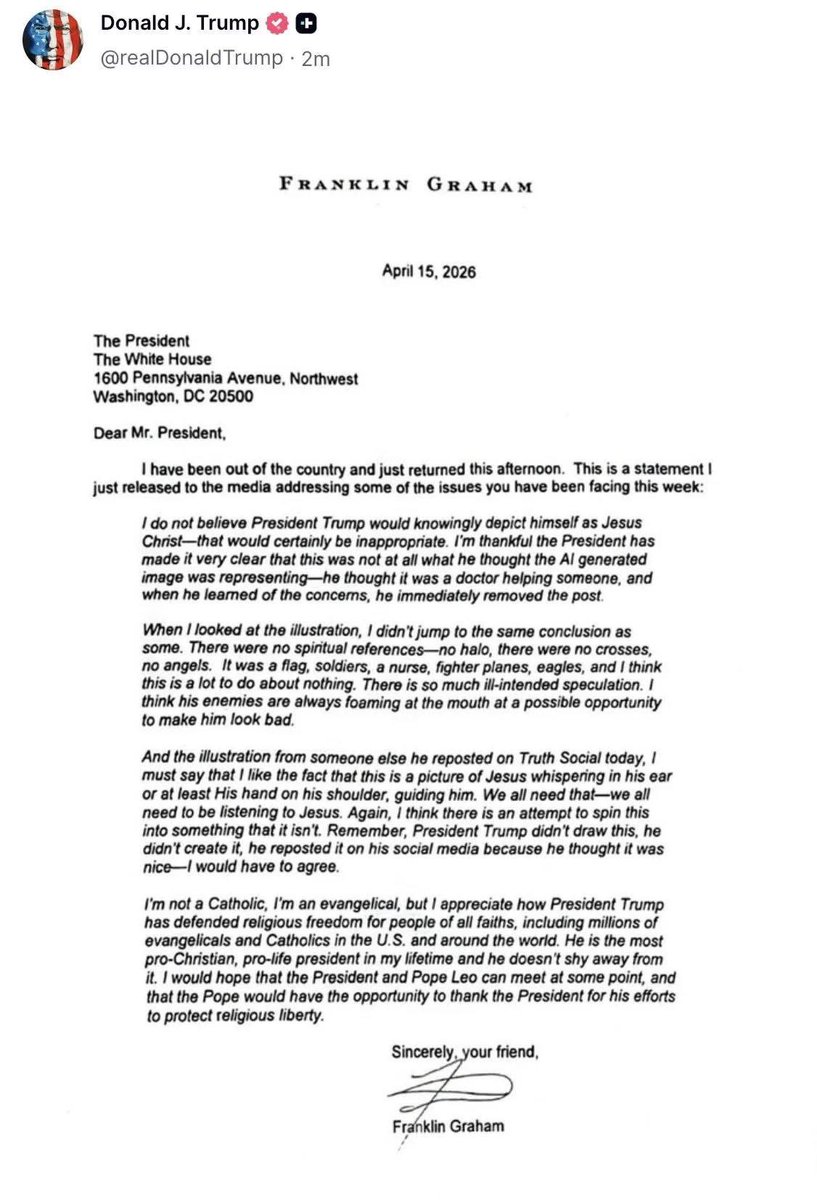
Trump just posted a letter from Franklin Graham saying he doesn’t believe Trump would knowingly share an image depicting himself as Jesus. Graham goes on to claim that Trump thought it was a “doctor helping someone,” and that critics are just trying to make him look bad.
I have two comments.
First, I think this is the first time Trump has gone to such lengths to whitewash himself. That means something. It means he is scared. He understands that he is losing a very significant part of his followers. And he is trying the only way he knows how to defend himself: lie. He is lying. But it is not working.
Any decent human being would simply apologize. Acknowledge the mistake. Show some humility. And move on.
Not Trump. His narcissistic personality does not allow him to say three simple sentences: “I was wrong. I am sorry. Please forgive me.” So for him, the only option is to lie.
Obviously, there is no way Trump truly thought it was him as a doctor. There is not a single country in the world where doctors look like that. But there are hundreds of paintings portraying Jesus exactly like that. So the only logical conclusion is that Trump is lying to reduce the backlash.
This brings me to my second point. Trump needs legitimacy. He needs someone to testify on his behalf. That is how Franklin Graham got into this mess. Graham has already said that Trump has been raised up by God. That God saved Trump’s life to save America. So of course, he cannot abandon his position now.
I am no longer surprised by Franklin Graham. This is the same man who has appeared on multiple russian propaganda channels, praised Vladimir Putin repeatedly, and urged people to pray for Putin’s “wisdom.” Not once has he called for Putin’s repentance.
It is because of people like this that many atheists want nothing to do with the church.
“The greatest single cause of atheism in the world today is Christians who acknowledge Jesus with their lips, walk out the door, and deny Him by their lifestyle. That is what an unbelieving world simply finds unbelievable.” – Brennan Manning
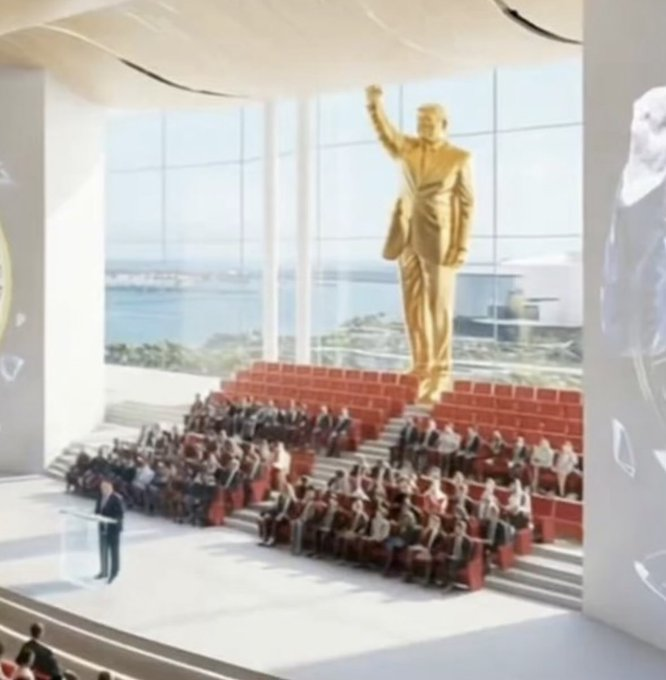
Not a parody, not a comedy show item. Donald Trump has designed for his Presidential Library main hall, as its highlight, a 10m tall golden statue of himself.