@GrainStats their tech is seasonal spreads and full carry calc's. in the meantime Inco bought every bean in Zone 3 and they just got smoked and are still short
Why Singulus? The actual chess move:
Singulus is a distressed German micro-cap (a CD/DVD machine maker that pivoted to solar, serially restructured, ~€50-70M revenue) and, after Meyer Burger’s collapse, essentially the last Western turnkey HJT equipment platform standing.
Now read the funding history the release politely compresses: the October subordinated secured loan was ~€22.75M, used to repay all of Singulus’s liabilities to Triumph, which then sold its ~16.75% stake to a German investor, with its board representative resigning, and the lender was the same party that financed Singulus in March 2026...SpaceX. Triumph is CNBM-affiliated. So, for about €23M SpaceX bought the Chinese creditor and shareholder out of its solar supplier before scaling it.
That’s defense-contractor hygiene and classic supplier capture: fund it, cleanse it, co-engineer it, and if the pattern holds, eventually insource it.
Solid observation that carries weight:
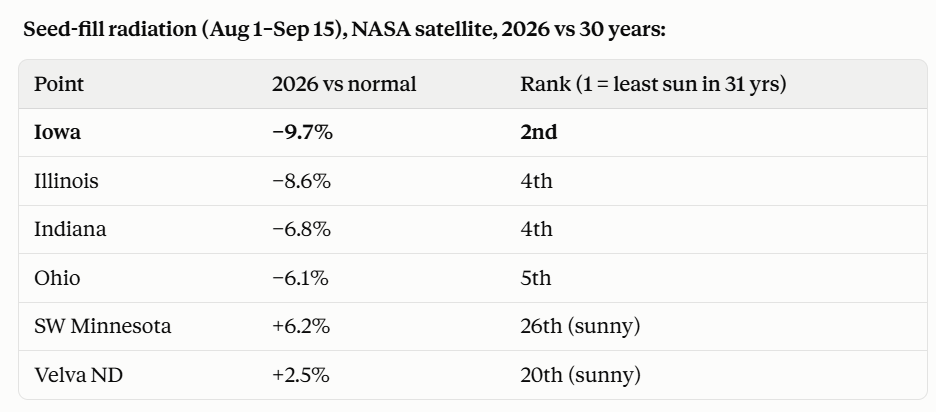
Every garden state ran a bottom-5-of-31 sun deficit during seed fill, and the four-state average, −7.8%, is the lowest of any year since 1996 — darker than 2018 (−6.0%), which is our closest hot-finish analog and walked −1.2 nationally. And look at the two years the crop is being compared against: 2024 and 2025 were both +6–7% sun-surplus fill windows. The 2026 garden filled with roughly 13–15% less radiation than the two record-setting years before it.
@GrainStats yeah, I ordered one and just canceled it for that reason. I don't want to deal with two computers and putting up more screens. feels like zuck and elon are going to push token costs to zero so might not be worth getting anyways.
For beans to be bigger than last year you need seeds-per-pod and seed weight to combine to +6%. Even granting +2.5% for the widely observed 3 and 4 bean pods, that leaves seed weight needing to finish +3.5 to +4% above last year and a record seed size.
Now the problem is seed weight is built during the R5–R6 fill window when the plant deposits by day what it doesn't burn by night. The published sensitivity work puts the cost at 2–4% of seed weight per +1°C of night temperature excess during fill. Our crop-weighted station data (July 1–August 17, day-length-adjusted night means) shows every major bean state running warm against its own three-year normal: Iowa +2.4°F, Minnesota +2.5°F, Nebraska +2.5°F, South Dakota +2.7°F, Illinois +1.5°F... a ten-state average of +2.0°F, with Illinois logging ten of the first seventeen August nights at or above 70°F.
The years that produced record soybean seed weights were cool-August, long-fill years. So, with that said there is nearly no possibility beans yield higher this year than last.
Nobody's arguing fill is over... 30–40% of kernel mass is still to come. The argument is that the fill already realized ran at a deficit (stage-matched ear weights −9% YoY at identical moisture, grain length down in all 7 tour states), and the remaining fill runs through the same warm nights into a warm-dry September that accelerates denting and shortens the window you're counting on. 'Not dented yet' isn't extra potential... it's exposure.