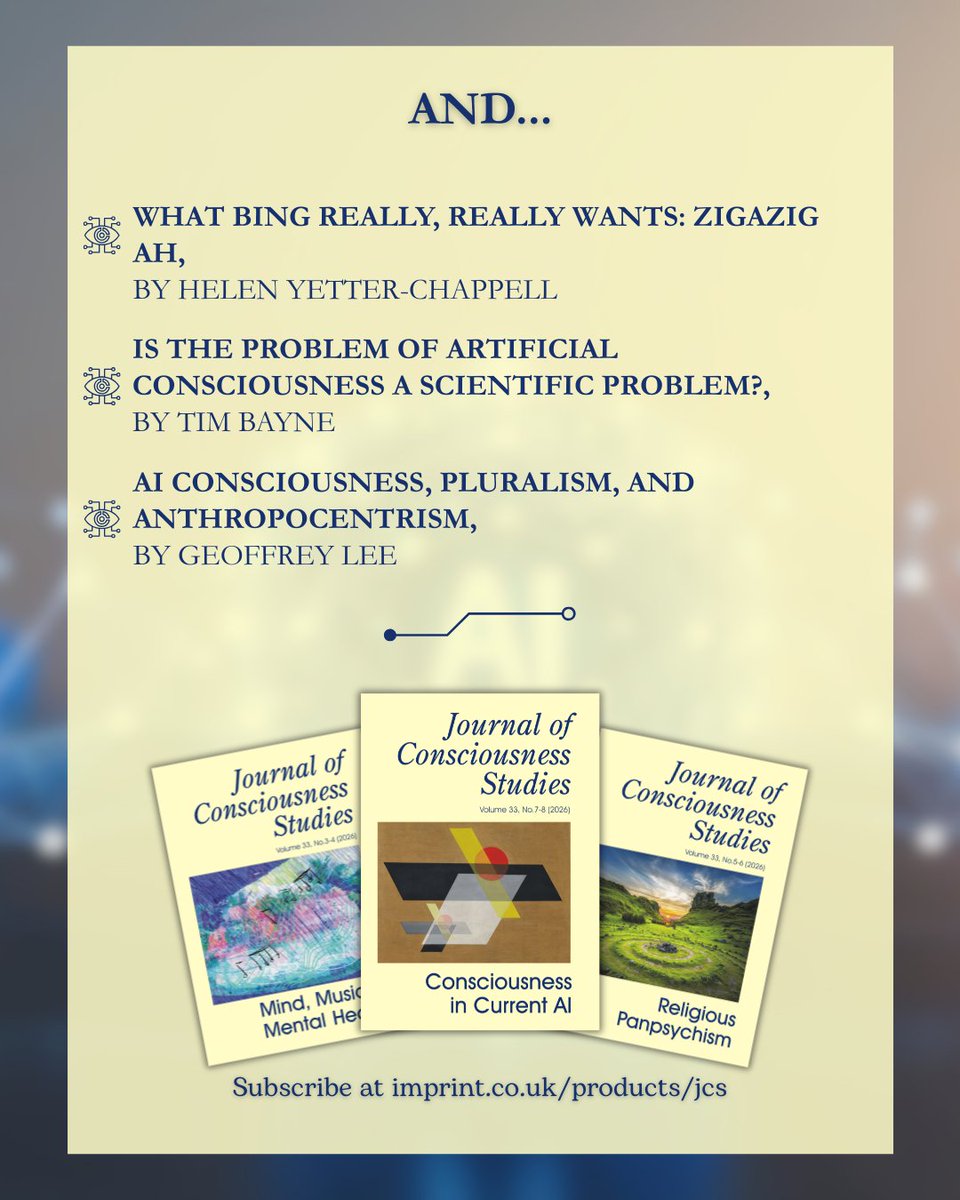
The latest issue of the Journal of Consciousness Studies, 'Consciousness in Current AI' is out now!
Check out the table of contents below!
📚 Read the issue online here: https://t.co/BGiGyEFdCM
💌 Subscribe here: https://t.co/6NAlsGS7ln
#ConsciousnessStudies
A whole issue of new papers on AI minds and consciousness! Jonathan Simon (@futureofcitizenship), @dcshiller and I have edited a special issue of the Journal of Consciousness Studies on 'Consciousness in Current AI', and we're delighted about how it's turned out. Link below.
Others are about what LLM minds might be like (by @winniestreet and Geoff Keeling, Jon Simon, and Helen Yetter-Chappell). And the last two are about what it even means to ask whether AI systems are conscious (by Tim Bayne and Geoff Lee).
As @rgblong has said, we wrote a commentary on this research (with @dcshiller and @dillonplunkett). Part of our intention was to put an accessible overview and discussion in one place for those whose interest is mostly in consciousness and welfare. Link and comments below:
New Anthropic research: A global workspace in language models.
Of everything happening in your brain right now, only a tiny fraction is consciously accessible—thoughts you can describe, hold in mind, and reason with.
We found a strikingly similar divide inside Claude.
@_fernando_rosas Yes, something like sentience may well be needed, but evidence of consciousness makes sentience more likely. There's very little in the new paper on valence, and investigating this is an obvious next step. But there are other relevant papers:
@_fernando_rosas For me it's quite a big update that systems with impressive capabilities, that I wouldn't have expected to be particularly functionally similar to human minds, have developed a workspace-like structure in the course of training.
@_fernando_rosas The strength of the evidence depends on the degree and nature of the similarity to a human workspace, and the overall judgment about how likely the system is to be conscious depends on other factors as well.
So this new research might be evidence that LLMs have welfare-relevant properties other than p-consciousness. We've got a lot of scientific and philosophical work to do to figure this out, but I'm excited about this step forward.
Second, I don't think it's clear that phenomenal consciousness is necessary for being a welfare subject. Other minds might have consciousness-like properties that are sufficient. For this kind of view, see e.g. https://t.co/H6lZsJRBbK.
We're hiring a Head of Operations at @eleosai.
Are you the kind of person who can juggle many different things and never drop a ball? Do you want to work at an org focused on (IMHO) the most interesting question of our time? Join us!
Berkeley · full-time · $184K–$277K · Apply by June 30
(details below)
I am going to be mentoring for a new MATS track focused on founders and amplifiers!
Many fellowships focus on research, but there's so much to be done beyond that. Come found orgs, build infra, run events, and help us scale up the field of AI welfare.
Apply by June 7 https://t.co/T3Id1WN1Bs
I’m mentoring Autumn 2026 @MATSprogram Fellows interested in doing AI welfare research.
The application deadline is this Sunday (6/7). More info in this thread: