On 30 Sep 2024, the UK closed its last coal plant.
This was the day we should have ended carbon price support – an extra tax to get coal off the grid.
In the Budget, @RachelReevesMP has the chance to cut bills for millions + boost electrification, by ending CPS
Here’s how:
New episode of What Rhymes With Now? where I speak with Nicholas Higham about his new book ‘How England Began’
We speak about Roman Britain, the Anglo Saxons and how our identity, culture and language emerged over time.
Listen here: https://t.co/5FGQIdipkv
Excited to share What Rhymes With Now? - A podcast where I interview experts about historical periods and what they teach us about the challenges we face today.
I spoke with the Guardian’s Andy Beckett about stagflation in the 1970s (and 2020s), and its effect on politics.
I also spoke with @robertmcelvaine about the Great Depression and New Deal, and what they teach us about populism and dealing with unemployment.
And with John Hardman about what the French Revolution can teach us about governance in chaotic times.
A couple of important announcements from @energygovuk today
To put it politely, I am concerned
There are two measures that are being pitched as “Decisive action to break the influence of gas on electricity prices.”
🪵 The stick is increasing the Electricity Generator Levy from 45% to 55%. The EGL is effectively a revenue tax that kicks in above a benchmark price of c. £83/MWh. It was introduced in January 2023 to claw back revenue from renewable and nuclear plants that were enjoying supernormal electricity prices, due to rising gas prices. It does not apply to assets under a CfD.
🥕 The carrot is a new voluntary fixed price contract for generators that aren’t under a CfD. Instead of relying on the wholesale power market, they can sign a “Wholesale Contract for Difference” (WCfD) and have the option to accept an (inflation linked?) fixed price for their wholesale power.
In essence the messaging is - “We want to reduce the impact that gas has on electricity prices - please sign a fixed price contract or we will tax you via the EGL” More generators on fixed price contracts means gas has less impact on retail electricity prices.
There is a case for this approach - consumers may favour more predictable power prices, and generators who are investing capital up-front want predictable revenues.
But today's measure isn't about securing new investment - it's a potential handout to generators that have already enjoyed incredibly generous subsidy schemes.
A few concerns:
The CPS raises electricity costs by £3.50 for every £1 it raises in taxes.
Keeping electricity costs low should be a massive social, economic and environmental priority for the government.
Great news today that the Carbon Price Support will be abolished from 2028.
It’s an obsolete policy that raises electricity costs and therefore slows decarbonisation and hurts our economy.
Proud of the analysis I conducted with @watt_direction@BritishProgress showing that…
Right now, British electricity pricing is bonkers. Prices are disconnected the from the underlying reality in several very important ways.
1. The costs of keeping the grid going, like transmission and balancing, are spread over every unit of electricity sold. This means the price of an extra unit of electricity is vastly higher than the social cost of providing that unit. The cost of having a grid connection at all is, conversely, much lower than it actually costs society to provide you one.
Economically, this amounts to a crippling price cap on grid connections, which is part of why we can't expand infrastructure to plug people in: they don't pay for it. It also amounts to an enormous tax, over 2/3 of the price of electricity, on using an extra unit of it.
Which is presumably why electricity use has cratered since 2003, when we started driving up the cost of our grid like this.
Note how perverse the incentive is here. We are heading into a situation where electricity is extremely expensive because the ratio of grid costs to the amount of electricity put through that grid. Our high prices incentivise everyone to have a connection, but then to use it as little as possible, the EXACT opposite of what we need. We charge the most tax on people use their connection most intensively (i.e., efficiently) and the least on those who use it the least intensively!
2. We impose carbon taxes on electricity produced through gas that we don't impose on gas used directly. This is part of why electricity is so expensive, and means people electrify less than we would like, which leads to less decarbonisation overall. A child, with a basic understanding of supply and demand, would see how perverse this is.
3. We charge the same price for electricity nationwide, and pay the same amount, in a single market, even though electricity is worth more and less at different places. This is part of why people are building solar farms in Scotland, where it is not only less sunny, but which is on the other side of massive grid congestion that we are paying BILLIONS of pounds to relieve. Yet we keep paying people to make the problem worse.
4. We keep buying Contracts for Difference off electricity generators. CfDs say 'we will pay you X for every unit of electricity you produce, whenever you produce it'. (Recent iterations have cut off these payments when prices go negative, but they will still pay them £90 per megawatt hour when the megawatts they are producing are worth 1p each!)
Renewables Obligations Certificates were a lot more honest. They just paid producers a top up on what they got on the open market: a straightforward subsidy. CfDs are a totally hidden subsidy. The amount of subsidy is set by the market trajectory after today. So, for example, every time we sign a new wind CfD we increase the subsidy for past tranches.
The really messed up thing is that CfD recipients do not cover for when they don't provide any power. If the CfD was set on quantity as well, so generators had to pay back money when they didn't produce, to cover the cost of running the grid to accommodate them, and for the gas needed to keep the lights on, then we would get a good sense of how much we were actually paying. Buying a CfD would be buying new electricity at its going rate. Instead, practically all the important pricing functions are hidden.
The result of all these broken pricing systems is poor coordination. Everyone is working exactly as the price system tells them to: plug in but only use your grid connection when the grid is having trouble, use less electricity, don't electrify, add generation far away from where it is consumed, and produce the most electricity possible whenever and wherever you like, not when or where it's rare and expensive. The ultimate result is expensive electricity, industrial decline, and economic stagnation.
Do 🫵 YOUR 🫵 civic duty and make sure anyone/everyone you know working in the Defence/Foreign Policy/National Security establishment in Britain is aware of the Mythos news.
Ignorance is not an excuse anymore. It’s going to get weird: strap in.
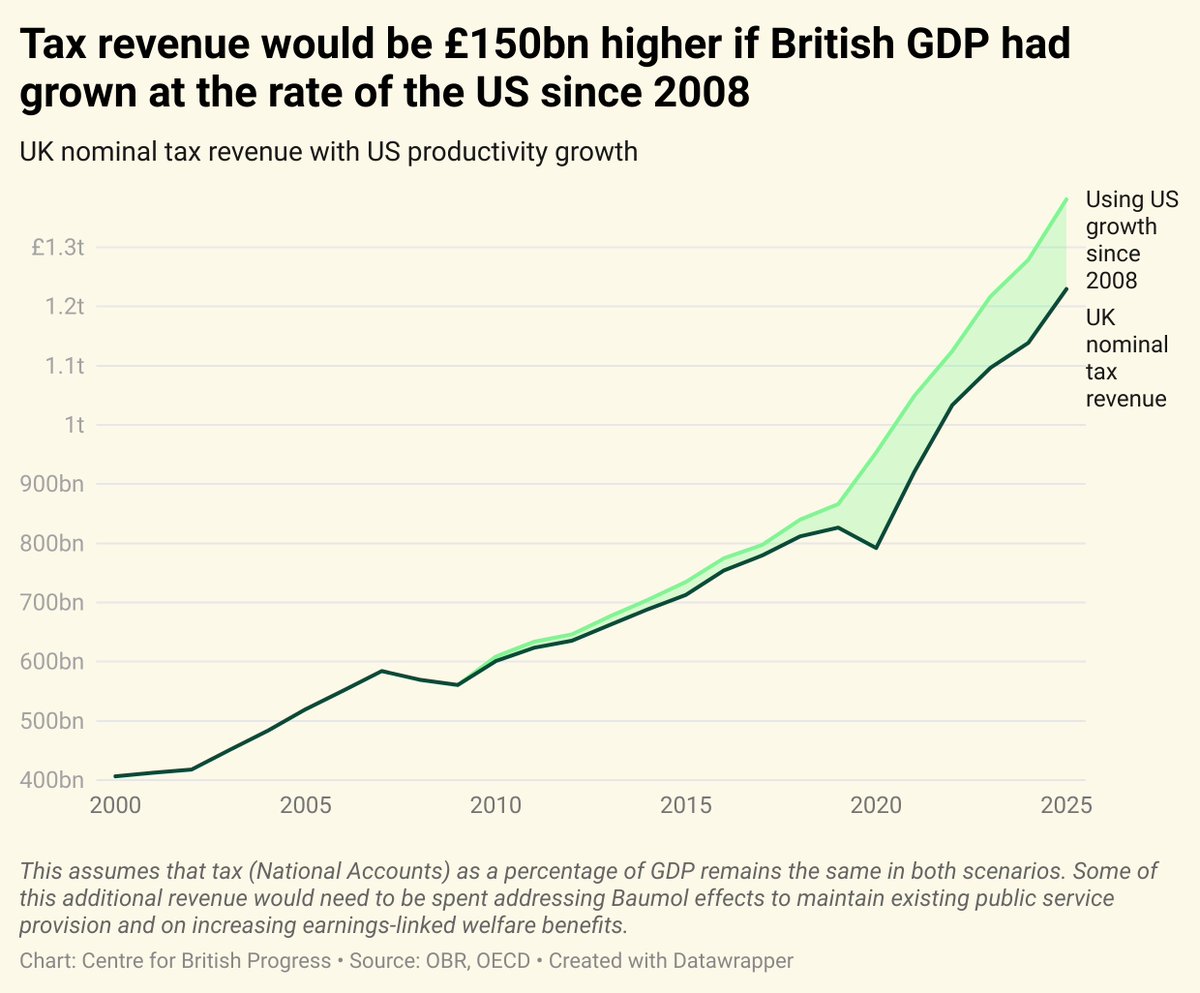
In tomorrow's Budget, the Chancellor will announce around £30 billion worth of cuts or taxes to meet her fiscal rules.
This is the right thing to do: anything else would shake investor confidence further and create even more trouble.
However, there are better and worse ways to raise taxes and cut spending. At @BritishProgress we believe the priority MUST be growth.
In fact, if we had matched US growth since 2008, the Chancellor would have an extra £150 billion to spare.
That’s 5x the fiscal black hole, larger than the entire budget for state pensions, and more than twice what we spend on schools and early years.
So how do you design a Budget for growth? Here’s what we think the Chancellor should do. 🧵
This is an excellent proposal 👇
Scrapping our top-up carbon tax that is solely on electricity would lower wholesale electricity prices and drive electrification
It'd also welcome to see climate policy levers removed from the statute books once they've served their purpose
Carbon pricing is an effective way of cutting emissions, but when rates aren't uniform they can have unintended consequences for climate.
We need people to go electric, but the Carbon Price Support pushes up the cost of (mostly green) electricity (vs gas). Counter-productive.
On 30 Sep 2024, the UK closed its last coal plant.
This was the day we should have ended carbon price support – an extra tax to get coal off the grid.
In the Budget, @RachelReevesMP has the chance to cut bills for millions + boost electrification, by ending CPS
Here’s how:
🚨 Guess who’s back? 🚨
Join us to celeb365 days of a Labour Government aboard the Emerald of London with drinks, DJs, and special guest speakers. 🥂🎶🛥
📅 Friday 4 July
📍 Thames River | 7–11pm
🎫 Book now at the link in our bio