Professor of Planetary Physics at the University of Oxford in the Department of Physics (sub-department of Atmospheric, Oceanic and Planetary Physics).
Fancy doing a planetary PhD (DPhil) in Oxford University's sub-department of Atmospheric, Oceanic and Planetary Physics? We still have a studentship available! See the list of projects here: https://t.co/MpnArI3ATE. Deadline is end of May.
@PatrickIrwin1 @OxfordAOPP And if you want a little more "behind the scenes" information on this study, Pat wrote an article for the Conversation that explains the process: https://t.co/zWI6YecH8X
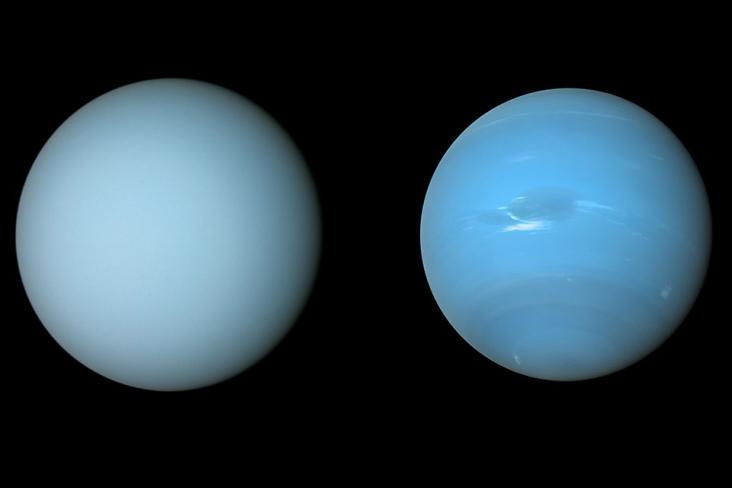
Work led by @PatrickIrwin1 @OxfordAOPP used careful characterisation of VLT visible spectra of #Uranus and #Neptune to explore their colours, revealing their subtle differences in blue hue, and an explanation for Uranus' apparent changes in average colour with Uranian season.
For more information, the paper has been published with @SpringerNature in @NatureAstronomy and an online version can be found here: https://t.co/PTIFTcFE5g
👀 Astronomers have observed a large dark spot in Neptune’s atmosphere, with an unexpected smaller bright spot adjacent to it
Get the gist of the discovery in our #ESOCastLight video below.
#BiteSizedAstronomy
Check out our new paper on haze and cloud in the atmospheres of Uranus and Neptune! Thanks to all my co-authors for their help in pulling this all together! https://t.co/j5r5zK4tdU
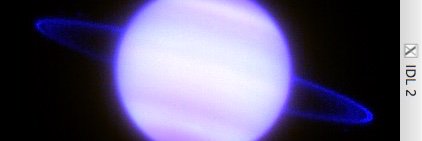
@StAnnesLibrary Here's the original image on which Hazel based this window. It was observed in February 2004 with the LWS instrument at the Keck I telescope by my JPL colleagues Glenn Orton and Padma Yanamandra-Fisher (10.1126/science.1105730). It shows thermal emission at 17.65 microns.
Want to see what it would be like to approach and then descend into Uranus and Venus? @PatrickIrwin1 uses the NEMESIS model to calculate and visualise the process!
Uranus: https://t.co/DgPbZUy20W
Venus: https://t.co/vaT5JJsISd
Article describing them: https://t.co/QPv6yWNwAo
And to round off the week, something very cool: @patrickirwin1 has been using NEMESIS to simulate the view from atmospheric descent probes for Uranus and Venus! The Venus cloud structure model I developed for my thesis gets 15 minutes of fame. https://t.co/8oDIUyqNpQ
Check out our cool new paper on 2.5-D retrievals from exoplanet phase curves by Pat Irwin, coauthors @V_Parmentier, @AstroJake, @AirborneGrain, @GleeAstro and Ryan Garland, + me of course! https://t.co/EhfaBkm20k