After more than a year of embargo we can now show you how speculative attacks can extract sensitive information from the Safari browser on @Apple platforms. Check out our latest paper https://t.co/R0n2LareR3. Great work by Jason Kim, @themadstephan and @yuvalyarom.
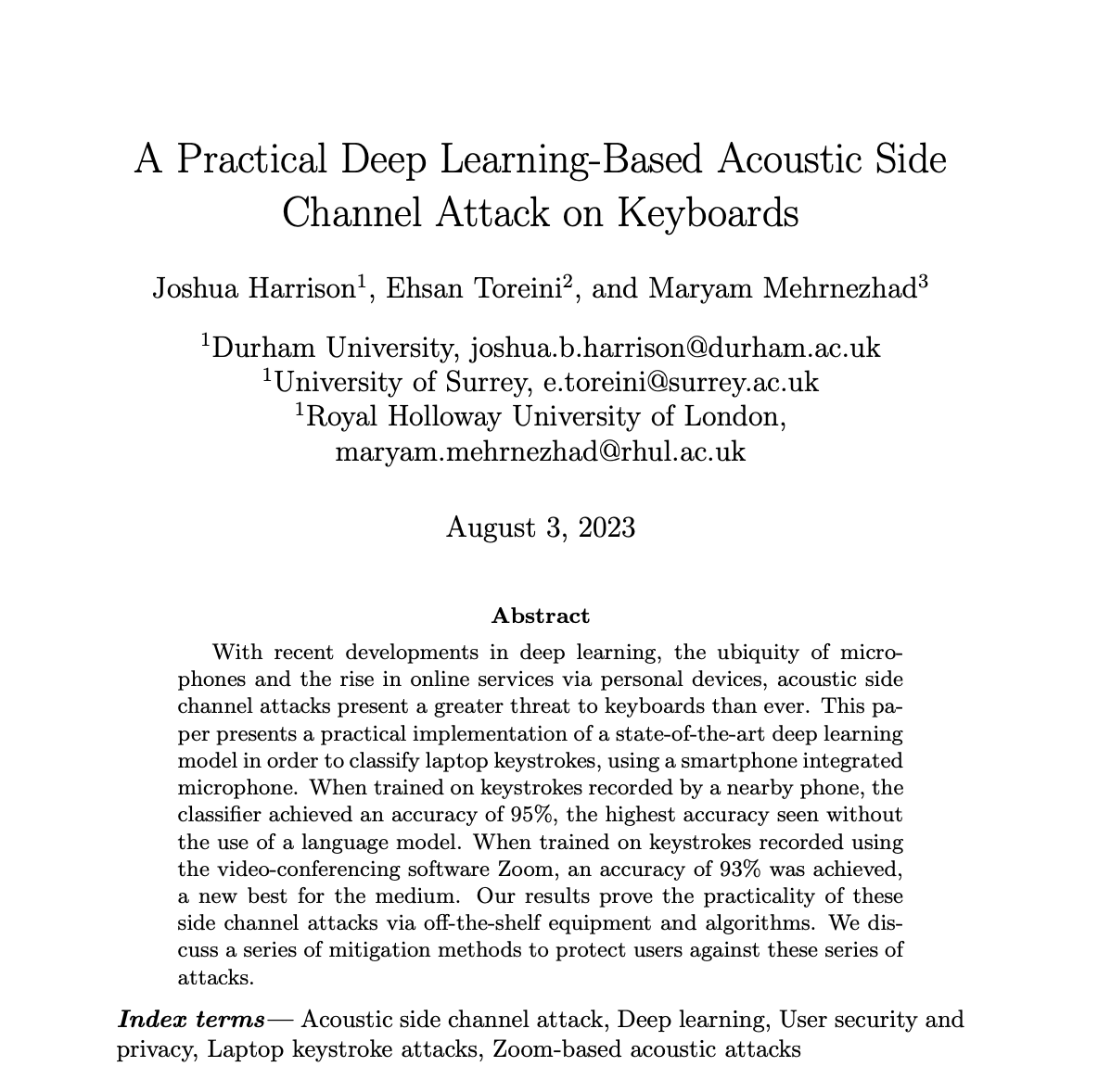
This side channel is fun. It's possible to guess what you type on your keyboard just listening to the sound it does. 93% accuracy on zoom call!
https://t.co/Gpr1zSd1ta
Can we design processors with powerful speculative execution that are *provably* secure for constant-time crypto code? 🧐
The answer is yes 🎉! To find out how, come to the "speculation doesn't pay" track on Friday afternoon at @USENIXSecurity#usesec23
#Event Latincrypt 2023: 8th International Conference on Cryptology and Information Security in Latin America: Quito, Ecuador, 2 October - 6 October 2023 https://t.co/wQGf5IU30x
My favourite people and the community I'm proudly part of: the cryptographic Latinamerican community. Check @criptolatinoOrg or https://t.co/doqYzQHI1k or talk to @deescuderoo at CRYPTO!
Have known about this case which Matt alludes to for a while. I am surprised the litigant is not more shunned by the crypto community. It is just one of a series of attempts to bully people in the community.
@gloupin The point of that blog post was to destroy the credibility of the PQC competition, for very cynical and self-interested reasons.
I think the research community is treating this mostly as a joke. They really shouldn’t.
I'm co-chairing CHES'23 with @marcel_medwed.
Scope now includes:
* Isolation & monitoring hardware for cyberresilience
* Engineering of zero-knowledge proof systems
* Privacy-preserving computing in practice (MPC, FHE)
* SoKs (since 2022_4)
Full CFP at https://t.co/5mr6Ug4tWF
@durumcrustulum The attacker injects points of the wrong order (not necessarily easy to identify "visually"). So what the "CLN test" (as called in the SIKE Channels paper) does is to verify that the input points generate the right torsion subgroup with the right order.