Op deze dag in 1629 overleed Piet Hein, commandant van de WIC. Hij is vermaard door zijn verovering van de Spaanse zilvervloot in 1628, die de Republiek (omgerekend) een half miljard euro opleverde. Het geld werd ingezet tegen de Spanjaarden in de Tachtigjarige Oorlog
Uma senhora já idosa foi parada pela polícia.
— Algum problema, policial? — perguntou ela.
— A senhora estava acima da velocidade permitida.
— Entendo.
— Posso ver sua carteira de motorista?
— Não tenho.
— Não tem?
— Perdi há quatro anos por dirigir bêbada.
— Certo... Então me mostre o documento do carro.
— Também não posso.
— Por quê?
— Porque roubei este carro.
— Roubou?
— Sim. E ainda matei o dono. Os pedaços dele estão em sacos plásticos no porta-malas.
O policial ficou pálido, recuou e chamou reforço. Em poucos minutos, várias viaturas cercaram o carro.
Um oficial mais experiente se aproximou.
— Senhora, desça do veículo, por favor.
Ela desceu calmamente.
— Um policial me informou que a senhora roubou este carro e matou o proprietário.
— Matei o proprietário?
— Sim. Poderia abrir o porta-malas?
Ela abriu. O porta-malas estava completamente vazio.
— Este carro é seu?
— Claro. Aqui estão os documentos.
Confuso, o oficial continuou:
— Também me disseram que a senhora não tem carteira de motorista.
A mulher abriu a bolsa e entregou a habilitação válida.
Sem entender nada, o oficial disse:
— Meu colega afirmou que a senhora estava sem carteira, roubou o carro e matou o dono.
A senhora suspirou e respondeu:
— Aposto que aquele mentiroso também disse que eu estava correndo.
Op deze dag in 1918 werd de Wet tot afsluiting en droogmaking van de Zuiderzee aangenomen, grotendeels in lijn met plannen van Cornelis Lely: de afsluitdijk, Flevoland, Noordoostpolder, Wieringermeer. Behoort tot grootste waterbouwkundige projecten ooit. Groot denken, groot doen!
Kasteel Rosendael bij Rozendaal werd rond 1300 gesticht door graaf Reinald I van Gelre en wordt voor het eerst vermeld in de 14e eeuw. Het begon als een versterkte burcht met een imposante donjon en was lange tijd een geliefde verblijfplaats van de graven en hertogen van Gelre. 1/4
Rommel gave them one chance to surrender. They said no.
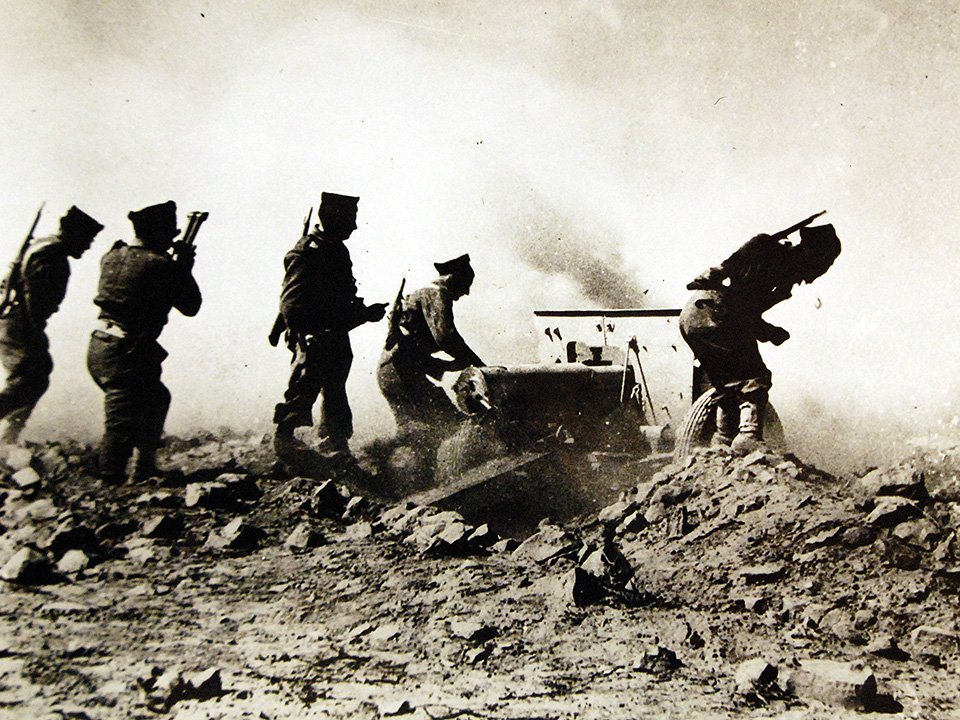
3,600 Free French soldiers held a desert fortress called Bir Hakeim against the full weight of Rommel's Afrika Korps for 16 days. They were surrounded, outnumbered, and running out of everything.
On the night of June 10-11, with the position finally collapsing, General Koenig ordered a breakout into the open desert in total darkness.
The Germans discovered the movement. The retreat became a brutal close-quarters fight. Men broke into small groups. Some crawled for miles. Most of them made it out.
What they bought with those 16 days: enough time for the British Eighth Army to withdraw to El Alamein, where the tide of the entire North African war would eventually turn.
Rommel later said the Free French fought magnificently. It meant something, coming from him.
France had been occupied for two years. These men had no country. They held anyway.
"Kiedy Vincent van Gogh zmarł w 1890 roku, mając zaledwie 37 lat, zostawił po sobie życie pełne niepowodzeń, kilka znoszonych ubrań i obrazy, których prawie nikt nie chciał kupować.
Sześć miesięcy później zmarł jego brat Theo — jedyny człowiek, który wspierał go do samego końca.
Wydawało się, że wszystko gaśnie.
Zostało małe dziecko, setki listów i ogromna liczba obrazów, których świat jeszcze nie rozumiał.
Wtedy na scenę weszła Jo van Gogh-Bonger, młoda wdowa po Theo.
Miała 28 lat, syna do wychowania, świeżą żałobę i żadnego obowiązku, by zajmować się artystycznym dziedzictwem szwagra.
Wielu uważało, że te płótna nie mają większej wartości.
Ona jednak zrozumiała coś, czego inni nie widzieli: za tymi gorączkowymi pociągnięciami pędzla i intensywnymi kolorami krył się geniusz, którego epoka nie potrafiła jeszcze usłyszeć.
Zaczęła od listów Vincenta i Theo.
Porządkowała je, tłumaczyła, przygotowywała do publikacji.
To właśnie w tej korespondencji odsłaniała się dusza Vincenta — jego wrażliwość, samotność, wewnętrzne poszukiwania, ból i światło.
Te listy zmieniły wszystko.
Pokazały, że za łatką „szalonego malarza od słoneczników” stał poeta, myśliciel i człowiek, który czuł więcej, niż potrafił unieść.
Potem Jo zajęła się obrazami.
Organizowała wystawy, pisała do krytyków, kontaktowała się z galeriami i muzeami.
Nie zgadzała się sprzedawać prac za bezcen, nawet wtedy, gdy brakowało pieniędzy.
Starannie decydowała, kiedy sprzedać obraz, komu i w jakim celu.
Nie tylko chroniła dorobek Vincenta.
Cierpliwie uczyła publiczność, jak na niego patrzeć.
Najpierw Berlin, potem Paryż, później Holandia…
Wystawa po wystawie, recenzja po recenzji, krok po kroku budowała reputację Van Gogha.
To nie była romantyczna legenda o wierze w artystę.
To była przemyślana strategia: wytrwałość, intuicja i konsekwencja.
Gdy zarzucano jej, że przecenia Vincenta, nie wdawała się w wielkie spory.
Odpowiadała jego obrazami.
Kiedy zmarła w 1925 roku, Vincent van Gogh był już uznawany za jednego z najważniejszych artystów swojego stulecia.
A rodzinna kolekcja, która później stała się fundamentem Muzeum Van Gogha w Amsterdamie, istnieje w dużej mierze dzięki niej.
Jo van Gogh-Bonger nigdy nie trzymała pędzla jak malarka.
Ale to ona pokazała Vincenta światu.
To ona pomogła przemienić niedocenionego artystę w uniwersalny symbol ludzkiej wrażliwości i twórczości.
Bez niej Van Gogh mógłby zniknąć w cieniu.
Dzięki niej stał się wieczny."
za Przytulność
Op deze dag in 1934 debuteerde Donald Duck in de tekenfilm The Wise Little Hen. Donald Duck viert dus vandaag zijn 91e verjaardag! The Wise Little Hen was een van de 75 Silly Symphonies van Walt Disney. Van harte gefeliciteerd, @DonaldDuckNL! Hiep, hiep, hoera! 🎂
Op deze dag in 1949 wordt 1984’ van George Orwell gepubliceerd. In deze dystopische toekomstroman beschrijft Orwell een staat waarin de overheid elk aspect van het menselijk leven bewaakt en controleert. Newspeak, de taal van de totalitaire staat, speelt een belangrijke rol
Schooneveld, 7 juni 1673. Op de vlakte van het Schooneveld voor de Zeeuwse kust vond een zeeslag plaats tussen de vloot van de Republiek onder bevel van De Ruyter en de gecombineerde Engels-Franse vloot. De Ruyter behaalde een overwinning en versloeg de geallieerde vloot opnieuw in een tweede slag op 14 juni 1673. 1/2
A Nazi commander loaded his pistol, pressed the cold metal barrel directly against the forehead of an American soldier, and gave a chilling ultimatum: "Order the Jewish soldiers to step forward, or I will shoot you right now."
What happened next in that frozen prisoner-of-war camp changed history forever, yet the man who stared down death kept it a secret for the rest of his life.
It was January 1945, and the bitter winter of World War II was at its peak. Inside Stalag IX-A, a notorious German prison camp near Ziegenhain, thousands of American soldiers were trapped behind barbed wire. Among them was Master Sergeant Roddie Edmonds, a twenty-five-year-old from Knoxville, Tennessee. As the highest-ranking non-commissioned officer in his section, Edmonds was responsible for the lives of 1,275 men.
One day, the camp commander, a fanatical Nazi major named Siegmann, issued a terrifying directive.
He ordered that the following morning, all American prisoners of Jewish faith must step out of the ranks during roll call. Everyone knew what this meant. Separating the Jewish soldiers was the first step toward sending them to extermination camps.
Inside the dark, freezing barracks, the prisoners panicked. Some of the Jewish soldiers considered stepping forward willingly to protect their Christian brothers from Nazi wrath. But Edmonds refused to let that happen. He looked at his men and gave a clear, definitive order: "Tomorrow, everyone steps forward. Everyone."
The next morning, the ground was thick with snow. Major Siegmann walked out onto the parade ground, expecting to see a small, isolated group of Jewish soldiers standing apart from the rest. Instead, he stopped dead in his tracks. All 1,275 American soldiers had stepped forward together in perfect unison.
The commander turned red with anger and stormed over to Edmonds. "They cannot all be Jews!" Siegmann screamed.
Edmonds stood completely still, looked the Nazi straight in the eyes, and replied: "We are all Jews here."
Enraged, Siegmann drew his Luger pistol and pressed it against Edmonds' forehead. The tension was suffocating. Hundreds of men held their breath, waiting for the gunshot. But Edmonds did not blink.
"According to the Geneva Convention, we only have to give our name, rank, and serial number," Edmonds said, his voice steady and calm. "If you shoot me, you will have to shoot all of us. And when the war ends, you will be tried for war crimes."
Edmonds knew the German army was collapsing and the Allies were advancing. Siegmann knew it too. The Nazi commander looked at the wall of unified men, realized he could not break their spirit, and slowly lowered his gun. He turned around and walked away without saying another word.
Because of that moment of defiance, two hundred Jewish-American soldiers survived the Holocaust. When the war ended, Edmonds returned to Tennessee, married his sweetheart, and raised a family. He never bragged about his actions, never looked for medals, and never even told his own children what he had done. To him, protecting his men was simply his duty.
Decades after his death in 1985, his son uncovered the truth by talking to the survivors. In 2015, Edmonds was officially recognized as Righteous Among the Nations, the highest honor Israel bestows upon non-Jews who risked their lives to save Jews during the Holocaust. He remains the only American soldier to ever receive this recognition.
True heroism does not look for applause, and love will always be louder than hatred.
By standing together in the snow, those soldiers proved that when we refuse to abandon each other, ordinary human beings can become absolutely invincible.
They called them flying coffins. The men who volunteered to fly them knew exactly why.
The Allied gliders of D-Day were made of fabric stretched over a frame of wood and metal tubing. They had no engine. No armor. No weapons. No parachutes for the men inside. They were towed to France at 130 mph on the end of a 300-foot nylon rope attached to a C-47, and when the rope was cut, there was one chance to land.
One. No go-arounds. No second approach. Whatever was below you was where you were going.
What was below them was Normandy at night.
The Germans had spent weeks preparing. Under orders from Field Marshal Rommel, they had driven wooden stakes into every open field in the region, angled to impale gliders on landing. The French called them Rommelspargel. Rommel's asparagus. Thousands of poles, many with mines or artillery shells wired to the tips, packed into every field large enough to land on.
What the glider pilots had not been properly told was the scale of the Norman hedgerows. The bocage. These were not English garden hedges. They were ancient earthen walls, some dating back centuries, topped with dense root systems and trees, rising 50 feet in places, bordering fields barely 200 yards long. A Horsa glider coming in at 100 mph hitting a hedgerow did not survive it. Neither did most people inside.
Some fields were flooded. Some were mined. Many were both.
517 gliders went into Normandy. 97 percent were abandoned in the field by the end of the operation. Most were destroyed.
General Don Pratt, assistant commander of the 101st Airborne, was in the first glider wave. His pilot managed to find a field near Hiesville and brought the glider down. It slid across the wet grass without slowing and hit a hedgerow at speed. The co-pilot died instantly. The pilot, Lieutenant Colonel Mike Murphy, broke both legs. General Pratt suffered a broken neck. He became the first American general to die in the Battle of Normandy. His glider had landed in one piece.
Sergeant Eric Wilson's glider did not. It hit a building at high speed. Both of Wilson's legs were broken. He was trapped inside the wreckage, unable to move, in enemy-held Normandy, for two and a half days before anyone reached him.
Lieutenant Den Brotheridge had come in earlier than anyone, in the first glider to land in France, the silent coup de main assault on Pegasus Bridge just after midnight. His glider stopped 47 yards from its target. He led his men out at a run, reached the bridge, and was shot. He died within minutes, the first Allied soldier killed by enemy fire on D-Day.
The men who survived the landing did not get to stop. Glider pilots were not assigned to combat units. Once down, they were expected to fight as infantry, dig foxholes, guard prisoners, carry ammunition, do whatever was needed. Most of them had trained to fly, not to fight on the ground behind enemy lines in the dark.
They did it anyway.
Of the 517 gliders that went in, 222 were Horsa gliders. Most were destroyed either on landing or by German fire in the hours that followed. The Waco CG-4As fared slightly better but 97 percent of all gliders from the entire operation were eventually abandoned in Norman fields, broken and empty.
The men who flew them were not pilots in the traditional sense. They were soldiers who had been given just enough training to put an unarmed, engineless box of fabric and wood into a dark foreign field at 100 mph, full of men and equipment, with one attempt and no margin for error.
Many of them got it exactly right.
Many of them did not come home.
Today is June 6th.
Remember them too.
On June 6, 1944, the man who predicted D-Day almost word for word was home celebrating his wife's birthday.
Months before the invasion, Rommel told his aide:
"The first 24 hours of the invasion will be decisive. For the Allies, as well as Germany, it will be the longest day."
He wasn't being poetic. He genuinely believed Germany had exactly one chance to win the war: stop the Allies while they were still in the water. Get them on the beaches before they could breathe. After that, it was over.
So he became obsessed. He personally inspected every bunker on the Atlantic Wall. He demanded 6 million mines be laid along the French coast. He flooded inland marshes specifically to drown Allied paratroopers mid-drop.
Then on June 5, German meteorologists reported the Channel weather was far too rough for any crossing. Rommel exhaled for the first time in months.
His wife Lucie was turning 50 the next day. He had already bought her a gift on a recent trip to Paris: a pair of shoes.
He drove home to Herrlingen, Germany. Hundreds of miles from Normandy.
At dawn on June 6, the largest naval armada ever assembled opened fire on the French coast.
When Rommel's phone finally rang, tens of thousands of Allied troops were already ashore. He begged Hitler to release the Panzer reserves to crush the beachheads before they could solidify.
Hitler refused. He was still asleep. His staff would not wake him. When he finally rose, he was convinced Normandy was a decoy and the real invasion was still coming at Pas-de-Calais.
Rommel raced back through France. By the time he arrived that night, the beaches were lost.
The man who called it "the longest day" spent the most decisive hours of World War II at a birthday party, 600 miles away, holding a pair of shoes.