I’m seriously concerned that match-fixing in tier 2/3 CS2 is spiralling out of control.
Please take a few minutes to read this. I want to explain what I’ve been seeing, why it worries me, and why the CS community needs to pay attention.
I’m not posting this for personal gain. My only goal is to raise awareness so these concerns reach people who can investigate them and help get something done. I care about CS, and I’m worried about where this is heading.
I’ve been a professional CS bettor for six years now. Recently, I’ve started looking much more closely at suspicious trading activity and posting what I find.
New accounts putting serious money into obscure matches at prices I can’t justify. Huge odds movements shortly before the start. The same teams appearing repeatedly.
I want to explain what I’ve been seeing, how prediction markets, VRS system and ESIC may be contributing to the problem, and what I think needs to change.
There are at least three cases that leave me with extremely strong suspicions of match-fixing only in the past week, plus several others that deserve a closer look. My goal is to get these cases in front of people who can properly investigate them. And the others happening in the future.
My probability estimates, the trading activity I can observe, and my interpretation of that activity are separate things. My model can be wrong. A strange price or a winning bet doesn’t establish that a match was fixed.
But the combination of what I’m seeing is worrying enough that I don’t think we should keep shrugging it off.
Match-fixing has existed in CS for years. Prediction markets didn’t invent it. My concern is that they may be making some forms of it easier and more rewarding.
With a traditional bookmaker, the bookmaker accepts the financial risk of your bet. If someone exploits a manipulated match, the bookmaker can lose money.
Identity checks, betting limits and market suspensions create obstacles. In my experience, some lower-tier markets only allow a few hundred euros per bet, although limits vary. I’ve also seen bookmakers stop offering certain teams’ matches.
None of that makes fixing impossible but it does put limits on how much money someone can get down and how easily they can keep doing it.
Polymarket works differently. Users trade against other users. The platform therefore doesn’t carry the same direct betting liability as a bookmaker. It charges fees from its users, so trading activity can generate revenue regardless of which side wins.
That changes the incentives. It doesn’t mean Polymarket has nothing to lose from corruption: trust in the platform matters. But its immediate financial exposure is different from that of a bookmaker facing the payout itself.
According to its published description, it doesn’t require every user to complete identity verification upfront. People can sign up with an email or wallet, and the platform says it requests additional information only from top-volume traders.
I’m using Polymarket as the main example because that’s where I’ve been tracking these matches. But the concerns I’m raising extend to prediction markets more broadly. Different platforms have different rules and safeguards, and all of them need to take suspicious betting activity seriously.
The public trading history is actually useful. It lets outsiders inspect accounts, prices and patterns that we couldn’t see at a traditional bookmaker.
Black Phoenix vs Lavked is one example of why I started paying closer attention.
I had Lavked a slight favourite. The market had them around 20% underdog. I also reported finding six accounts created that day whose first and only visible betting activity was backing Black Phoenix in this match. After the match they didn't place a single bet and withdrew their money.
Several fresh accounts. One obscure match. Large positions at prices I considered terrible relative to normal team strength. Then funds moving out afterwards.
What is the explanation for that pattern?
In Black Phoenix vs BAKS, BAKS was trading around 83% with the series tied 1–1, after losing the second map 1–13. They should have been around 60% favourites at best. There were over $300,000 traded across the match’s markets, which is 10x more than in a typical match like this.
Arbitrage can bring additional money into these markets too.
Suppose a bookmaker offers Team X at 2.00 and someone on Polymarket offers the opposite outcome, Team Y, at 2.10, that creates an arbitrage.
The person supplying Y at 2.10 is effectively backing X at about 1.91. They’re accepting a worse price than the bookmaker offers, but that price difference can attract arbitrage traders to take the other side.
And this process can repeat. As arbitrage bettors back X at the bookmaker, its odds gets worse. The person backing X on Polymarket can respond by offering even better odds on Y, creating another arbitrage opportunity and attracting more counterparties.
If a potential fixer knows the result is already decided, they are willing to accept worse and worse odds on X. Their priority is getting more money matched on the outcome they expect, even at prices that would make no sense based on the teams’ actual chances.
That means the opportunity doesn’t necessarily disappear when the bookmakers adjust its odds. The trader can keep moving their own price to attract more arbitrage betting, as long as the gap covers the costs and bookmakers keep accepting the other side.
So what should change?
First, prediction markets need to take responsibility for how suspicious CS2 activity is handled.
They should have clear rules for pausing suspect markets and reviewing settlement, including when established manipulation could justify a void / refund.
Second, tournament organisers need credible findings they can act on under the VRS rules.
The practical problem is that direct VRS invitations must follow the ranking order. Organisers can’t simply skip a team because they suspect fixing or cheating. Without grounds for exclusion under their published integrity rules, they still have to follow that order, even when serious concerns remain unresolved.
Valve already allows exclusions for integrity reasons, provided organisers follow published, objective and consistently applied criteria and publish their decisions. The ability to exclude teams exists.
But where is the evidence supposed to come from?
Tournament organisers shouldn’t be expected to investigate betting networks, trace suspicious transactions and determine whether players are fixing matches or cheating entirely on their own. They have a responsibility to cooperate and act on credible findings, but conducting these investigations requires specialist knowledge, time and resources.
This is where VRS becomes part of my concern. When direct invitations follow the rankings, teams can keep receiving invitations while serious suspicions remain unresolved. Without a properly investigated case, an organiser may have little basis for excluding them.
Following the invitation order is straightforward. Building a defensible case for an integrity ban is much harder. We shouldn’t have a system where the practical answer is to keep inviting a team because nobody has taken responsibility for investigating the concerns around it.
A team could, in principle, win enough matches to maintain its ranking while manipulating selected games. Ranking points alone cannot protect the competition from that.
That’s why the third part matters: CS needs a properly resourced integrity body (ESIC???) doing this work every day, with findings that Valve and tournament organisers recognise and can act on.
We need people reviewing reports, preserving trading data, investigating connections and contacting organisers while the information is still useful. ESIC, Valve, organisers and betting platforms need to make it clear who is responsible for doing that and who can act on the findings.
This needs to be someone’s job every single day.
My worry is that larger betting opportunities, continued tournament access and a response that fails to keep pace can reinforce each other. That creates an environment where corruption can become more rewarding and harder to contain.
The cost goes beyond bettors losing money. Fixing damages honest players, teams, organisers and trust in the competition.
My biggest concern is what happens when these three things come together.
Prediction markets can bring far more betting money into low-level matches. On platforms without mandatory upfront identity checks, identifying the people behind suspicious activity may also be harder.
Meanwhile, teams continue receiving VRS-based invitations while serious concerns remain unresolved and organisers lack the evidence needed to justify excluding them. And the response I’m seeing from ESIC is nowhere near enough (There is no response).
More money available, continued access to tournaments, and enforcement that doesn’t appear to be keeping up. Put those three together, and lower-tier CS starts to look like a match-fixer’s paradise.
I’ve posted the individual match examples on my profile. Honestly, talking about this every day is draining. Me shouting on Twitter can only do so much. I want these cases to reach people with the resources and authority to investigate them.
I don’t expect one post to solve this overnight. I do think more people understanding what is happening gives us a better chance of getting something done.
If you care about CS, please like and share this post. Tag people in the comments who should read it: players, coaches, casters, analysts, organisers, journalists and people who can act on this.
I want the people who can investigate these cases to actually see them.
And sorry for using AI to help put this long post together. I wasn’t sure how to organise all my thoughts, and English isn’t my first language :D
🚨 Fix alert again?
Leo Team were still slight favourites against G2 Ares this morning, trading at around 54% on Polymarket. That was pretty close to my assessment of the normal matchup.
By the time the match started at 17:20 Finnish time, G2 Ares were trading as 85% favourites. Almost $100,000 traded on the moneyline alone. An absolutely insane amount for a match at this level.
I've avoided Leo's matches for a long time. Several bookmakers have stopped offering them, and I've noticed suspicious odds movements in their games before.
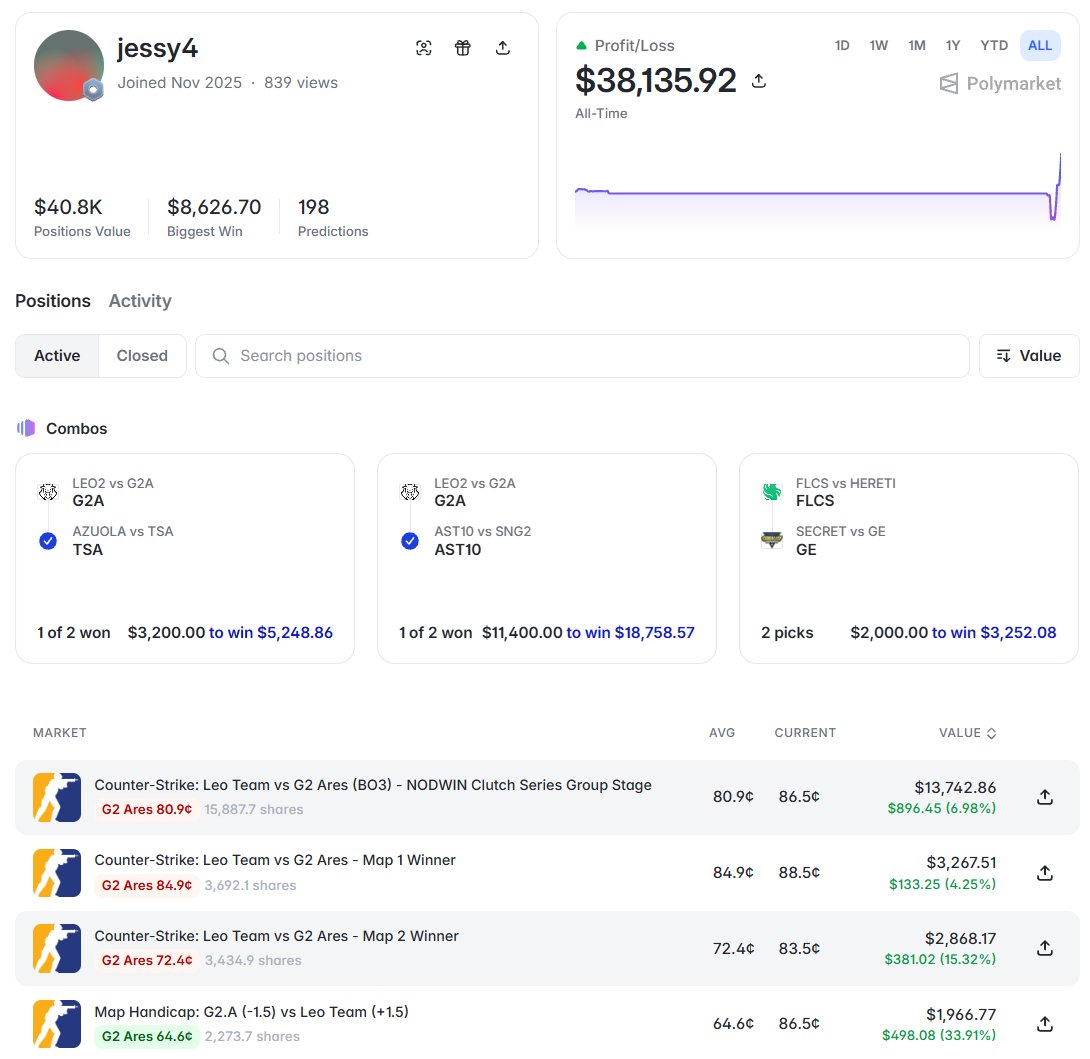
One account worth looking at is jessy4. The screenshots show these average entry prices on G2 Ares:
Moneyline: 80.9¢
Map 1: 84.9¢
Map 2: 72.4¢
G2 Ares -1.5: 64.6¢
Based on my assessment of these teams, those prices are absolutely awful.
The account was created in November 2025. Its P/L chart shows a long flat stretch followed by a sudden surge, and it is now showing over $38,000 in all-time profit.
The same account also backed Spirit Academy against Azuolas today. I had Spirit Academy at around 55%, and Polymarket was still trading them at roughly 55% an hour before the match. During that final hour, they suddenly moved to 82%.
This account's average entry prices were 78¢ on Spirit Academy to win the match, 74.4¢ on Map 1, 80.5¢ on Map 2 and 56.9¢ on Spirit Academy -1.5. Spirit Academy won 2–0.
It also backed UNiTY against Leo: 67.1¢ on the moneyline and 58¢ on UNiTY -1.5. Paying 58¢ for a 2–0 win, compared with 67.1¢ for just winning the match. UNiTY won that one 2–0 as well.
Now the same account is heavily backing G2 Ares against Leo at prices I wouldn't go anywhere near under normal circumstances.
There could be an innocent explanation, but the combination of these odds movements, unusually high volume and repeated bets at prices this bad looks suspicious as hell to me.
When is someone going to look into this?
https://t.co/ruKoeXAu4C
GIVEAWAY TIME! #ad Giving away this ★ Skeleton Knife | Vanilla worth $750 with @skinsauna. Want it?
* Follow @skinsauna & @GeT_RiGhT
* Like this post
* Retweet
Winner will be drawn at the end of the month. Good luck to everyone and be sure to check out Skin Sauna in the meantime!
Bonus + code GTR 👉 https://t.co/QLviX08EWG