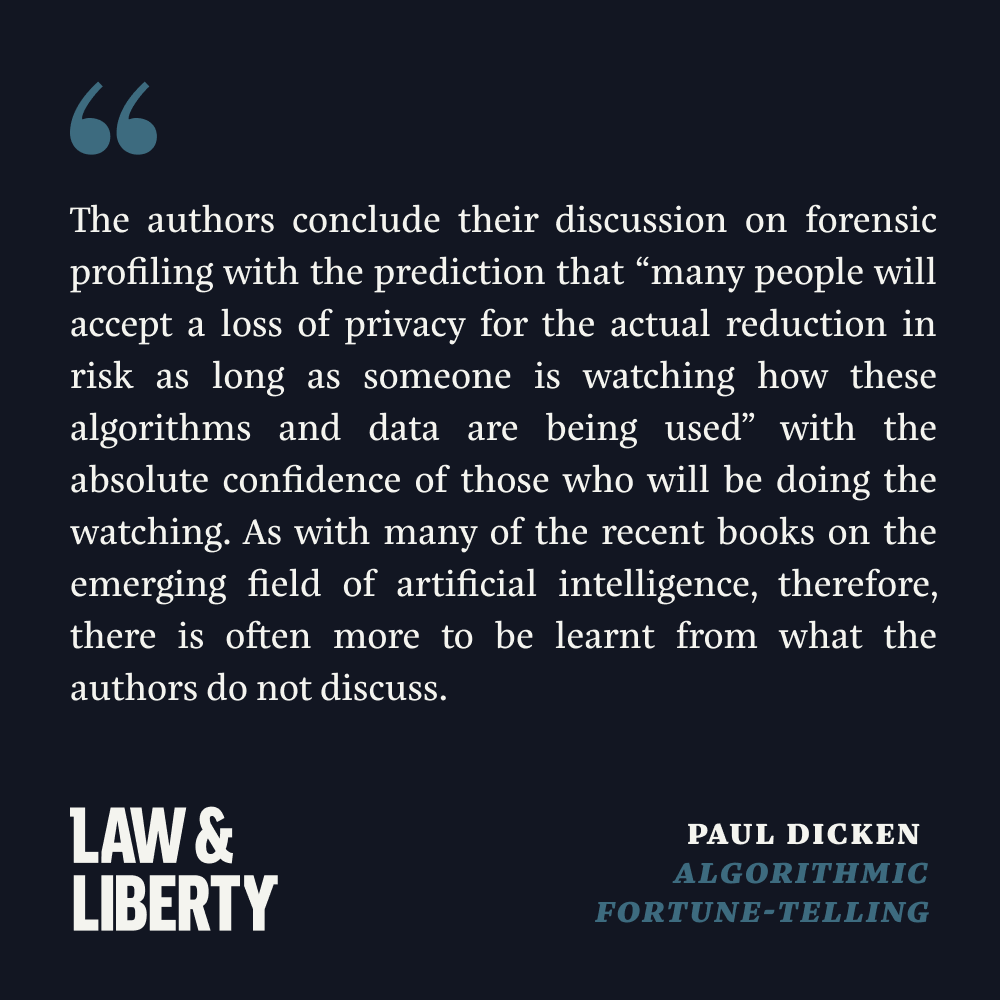
@paul_dicken: "In his new book, Lowry Pressly argues that the right to privacy goes deeper than concerns about free speech—it is at the core of our humanity."
https://t.co/qig2lYdUND
Upon reviewing “The Age of Prediction,” @paul_dicken is left largely unimpressed with what the authors have to say about artificial intelligence. Reading between the lines, however, proved to be quite interesting. https://t.co/EBkpGuz6jz
What will be the social and political consequences of living in the world of algorithms and AI?
@paul_dicken considers in his review of “The Age of Prediction.”
https://t.co/EBkpGuz6jz
@ojusher Nor did it address notorious interview bias. In many ways, algorithms and quotas more designed to show that "we are doing something" rather than addressing underlying issue.
@ojusher The idea made sense -- getting mediocre grades in awful environment more impressive, etc. Not sure how you quantify that in an algorithm though. And every college had its own, jealously guarded, and incomprehensible to everyone except the batty old prof who designed it.
"It has become increasingly clear to many that while the specialization of the natural sciences has led to unprecedented technological progress, this has been a mixed blessing."
By Paul Dicken:
https://t.co/jvwj1a0Rpt
This week, a short story in @LoftBooks and an essay in @LAReviewofBooks.
One is about a lobster; the other is about Thomas Kuhn.
https://t.co/gneM5yboau
https://t.co/8PtAV9uTYE
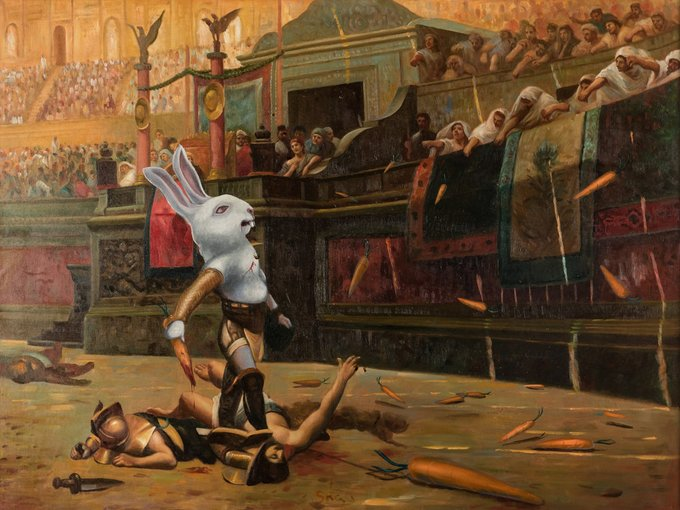
Are you not entertained?
“Where the early Kuhn highlights differences between scientific communities, his later work emphasizes similarities.” @paul_dicken reviews “The Last Writings of Thomas S. Kuhn: Incommensurability in Science,” edited by Bojana Mladenović. https://t.co/8tfWeSAEiY