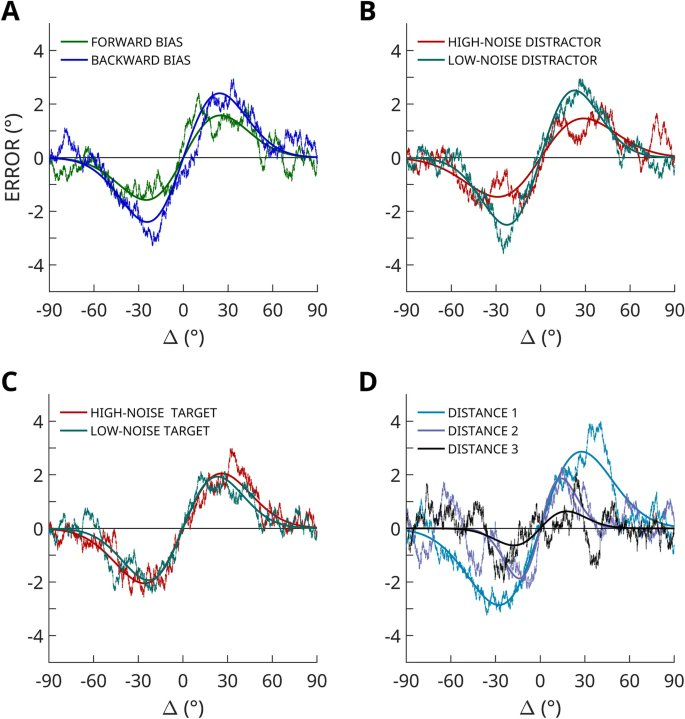
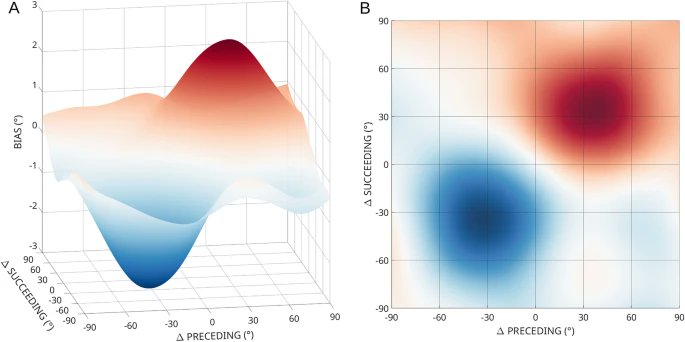
as the item is task-relevant. This is irrespective of their place in the sequence, that is, items are biased both by preceding and succeeding items, indicating that all relevant items in memory bias memory report.
We propose that our observations might reflect an obligatory mechanism of information averaging in working memory to support effective perception and action.
In four online psychophysics working memory experiments (with 330 participants in total; main hypotheses pre-registered), we show that when multiple items are memorized in sequence, each item biases each other item towards itself (similar to the serial dependence effect), so long
The last paper of my PhD has finally been published (: Thread below -->
Thank you @SuryaGayet and Stefan van der Stigchel (@AttentionLabUU) for the amazing collaboration!!
Memory reports are biased by all relevant contents of working memory
https://t.co/jP5ABxPXR0
Hey twitterverse, I'm getting serious FOMO. What are the best accounts to follow, specifically when it comes to using AI (esp. LLMs) for academic research?
@AcademicChatter@PhDVoice@PostdocVoice
ChatGPT(4) is *so* helpful for me as a developer of scientific software without a large team. It's like having a super-fast programming assistant who executes semi-complex tasks almost perfectly and based on very little explanation, while I can focus on higher-level design.
✨ New: Text to shareable web apps.
Transform natural language into simple apps, UI, widgets, websites, games, forms – LITERALLY ANYTHING. Not just calculators, but fully featured web apps.
🪄 https://t.co/tzy3x9ZAhP (desktop only for now)
Something we’ve been iterating on at @bighuman
👀 Soon: less buggy, more pretty, more external API integration (dynamic data, monetize your app, etc)
@GunnarBlohm @SfNtweets Most don't know, and those who do don't care. Maybe it's time for us to envision the future as it can be, instead of clinging to an expired normal. I'm quite interested in air filtration and better virtual audiovisual tech.