The pause isn't about doing nothing. It's about noticing what you're doing before you do more of it.
Why am I chasing this?
Why does this failure bother me so much?
Why do I need this person to think I'm successful?
Why can't I just stop?
Some of the most useful answers I've found started with questions like these.
@RianSweetDoris The distinction between what you can control and what you can’t takes a lot of pressure off. You can focus on the process instead of trying to force the outcome.
@MrKunalSaini Some things don’t need closure, they just need to stop getting your attention. You can move forward without having every part of the past figured out.
@foundrr_ I think the hardest part is protecting your discipline when nobody is watching and there’s no immediate reward. That’s where most of the real compounding happens
@rajshamani That’s probably why the skills you use in real life tend to stick so much better. You’re constantly giving your brain a reason to keep them around.
@benaratame I relate to this. I don’t think ambition necessarily fades with age, but the way you channel it probably changes. The real challenge is keeping the hunger without letting it consume everything else.
@ItsKieranDrew Love this. There’s something special about finally starting the thing you’ve been putting off for years. The fact that you’re not worrying about where the story goes probably makes it much easier to keep showing up.
@adamshuaib I’d add curiosity to this list. The really unusual people tend to keep learning long after they’ve become good at something, and that ability to keep improving is often a better signal than how intense they seem in the first conversation.
@rajshamani The bigger cost is that complaining can make you less adaptable. If your first instinct is to look for what’s wrong, you spend less energy looking for what you can actually change.
@SahilBloom Resourcefulness compounds too. Someone who knows how to figure things out will keep finding opportunities even when the obvious resources aren’t available.
Nirmal Purja climbed all 14 peaks above 8000m- a feat that took most people 7 year, in 6 months, while carrying teammates who couldn't walk.
David Goggins finished a mile race on stress-fractured feet, then went home and signed up for the next one.
Mark Dowdill ran 630km in 94 hours with zero sleep, and 83 hours in- ran his FASTEST lap of the whole race.
3 different people. 3 different sports. Same one thing that didn't stop them: they never stopped believing.
Not fitness. Not talent. Not genetics.
The only question is whether you're ready to stop believing your limits are real.
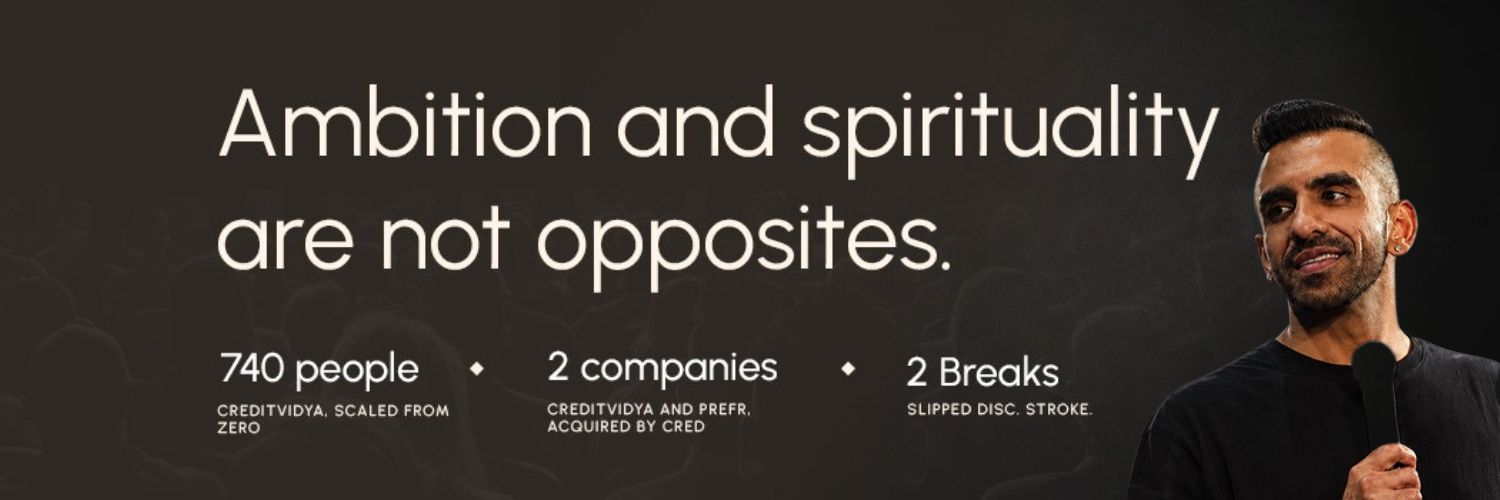
My dream was to become a millionaire by 28. But when I sold my company to CRED and achieved my dream, I woke up the next morning feeling empty.
I grew up in a small house in Kathmandu (8 of us crowded into 2 rooms).
In the corner of our tiny kitchen in that house, my mother kept a small space just for her Krishna. And every evening I would sit with her down there & pray.
I didn't understand faith back then. I just understood that my mother believed in something, so I believed too.
That’s how my relationship with God began.
Sitting in her lap, I also learned something else. God was who you asked when you wanted something.
So every night, tucked beside her, I made my request to Krishna 🙂...
to get me out of Kathmandu, get me to America & then, finally, my life would be complete.
And Krishna was kind to me that everything I asked for arrived on almost the exact timeline I'd imagined as that boy. America at 18, the degree, the jobs, the money & eventually the exit from Prefr (Formerly CreditVidya) that made headlines.
The day it happened, everyone around me was celebrating, but I remember standing there feeling almost NUMB.
For the 1st time, I had reached the end of the road I had been running towards my entire life. There was no bigger milestone waiting for me that could explain what I was supposed to do next.
For a while, that emptiness haunted me, but one day I got my answer. And it took me back to my mother's kitchen.
It hit me that all those years, I had only ever asked Krishna for things. I had never once asked him what it would actually feel like once I had them.
Somewhere after the exit, that started to change.
I stopped asking Krishna for the next thing and started learning to simply sit with him.
He stopped being someone I went to when I needed something. He became my friend. (Yes, a great friend)
@Dwriteway Information is no longer the scarce resource. Attention is. You can know exactly what to do and still get nowhere if you keep switching between ten different things
@rajshamani This is such an easy trap to fall into. A small problem can feel huge when it hits the right emotional nerve, while something genuinely important can feel surprisingly calm.
@ItsKieranDrew The hardest part is separating useful feedback from the feeling of being criticised. Once you stop defending yourself, you can actually see what the feedback is trying to teach you.