Asst Prof. of Global Studies @weareAUD
PhD Vallabhbhai Patel & India's Foreign Policy.CIPOD.JNU. Indian IR. Caste & IR. Gender.Realism.Indo-Pacific.China
Caste and Diplomacy? Really?
Read our special issues, brought together by @vineet1232 and @KalathmikaN. This is the culmination of over four years of work, from Vineet's initial conceptualisation to the efforts of all the authors who brought it to life. https://t.co/8ZXGoFbRY4
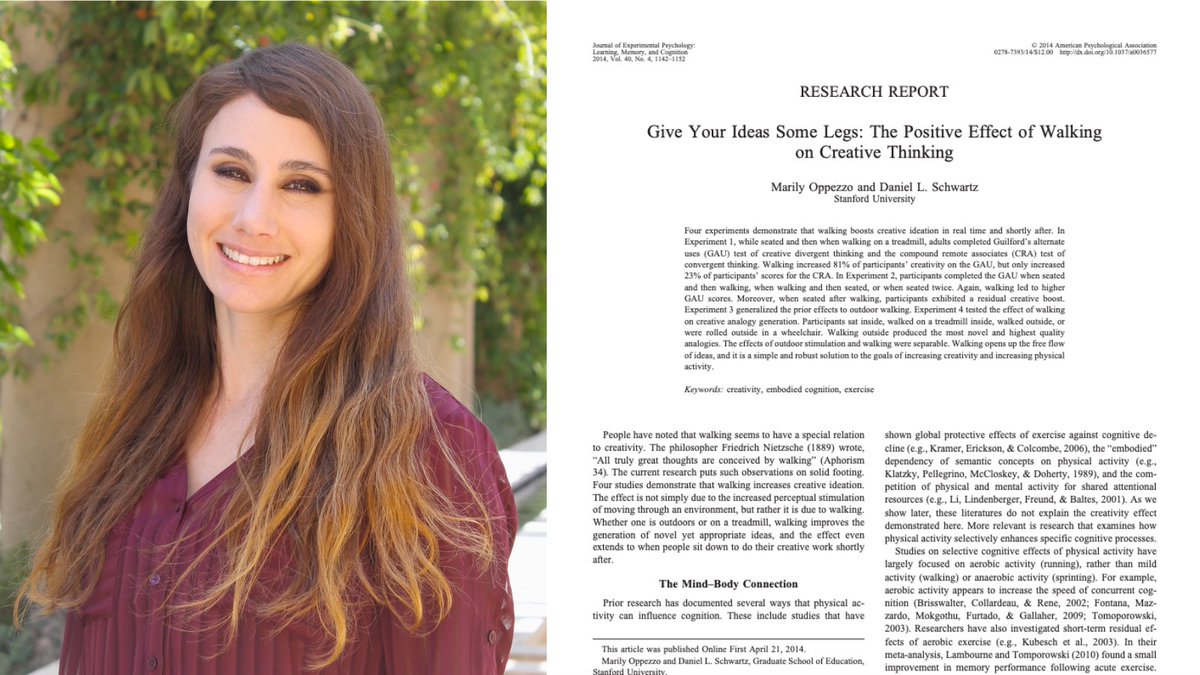
A Stanford psychologist spent 4 years proving that the simple act of walking generates 60% more creative ideas than sitting, and the experiment she designed to kill every alternative explanation is one of the most decisive findings in modern psychology.
Her name is Marily Oppezzo.
She got the idea for the study while walking with her advisor at Stanford to discuss her thesis topic, and the paper she eventually published in the Journal of Experimental Psychology in 2014 is sharp enough that it should have ended the seated meeting on the day it came out.
She ran 4 experiments on 176 people. Same person tested twice. Once sitting, once walking. The creativity tasks were the standard ones psychologists have used for decades to measure how good a brain is at generating novel useful ideas.
The result was almost too clean to publish.
81% of participants in the first experiment produced more creative ideas while walking than while sitting. In the second experiment, 88%. In the third, 100%. Every single person walked into a more creative version of themselves.
On average, people generated 60% more novel useful ideas the moment their legs started moving.
The skeptical question is the obvious one. Maybe it was the fresh air. Maybe it was the scenery passing by. Maybe it was the change of environment doing the work, not the walking itself.
Oppezzo killed every one of those explanations with one experimental decision.
She put people on a treadmill facing a blank wall. No scenery. No fresh air. No environmental change. Just legs moving in place while staring at white drywall. The 60% boost held.
Then she ran the experiment that closed the case completely. She took participants outside in two conditions. Half of them walked through a Stanford courtyard. The other half were pushed through the exact same courtyard in a wheelchair. Same outdoor stimulation. Same scenery passing at the same speed. The only difference was whether the legs were moving.
The walkers produced dramatically more novel high-quality ideas than the wheelchair group. The outdoors did almost nothing on its own. The walking did everything.
This is the part of the study that hit hardest when I read it the first time.
She also tested the opposite kind of thinking. Convergent thinking. The kind where there is one right answer and you have to narrow down to it.
Word puzzles where 3 words share a hidden fourth word that connects them. The seated participants did slightly better on these. Walkers got slightly worse.
Walking is not a general intelligence enhancer. It does one specific thing. It opens up the divergent search inside your brain. The part that generates options. The part that produces unexpected connections. The part that takes a problem and finds five ways into it instead of one.
When you need to converge on the single right answer, sit down. When you need to find the answer in the first place, get up.
The mechanism is now well understood. Walking selectively activates what neuroscientists call the default mode network, the system inside your brain that runs when you are not consciously focused on anything. The DMN is where mind-wandering happens. Where memories cross-reference each other. Where ideas that have been sitting in separate folders inside your head finally bump into each other.
When you sit at a desk and force yourself to concentrate, you suppress the DMN. When you walk at a natural pace, the executive part of your brain gets just busy enough handling the walking that the DMN comes online and starts doing the work that focus was blocking.
The most useful finding in the entire paper is the one almost nobody quotes.
The boost did not turn off the moment people stopped walking. Participants who walked first and then sat back down stayed elevated. Their next round of seated creativity work was still significantly better than people who had been sitting the whole time. The rest lingered for at least several minutes after the legs stopped moving.
You do not need to do creative work while walking. You need to walk before the creative work. The brain holds the state.
The history of this is the part that should haunt anyone who still does meetings in chairs.
Charles Darwin built a gravel loop behind his house in Kent called the Sandwalk and walked it 3 times a day for the rest of his life. The theory of evolution was developed one lap at a time on that path.
Nietzsche walked up to 10 hours a day during the years he wrote his most important books and openly said the work was conceived on his feet.
Beethoven composed for the morning and walked for 5 hours every afternoon with a pencil in his pocket for when something landed.
Kahneman said the best thinking of his Nobel Prize-winning career happened on leisurely walks with Amos Tversky. Steve Jobs refused to take important conversations sitting down. He held them on foot.
Every one of them was using the system Oppezzo would not measure until 2014. They just did not know what to call it.
The question worth sitting with is the one almost nobody asks.
Every meeting you have ever attended sitting around a table was a meeting held at a fraction of the brain power that was actually available to the people in the room. Every brainstorm that got stuck inside a conference room. Every problem you tried to solve at a desk and gave up on. Every idea you could not quite get to.
The intervention is the easiest one in modern science. No supplement. No app. No subscription. No training program. Just a pair of legs and 15 minutes.
The Stanford lab proved it. The philosophers knew it. The neuroscience explains it.
And almost everyone reading this is still trying to think their way out of problems sitting completely still.
As temperatures soar past 45 degrees Celsius, and with record high night temperatures, the death till in India because of the extreme heat wave is on the rise. Worst affected are the daily wagers who do not have the option of staying indoors or air conditioned spaces. I report with comments from @anshu_seeds . For more such reports in English and Hindi subscribe to YouTube- Smita Sharma Journalist @ChintanIndia@Bharati09
Dr Ambedkar remarked that the educated classes cannot be relied upon to assist in transforming the future of the 'backward and the depressed classes'. The right to benefit from education should be given to all, but through equal representation in how the university functions.
InstaGPT in our Classrooms. I reflect on the disturbing trends of AI in our classrooms and ways to address them in the latest issue of Mainstream Weekly.
https://t.co/FvqXVr5Ppb
#Classroom#ChatGPT#AI#Education
En 2019, el profesor del MIT, Patrick Winston dió una conferencia magistral de 1 hora llamada «Cómo hablar».
Tiene más de 18 millones de vistas por una razón.
Sus conceptos clave:
- Tus ideas son como tus hijos
- La regla de los 5 minutos para conferencias de trabajo
- Por qué los chistes fallan al principio
En vez de ver Netflix hoy, deberías ver este video.
15 lecciones sobre comunicación:
🧵
1. Tu éxito está determinado por tu habilidad para hablar, habilidad para escribir y la calidad de tus ideas. En ese orden.
I can think of at least three celebrated foreign policy experts who claim it's diplomatically astute for India to not defend Iran. No names taken. But there's a strong case to be made for India to defend Iran, and not only because it's morally sound. There's an even more pressing argument. Give @pavanjnu a read and he explains precisely why. https://t.co/dsvEMAhSbL
“With its sovereignty undermined and its leadership humiliated, Iran opted to elevate a figure representing resistance to foreign pressure—even as that choice contradicted the regime’s ideological principles,” writes @GanjiAkbar.
https://t.co/zchGTkFRMA
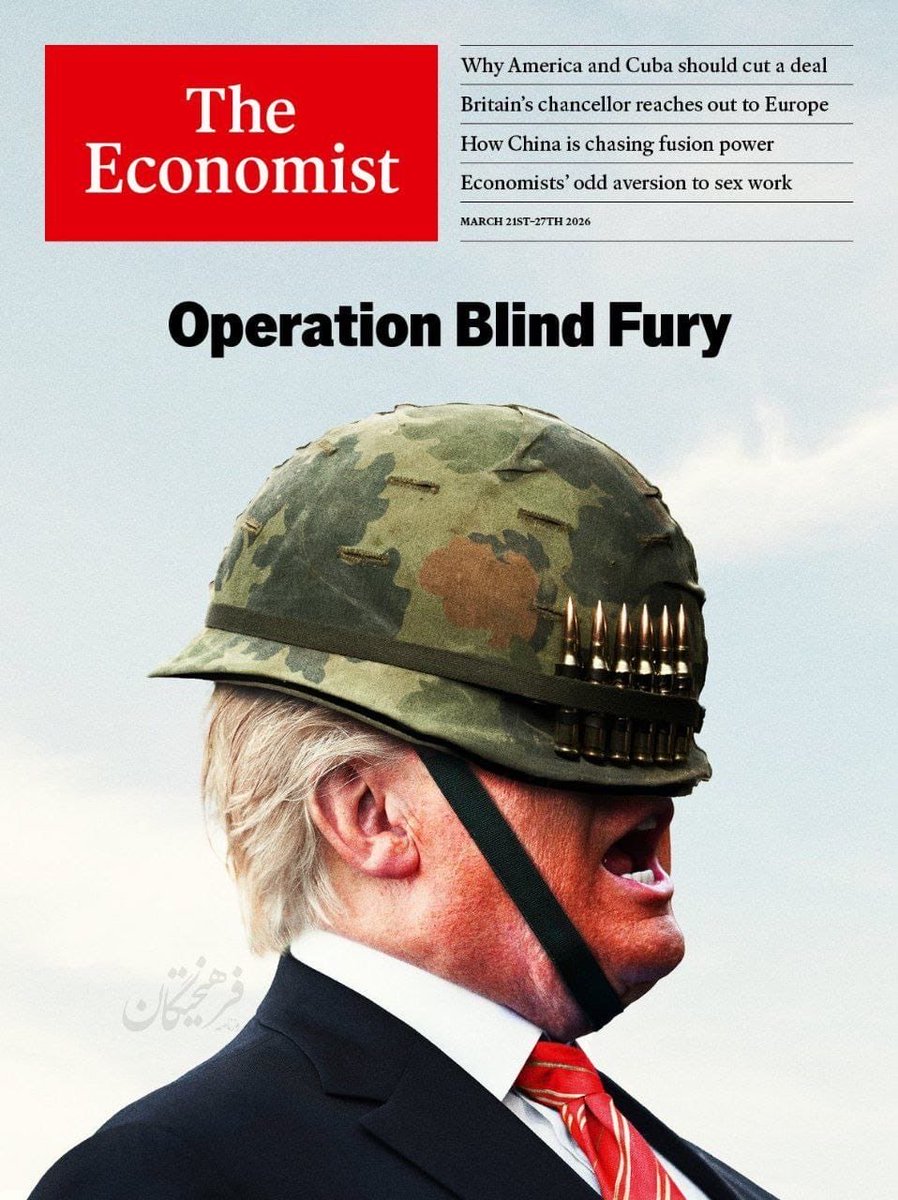
In Iran, Trump’s aerial campaign is “already yielding diminishing returns,” writes Nate Swanson. But the alternative—putting American boots on the ground—is “precisely what Trump, as a presidential candidate, repeatedly pledged never to do.”
https://t.co/2QJ3c51rOZ
By upholding the principle of sovereignty, India defends its stance against external powers seeking to interfere in South Asia.
Pavan Kumar writes.
#US#Trump#IranAtWar#WestAsia#IndiaIranRelations
https://t.co/xcAuHb1vbc
Condemning an imperialist war might not end that war, but it certainly delegitimises the imperialists. We condemn not for the present, but for the future. Ideas and values have always been the foundation of society, domestic or international. Thats how we progressed.