It's a weird time. I am filled with wonder and also a profound sadness.
I spent a lot of time over the weekend writing code with Claude. And it was very clear that we will never ever write code by hand again. It doesn't make any sense to do so.
Something I was very good at is now free and abundant. I am happy...but disoriented.
At the same time, something I spent my early career building (social networks) was being created by lobster-agents. It's all a bit silly...but if you zoom out, it's kind of indistinguishable from humans on the larger internet.
So both the form and function of my early career are now produced by AI.
I am happy but also sad and confused.
If anything, this whole period is showing me what it is like to be human again.
Andrej Karpathy literally built the neural networks running inside coding assistants.
He taught the world deep learning at Stanford. He ran AI at Tesla.
If he feels “dramatically behind” as a programmer… that tells you everything about where we are.
The confession here is that raw intelligence and deep technical knowledge no longer guarantee mastery. The new stack isn’t about understanding transformers or writing elegant algorithms. It’s about orchestrating a zoo of stochastic systems that nobody fully controls.
Karpathy’s list is revealing: agents, subagents, prompts, contexts, memory, modes, permissions, tools, plugins, skills, hooks, MCP, LSP, slash commands, workflows, IDE integrations. That’s 15+ new primitives that didn’t exist 18 months ago. Each one evolving weekly.
The mental model problem is real. Traditional engineering gives you deterministic systems. You write code, it does exactly what you wrote. Now you’re managing entities that are “fundamentally stochastic, fallible, unintelligible and changing.”
His “alien tool with no manual” framing is exactly right. We’re all reverse-engineering capabilities in real-time. The documentation is always out of date. The best practices from 3 months ago are already wrong.
The magnitude 9 earthquake isn’t coming. It already hit. The aftershocks are the new normal.
1/5 Quanta Magazine has unveiled a breakthrough story in 'Undergraduate Upends a 40-Year-Old Data Science Conjecture.' In this article by Steve Nadis, an undergraduate computer scientist from Rutgers, Andrew Krapivin shakes the foundations of decades-old beliefs about hash tables. Read the full story at https://t.co/1Rkovw7dw0 and follow the journey with @QuantaMagazine. via @xcomposer_co ⬇️
@rowancheung Pro tip: Configure Perplexity with Claude 3.5 Sonnet - the combination is unbeatable and will make your productivity seem magical.
Side note: I recommend watching @AravSrinivas podcast with @lexfridman.
@AravSrinivas Great product @AravSrinivas. The differentiation in the product is so basic and critical compared to the typical LLMs and yet it’s been a challenge for me to champion it to my colleagues. Seems like the messaging might need to get simpler for a bit more mainstream consumption.
Wow!!! I can't believe someone picked up on this. Only one other person till now has identified the sound, Gautham from Charan's music team. I had read about these group of scientists who went around capturing the last sounds of animals going extinct. I was incredibly moved when I heard the male kauai bird song. I knew instantly I'd be using it for this sequence.
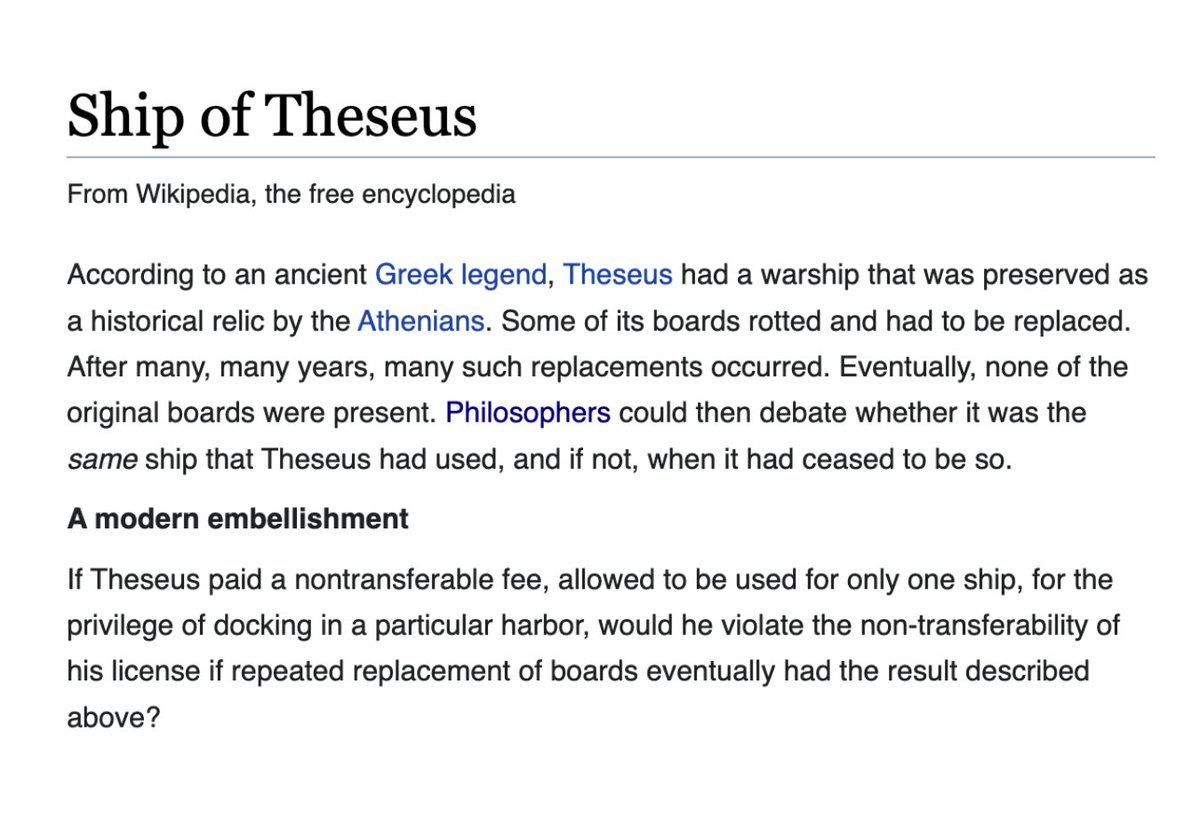
The "Ship of Theseus" article has been edited 1792 times since it was created in July of 2003. At present, 0% of the phrases in the original article (seen below) remain.
I mis-clicked on one of my 150 open tabs and it happened to be a tab that's been open since 2019 with a paper that has a solution to the exact research problem I've been puzzling over today. This is the moment I've been waiting for and I've decided to never close any tabs again
@blaglag11@verge The one tech publication and podcast I used to really enjoy has become overtly political and partisan. It always used to take the one side (you know which side) but only in passing, but now it’s a lot more pronounced 🤷🏽♂️😒
In an office at the NCA in Bangalore, Rahul Dravid must be watching and feeling proud of the India A and India U19 programs he's developed, which gave India their depth.
Then, he'll quietly get back to work planning the next series.