Reservation for poor, not caste: Protesters seek changes to quota system
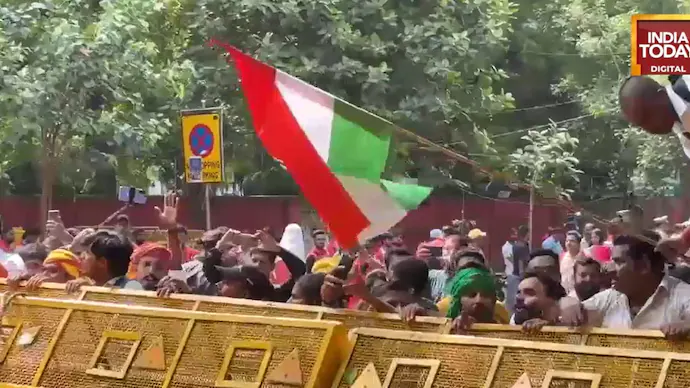
Members of an upper-caste group and many youths protested at Jantar Mantar on Friday over reservation and the SC/ST Act. They said quotas should be linked to economic status and warned the agitation could expand without action.
Read in detail: https://t.co/gN6RlFRIaN
#Delhi #JantarMantar #Protest
True. And they saw Lokmanya Tilak and other Brahmins in Bombay as taking forward the legacy of the Peshwas, and feared that they could inspire more people by drawing from the history of the Maratha Empire.
क्या आप जानते हैं?
जिन्ना, अम्बेडकर और पेरियार-ये तीनों मांग कर रहे थे👇
-पाकिस्तान (मुस्लिमों के लिए)
-द्रविडनाडू (द्रविड़ियन के लिए)
-बुद्धिस्तान (दलितों के लिए)
अम्बेडकर और जिन्ना ने ये तय भी किया था कि वो अप्रैल/मई 1940 में पेरियार के साथ तमिल इलाकों में दौरा करके, द्रविडनाडू की मांग का समर्थन करेंगे!
Source: The Historic Meeting of Ambedkar, Jinnah and Periyar (K.V. Ramakrishna Rao)
If you want to read about Roles and actions of Ambedkar during Indian Independence struggle and partitions with proofs attached .
Please look into this thread and judge accordingly :-
After grand success of 99% false cases already .
Now they are increasing incentive for filing false cases .
Free business for these gangs to extort money out of government funds and money from GC and OBC families in the name of Settlement .
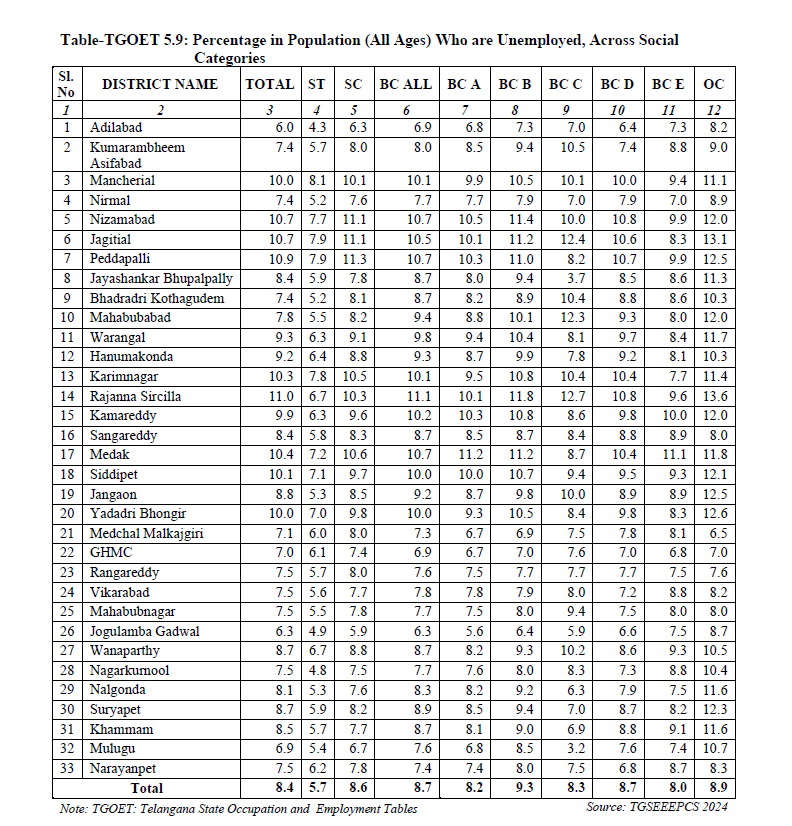
Telangana Caste Census (2025):
Recently, Telangana Government conducted a caste survey. Shocking results emerged out of it. The stats elucidate the reality and bust atrocity propaganda.
GC Hindus have the highest unemployment rate among all sections (8.9%).
Thread 🧵
The Meena community, which makes up only around 4.5% of the ST population, gets around 40% of the seats in the UPSC: @talk2anuradha
Around 81% of cases under the SC/ST Act are filed against OBCs...Data shows that reserved categories are involved in caste discrimination more than the general category. So, who is punishing whom?: @neha_laldas
Watch INDIA UPFRONT with @roypranesh.
The 'Creamy Layer' Debate
The ST and SC reservations both have an economic criterion. It is mentioned that economic backwardness is one of the criteria, which debunks the narrative that economic criteria cannot be used for sub-classification under SC-ST reservation: @neha_laldas
The big question is, when the reservation policy was brought with the intention, has that been fulfilled?: @dr_rkrajan tells @RoyPranesh
🚨 SHOCKING 🚨
A girl who scored 299.175 out of 300 in the Jharkhand PGT exam still remained UNSELECTED 🤯
“What more should a student do to get selected?” she asks.
That was absolutely chad .@ARanganathan72 🔥🔥
"I want resignation of Pradhan & also of education ministers of Karnataka & Punjab, over paper leaks"
Cockroach Dahiya: "This is whataboutery"
AR: "If 3 people have committed same crime, why are U demanding that only 1 be punished? Everyone must be held with same standard."
"Just keep eating your burger & enjoy"
That was lethal.😂😂😂
NEET-PG 2025, cut-off:
A) Orthopaedics seat filled at:
4 marks out of 800.
B) Obstetrics and Gynaecology seat:
44 marks out of 800.
C) General Surgery seat filled at:
47 marks out of 800.
D) Biochemistry:
minus -8 marks out of 800.
E) Transfusion Medicine:
10 marks out of 800.
F) Anatomy:
11 marks out of 800.
G) MS Orthopaedics seat filled at:
1 mark out of 800 in a medical college in Hyderabad.
H) MD Forensic Medicine seat filled at:
12 marks out of 800 in a Govt medical college.
I) MD Pathology seat filled at:
24 marks out of 800 in a Govt medical college.
In NEET-PG 2025, candidates with scores as low as –40 out of 800 were allowed to participate in PG counselling. A negative score was considered qualifying.
These extremely low scores, at which seats were actually allotted, indicate a serious crisis in academic standards. A reasonable minimum qualifying merit must be established to maintain the integrity of medical education and the healthcare system.
Forget about dialogue or discussion. So far, neither the Government nor the Opposition has said a word about this because it does not suit their agenda, and it would affect their vote banks and political interests.
Even those who are protesting today in the name of concerns about the education system are not addressing this issue because they too have political ambitions and know that speaking about it could cost them support rather than gain it.
Dear Chinmayi garu,
You wrote an open letter, but conveniently avoided the very question I raised.
I spoke about the double standards surrounding religious practices. You ignored the burqa comparison completely because answering it would expose the selective outrage.
Instead, you built a strawman- surgeons, recording studios, Afghanistan and every Hindu woman in the country.
Bandi Sanjay’s statement was about school students, not policing every woman in India.
If your principle is “no religious symbols in public institutions,” say it for every religion. If not, don’t selectively target Hindu traditions while remaining silent on others.
Equality cannot be selective. Secularism cannot be selective. Outrage cannot be selective.
India also does this to its students from general caste population through reservation. The only difference is that there is no criminal record involved. Only an assumption that something bad was done 3000 years ago by general caste people. Which makes it worst than what China did to this student.
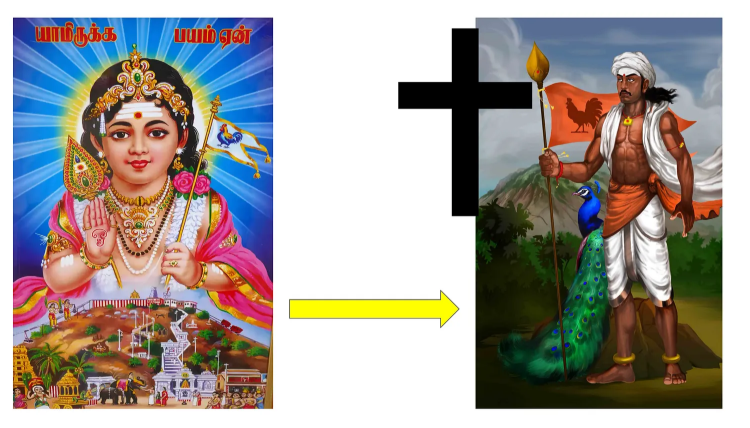
1/2 Poet Arivumathi’s Thamizh Murugan, now reported to be the inspiration behind @dhanushkraja and Vetrimaaran’s next film, has once again brought to the fore an old claim; that Murugan and Kartikeya were originally different deities, and that the former was later absorbed into Brahmanical Hinduism.
Is it sound history? The answer depends less on ideology than on evidence.
Every historical argument must begin with a simple questions:
What do the earliest sources say? Not what nineteenth-century theories imagined or what modern politics requires. What do the texts closest to the period actually tell us?
Surprisingly, none of the earliest Tamil works presents Murugan and Kartikeya as unrelated gods.
The Tolkappiyam, our oldest surviving Tamil grammatical work, associates Seyon (Murugan) with the Kurinji landscape. It establishes his place within the poetic universe of ancient Tamilakam, but nowhere does it contrast him with a northern deity named Skanda or Kartikeya. Such a distinction, so central to contemporary debates, is absent from the text itself.
The Tirumurukarruppatai describes Murugan as the youthful warrior carrying the Vel, riding the peacock, associated with the Krittikas, the son of Shiva, commander of the celestial hosts and six-faced. These are not isolated motifs. Collectively, they constitute the classical identity of Skanda as preserved in the Mahabharata and later Puranic literature.
The Paripadal continues in precisely the same direction. Murugan remains the son of Shiva, the radiant youth, lord of the spear and object of deep devotion. The poetry is unmistakably Tamil; the deity is unmistakably familiar to the wider Hindu tradition.
This is where the separation thesis begins to encounter difficulty.
If Murugan and Kartikeya were truly unrelated, why do the earliest surviving Tamil texts already describe Murugan through attributes that define Skanda in Sanskrit literature? Why is there no literary memory of two distinct gods existing side by side? Where are the debates, the competing myths, the attempts to distinguish one from the other?
History is often as revealing for what it does not say as for what it does.
Some argue that Murugan was an older Tamil deity who was later identified with Skanda. That is certainly possible as a hypothesis. Regional cults existed throughout India, and every major Hindu deity absorbed local traditions over centuries. But a hypothesis is not evidence.
The leap from “Murugan had ancient Tamil roots” to “Murugan and Kartikeya were different gods” is precisely that—a leap.
By the same logic, one would have to argue that Jagannath was once unrelated to Krishna because Odisha developed a distinctive theology around him, or that Nataraja was once separate from Shiva because Chidambaram imagined him through dance. Few historians would accept such reasoning.
The sharp opposition between “Tamil Murugan” and “Sanskrit Kartikeya” owes much to colonial-era scholarship, which habitually divided Indian civilisation into Aryan and Dravidian spheres and interpreted every shared tradition as the outcome of conquest, appropriation or cultural domination. Those models profoundly shaped twentieth-century discourse, but they should not be mistaken for established historical fact.
None of this diminishes Murugan’s uniquely Tamil identity.
Tamil civilisation gave Murugan some of the greatest devotional poetry in the world. It gave us the emotional universe of Valli, the sacred geography of the Arupadai Veedu, the symbolism of the Vel and a living tradition that continues to define Tamil spirituality. That heritage deserves celebration.
But celebrating Murugan’s Tamil character is not the same as denying his identity as Skanda or Kartikeya.
Ancient India did not struggle with this supposed contradiction.
Tamil poets did not, nor did the composers of the Puranas.
Neither did Temple builders or the pilgrims.
This is not some exaggeration pulled out of thin air. This "Your Gods were historic men/kings" is their 1800 year playbook to reduce immortal pagan gods to mere mortals. Its called Euhemerism.
They called pagan god Zeus as a historical king. King, but mortal, not even god in small letters. Now they are calling Kadavul Murugar as a Mupaatan/King of an evidence-less geographic place called Kumari Kandam. The more things change, the more they are the same.
Detailed essay by @maa_bhaishiiH in comments, for those interested in the history of this playbook.