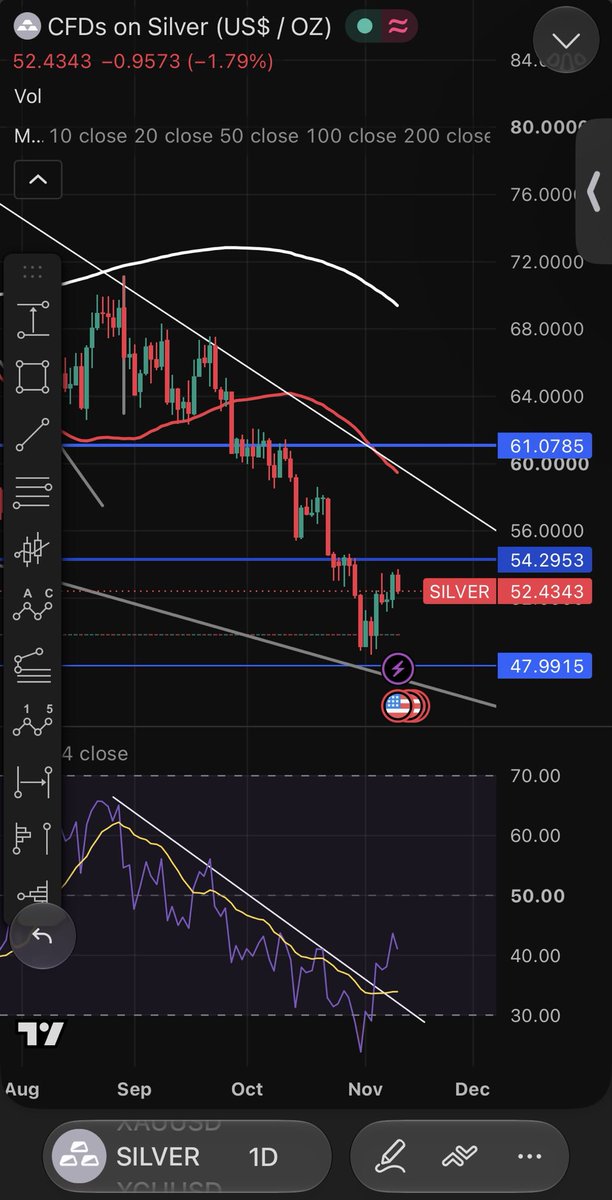
#Silver COT: managed money net long just 4k contracts, 4th percentile of 3 yrs (was 14k in Sept). Spec shorts doubled to 13.5k while commercials cut to their lightest net short in 6 months. Washed-out positioning = squeeze fuel.
Don't miss this article🚨
Rick Rule: #Uranium Equities Are Disconnected From Fundamentals, #Gold Stocks Are Cheap, and a Massive M&A Wave Could Be Coming
Read now⬇️
https://t.co/faSrOrYTGs
@RealRickRule
This month is our 4th Year Anniversary of launching @TheLongInvest
Since then:
- I have uploaded over 21,000 Charts to my private Patreon group
- Shared +100 Deep Dives
- Shared over +200 Videos
- Shared 360 Fundamental Analysis
- Tweeted 25 times a day (every day)
- Grown my X account from 3,000 to 277,000
- Interviewed Multiple CEO's
- I have the Number 1 Finance page on Patreon
- We have a large team based in 4 different countries
- Created a Multi-Million Dollar company
- Have a better market performance than every single fund on the Street.
- Our Top 20 list, if it were a ETF, would be the best performing ETF in the market over the last 4 years
- And I charge the lowest fees, as we are not performance percentage based.
We are completely independent and have our own in house analysts that can’t be influenced.
And there is no delay when we issue our Buy and Sell alerts, unlike the 3 month delay for superinvestors.
You can’t compete with this
I work 12-14 hours every day and enjoy every minute of it.
Join the movement:
https://t.co/l5G3BOPh5i
THE BIG URANIUM ANALYSIS IS HERE!
I’ve published an extensive article featuring Mike Alkin of Sachem Cove Capital Management, breaking down the #uranium market’s structural supply challenges. We cover dwindling inventories, fading secondary supply, soaring mining costs, utility under-contracting, delayed projects, Kazakhstan’s potential strategic uranium reserve, US national security demand, Project UPRISE, and the outlook for utility contracting, uranium prices, and equities. Featuring key insights and charts from Mike’s October 2026 NEI presentation, this article examines why the market may be underestimating the scale of the coming supply gap. A must-read for uranium investors! 👇
https://t.co/iVOSQ0qhUl
Today's uranium buyers should take a few hours to see what lessons they can learn from Westinghouse's uranium experience in the 1971-1975 period.
In the late 60s and early 70s, after several years of slowly falling uranium prices, Westinghouse assumed that past trends in uranium prices adequately predicted future trends. They didn't consider the effects that their own behavior was having on the market as they continued selling and building massive new nuclear plants.
They even included a few fuel reloads with each reactor they sold, believing that the inclusion was a low cost, low risk sales incentive. Their big mistake was failing to contract for adequate volumes of uranium to fulfill their fuel promises. They planned on being able to buy whatever they needed from the spot market at the time that they needed it.
The fuel buyers had no idea that they were engaging in uncovered short sales or the risk that is associated with such a trading strategy.
By 1975, uranium prices had skyrocketed, approximately quadrupling in just a few years. Westinghouse was facing a liability totaling several billion dollars - in nominal, non inflation-adjusted 1970s dollars. It reneged on its contracts, making firm enemies of its large utility customers. They sued Westinghouse; Westinghouse sued uranium suppliers. Circle W executives spent half a decade in the resulting litigation. It wasn't resolved until the 1980s.
A Dec 1977 article in the New York Times described the lawsuit filed by utilities against Westinghouse as "one of the biggest private lawsuits ever filed."
There are entire books on the 1970s uranium saga collecting dust in publicly accessible libraries - and in at least one private library.
Consuming uranium while knowing that you need to keep consuming uranium without also contracting for replacement uranium comes very close to the same short selling strategy and carries similar risks.
When operating companies begin desperately needing new uranium to keep they multi-billion dollar assets in revenue service, they will end up paying whatever the suppliers ask them to pay.
As many of U know, Mike Alkin - CIO of @SachemCove Capital Management - is IMHO the Godfather of the #Uranium sector investing thesis🧙♂️⚛️⛏️💰 who way back in 2018 began giving investor conference presentations outlining his well-researched belief that fuel buyers are being overly complacent & suffering with recency bias in their expectations that their future reactor fuel needs can be easily met by new emerging uranium supply at a low cost, especially with their reliance on Kazakhstan to flood the market with cheap uranium for decades to come.♒️😆
🧮He's spent thousands of hours crunching the numbers, definitively making the case that the coming uranium bull market will make a lot of investors very wealthy as prices skyrocket far beyond the old unrealistic conservative estimates tossed around by fuel market analysts with their head in the sand.🙈
👨💼When he gave his presentation to a room full of fuel buyers back in 2019 at the NEI's International Uranium Fuel Seminar he was basically laughed out of the room, dismissing his numbers and conclusions as ridiculous.🤡
Now, 7 years later, as the Spot price has since risen nearly 4X from $25 to $90 and the long-term contract price has steadily soared to an all-time industry high of $97/lb, he just gave the same group a new presentation, IMHO his best ever!🌟👨💼 This time, instead of laughter, the room was filled with the worried faces of fuel buyers who, having ignored his 2019 warnings, are now facing a deep structural supply deficit in a "seller's market" with producers demanding ceiling prices in new long-term supply contracts at $150-160 or with no ceilings at all! Laughter was notably absent.🦗😒
Below is a synopsis of Mike's presentation. I've not been given permission to publicly post his proprietary charts and graphics so will instead just share with you the key points in his talk. I hope he doesn't mind, but I am posting 1 slide of his that will blow your mind!🤯
THE DIE IS CAST ON URANIUM’S COST CURVE. WHAT THE LOWEST COST PRODUCER JUST TOLD YOU ABOUT EVERYONE ELSE
"For a decade, the industry met today’s reactor requirements with uranium produced yesterday. What happens when that bridge is gone?"
WHAT THE MARKET BELIEVED
SUPPLY: Inventory liquidation and underfeeding could keep filling the gap.
COST: Historical mine economics were a reasonable guide to future supply
Over the past decade fuel buyers have been lulled into believing that Uranium supply has been in a structural surplus when in fact, due to the misleading way the industry consultants count inventory drawdown as "supply", the market has been under-supplied.🗜️
Actual new mined uranium coming into the market versus that consumed by reactors was ~58 Million lbs below requirements from 2016 to 2025, while the drawdown of stockpiles and supply from underfeeding was counted as 172 Million lbs of supply over the same period, giving fuel buyers the false illusion of a +115 Million lbs supply surplus.😳
The thing is, stockpiles are finite. Once they are sold, they're gone. Underfeeding is a source of supply when SWU is cheap and enrichment demand is low, but now SWU prices have skyrocketed and demand is high, so enrichers are switching from underfeeding to overfeeding, which is drastically reducing that source of "secondary supply" from 11% to less than 2% of global supply over the next 5 years.
In 2017, industry consultant forecasts estimated 10 years of 8M lbs per year from inventory drawdowns as "supply", but actual drawdowns have been 29M lbs per year providing 14% of global supply! As stockpiles have depleted, that misleading source of supply is becoming scarce.🏜️
Then the market delivered its verdict
"Uranium prices rose sharply despite a market widely characterized as adequately supplied. If the market was truly oversupplied, why did price rise?"😲
The 2016 the consensus estimates showed a 115M lb surplus. Prices more than tripled anyway. Commodity prices don’t do that in a market that is truly oversupplied.
Houston –We Got A Problem –Mining Costs Are Soaring 🚀🌜
“You can’t run a mine if you can’t afford to run a company. The cash cost of mining a pound is not the economic cost of sustaining a business."
Since 2018 the reported C1 cash costs for Kazatomprom, the world's lowest cost miner, have soared +127%, but that increase is actually +227% if the mask of currency depreciation is removed. 2026 C1 cash cost guidance is +150% higher than in 2018.⏫
Over the same period, Kazatomprom's All-In Sustaining Costs have soared +164%, a staggering +280% with that currency depreciation mask removed. 2026 AISC guidance is +182% higher than 2018.⏫
However, their realized Uranium prices have risen just +99% over that same timeframe. AISC has risen far faster than the prices realized in their sales.
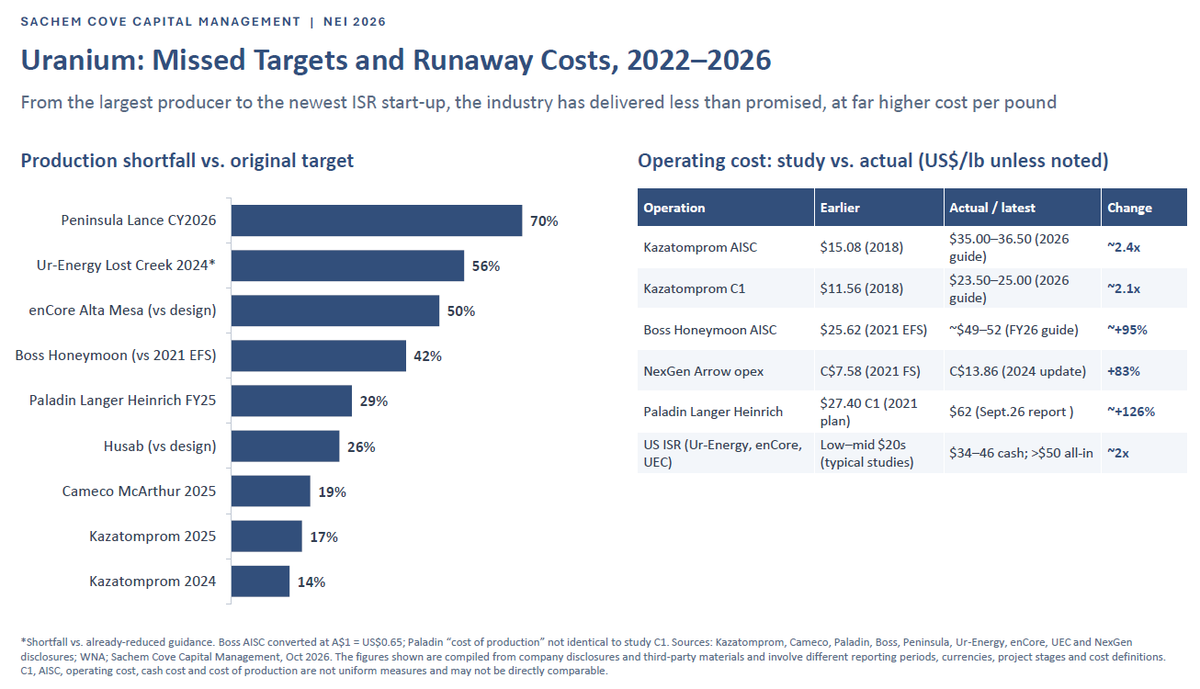
Uranium: Missed Targets and Runaway Costs, 2022–2026
From the largest producer to the newest ISR start-up, the industry has delivered less supply than promised, at far higher costs per pound.
Production shortfall vs. original target:
Peninsula Lance CY2026 ⬇️ -70%
Ur-Energy Lost Creek 2024 ⬇️ -56%
enCore Alta Mesa (vs design) ⬇️ -50%
Boss Honeymoon (vs 2021 EFS) ⬇️ -42%
Paladin Langer Heinrich FY25 ⬇️ -29%
Husab (vs design) ⬇️ -26%
Cameco McArthur River 2025 ⬇️ -19%
Kazatomprom 2025 ⬇️ -17%
Kazatomprom 2024 ⬇️ -14%
Operating costs: study vs. actual:
Kazatomprom AISC ⬆️ ~2.4x
Kazatomprom C1 ⬆️ ~2.1x
Boss Honeymoon AISC⬆️ ~+95%
NexGen Arrow opex ⬆️ ~+83%
Paladin Langer Heinrich ⬆️ ~+126%
US ISR (Ur-Energy, enCore, UEC) ⬆️ ~2x
You Can’t Run A Mine if You Can’t Sustain The COMPANY
"In 2019, At This Conference, I Argued The Industry Cost Curve Was Wrong As it Excluded A Lot of The Costs Uranium Companies Incur."
There are 3 very different costs for mining uranium:
01 CASH COST
What it costs to produce the next pound today.
02 ALL-IN SUSTAINING COST (AISC):
World Gold Council framework: operating costs plus sustaining capital, corporate overhead, sustaining exploration and reclamation. What does it cost to sustain production today?
03 FULL-CYCLE INCENTIVE PRICE
What a new mine must earn to recover development capital, financing costs and a risk-adjusted return. What price finances replacement supply?
YOU CANNOT SUSTAIN AN INDUSTRY ON CASH COSTS —OR BUILD NEW MINES ON AISC ALONE.
“New Realities are signaling that the era of cheap uranium is fading away “
MeirzhanYussupov, CEO Kazatomprom, August 21, 2026, Half-year results call
Producers Now Require Higher Prices Given Cost Structures Have Risen Materially and to Make Up for a Decade of Poor Returns to Investors During a Low-Price Environment
Over the past 5 years the average production cost estimates for major western producing uranium mines have doubled from ~20/lb to ~40/lb
Those fuel buyers still holding out for lower prices will need to see the industry magically reverse course.🪄📉↪️📈🤪
1 Existing mines must deliver the assumed production volumes.
2 New mines must start and ramp on the modeled schedules.
3 Secondary supplies must remain available in modeled quantities.
4 Incremental supply must be financeable at prevailing contract prices.
History Rhymes
Uranium prices soared during the last bull market cycle despite looming surpluses.
This cycle, there are supply deficits and rapidly shrinking secondary supply.
Global investment banks are now forecasting supply deficits in each of the next 10 years:
~10 Million lbs (4% of global demand) in 2026 growing to over 45 Million lbs (18% of demand) in 2035
BUT, Utilities have only signed supply contracts for on average 55% of their total reactor fuel requirements since 2015, far below that needed to replace the fuel being consumed each year.⚠️
Given how much the economic and strategic realities of uranium have changed over the past decade, as Nuclear fuel demand has shifted from an expected decline to surprisingly strong global growth, how high must uranium prices rise to prevent supply from disappearing? 🤔💲🛢️☢️
Are prices high enough to finance the uranium supply the world needs tomorrow?
Can new mines get built on on-time? Can they get financed? At what cost of debt? Do financing costs make prior assumptions more difficult to achieve?
What gives fuel buyers comfort that certain pounds from new mines will be offered to them for use in reactors?
What gives fuel buyers comfort that the strategic value of pounds from potential mines is not more valuable staying in the ground for longer than projected than producing at a time the utilities want and need?
What happens IF?
SUPPLY FORECASTS ARE TOO OPTIMISTIC
Project delays, slower ramp-ups and fewer deliverable pounds than forecast.
SECONDARY SUPPLY SHRINKS FASTER
Inventory drawdowns and underfeeding cannot bridge the gap at historical rates.
INCENTIVE PRICES ARE TOO LOW
New mine commitments slip while the capital and development clock keeps running.
The risk to fuel buyers today is not simply a higher uranium price. It's discovering too late that expected supply cannot arrive on time!
In closing, Mike offers up what sounds like his final warning to fuel buyers:
The cost of securing supply early is visible. The cost of discovering a shortage too late may be much greater. ⚠️😱
In other words... if fuel buyers continue to hold out for unrealistic lower uranium prices that have a snowball's chance in hell of materializing, instead of going full-on into replacement-rate contracting now at the prices and terms being asked by producers, then the mines those fuel buyers are counting on in future may not ever go into production! The risk then is that reactors will not get the fuel they need, at any price. The choice is theirs.🎭
IMHO... No matter the choice, uranium prices are going much much higher. History rhymes.
The end. Cheers and best of luck with your investments! ☘️🌈💰🤠🐂
🤔The No. 1 question I get from frustrated investors is:
"By every metric, the underlying #Nuclear fundamentals are extremely bullish, as plain as the nose on your face👃 yet #Uranium#stocks have been beaten down to severely oversold levels. Why?"🤪 Here's my take:
The Uranium space is tiny compared to other sectors, with high levels of volatility and a very high risk investment profile.⚠️ As a result, it gets treated as a small "add on" by fund & institutional portfolio managers, hedge funds, family offices and high net worth investors. They don't build separate portfolios just to hold their small uranium stocks & ETFs exposure.🦐
Instead, they put their uranium holdings into other baskets of investments.🧺 Some see U as an AI picks & shovels play with Nuclear power, so they put their U sector holdings in their AI baskets.🧺🤖
Others see U as a mining & metals play, so they put their U holdings inside their gold, silver, copper and other mining & metals baskets.🧺⛏️🪙
As uranium is the fuel for Nuclear reactors, they also put U stocks & ETFs in their oil & natgas energy baskets.🧺🛢️☢️
U can see the problem with that.😧 If any one of those sectors gets dumped by those portfolio managers, it ends up driving down uranium stocks as "collateral damage" with baskets getting tossed for reasons completely unrelated to the extremely bullish U sector fundamentals!🧺🤖⛏️🪙⤵️🗑️
Since Trump launched his war on Iran, energy prices have soared, as have US Treasury yields to 24 year highs, while metals prices have tanked and investors have gone "risk off."😱 Portfolio managers have been dumping their high risk mining & metals baskets as the costs of production & financing have risen while commodity prices have fallen (except for Uranium prices which remain at a record high for term contracts).🧺⛏️🪙⤵️🗑️
At the same time we see investors taking profits and rotating out of the AI boom, concerned about debt levels & CAPEX requirements amidst uncertain profit outlooks.😟 AI added an extra tailwind to the Uranium bull case, but as portfolio managers dump their AI baskets they end up dumping their U sector holdings at the same time, regardless of the U sector's bullish outlook.🧺🤖⤵️🗑️
On top of that you have Trump's irrational trade war launched against Canada.🦧 The major western uranium producers & developers are in the ultra high-grade Athabasca Basin... Cameco, NexGen, Denison et al... based in Canada.🇨🇦 Small explorers & developers trade primarily on Canada's TSX Venture high-risk speculative resource exchange.🎢 When investors saw uncertainty around Canada's ability to win this trade war (while Alberta was toying with the idea of separation) many exited their high risk U stocks positions until they see more certainty returning.🧺⚛️⛏️⤵️🗑️
U see... the convergence of AI, risk-off, mining & metals sell-offs since January has led to U stocks & ETFs becoming "dramatically oversold" while the fundamentals for the U sector have continued to grow more bullish on a daily basis, now the strongest they've been since the 1980s as the world turns to Nuclear to mitigate climate change, find energy security amidst a global energy crisis and provide the essential 24/7 reliable carbon-free electricity needed to fully enable the AI revolution.💪⚛️⛏️
Eventually the tide will turn as the very compelling investment case for Uranium becomes too extreme to ignore.🤑 It's anyone's guess as to when that happens and what new catalyst will trigger what is setting up to be a rapid & powerful Uranium bull run for the history books.⚛️⛏️🚀🌜 All we know is that it is imminent, with more explosive violent upside potential than ever before when launched from such extremely oversold levels.💣💥💰💰
Just my own analysis & opinions.🕵️ Yours may be different.🙃 That's what makes a market.🎭 Good luck with your positioning & bottom feeding as we await the inevitable U sector turn!🦈🌊🏄🤠🐂
@blindpig_1966@capnek123 I own some U equities, deep underwater but got used to it before the last run; I do think market will tank, U equities should get obliterated then, I am going to deploy a good chunk of my cash into these then. If that won’t happen, I still own some