China has launched its first fully automated humanoid‑robot production line in Foshan, Guangdong Province, with an annual capacity of up to 10,000 robots.
Manufacturing a single robot takes only about 30 minutes, thanks to high‑precision digital technologies that have boosted efficiency by 50%.
The robots undergo 77 inspection stages to ensure safety and quality, and the line can flexibly produce a variety of models.
In my past research experience, finding or developing an appropriate simulation environment, dataset, and benchmark has always been a challenge. Missing features, limited support, or unexpected bugs often occupied my days and nights. Moreover, current simulation platforms are relatively fragmented—making it challenging to replicate the success of the RT-X dataset in unifying community efforts.
Introducing RoboVerse, we provide a unified platform, dataset, and benchmark for scalable and generalizable robot learning. We hope to build a shared foundation to combine the community efforts. RoboVerse includes:
MetaSim: We carefully designed a configuration system and a universal interface to align current robotic simulators. With MetaSim, you can use any simulator with the same code—bringing together the community’s diverse efforts under one framework!
RoboVerse Dataset and Benchmark: We unify popular simulation environments and benchmarks into a single cohesive system and introduce the RoboVerse dataset—a large-scale, high-quality synthetic dataset. Additionally, we propose a standardized benchmark across both imitation learning and reinforcement learning.
A cool feature enabled by our unified framework: Hybrid Simulation! You can now integrate physics engines and renderers from different simulators—e.g., using MuJoCo precise physics with Isaac photorealistic rendering. This not only elevates simulation fidelity but also significantly enhances real-world transfer performance across complex robotic applications.
Hopefully, our team’s efforts could serve the robotic community to thrive vibrantly in the years to come.
RoboVerse is open-sourced🥳!!!
Project Page: https://t.co/IJR1iuEW1L
Documentation: https://t.co/7Ff4uhbJR0
Github Repo: https://t.co/iLRpjSNokQ
Paper: https://t.co/LUMJrd6i5I
Despite great advances in learning dexterity, hardware remains a major bottleneck. Most dexterous hands are either bulky, weak or expensive.
I’m thrilled to present the RUKA Hand — a powerful, accessible research tool for dexterous manipulation that overcomes these limitations!
I'm going to call it right now. A lot of stuff is going to break on this mission.
By design.
As part of the plan.
Don't get upset. I'm not saying SpaceX plans to fail. I'm pointing out that SpaceX has taken an ultraimportant principle from software engineering, and realized it applies to all engineering.
Feedback beats planning.
And that, you see, is why SpaceX doesn't do things the NASA way. The NASA way was to gold-plate everything, plan and test and plan and test, and generate mountains of paper detailing every contingency, with every scenario prepared for.
SpaceX just shrugs, says "it's unmanned", and sends it.
Half the time it blows up. That's the whole point. They don't actually want it to blow up, of course, but they're anticipating that it might.
That possibility is part of the plan. Because one rocket blowing up, or crashing, in an actual end-to-end test, beats many, many man-years of planning and plotting.
The key realization here is that knowledge only comes from empirical observation. Everything else is just speculative.
The sooner you get into a feedback loop, and the faster you run it, the more iterations you can do in less time. This means, while others are planning and speculating, you actually learn something.
Relevant data is the most precious thing in the universe. And it's worth blowing up any number of rockets to get it.
Because rockets are just stuff. They're just made of stuff. And you can always get more stuff.
You can never get more time.
So expect to see a lot of things go wrong on this, and other SpaceX missions. Anticipate it. Accept it when it happens. Doesn't mean the dream of the stars is dead.
It just means we're doing it cowboy style.
This is a valuable lesson for our own lives. If there's something you want to do, something you want to try, some goal you have, it's easy to dip a toe in the water, test the temperature, and plan. A lot.
Planning makes us feel good if we're afraid. Because it provides us with the illusion of security. Never mind that we don't know which scenarios are actually going to happen, never mind that we're planning for the wrong thing, planning makes us feel safe. And if we're nervous, we can plan forever.
But the difference between the expert and the novice isn't theory or intelligence or plans. It's relevant domain knowledge. Gathered from empirical observation.
So the trick is to get into that feedback loop as soon as possible, and run it as fast as possible. Give yourself the most possible opportunities to learn, per unit time.
We only learn while we are moving.
Please see this important update on my client @RubenVardanyan_’s situation. One week later, his blood pressure is up to 140/11 and he has lost six kgs (13 lbs) & the #Azerbaijan military court refused five motions to postpone the trial and insisted Ruben attend, despite his being on the verge of passing out. #HumanRights
I don’t want to connect my coffee machine to the wifi network. I don’t want to share the file with OneDrive. I don’t want to download an app to check my car’s fluid levels. I don’t want to scan a QR code to view the restaurant menu. I don’t want to let Google know my location before showing me the search results. I don’t want to include a Teams link on the calendar invite. I don’t want to pay 50 different monthly subscription fees for all my software. I don’t want to upgrade to TurboTax platinum plus audit protection. I don’t want to install the Webex plugin to join the meeting. I don’t want to share my car’s braking data with the actuaries at State Farm. I don’t want to text with your AI chatbot. I don’t want to download the Instagram app to look at your picture. I don’t want to type in my email address to view the content on your company’s website. I don’t want text messages with promo codes. I don’t want to leave your company a five-star Google review in exchange for the chance to win a $20 Starbucks gift card. I don’t want to join your exclusive community in the metaverse. I don’t want AI to help me write my comments on LinkedIn. I don’t even want to be on LinkedIn in the first place.
I just want to pay for a product one time (and only one time), know that it’s going to work flawlessly, press 0 to speak to an operator if I need help, and otherwise be left alone and treated with some small measure of human dignity, if that’s not too much to ask anymore.
📊 The deep tech landscape for robotics and autonomous systems is thriving! This market map showcases top players in sectors like industrial robots, warehouse logistics, humanoid systems, agriculture, aerial delivery, and more. 🚀#Robotics#AutonomousSystems#AI#CES2025
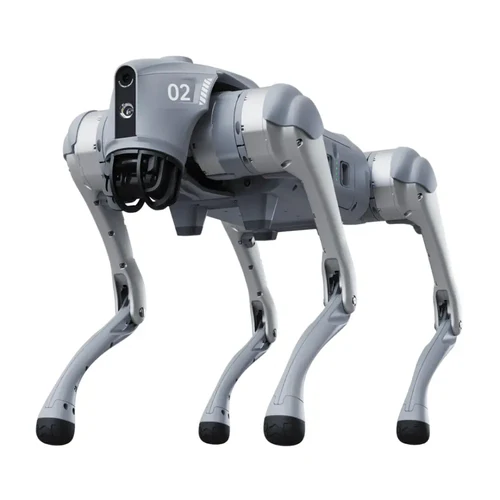
How can @BostonDynamics compete with @UnitreeRobotics? The Chinese firm's robot dogs cost less than 1/10th as much and, as recent videos have shown, are capable of way more nimble and speedy movement.
I'm getting PTSD flashbacks to 3DR competing with DJI in drones. It was near impossible. The Chinese hardware supply chain is just too good and cheap
https://t.co/yJVbvnU7C6
March of the humanoids still has some way to go https://t.co/ANaPDEehSA via @ft Payback is swift. Even on a $35,000 price tag and (US) minimum hourly wage of $7.25, upfront costs — based on a 96-hour working week — are recouped in under a year, says Citi.
Step into the heart of our factory, the "War Room". Our Xiaomi Hyper IMP (Intelligent Manufacturing Platform) is the brain of the operations, proactively solving issues and optimizing production.😎
"oil reserves [has] defined geopolitics for the last five decades. Where the technology supply chains are, and where semiconductors are built, is more important for the next 5 decades" https://t.co/vClTIWr30A