@Ohiocovid1@CaitlinPacific Saw this post, just did an app search on my laptop and Copilot is there, without my permission. Uninstalled. Scrolled down to see this 2 version post, searched again... AND THERE'S ANOTHER COPILOT. WHAT IS THIS?!
Jennifer Doudna won the Nobel Prize for gene editing and went on Bloomberg to say the chatbots everyone is betting on cannot innovate at all. Every promise Silicon Valley is making about AI curing disease just hit the one person qualified to check it.
She has spent her whole career inside the actual frontier of curing disease.
So when she talks about what AI can and cannot do in biology, she is not guessing. She is reporting from inside the lab.
Her words were blunt. She is not seeing chatbots innovate. They summarize data. They write reports. They do not come up with a brand new idea nobody has ever had.
Then the interviewer pushed. So you're saying AI can't innovate?
Doudna did not flinch. She does not know if it can't. She just does not see it doing it right now.
This lands harder when you remember who is making the opposite case. Sam Altman says AI will eliminate disease within five years. Larry Ellison says AI will cure cancer in a 48 hour window.
An OpenAI executive even floated that the company should get a cut of sales on any drug discovered through ChatGPT. Doudna answered that in two words. Good luck.
Even the cancer specialists Altman is selling to keep warning that cancer is not one disease but hundreds, each needing its own cure, and that compute does not skip the years of lab work.
Her reason is simpler. Biology is hard. You cannot simulate your way to an understanding of the human body.
The people promising cures are the ones selling the tool.
The person who actually won a Nobel building them is telling you it has not happened yet.
Source: Bloomberg Originals
Watch the full video on their official channel.
The less Great Books-y, in general more academic faction in here seem skeptical or hostile to this political orientation to the Classics. They are interested in the scientific approach to uncovering the truth lying behind ancient texts:
Dorothy Sayers wrote popular theological essays with a remarkable ear for how people heard words. She had worked in advertising, had written for radio, and had translated Dante for readability without down-dumbing.
Let me trace the timeline here because nobody's connecting it.
Step 1: Scrape the entire internet. Every book, every article, every conversation, every piece of art, every forum post. Do it without asking. Do it without paying.
Step 2: Train a model on all of it. Call it "artificial intelligence."
Step 3: Go to BlackRock's Infrastructure Summit and announce: "We see a future where intelligence is a utility, like electricity or water, and people buy it from us on a meter."
Step 3 is where you sell people's own knowledge back to them. On a meter.
They took the collective output of human thought, compressed it into a model, and now they want to charge you by the token to access a version of what you and everyone you know already created.
One Reddit user put it perfectly: "They stole all this data from us, the people, our life's work, creativity, art, by devouring the internet and blowing through all copyright laws. Now they want to sell it back to us in the form of a utility."
Imagine if someone photocopied every book in the public library, burned the library down, and then opened a subscription service for the copies.
That's the metered intelligence business model.
And they're pitching it to infrastructure investors as though they invented water.
To clarify no one in these conversations thinks there is more than one God in the contemporary sense. What we think is that there is one God, Father, Son & Holy Spirit, who created all things visible and invisible.
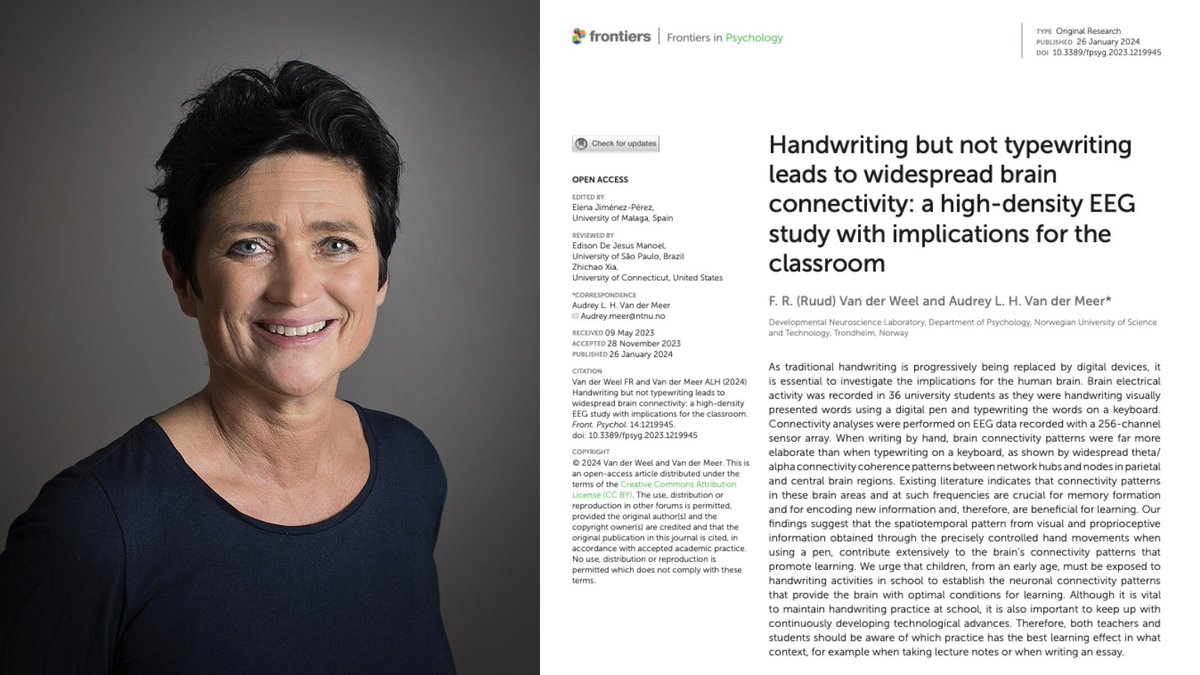
A Norwegian neuroscientist spent 20 years proving that the act of writing by hand changes the human brain in ways typing physically cannot, and almost nobody outside her field has read the paper.
Her name is Audrey van der Meer.
She runs a brain research lab in Trondheim, and the paper that closed the argument was published in 2024 in a journal called Frontiers in Psychology. The finding is brutal enough that it should have changed every classroom on Earth.
The experiment was simple. She recruited 36 university students and put each one in a cap with 256 sensors pressed against their scalp to record brain activity. Words flashed on a screen one at a time.
Sometimes the students wrote the word by hand on a touchscreen using a digital pen, and sometimes they typed the same word on a keyboard. Every neural response was recorded for the full five seconds the word stayed on screen.
Then her team looked at the part of the data most researchers had ignored for years, which is how different parts of the brain were communicating with each other during the task.
When the students wrote by hand, the brain lit up everywhere at once.
The regions responsible for memory, sensory integration, and the encoding of new information were all firing together in a coordinated pattern that spread across the entire cortex. The whole network was awake and connected.
When the same students typed the same word, that pattern collapsed almost completely.
Most of the brain went quiet, and the connections between regions that had been alive seconds earlier were nowhere to be found on the EEG.
Same word, same brain, same person, and two completely different neurological events.
The reason turned out to be something nobody had really paid attention to before her work. Writing by hand is not one motion but a sequence of thousands of tiny micro-movements coordinated with your eyes in real time, where each letter is a different shape that requires the brain to solve a slightly different spatial problem.
Your fingers, wrist, vision, and the parts of your brain that track position in space are all working together to produce one letter, then the next, then the next.
Typing throws all of that away. Every key on a keyboard requires the exact same finger motion regardless of which letter you are pressing, which means the brain has almost nothing to integrate and almost no problem to solve.
Van der Meer said it plainly in her interviews.
Pressing the same key with the same finger over and over does not stimulate the brain in any meaningful way, and she pointed out something that should scare every parent who handed their kid an iPad.
Children who learn to read and write on tablets often cannot tell letters like b and d apart, because they have never physically felt with their bodies what it takes to actually produce those letters on a page.
A decade before her, two researchers at Princeton ran the same fight using a completely different method and ended up at the same answer. Pam Mueller and Daniel Oppenheimer tested 327 students across three experiments, where half took notes on laptops with the internet disabled and half took notes by hand, before testing everyone on what they actually understood from the lectures they had watched.
The handwriting group won by a wide margin on every question that required real understanding rather than surface recall.
The reason was hiding in the transcripts of what the two groups had actually written down.
The laptop students typed almost word for word, capturing more total content but processing almost none of it as they went, while the handwriting students physically could not write fast enough to transcribe a lecture in real time, which forced them to listen carefully, decide what actually mattered, and put it in their own words on the page.
That single act of choosing what to keep was the learning itself, and the keyboard had quietly skipped the choosing and skipped the learning along with it.
Two studies. Two countries. Same answer.
Handwriting makes the brain work. Typing lets it coast.
Every note you have ever typed instead of written went into your brain through a thinner pipe. Every meeting, every book highlight, every idea you captured on your phone instead of on paper was processed at half depth.
You did not forget those things because your memory is bad. You forgot them because typing never woke the part of the brain that would have made them stick.
The fix is the thing your grandmother already knew.
Pick up a pen. Write the thing down. The slower road is the faster one.
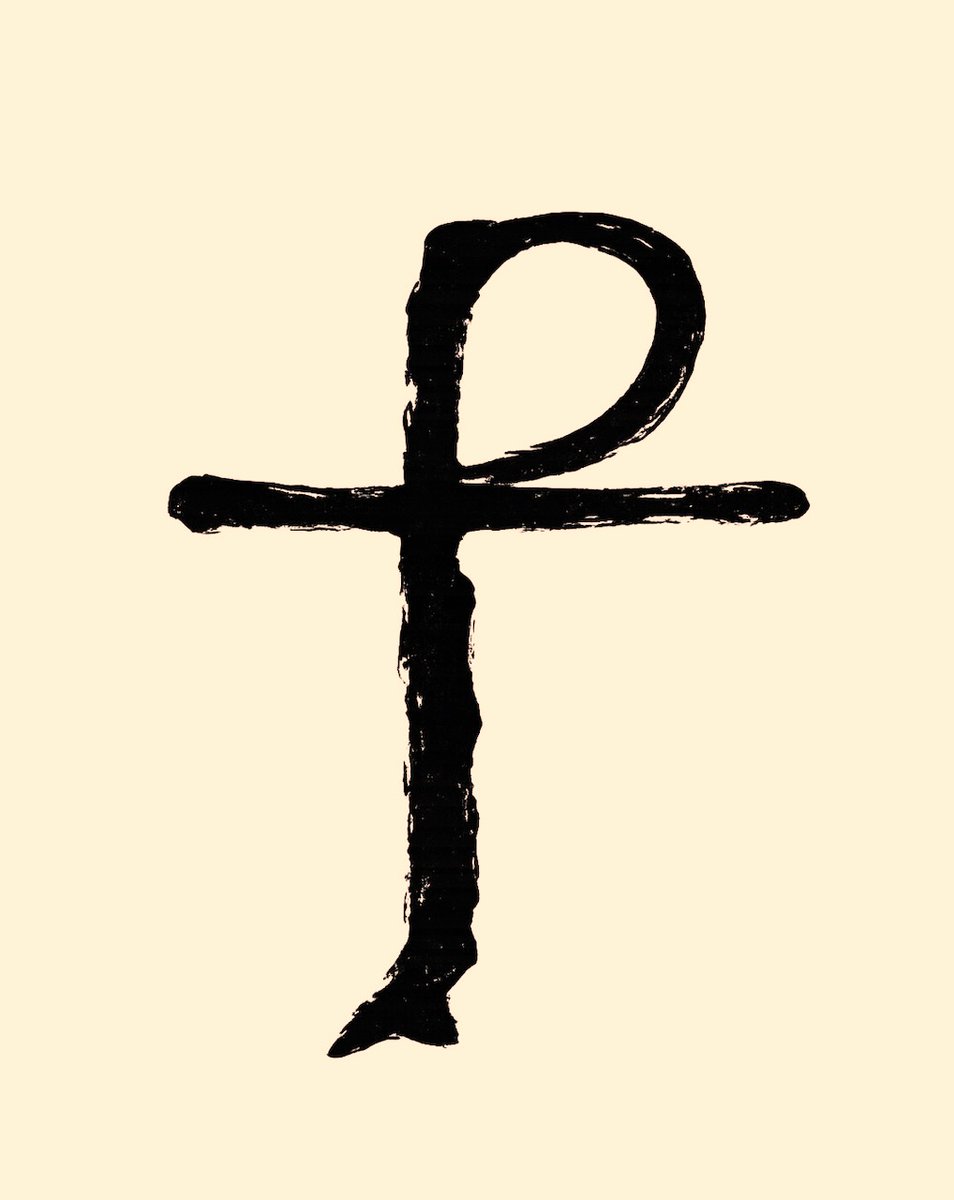
This is likely the earliest Christian symbol, exactly as it appears in the oldest manuscript of the Gospel of Luke (c. AD 200). It is a clever ligature — superimposing the Greek letters tau (Τ) and rho (Ρ) to depict a man hanging on a cross. Even better, the scribe formed this image within the Greek word for "cross" (ΣΤΑΥΡΟΣ, stauros) in the words of Jesus: "Whoever does not carry their cross and follow me cannot be my disciple" (Luke 14:27). And, yes, this is my next T-shirt.
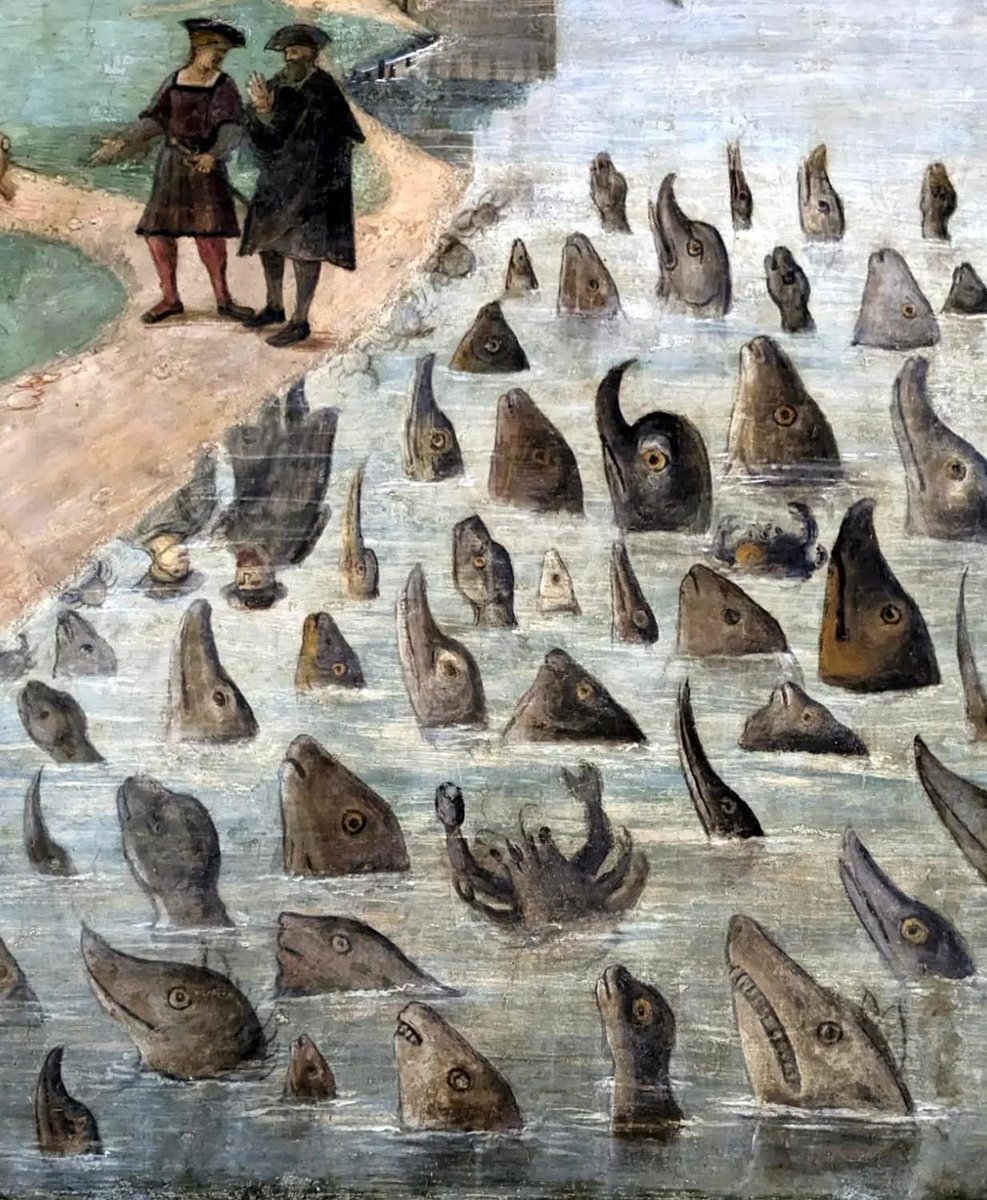
Saint Anthony Preaching to the Fish in Rimini, detail, 1518, fresco, anonymous painter from the circle of Gerolamo Tessari, Basilica di Sant’Antonio, Padua
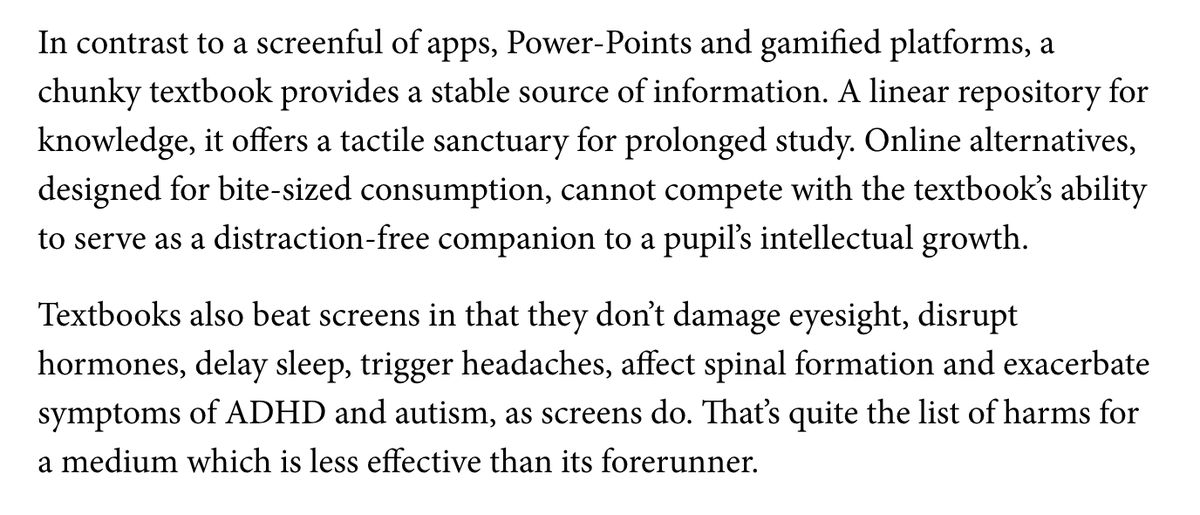
A beautifully written case for why physical textbooks are so much better for learning than the online distractions that have replaced them.
From Sophie Winkleman and @drdavidajames
https://t.co/Jpmd5tJ9nm
Noam Chomsky once called English spelling "a near optimal system."
You might think he was being ironic. Far from it.
The silent 'b' in "bomb" reappears in "bombard." The silent 'n' in "hymn" is pronounced once again in "hymnal." The silent 'g' in "sign" comes back in "signal."
English spelling keeps these words looking like the family they are, even when pronunciation pulls them apart.
The past tense ending "-ed" is pronounced three different ways (-t in "jumped," -d in "played," and -ed in "painted"), but spelled the same every time. One spelling, one meaning: something happened in the past.
English spelling is full of inconsistencies and silent letter because it’s not simply encoding how words sound.
If English spelling were aiming to represent sound alone, it would indeed be a total failure.
But that's not the kind of system English has. It encodes words' meaning and history as well.
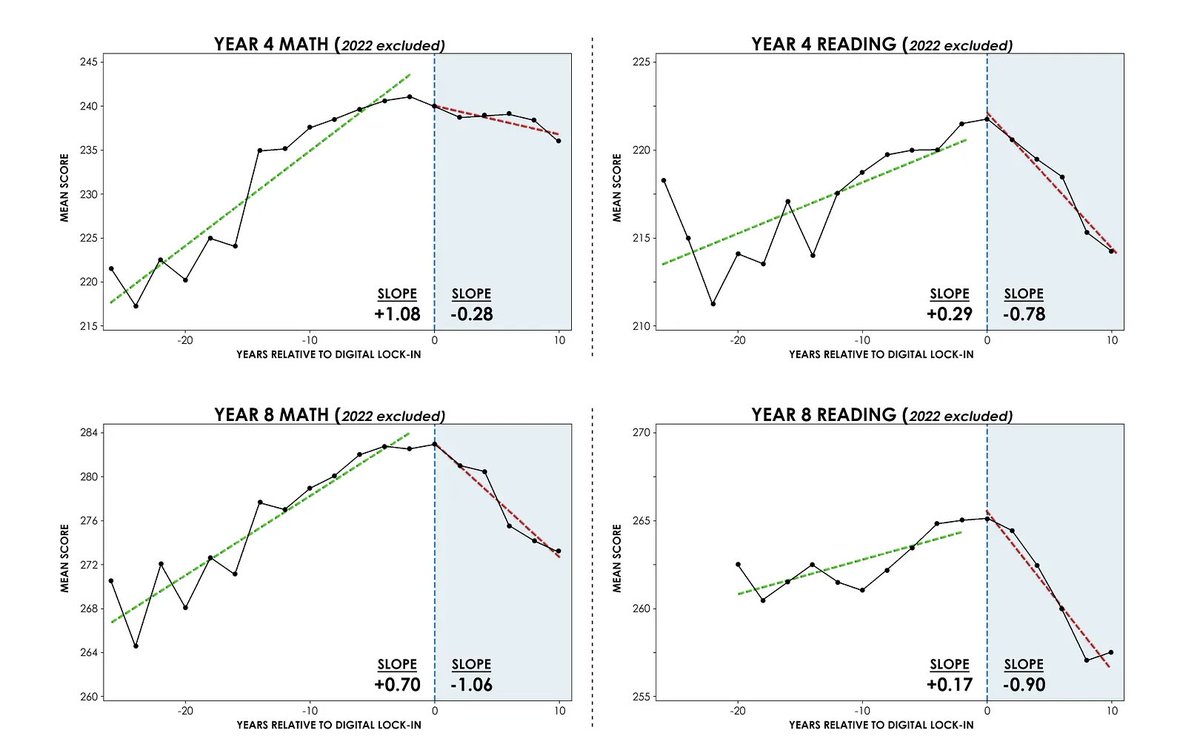
Still more evidence that EdTech harmed American education: Across states, the year that the state imposed mandates requiring computers/tablets, that's the year that test scores stopped rising and in most cases started falling.
From Jared Cooney Horvath
https://t.co/TSH1bfp8lA
We can’t even make machines that are alive. We don’t even try. Biology is baffled at simply trying to define life.
So why would we think we can skip over life’s irreproducibility and make machines have the functions of life, especially the highest ones such as willing & knowing?
29 days. Kobane is still under siege.
600,000 civilians trapped with no food, no water, no shelter.
No media coverage. No international outrage. No humanitarian aid.
But when Hamas uses AI to spread Palestinian propaganda, the world rushes to defend them.
When Kurds are oppressed and ethnically cleansed, the world turns its back and stays silent.
Why?
#KobaneUnderSiege #KobaneUnderAttack
https://t.co/FYVOpANLJA