Food for thought.
Clay’s Revenge
Treasury Secretary Scott Bessent’s speech at the Reagan National Economic Forum was more than a defense of tariffs or industrial policy. It was the clearest public restoration of Henry Clay’s American System in generations.
Clay understood what the priesthood of globalization spent three decades denying: Economic power is national power. A country that cannot make what it needs, finance its own expansion, or secure the energy that sustains both is not sovereign in any serious sense. Bessent’s formulation, that economic security is national security, is simply Clay’s doctrine translated into the language of the 21st century.
President Trump had already prepared the ground. In April, he proclaimed April 12, 2026, a day of celebration in honor of Henry Clay and ordered Room 208 in the Eisenhower Executive Office Building redesignated as the Henry Clay Room. That was not empty nostalgia. Trump has long treated Clay’s creed of “fair, equal, and reciprocal” trade as a precursor to America First economics. Bessent’s speech converted that historical tribute into governing doctrine.
The significance reaches beyond one speech. The United States is rediscovering its native political economy: strategic protection for key industries, public backing for national development, and finance aligned with national strength rather than with the abstractions of borderless efficiency. Kevin Warsh is attempting something parallel at the Federal Reserve. His call for a new Treasury, Fed accord and a smaller Fed balance sheet points toward a more Hamiltonian vision of public credit, and, in a deeper sense, an effort to undo William McChesney Martin’s betrayal of Harry Truman.
Truman called Martin a traitor when the Fed chairman prioritized monetary independence over financing national strategy. What Martin enshrined as central-bank independence, Warsh seems to treat as a historical deviation from the older American tradition in which public credit served national power.
The last time the United States operated on anything like this logic at full scale was during World War II, when Washington treated steel, shipping, energy, logistics, and capital allocation as parts of one integrated national mission. That, not laissez-faire mythology, is the real American precedent for national power in an age of danger.
The world woke up when President Trump launched Operation Epic Fury and Operation Absolute Resolve. The closure of the Strait of Hormuz then made the lesson impossible to miss: resource security is not a seminar topic but the hard foundation of state power. Once one of the world’s critical energy choke points was effectively shut, the entire fantasy that advanced economies could float above geography, production, and force collapsed in real time.
That is why leaders across the West, Mark Carney included, are drifting toward the language of resilience, industrial capacity, and strategic autonomy.
Yet America retains the decisive advantage. Coupled with Canada and Venezuela, the Americas are becoming the center of resource security. The United States sits at the heart of that system as an energy superpower, with the oil, gas, capital, and industrial base to turn strategy into production. Europe lacks that foundation. China cannot trust its access to it.
Bessent did not merely defend a policy mix. He announced a return to an older American statecraft: Clay at Treasury, Hamilton at the Fed, and the American System back at the center of national strategy.
...The British people have become conditioned to censorship as different groups seek to silence those who express opposing viewpoints. The result is one of the most speech-phobic nations on Earth as offices like OFCOM fuel the fear of free speech.
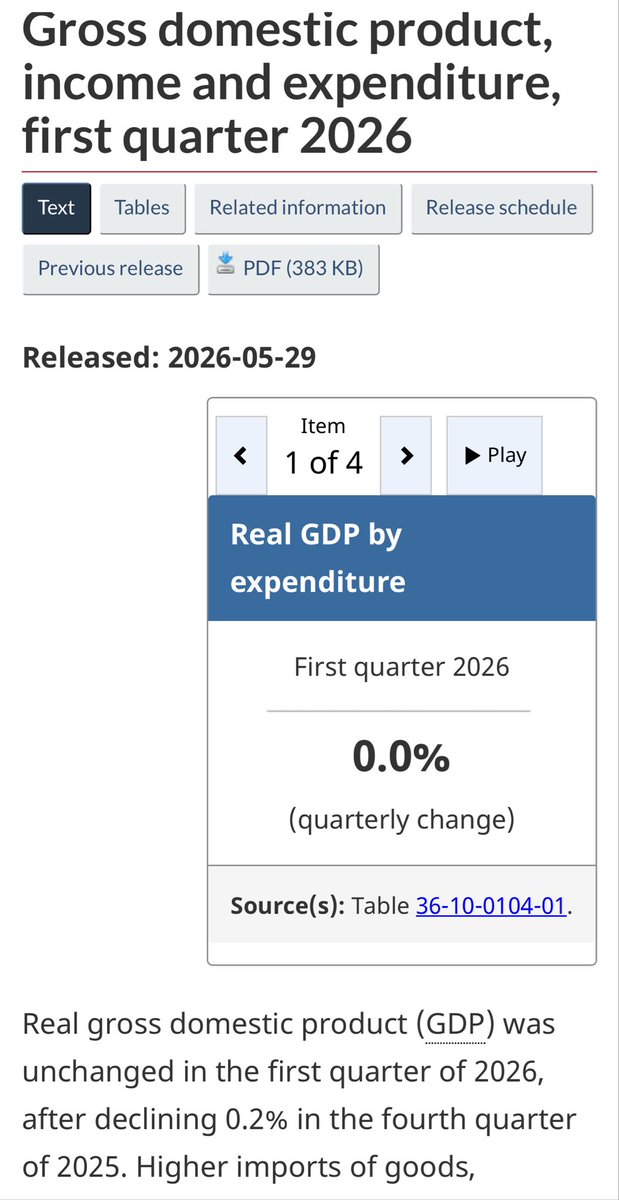
Canada’s Parrot Economy now in a Technical Recession.
Canada has slipped into a technical recession, yet Bay Street pundits and the Bank of Canada continue to insist the economy is “resilient” and capable of absorbing further rate hikes. This is not analysis, it’s denial.
What we are witnessing is a real-time reenactment of the Monty Python “dead parrot” sketch. The data is deteriorating, growth is contracting, and the consumer is clearly strained.
Yet the official narrative refuses to acknowledge what is plainly in front of it. Instead, we get semantic gymnastics: the economy isn’t weakening, it’s “normalizing”; it isn’t rolling over, it’s “adjusting.”
At some point, this stops being a difference of interpretation and starts looking like institutional groupthink.
The insistence on strength in the face of weakening fundamentals risks a policy error, one where rates remain too restrictive for too long, deepening the downturn that policymakers claim does not exist.
The parrot is not resting. It is, unmistakably, dead.
𝗥𝗮𝗴𝗲, 𝗥𝗮𝗴𝗲 𝗔𝗴𝗮𝗶𝗻𝘀𝘁 𝘁𝗵𝗲 𝗗𝘆𝗶𝗻𝗴 𝗼𝗳 𝘁𝗵𝗲 𝗡𝗲𝘁 𝗭𝗲𝗿𝗼 𝗗𝗿𝗲𝗮𝗺
The IPCC has admitted its extreme RCP8.5 scenario, the basis for the entire EU Green Deal, is implausible. Pielke Jr. calls it officially dead. But the climate establishment refuses to let go. They rage against the dying of the Net Zero dream with more regulations and taxes.
Read the full article:
https://t.co/Z0eCCenkFZ
Western Civilization didn't flourish because "white males" stopped other groups from succeeding.
The West thrived because of rational thought, individual rights, and free enterprise.
"White males" that invented the steam engine, electric generation, the combustion engine, flight, and space exploration did not do so because they "stole" the ideas of minorities.
These inventions helped lift mankind out of ignorance and hardship, improving the quality of life for all of humanity.
"White males" didn't oppress the entire world, they helped make it a better place.
"White males" didn't oppress everyone's rights, they invented the idea of rights and paid in blood to liberate tens of millions of people.
"White males" didn't invent slavery, they ended it.
"White males" didn't invent tyranny, they devised a form of government to end it.
Destroying Western Civilization isn't about empowering groups that were "oppressed." It is about tearing down civilization itself so that globalist parasites can rule over all of us.
Let’s be honest.
Expect the global political class and its commentators to dismiss the deal President Trump just negotiated as the final proof that his Epic Fury was a foreign-policy failure. Expect columns declaring it a climbdown, a muddle, a sideshow. Expect the same people who misread his strategy from the start to congratulate themselves for their consistency. Expect it. It’s wrong.
Thesis, antithesis, synthesis: what they will miss, as usual, is the higher-order story taking shape beneath their own talking points. Iran’s leverage is dying; a world in which it never gets a usable nuclear weapon is coming into view; and the old, sentimental Pax Americana is giving way to a colder, more durable American-anchored order.
The thesis of the post-Cold War era was simple and unspoken: you could tolerate fragile choke points and rising Iranian capabilities so long as flows stayed cheap. Inspectors would count centrifuges, diplomats would draft communiqués, and tankers would keep threading a narrow strait under the guns of a revolutionary regime. American power, as benevolent global referee, was the background assumption that made this fantasy bearable.
Trump supplied the antithesis by refusing to treat Iranian geography and nuclear ambition as separate dossiers. Sanctions, targeted strikes, and a visible naval vise around Hormuz forced the world to confront a fact it had politely ignored: you cannot base global prosperity on routes and regimes that can be shut at will. In pushing the confrontation to the point where shipping hesitated and war felt plausible, he burned away the illusion that Tehran’s leverage was tolerable.
The synthesis now taking shape is less theatrical and more consequential.
Step by step, capital and strategy are moving toward a world in which Iran’s hypothetical bomb buys it little. As pipelines and LNG routes bend away from contested waters, as supply chains re-anchor in the Americas and other safe basins, the value of nuclear blackmail shrinks.
At the same time, the universalist Pax Americana of think-tank nostalgia is dying. In its place is a harsher, more honest reality: the Americas as an resources, energy and industrial super-region, secured by American hard power; Europe free to look down its nose and build industrial policy on climate pageantry; and the real work of prosperity done where fuel is abundant and sea-lanes are actually defended.
As the nuclear threat slowly declines and the knee-jerk criticism of Trump’s strategy is seen for what it is, biased political commentary, the pedantic analysis from the elites will wither away. The neo-cons will be upset as well; a world that no longer needs their dreams of democracy at gunpoint, but does need hard borders, secure energy, and unapologetic American leverage, leaves them without a crusade.
The Neo Cons will keep arguing about atmospherics and adjectives, but the system will already have moved on to more basic questions: which geography is safe, which supply is reliable, which political order keeps the lights on. On that map, Iran is not a pivot and Brussels is not a conscience.
The United States is once again recognized, not as global schoolmaster, but as the indispensable guarantor. Just as the same class confidently dismissed Trump’s first run for president the day he came down the escalator, they will be wrong again about how Operation Epic Fury has changed the world, for the good.
https://t.co/BuMidnoKDw
Let’s be honest.
Warsh at the Fed.
Kevin Warsh’s arrival at the Federal Reserve is not a personnel change. It is a regime change attempt inside an institution built to prevent one. A supply-sider now runs a central bank hard-wired for Keynesian demand management, and the machine is already resisting the new code.
The next mistake is visible in plain sight. Keynesians on Wall Street and inside the Fed are treating a supply shock as if it were a demand boom and calling for tighter money. This is dogma masquerading as seriousness. A chokepoint in the Strait of Hormuz, a jump in energy prices, and a cost shock rolling through transport, food, and manufacturing are not evidence of overheated demand. They are evidence of a damaged supply side.
Monetary policy cannot reopen a shipping lane. It cannot pump more oil. It cannot repeal geopolitics. It can only crush demand somewhere else, usually with a lag, and usually in the most interest-rate-sensitive corners of the economy first, housing, commercial real estate, capital spending, and durables. Those sectors did not close the Strait. They are simply first in line to pay for the Fed’s intellectual mistakes.
That is the Keynesian reflex in its purest form. Every price spike becomes “inflation.” Every inflation scare requires a rate move. Every rate move is advertised as proof of resolve. It is nonsense. A change in relative prices caused by a supply shock is not the same thing as an inflationary spiral. Pretending otherwise is how central banks turn an external shock into a domestic recession.
Machiavelli explained why change is so hard. The innovator makes enemies of everyone who did well under the old order and wins only lukewarm defenders among those who might benefit from the new. Christensen gave the same warning in corporate language. Incumbent institutions kill disruptive change because their processes, incentives, and prestige are built around the existing model.
That is the real problem Warsh faces. The resistance is not incidental. It is structural.
The test for Warsh is not whether he can sound tough on television. It is whether he can resist the Wall Street catechism that every supply shock must be met with tighter money. If he hikes rates into a supply-driven price spike to prove his anti-inflation credentials, he will not have broken with the Keynesian regime. He will have submitted to it.
This is not the 1970s. Expectations are not unanchored, and the productive economy is already scarred by years of policy excess, fiscal decadence, and institutional bias.
The hope is that Warsh understands the difference between inflation and a supply shock, ignores the Keynesian pundits, and refuses to compound one policy error with another.
Food for thought.
Canada’s constitutional crisis did not appear overnight. It is the predictable result of decades of economic policy that penalizes productivity, suppresses resource development, and redistributes wealth away from the province that sustains the federation’s fiscal base.
Alberta’s looming referendum on separation should surprise no one.
IMHO the core issue is not separatism. It is asymmetry. Quebec has long exercised economic and political latitude, often backed by the credible threat of secession. Alberta, by contrast, is expected to finance the federation while accepting federal policies that undermine its primary industry. That imbalance is no longer tenable.
At the center of the dispute is Canada’s equalization regime. In theory, it ensures comparable public services across provinces. In practice, it has become a structural transfer system that rewards stagnation in recipient provinces while disproportionately burdening Alberta’s economy. One province produces. Others redistribute. The incentives are backward, and the politics are corrosive.
This might be manageable if federal policy were neutral toward Alberta’s economic strengths. It is not.
Over the past decade, Ottawa, backed by the Trudeau Liberals and the NDP, has pursued an industrial strategy explicitly hostile to oil and gas development. Pipeline projects have been delayed or canceled outright. Regulatory hurdles have multiplied. Global capital has taken the hint and moved elsewhere.
The consequences are clear: declining investment, reduced growth, and a measurable erosion in Alberta’s standard of living.
Meanwhile, provinces less exposed to resource development continue to benefit from transfers financed in large part by Alberta’s shrinking surplus.
This is not simply an economic grievance. It is a crisis of legitimacy.
No federation can endure when a productive region believes it is being systematically disadvantaged by national policy. Whether Ottawa sees its agenda as climate leadership or not is beside the point. In Alberta, it is experienced as economic containment.
A referendum is not yet secession. It is leverage, something Quebec has used effectively for decades. But it is also a warning. If Ottawa continues to dismiss Alberta’s grievances, it risks turning a bargaining tool into a break.
Canada’s unity has always rested on a basic sense of fairness. That foundation is now cracking. Alberta’s referendum is not the cause of the crisis. It is the consequence.
A message I sent to prof Gad Saad via one of his posts:
@GadSaad
I went to a Canadian bookstore in Victoria, BC, to buy your book today, for a friend who had asked it as a gift.
I did not see it on the New Books table. So I asked at the counter, Do you have Gad Saad's Suicidal Empathy?
The black-masked individual at the counter asserted that the title was not recognized. But could be looked up.
I said very distinctly, "Suicidal Empathy."
It was looked up. It was not in stock. But, I was told, it could be special ordered.
I said, "Oh well, it was only released a few days ago..."
Then I was told, "A decision has been made not to stock it. But it can be special ordered."
I thought about that and said, "If you have made a decision not to stock it, that's fine."
I will go to Amazon Canada, where it is currently a bestseller:
https://t.co/2GSBQdSjot
Remember this, readers, when Canadian booksellers whine about Amazon killing their business and especially if they want money from the government and you pay taxes in Canada.
If we vote for this, Dr. Saad can add us to his notes. I will make a point of not patronizing that business again. I *cannot stand* this sort of thing.
In Quebec, the Archambault Group, which operates 13 bookstores, has a single copy available in one store. The portal of independent canadian booksellers, https://t.co/UPg0e2ew9O, indicates one copy available in one bookstore across its entire network of over 165 bookstores across the country.
Get woke, get broke. I also bought it on Amazon.
NEW from Free Speech Union of Canada Executive Director @LDBildy:
“Does anyone understand what ‘classical liberalism’ is anymore? The British Columbia Human Rights Tribunal certainly doesn’t.
Last month, it tossed out a complaint filed by a former political science professor against Simon Fraser University. He argued that he was passed over for a tenure-track position because his classical liberal beliefs did not align with the university’s demand for ideological conformity to equity, diversity & inclusion (EDI).
His case didn’t even get past the gatekeeping stage. Four years after his complaint was filed, the tribunal ruled, without a hearing, that his beliefs were not grounded in a cohesive and recognized political philosophy and that there was no reasonable prospect of success.
This is the philosophy that shaped the modern West. But it’s apparently not one that the tribunal, or SFU, recognizes.”
Read the full article via link below 👇
Food for thought
America at 250: Museum or Nation?
Donald Trump saw the decay early, and was willing to fight it.
America is approaching 250 with a question larger than any election cycle: Is it still a living republic, or has it become a managed inheritance drifting toward elegant decline?
The anniversary will not just be a birthday; it will be a verdict on whether the United States still intends to choose its own future.
Oswald Spengler warned that civilizations decay when faith gives way to technique, when politics becomes administration, and when ruling classes lose the will to defend what made their civilization worth inheriting. Look at the European Union and the pattern is easy to see: technocracy without vigor, regulation without purpose, procedure without renewal. It manages decline; it cannot reverse it.
The United States has been moving in that direction for years: deindustrialization, open borders, elite detachment, strategic drift, and a governing class more comfortable managing national weakening than challenging it. Donald Trump recognized that decay earlier than most. More important, he was willing to say out loud that it was a choice. He saw that a nation cannot survive if it gives away its industry, dissolves its sovereignty, and treats energy dependence as moral progress.
But America has one resource Spengler did not fully account for: the American jeremiad. A political and social tradition that treats national failure not as proof the country is a fraud, but as proof it has betrayed a real promise and must recover it. Trump instinctively spoke that language. His deepest offense to the caretakers of decline is simple: He refuses to treat the Constitution’s call to form “a more perfect Union” as a museum text. He treats it as a marching order, and acts as if borders, energy, industry, and sovereignty still belong to a people who mean to perfect their Union, rather than preside over its managed decay.
That is why the coming midterm elections matter so much. They are not a pause between presidential choices. They are a national referendum on whether the work of reversing decline continues, or is handed back to the managers of exhaustion. At 250, America will learn again that elections have consequences, including the ones in the middle. The choice is stark: retire “a more perfect Union” to the glass case, or live as if we still intend to build it.
@EvaVlaar@X@J_Bardella@elonmusk Europe is aligning its censorship policies with those of China. It is mounting accusations not only against X but also against CNews. Moreover, like China, it is also targeting VPNs.
https://t.co/FsyvSOUTHY
🚨🇪🇺 Ursula's Democratic European Union Plans to Crack Down on VPNs!
"The new EU age ID verification system will not be 'bypassed' via VPN access."
Not even China does this to their citizens.
The Prime Minister appears to be moving Canada toward closer alignment with the European Union, raising important questions about national sovereignty and democratic accountability. Canada is an independent country with its own Constitution, including the Canadian Charter of Rights and Freedoms, which protects the fundamental liberties of Canadians.
Any move toward deeper political or legal integration with a supranational body like the EU could shift decision-making authority away from Canadian institutions and toward external bodies that are not directly accountable to Canadian voters.
https://t.co/MDUCmKUVv3
@nationalpost Perhaps people have had enough of these pseudo-intellectual, childish musings that project an air of superiority. They expect their leaders to discuss issues and conflicts openly, like mature adults. We expect open discussions and pragmatic results, not mere theater.
Conservative social attitudes are linked to higher fertility across 72 countries, with stronger effects among women | Mane Kara-Yakoubian, PsyPost
A study published in Evolutionary Psychological Science found that people who endorsed more conservative social attitudes tended to report having more children across a large international sample, suggesting that these attitudes may be linked to contemporary reproductive patterns.
Social attitudes are broad orientations toward social life, including views about religion, politics, hierarchy, gender roles, sexuality, and authority. In this article, “conservatism” is used in a broad sense to refer to a shared tendency across attitudes such as right-wing ideology, religiousness, lower support for gender equality, and preference for religiousness in romantic partners.
The study builds on prior research showing that these attitudes often correlate with one another and that many social attitudes show some degree of heritability. That heritability is part of what makes them interesting from an evolutionary standpoint, particularly if they’re also tied to how many children people have.
Janko Međedović set out to investigate exactly that. His motivation came from a gap in evolutionary behavioral ecology; researchers have extensively studied how personality, cognition, and religiousness relate to fertility, but social attitudes more broadly have largely been left out of that conversation. Given that conservative worldviews tend to emphasize family formation, traditional gender roles, religious commitment, and pronatalist values, Međedović wanted to test whether people who hold these attitudes actually report having more biological children.
The study used a publicly available dataset originally collected for research on romantic love and mate preferences. The full dataset included 117,293 participants from 175 countries, with data collected mostly online in 2021 (Algeria and Morocco used paper-and-pencil surveys; Russia used Toloka; Iran used Google Forms). After removing participants with missing data on key variables and excluding countries with fewer than 100 respondents, the final analytic sample included 78,754 participants from 72 countries. About two-thirds of the sample were women.
Participants answered questions about political ideology (a single item, far-left to far-right), support for gender equality (a three-item scale, where higher scores meant stronger support), religiousness (an 11-point self-report item), preference for religiousness in an ideal romantic partner (a parallel 11-point item), and number of biological children. They also reported their gender, age, education level, and social class, variables that can shape both attitudes and family formation in important ways.
Međedović found that conservative social attitudes were consistently linked with higher fertility. Participants who reported stronger right-wing ideology, stronger religiousness, stronger preference for religiousness in a romantic partner, and lower support for gender equality tended to report having more children. The associations were generally small—age was by far the strongest predictor of how many children someone had—but they were consistent enough to show up reliably in a sample of nearly 80,000 people spread across 72 countries.
The size of the relationship between conservative attitudes and fertility also varied considerably across countries, and in a small number of cases it even flipped direction. This suggests the attitude-fertility link is not a fixed universal mechanism, and that national and cultural context shapes it in meaningful ways.
Several more specific patterns also emerged. Right-wing ideology and lower support for gender equality were more strongly associated with fertility among women than men, suggesting that conservative attitudes may be especially tied to women’s reproductive outcomes in this dataset. Self-reported religiousness was strongly associated with preferring a religious romantic partner, and the interaction between these variables showed that people low in religiousness who also preferred nonreligious partners had especially low fertility. Education further qualified the findings: right-wing ideology predicted higher fertility among less educated participants, but not among highly educated participants.
The author also found small quadratic effects, but described these as slight departures from linear associations rather than strong evidence of a clearly nonlinear pattern.
Međedović notes several important limitations. Women and more educated participants were likely overrepresented, and many participants were still young enough that they may not have completed their reproductive years (average age for men = 31.5 years, women = 29.5 years). The cross-sectional design also means the study cannot establish that conservative attitudes cause higher fertility or that they are definitely evolving through selection. As well, several attitudes were measured with only one item, which also limits measurement reliability.
Still, the findings make a reasonable case that social attitudes deserve more attention in research on fertility differences, while also raising the possibility that attitudes could be relevant to contemporary human behavioral evolution.
Read more:
https://t.co/LmXRYI2WYW
Attempting to abridge God-given liberties is a sure path toward a totalitarian state that is ultimately doomed to fail. For the USSR, this resulted in economic and social collapse. For China, it has taken the form of a catastrophic decline in fertility that will annihilate the country within the next 50 years. Europe is treading the same path and will reach the same destination.
Why is our government always attempting to adopt such flawed models instead of following the example of the most successful country right on our southern border?
This is absolutely disgraceful. A mother in Sechelt speaks up against a forced political ritual in her daughter’s school, gives fair warning, keeps it short, and sits down quietly and the principal responds by calling child protection services on her family? Then bans her from school grounds? Then lets the drama teacher out her daughter to the class, sparking bullying that forced the kids out of school?
This is authoritarian bullying dressed up as “reconciliation.” The Ministry of Children and Family Development showed up, interviewed the kids, and immediately closed the file because there was nothing wrong. The only “threat” here was a parent who refused to bow to ideological nonsense.
This is what the NDP’s capture of our schools has produced: principals acting like thought police, child services being weaponized against dissenting families, and kids caught in the crossfire. Land acknowledgements have become a compulsory loyalty test that does zero for Indigenous people but everything to divide us and punish anyone who questions it.
Enough is enough.
Our schools are for teaching, not indoctrination. Parents have the right to push back without the state coming after their children. This kind of abuse of power is exactly why British Columbians are fed up and why we need real change.
#cdnpoli #bcpoli
On January 1, 2026, the European wind industry implemented a self-imposed landfill ban on turbine blades.
This has left many countries scrambling silently for solutions. Landfill has become the next unwanted crisis, yet it's the conversation no one wants to have. Germany, Finland, and the Netherlands have banned blade landfills, and so for a time they are being exported to countries like the UK or France, where they can still be buried.
Banning waste like turbine blades doesn't make it vanish though—it just puts it on a truck to a neighbour's backyard. Low-scale solutions are often cited as the answer, like turning blades into noise barriers, bridges or playground equipment.
How do you turn 43 million tons of blade waste from turbines into park benches and koala crossings? How many park benches does one planet actually need?
Modern recycling for glass and carbon fibre often requires pyrolysis (high-heat chemical decomposition). To recycle a 'green' blade, you must burn an immense amount of energy to break down the resins.
We are trading a physical waste problem for a new energy demand problem. People love a quirky solution that highlights the absurdity of the problem—like the image of a massive 80-metre blade being used as a single, very long bus shelter.
Even 'green' solutions have a physical footprint that can't be wished away by a spreadsheet.