This may seem trite, but evolved principles (such as tort law) are more flexible and suitable for new technologies than highly tech-specific detailed statutes (like the CFAA in the USA or the IT Act in India). #regs#tech
An owner brought in a 13-year-old dog, asking to euthanize him just because he had bad legs from arthritis. The dog shivered in terror, as if he understood what was about to happen. Looking into the dog's eyes, the vet couldn't do it. So, she decided to take him in herself, giving him a brand-new name: Sam. 🐕🦺💓💓
"We have built a world with flawless logistics for war and broken logistics for food"
"This is not Nepal's private misfortune. Ask Bangladesh. Ask Bhutan. Ask India. Ask the Maldives. Ask Pakistan. Ask Sri Lanka"
Nepal PM Balen Shah
Bless these two fishermen ♥️🥹 They rescued a helpless baby elephant being swept away by the raging Teesta River in West Bengal, then hugged the little one like their own. What a beautiful moment! Humanity at its finest. 🐘♥️
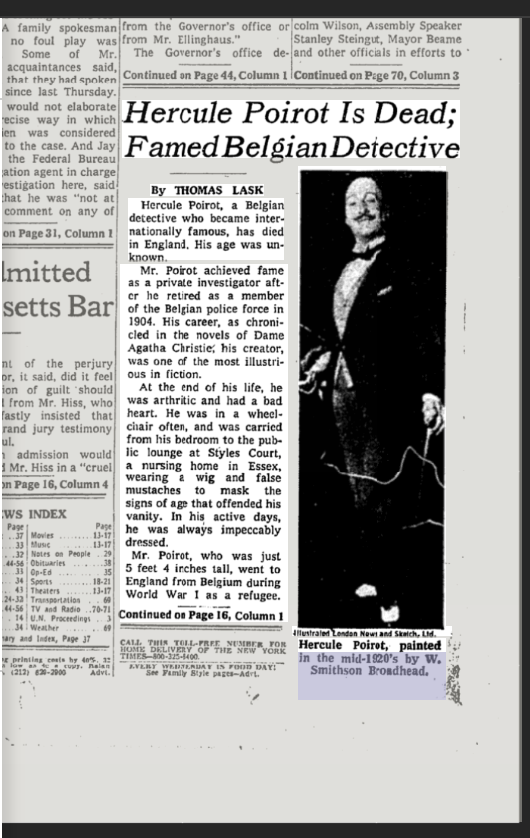
On August 6th 1975, the New York Times carried a front page obituary about the death of a detective. His name was Hercule Poirot, and, amazingly, he was fictional, the creation of Agatha Christie.
This was to commemorate the release of Curtain, the last Poirot mystery.
Agatha Christie, born on this day in 1890, captivated generations with her 66 detective novels and 14 short story collections. Her play 'The Mousetrap' is running in London since 1952, and her stories have been used, acknowledged or otherwise in countless films and serials, including Indian classics like Gumnaam and Dhund, and the recent Charlie Chopra.
She also wrote a few very decent romance novels as Mary Westmacott.
Revisiting one of her classics, 'Death on the Nile' today.
Which was your favourite?
I was encouraged this week to see the leaders of the frontier labs agree on the need for them to slow down the pace of AI development. Given the stakes, it’s a good and necessary first step.
But I’m even more encouraged by the growing recognition that how this powerful new technology develops should be at the center of our public debate.
I’ve been watching the progress on AI for over a decade now, and one thing that’s clear to me is that the potential impact of this technology is not overhyped. It’s also moving at lightning speed – and even faster than those who are engineering it can keep up with.
I’m not an AI accelerationist who believes it will lead to some techno-utopia, and I’m not a doomer who thinks it will inevitably lead to humanity’s destruction.
But whether this technology results in amazing breakthroughs in medicine, energy and education or unleashes huge economic disruptions, greater inequality, and potential catastrophe will depend on the choices that we make right now – choices that should be made not just by the companies involved, but by all of us.
Patients or their attendants who sit in the waiting rooms or hospitals or clinics are, by definition, stressed. My humble suggestion to all medical establishments is to avoid adding to their stress ny playing the most stressful possible thing on TV, that is, shit and vile TV news. Nobody is interested in it!
Just play soulful classical music. No visuals required. People are happy with their smartphones these days.
Asmita Dey -
"My Papa cannot see this, but this Commonwealth Games gold medal is for him.
He died of a brain stroke seven months ago. 😢
My Papa was a cycle mechanic who earned barely ₹300 a day. He raised our family in a mud house in a small village in Tripura.
He always supported me. After my knee injury, he took me to Delhi for treatment"
He ran the school board of an entire Indian state, and he did something no one before him had dared. He let over ten lakh students fail. On purpose. Because for the first time, he had stopped them from cheating.
His name is Anand Kishore.
For years, the board examinations in Bihar had been a national joke. Everyone had seen the photographs. Relatives climbing the outside walls of exam halls, four storeys up, to pass cheat sheets through the windows while police stood and watched.
Toppers who could not answer a basic question about their own subject on camera. A whole system quietly agreed that the results were fiction, and everyone played along, because the alternative was admitting the truth.
The truth was that lakhs of children were being handed certificates that meant nothing, sent into the world believing they were educated when they had been robbed of an actual education.
When Anand Kishore took charge of the Bihar School Examination Board, he decided the lie would stop, even if the whole state hated him for it.
He locked the system down. Proper frisking. CCTV. Randomised seating so friends could not sit together. Answer sheets with unique codes. Evaluation that was actually checked. He made the exam honest, possibly for the first time in a generation.
And the honest result was brutal. The pass percentage collapsed. In some years more than half the students failed. Over ten lakh children who, in the old system, would have walked away with a fake certificate, now failed, because now the exam was real.
Imagine the pressure on him to soften it. To quietly let the numbers rise, to protect the state's image, to give the politicians the headlines they wanted. Every incentive he had said look away.
He refused. He said a certificate that lies to a child is worse than an honest failure, because the failure at least tells the child the truth in time to do something about it.
Slowly, it worked. Cheating collapsed. Schools that had coasted for decades were forced to actually teach. And the pass percentages that recovered in later years were real, earned by children who had genuinely learned.
He made a whole state fail an exam honestly, so that passing it could finally mean something again.
At one point P.G. Wodehouse was rather upset that somebody writing under the name 'Indignant,' said his work was overrated. His reply!
"I do not wish to labour this point, but I must call Indignant's attention to this letter in The Times from Verrier Elwin, who lives at Patangarh, Mandla District, India.
Mr Elwin speaks of a cow which came into his bungalow one day and ate his copy of Carry On Jeeves, selecting it from a shelf which contained, among other works, books by Galsworthy, Jane Austen and T.S. Eliot. Surely a striking tribute."
Verrier Elwin writing to The Times about Wodehouse. Wow!
Lord’s, August 1973. A 37 year old Garry Sobers was playing his last series in England. He was batting on 31 not out at the end of the first day’s play and decided to go out with Clive Lloyd.
After meeting friends they went to a nightclub and drank and danced till five. Sobers then decided it was no point going to sleep and went out for a few more drinks and then showered just before going in to bat. He took a break when batting to go to the toilet, had a couple more drinks in there and then went back in to smash an unbeaten 150.
RIP Sir Garfield Sobers, the man who could outdrink Botham and Boon and outplay every cricketer on the planet.
Hello! A short note from us this Sunday!
Over the past week, as the visibility of some of our work on social media has increased, there has been a sharp escalation in ad hominem attacks. Under normal circumstances these are best ignored, as we have an extremely strong community of Indians who fund and support our work and take a stand online based on the merits of argument and reason. However, a high volume of aspersions and coordinated attacks, alleging a "lobby", "vested interests", "big tech proxies" and the like, is emerging. This may lead to gradual suspicion of our work, which is critical for the digital rights of every Indian.
IFF has a clear mission and is funded by ordinary Indians. We are far from perfect. We also have capacity issues given the breadth and pace of digitalisation and our mandate to serve civil liberties and social justice under the Constitution of India. However, most of the targeting across social media emerges from false assertions of securitisation and betrayal of the national interest. This is false, as IFF's mandate is to serve the digital rights of every ordinary Indian and to act as a watchdog for them. This includes challenging, and advocating for reforms from, the Government of India (and state instrumentalities across the political spectrum) and technology companies. Our work over nine years, carried out by dozens of staff and hundreds of volunteers and collaborators, attests to this.
IFF's work also goes beyond the more research-oriented approaches to digital rights in order to reach the public. Here, popular advocacy, especially that which relies on social media, will lead to differences of opinion, which we encourage. However, it has taken the form of attacks. In the past, due to the targeting of several Indian organisational donors (which we ourselves had proactively disclosed) and philanthropies, our funding ceased. To overcome this, we launched a fundraiser (the Annual Membership Drive) three months ago, in which thousands of Indians chipped in to help us reach financial stability until November.
We do not have any grants or philanthropies supporting us any longer. We have a small budget and a small staff who work for the cause, funded by more than 3,000 Indians year on year, who have supported us since 2018. We will not stop fighting the good fight, and there is ample evidence that the IFF community and donors stand up for it. If you would like to support our work and help improve our capacity, please encourage friends and family to donate to us, or to any other non-profit or digital news platform that you believe still works for the ordinary citizen today. Even if you cannot donate, we encourage you to speak up for them and provide them greater safety to challenge power and profit.
Have a good Sunday. We wish you rest and play! 🌻
Really excited to be taking this six week course on #dataprotection law! Please do register if this is of interest! We will be talking about all things #DPDA, #privacy, #technology, and #AI
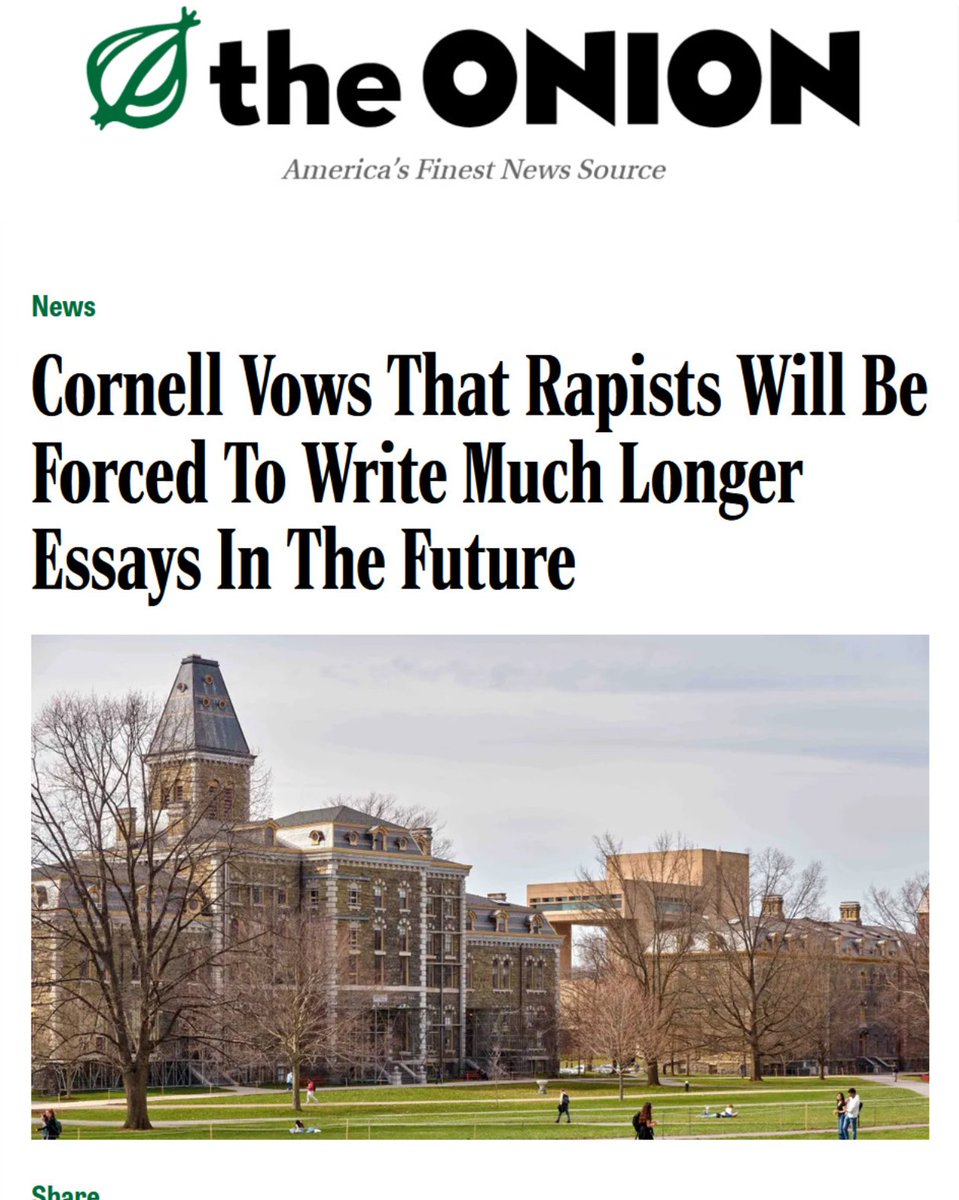
A student submitted an essay she wrote by hand. Her university ran it through an AI detector. The detector said she cheated. She is autistic.
Her name is Moira Olmsted. Adelphi University. February 2026. Turnitin flagged her essay as 100% AI-generated. She was disciplined.
Two other AI detectors classified the same essay as human-written.
She sued. She won. The court called the school's decision "arbitrary and capricious."
She is not the only one.
In May 2026, a high school student in Palo Alto was expelled after an AI detector flagged his work. He faced visa revocation. He filed a federal civil rights lawsuit.
A researcher at Griffith University just proved mathematically why this keeps happening. The paper is on arXiv. The finding is one sentence.
AI text detectors have a structural flaw that no amount of better engineering can fix.
Here is what the math says.
If a university wants its detector to catch 80% of cheaters, at least 750 out of every 10,000 innocent students will be wrongly accused. That is not a software problem. It is a theorem.
If the university tries to limit false accusations to 1%, detection power collapses to 6%. It catches 6 out of every 100 AI-written papers. The other 94 get through.
There is no setting where the detector is both fair and effective.
The reason is diversity. Every student writes differently. Non-native English speakers use simpler vocabulary. Shorter sentences. Clearer structures. So does AI. A Stanford study found that 61.3% of TOEFL essays written by non-native English speakers were misclassified as AI-generated. A separate analysis tested 14 commercial detection tools. Zero out of 14 reached 80% accuracy.
The students most likely to be wrongly accused are non-native English speakers, neurodivergent students, and anyone who writes with clarity and precision. The qualities that make their writing effective are the same qualities the detector mistakes for a machine.
Vanderbilt University understood this. They disabled Turnitin's AI detection in 2023 after calculating that even a 1% error rate across 75,000 submissions would produce 750 wrongful accusations per year.
750 students accused of cheating for writing like themselves.
The paper's conclusion is not that we need better detectors. It is that the diversity of human writing itself makes accurate detection mathematically impossible.
The same thing that makes your writing yours is the thing that gets you accused.
https://t.co/L91ldtXP05