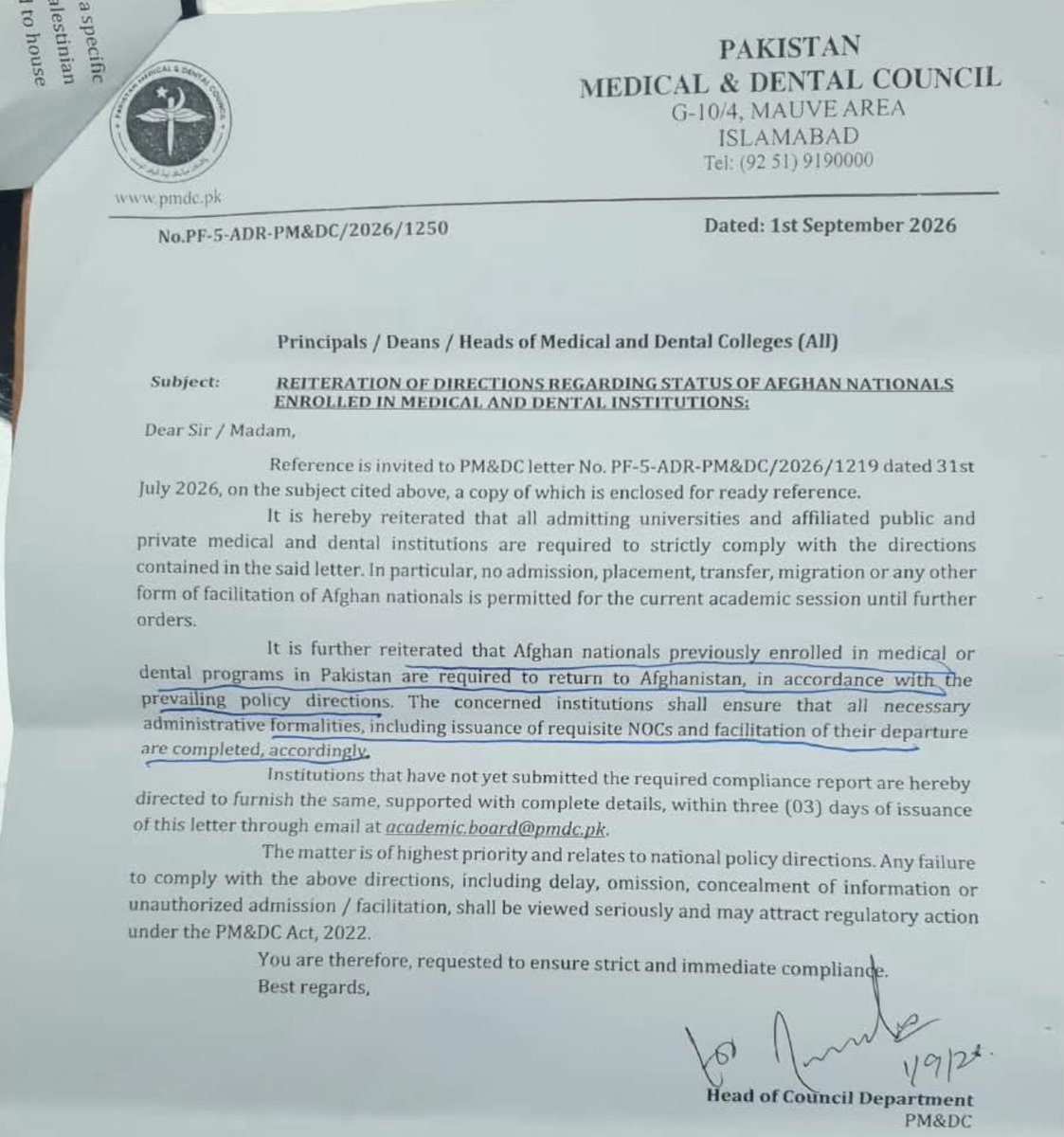
It’s sad that Afghan medical and dental students already enrolled in Pakistan are asked to leave mid-degree, after years of education. Whatever the political circumstances, students should not bear the cost of policy decisions. They deserve an exception to complete their degrees.
It is extremely unprofessional to send students back in the middle of medical school and disregard the hard work they have put into their education. No student should be deported.
PMDC just issued a notification that all Afghan students currently enrolled any medical/dental college are required to return back to their country with immediate effect. Harmless students who took the legal route.
🔍 Coronary Microcatheters: Small Device, Big Impact in Complex PCI
Coronary microcatheters have become indispensable tools in modern percutaneous coronary intervention (PCI), especially when dealing with complex coronary anatomy.
Thread 👇
Fractional flow reserve–guided PCI using zotarolimus drug-eluting stents provides significantly better long-term value than CABG for treatment of patients with multivessel CAD, with equivalent clinical outcomes at substantially lower cost https://t.co/v0QW9avx8A
In selected patients undergoing high-risk PCI, completely percutaneous VA-ECMO with local anaesthesia was associated with high procedural success, acceptable access-site safety, and limited postprocedural ICU need.
These findings support the feasibility of a less invasive ECMO strategy.
#Cardiology #PCI #ECMO
https://t.co/L19DwnobkN
Ultra-high-pressure balloon strategy in complex PCI: @KAlaswadMD shares how the OPN NC (35 atm) can tackle resistant calcium/underexpanded stents, with trial data (eg, VICTORY) supporting stent expansion comparable to IVL in selected cases.
https://t.co/VHe0YfFp3d
‼️📢 IAS is happy to announce applications for the 8th @wmahmeed and IAS Research Training Fellowships: Middle East & Africa are now open!
Applicants from the Middle East or Africa will receive up to $10,000 USD, which will allow them to spend up to 6 months progressing their research and honing their skills at an institution of their choice outside of their home country.
📆 Learn more & apply today: https://t.co/rzSzpwrFA2
@brettsmansfield@azinkh96@njume_epie@yoyo230786
Shock patients who are treated with a temporary mechanical circulatory support device in hospitals that aren't dedicated shock centers may be at higher risk of device-related adverse events, based on a new study. https://t.co/e3LnTFAePp
With my mentor Dr. Eugene Braunwald celebrating our decades of work together
The 80s, 90s, 00s 10s, & 20s have been a great ride
He taught me most of what I know about science, trials, & people
I owe so much to him as do so many others
Thank you for all you do 🙏
#cmgsees the #GOAT
NOBLE 10-year just dropped in @TheLancet. HR 0.93 (0.74–1.18) for all-cause mortality, PCI vs CABG in unprotected LM disease.
Headline: "PCI is equally as safe as CABG."
The statistical design tells a more complicated story. Long post — let's go deep.
NOBLE enrolled 1,201 patients at 36 sites in N. Europe + UK. Heart-team consensus on dual eligibility. Open-label RCT. Predominantly 2nd-gen DES. ITT analysis. The original design was a non-inferiority test on a MACCE composite at 5 years. The 10-year "primary" is all-cause mortality. That switch matters.
The numbers: PCI 23% (136/592) vs CABG 25% (145/592). HR 0.93 (95% CI 0.74–1.18); p=0.56. 98% follow-up at 10y — that part is excellent. Landmark 0–5y: HR 1.06 (0.73–1.55). Landmark 5–10y: HR 0.86 (0.64–1.16). No late catch-up — that's a real finding.
First problem, and the authors are upfront about it: "The statistical analysis plan for the 10-year endpoint was not prespecified in the protocol." They reused the 5y SAP "for consistency." So the 10y analysis is essentially a post-hoc primary endpoint. That changes how you read p=0.56.
Second: the trial was never powered for all-cause mortality. The original power calc was for MACCE. With 281 total events, the Schoenfeld formula gives ~80% power to detect HR ≈ 0.72 — i.e., a 28% relative risk reduction. For a smaller effect like HR 0.74, NOBLE has only ~71% power. To hit 80% at HR 0.74 you'd need ~346 events; they have 281.
Authors say it themselves: "a type 2 error cannot be excluded."
Now to the deepest issue with the conclusion.
Three statistical frameworks exist for comparing two treatments, and they ask genuinely different questions.
Superiority asks: is A different from B? A positive result (p < 0.05) means you've shown A and B differ. A negative result (p ≥ 0.05) means you have NOT shown they differ. Now, that's not the same as showing they're the same. You've simply failed to find a difference, which can happen either because there isn't one or because your trial wasn't large enough to detect one.
Non-inferiority asks: is A no worse than B by more than some clinically tolerable margin δ? You define δ in advance (say, HR 1.15 — "we'd accept up to a 15% relative increase as not meaningfully worse"). A positive result means you've shown A doesn't fall below that margin on the worse side. A negative result means you have NOT shown non-inferiority — A might be acceptably close to B, or it might be meaningfully worse; this trial just can't tell. Non-inferiority says nothing about whether A is better than B.
Equivalence asks: are A and B clinically interchangeable? You define a margin δ in both directions (e.g., a band of HR 0.87–1.15). A positive result means the entire CI fits inside that band — you've shown the two are close enough in both directions to call them equivalent. A negative result means you have NOT shown equivalence — the CI extends past the margin on at least one side, meaning a clinically meaningful difference (in either direction) remains possible.
The common trap across all three: a negative result never proves the absence of an effect. It only means the trial couldn't demonstrate the effect it was testing for. The framework you choose determines what that "demonstrated effect" actually is — and you can't borrow the conclusion from one framework when you ran the test for another.
NOBLE 10y ran a superiority test. p=0.56 means we cannot conclude PCI and CABG differ in mortality. That's it. It does NOT mean we've shown they're the same. Failing to detect a difference is not the same as detecting equivalence — a small or underpowered trial will fail to find a difference even when a real one exists. Exactly the type 2 error the authors flag.
But the published conclusion — "PCI is equally as safe as CABG" — is an equivalence claim. To support it, you'd need a prespecified margin (say HR 1.15), a power calculation built around it, and a CI that fits entirely between 0.87 and 1.15. NOBLE has none of these.
And the CI is the giveaway. The 95% CI of 0.74–1.18 spans a 26% relative mortality reduction with PCI to an 18% increase. If equivalence had been prespecified at HR 1.15, NOBLE would have FAILED to demonstrate it — the upper bound (1.18) extends past the margin. So even on a reasonable equivalence framework, the trial doesn't prove what its abstract claims.
The honest framing: mortality was numerically similar at 10 years; the trial was not designed to demonstrate equivalence; the CI is consistent with mortality differences up to 18% in either direction. That's defensible. "Equally as safe" is not.
Now the strengths, because the trial does have them.
The 0–5 vs 5–10 landmark directly tested the "late mortality catch-up" hypothesis raised after EXCEL. Both windows neutral (HR 1.06 and 0.86, both CIs cross 1). That hypothesis is now harder to defend. Clean, prespecified piece of work.
The Bayesian-Weibull sensitivity is also smart. Informative prior HR 1.10 (from SYNTAX + PRECOMBAT, 1st-gen DES). Posterior median 0.95 (95% CrI 0.74–1.18). Conservative prior, neutral posterior, robust to modeling assumptions. Caveat: the prior is drawn from 1st-gen DES trials applied to a mostly 2nd-gen comparison.
Now the trickiest piece — the ACS subgroup. PCI vs CABG in ACS: HR 0.57 (0.32–0.99), p_interaction = 0.049. PCI mortality reduction of 43% relative to CABG — if true, a major shift in how we think about LM revascularization in ACS.
But two things make this fragile.
First, the interaction p-value sits exactly at the conventional 0.05 threshold. A single reclassified event, a slightly different model, one more patient lost to follow-up, and it flips. The universe doesn't change between 0.049 and 0.051 — but our willingness to believe the result probably should.
Second, multiplicity. NOBLE tested nine subgroups (age, sex, BMI, diabetes, lesion count, ACS, distal LM, SYNTAX, overall). With α = 0.05 per test and no correction, the probability of at least one false positive across nine independent tests is 1 − 0.95⁹ ≈ 37%. Even if PCI and CABG were truly equivalent in every subgroup, you'd see a "significant" interaction roughly one trial in three by random noise alone. A Bonferroni-corrected α would be 0.05/9 ≈ 0.0056 — and the ACS interaction at 0.049 is ~9× that threshold.
The authors acknowledge this: "the risk of a type 1 error cannot be excluded." A structural anomaly inside the ACS interaction reinforces the caution: CABG mortality in ACS = 31% in NOBLE vs ~22% in pooled SYNTAX/PRECOMBAT ACS. Plausible mechanism (median CABG delay 6d vs PCI 1d in ACS), but this is post-hoc reasoning on a borderline interaction. Hypothesis-generating, not practice-changing.
One more methodological note: the PH assumption was tested with log-log plots only — no Schoenfeld residuals, no formal test reported. The ACS subgroup KM curves diverge late (clear non-proportionality). For that subgroup specifically, RMST would have been more appropriate than HR.
Now the IVUS substudy — and an important update. NOBLE reported a striking post-hoc signal: final IVUS after PCI: HR 0.79 (0.61–1.04) vs CABG; no final IVUS: HR 1.31 (0.94–1.83) vs CABG.
Let's take a moment here. OPTIMAL (Testa et al., NEJM 2026) was recently published with 806 patients, a dedicated RCT of IVUS-guided vs angio-guided PCI in unprotected LM disease, mean SYNTAX 29.7. Primary patient-oriented composite: HR 1.11 (0.87–1.42), p=0.40. Death: HR 1.06 (0.74–1.50). The signal NOBLE's substudy hinted at didn't replicate when tested under randomization.
The most likely explanation: the NOBLE IVUS substudy was confounded by era, operator, and center selection — patients receiving IVUS in 2008–15 were treated by different operators at different centers under different protocols than those who weren't. Randomization in OPTIMAL stripped that out. A secondary explanation: OPTIMAL's angio arm was operationally executing IVUS-derived best practice (97% post-dilation, 89.6% POT, high-volume operators using IVUS in 50–100% of routine LM cases), shrinking the marginal benefit of the imaging itself. The LM-specific imaging benefit looks much smaller than NOBLE's substudy suggested.
One structural shortcoming worth flagging: adverse events (MI, stroke, repeat revasc) weren't collected after year 5 in NOBLE. So the 5–10y window has only mortality — the least sensitive endpoint for PCI vs CABG. The MACE gap from year 5 could have widened. We don't know.
Bottom line.
What NOBLE 10y proves: in selected LM patients (no complex lesions), 10-year mortality is similar with PCI vs CABG. No late mortality catch-up after year 5.
What it doesn't prove: equivalence (never formally tested). MACE parity at 10y (not measured). PCI > CABG in ACS (hypothesis-generating). And after OPTIMAL: a meaningful incremental benefit of routine IVUS over angio in LM PCI at expert centers.
What would actually settle the PCI vs CABG question: a modern RCT of contemporary LM PCI (operator-discretion intracoronary imaging, POT discipline, contemporary DES, optimal DAPT) vs multi-arterial CABG, MACE prespecified through 10 years, with women, ACS presentations, and non-White patients adequately represented.
Until then: nuanced shared decisions.
#CardiologyX #PCI