Taiwan solved tax evasion in 1951 with a trick so cheap it should embarrass every tax authority on the planet.
The problem was an all-cash economy full of small shops. A merchant pockets the cash, skips the receipt, and the sale never existed. Auditors can't catch what was never recorded, and hiring enough of them to watch every noodle stand costs more than the missing tax.
So finance chief Ren Xianqun flipped the incentive. Print a lottery number on every receipt. Draw winners every two months on live TV. Top prize today: NT$10 million, about $310K.
Suddenly the customer and the shopkeeper want opposite things. The merchant wants the sale off the books. The customer wants the ticket. And there are millions more customers than merchants. Every transaction now carries a built-in witness demanding the paper trail.
Year one, reported tax revenue jumped 75%, from NT$29 million to NT$51 million. Seventy-five years later, roughly 70% of Taiwanese still play. Convenience stores redeem the smallest NT$200 prizes at the register, so even a coffee receipt feels like a scratch card.
The elegant part is what the audit force costs. The prize pool runs about NT$7 billion a year, roughly $20 million. In exchange, the government gets 23 million unpaid auditors working every checkout line in the country, forever. No inspector general on earth delivers that coverage at that price.
Greece, Italy, Portugal, and Slovakia all copied it. The most effective compliance tool ever built looks like a game, and that's exactly why it works.
I've always told my PhD students that a PhD is a marathon and not a sprint. Now that Sabastian Sawe has run the London Marathon in under 2 hours, I'll need to think of something else to tell them.
PODCAST: What’s next for oil, natural gas and the U.S.-Iran war?
A great pleasure to join a special edition of the #ColumbiaEnergyExchange podcast with host @JasonBordoff to discuss how supply disruptions are reverberating across the industry.
🎧Listen now: https://t.co/Nfa3nQ6UWm
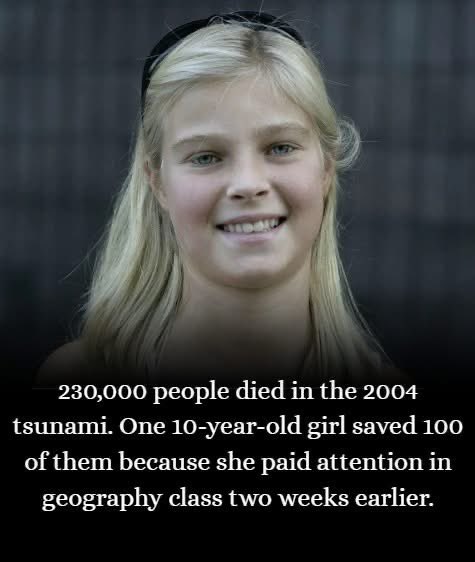
Her name was Tilly Smith. And she was about to prove that a single school lesson could mean the difference between life and death.
On the morning of December 26, 2004, Tilly was walking along Mai Khao Beach in Phuket, Thailand, with her family. They were on their first overseas holiday together—a Christmas treat.
The beach was beautiful. The weather was perfect. But something was wrong.
Tilly noticed the water wasn't behaving normally.
"It wasn't calm and it wasn't going in and then out," she later recalled. "It was just coming in and in and in."
The sea had turned frothy—"like you get on a beer," she said. "It was sort of sizzling."
Any other 10-year-old might have thought it was strange. Tilly knew exactly what it meant.
Just two weeks earlier, in her geography class at Danes Hill School in Surrey, her teacher Andrew Kearney had shown the class black-and-white footage of the 1946 tsunami that devastated Hawaii. He taught them the warning signs: the sea receding unusually far, frothy bubbling water, the ocean behaving in ways it shouldn't.
Tilly was watching those exact warning signs unfold in front of her.
She started screaming at her parents. "There's going to be a tsunami!"
They didn't believe her. They couldn't see any wave. The sky was clear. The beach was calm.
But Tilly wouldn't stop. She became more insistent, more frantic.
"I'm going," she finally said. "I'm definitely going. There is definitely going to be a tsunami."
Her father Colin heard the urgency in her voice. He decided to trust his daughter.
By coincidence, an English-speaking Japanese man nearby overheard Tilly use the word "tsunami." He'd just heard news of an earthquake in Sumatra. "I think your daughter's right," he said.
Colin alerted the hotel staff. They began evacuating the beach immediately.
Tilly's mother Penny was one of the last to leave. She had to sprint as the water began rushing in behind her.
"I ran," Penny recalled, "and then I thought I was going to die."
They made it to the second floor of the hotel with seconds to spare.
Then the wave hit.
It was 30 feet tall.
Everything on the beach—beds, palm trees, debris—was swept into the swimming pool and beyond. "Even if you hadn't drowned," Penny later said, "you would have been hit by something."
The 2004 Indian Ocean tsunami killed over 230,000 people across 14 countries. Entire beaches in Phuket were wiped out. Thousands died.
But at Mai Khao Beach, not a single person was killed.
Because a 10-year-old girl paid attention in geography class.
Tilly was hailed as the "Angel of the Beach." She received the Thomas Gray Special Award from the Marine Society. She was named "Child of the Year" by a French magazine. She appeared at the United Nations and met Bill Clinton.
Her story is now taught in schools around the world as an example of why disaster education matters.
Her father Colin still thinks about what could have happened.
"If she hadn't told us, we would have just kept on walking," he said. "I'm convinced we would have died."
Tilly is now 30 years old. She lives in London and works in yacht chartering.
She still credits her geography teacher, Andrew Kearney.
"If it wasn't for Mr. Kearney," she told the United Nations, "I'd probably be dead and so would my family."
Two weeks. One lesson. One hundred lives.
That's the power of education.
"Tilly Smith’s quick thinking saved her family during the 2004 tsunami. Click to read how one geography lesson made all the difference!"
Suffered through traffic from Thembisa for my favourite Meaty Bone and Chakalaka (minus the papa December body).
I found this place by chance, starving, bone tired from my work on township entities.
Worth the drive. The Sauvignon Blanc is mine.
My dad was advising a man that was complaining about his wife not giving birth to a boy because the man said how will his name "survive"
And my dad said something that made me go crazy with my goals
he said,
If you want your name to live and not die, make a name for yourself. your kids cannot keep your name alive.
If you want your name to survive, give your name life by doing things that people will talk about when you die.
he asked the guy "who remembers the kids of Abraham Lincoln or the kids of Thomas Edison or even Nnamdi Azikiwe?"
"Who even cares about the kids of anyone great in history?" we don't.
So if you want your name to not die, make a name for yourself by being a great person or else, your name will die when you die and there is nothing you can do about it.
Every lineage comes to an end.
But the great names in every dead lineage do not die. They outlive generations.
Tomorrow evening we will deliver a presentation at the Public Dialogue hosted by the OR Tambo School of Leadership (ORTSoL) under the theme “Enhancing South Africa’s Energy Security to Boost Economic Productivity.”
Do Tune in