Distinguished Professor of Cognitive Psychology at La Trobe University. Co-Director, Science of Language & Reading Lab, School of Education. Psych & Sp Path.
If only politics, identity, and ideology wasn't so involved, it wouldn't be so hard to get people to understand and accept that Language Development is important for all students.
But here we are.
What's wrong with this picture? 🤔
Sure, we should be treating new teacher grads like interns and giving them mentoring and support. But we should also be able to assume core knowledge on human learning, especially as this applies to literacy and numeracy. And new grads should not have to spend time and money "unlearning" what they spent time and money consuming in their #ITE.
When we employ graduates teachers at @tempyheightsps, we invest significant 💰 (people & e-courses) to ensure they understand SOL- the guiding principles of our teaching & learning model and of statewide reforms. Isn't this the role of ITE providers? Surely.
There is no "philosophy of gravity."
I'm an engineer by training. In my profession, nobody gets to opt out of physics because they have a different "approach" to load-bearing beams. The knowledge base is shared, it evolves with the evidence, and we all speak the same language.
Medicine works the same way. So does aviation.
Teaching reading should too.
I just finished Season 2 of @ehanford’s Sold a Story, and I'm more convinced than ever that Doug Carnine and Reid Lyon have been right all along: teaching has to be professionalized like medicine and engineering.
That means: ✅ A common body of knowledge grounded in science ✅ A common professional language ✅ A system that updates as the research advances, not as the marketing does
Our kids aren't a matter of opinion. Neither is how the brain learns to read.
This is the most important macro-level work in front of us. I'm ready to help build it. Who's with us? 👇
#ScienceOfReading #SoldAStory #Literacy #Education
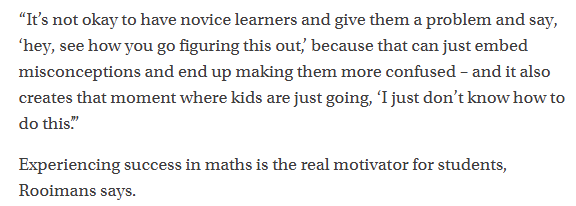
@educationweek The evidence shows that problem-solving then instruction (i.e., discovery learning, i.e., productive failure) does NOT work in elementary school.
https://t.co/nzSifVvKF2
@doxtdatorb@ehanford The evidence that these terms have “disappeared” would need to be quite substantial. It may well be Biesta’s earnest belief but that doesn’t give it an empirical basis.
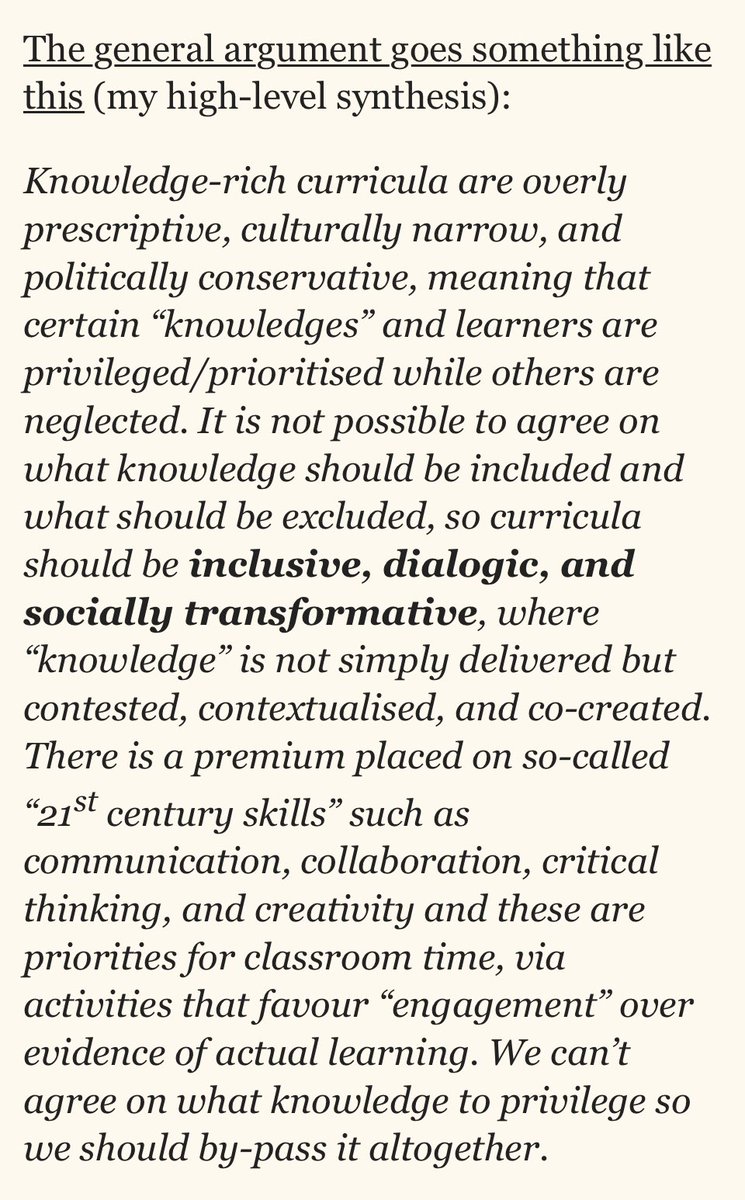
@ehanford’s Season 2 of #SoldAStory is a wrap (for now) so it’s a good time for us to have the long overdue conversation about the relative effectiveness of different instructional approaches. Doing so will trip a wire though and I wrote about this late last year. Is conveying knowledge core business for schools? Many think not, which goes some way towards explaining their antipathy to Direct/direct/explicit instruction.
Welcome to SPOCK: The Society for the Prevention of Children’s Knowledge.
https://t.co/VxfZPbbwFi
@doxtdatorb@ehanford But the proposition that those terms (teaching, student, knowledge etc) have “disappeared from the discourse” is entirely unsupported by evidence. It’s just a proposition and as such crumbles as a basis for the term “learnification”.
❓ Is it unethical to test teaching methods through randomized controlled trials? Pamela Snow makes the case that it may be more unethical NOT to test through RCTs. Education is too important to leave to chance!
@PCSnow1604
@doxtdatorb@ehanford He doesn't appear to be positioning the teaching/learning of knowledge as a positive attribute in schools - rather he problematises it via his term "learnification".
@planebottle@rastokke The great irony here is that teachers have to "discover" for themselves that discovery learning is ineffective, and they do this by using, you guessed it - discovery learning. Little wonder so many new teachers leave the profession within five years - this is a terrible waste.
@Lexz1ss@rastokke I'm sorry, but I still don't see how the video is a form of teacher blame. If anything this segment elevates the importance of teachers and their role in directly influencing children's outcomes.
And if you'd like to do a deep-dive, this #OpenAccess paper led by @latrobe#SOLARLab PhD student @AnnieMaryUnger may be of interest:
The road to Running Records: a narrative review of their history and a systematic narrative review of the evidence for their use. Review of Education Research. Published online July 22, 2025. https://t.co/wEVCPN0WZN
The Running Record is not a psychometrically robust assessment tool. For a long time it was all teachers had but that's not a reason to continue using it when better tools exist. Initial Teacher Ed programs need to catch up with the play on this. Read more in this new post by Harriett Janetos: https://t.co/hrtiNGKvvF