Chemputation is a formal system for the digital control of matter. This paper https://t.co/Sh4fIDA8Ao outlines the proof & a practical roadmap for Turing complete chemputing in chemical von Neumann machine - a chemputer.
No toda tecnología termina en el Proyecto Manhattan. Vida y obra de Oscar Varsavsky, una supernova argentina. Escribe para el mes de “Prospectiva” de @RevSupernova_ Ernesto Román https://t.co/zMXzNxJ4rF
If you set your calculator to radian mode and then repeatedly press the cosine button, you always end up with numbers approaching 0.739…, no matter what number you started with. Do you understand why?
A Lens That Takes Derivatives
US Patent Basis: US8610839B2 - Optical Processing System for Computing Derivatives.
In a 4f Optical Processor, the first lens takes the incoming field and forms its Fourier spectrum. At that middle plane, a tiny optical mask multiplies the spectrum by iξ. This is the derivative operator written in Fourier language
u(x) -> U(ξ) -> iξU(ξ) -> ∂u/∂x
Then the second lens brings the field back to the real space. What comes out is no longer just a focused beam. It is the spatial derivative of the input field, computed by light as it propagates.
So, this is the serious promise of optical computing. A physical optical train can perform operations that usually live inside numerical code: differentiation, filtering, convolution, edge detection, correlation, and many other linear transforms.
Your brain has a circuit that doesn't know you live in a city. Its only job is to monitor whether birds are still singing. Right now, in this room, it is on.
The circuit predates primates. Mammals have been using ambient soundscape continuity as a predator-detection system for roughly 200 million years. Birds stop singing when something larger moves through their territory. For most of mammalian history, a forest full of song meant no large predator was nearby, and the cessation of sound was the warning. Your nervous system never updated this software.
The Max Planck Institute tested the inverse in 2022 with 295 participants. Six minutes of birdsong dropped anxiety with a medium effect size. Six minutes of traffic noise raised depression with the same. The effect worked on subjects who lived in dense urban environments and had no regular contact with nature. The brain still ran the check.
Birdsong sits in the 1,000 to 8,000 Hz range. Your brainstem reads continuous patterns in that band as a signal that nothing dangerous is currently moving through the environment. EEG data shows birdsong at 45 to 50 decibels boosts alpha wave activity by 14.1% relative to silence. Alpha is the brainwave signature of relaxed alertness. Push the same birdsong above 60 decibels and the response flips. Stress markers rise 29%. The circuit only trusts the signal at the volume of quiet conversation, which is exactly the volume birds sing at from a typical distance.
Three things happen simultaneously when the brain registers ambient safety. The amygdala downregulates. The parasympathetic nervous system takes over from the sympathetic. Heart rate variability rises, cortisol drops. The posterior cingulate cortex, which sits at the center of the rumination circuit, quiets down. King's College London tracked this through a smartphone study with over 1,200 participants and found the mood lift lasted hours after the sound stopped. People diagnosed with depression got the same response as healthy controls.
Most of what gets labeled mental fatigue is hypervigilance running in the background. Birdsong tells the circuit it can stand down, and the brain reallocates the freed compute everywhere else.
A quiet park feels different from a quiet office because the parks have sentinels.
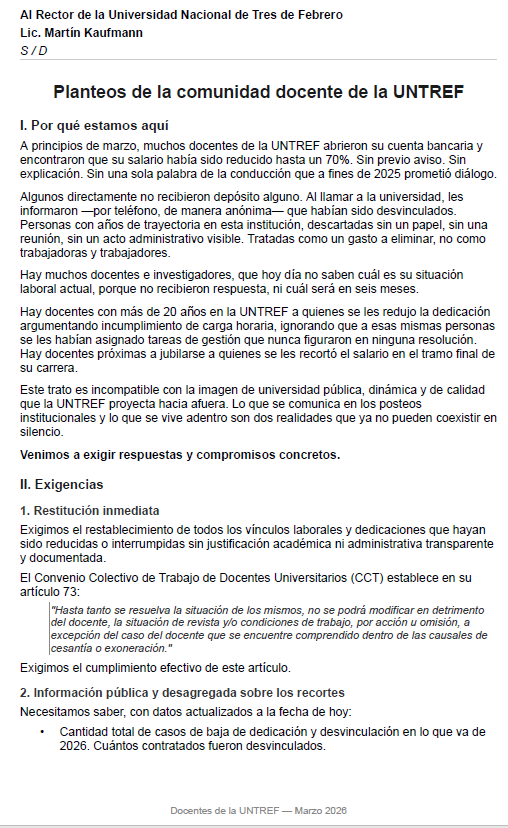
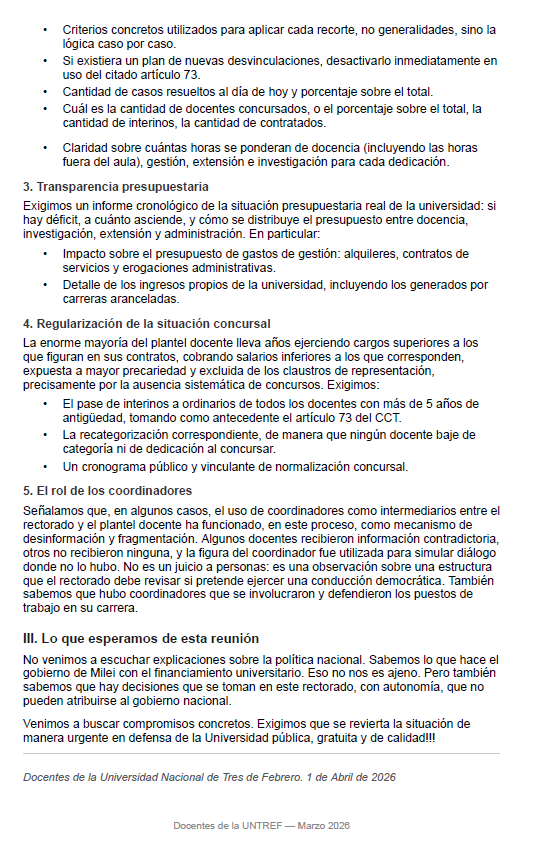
Masiva reunión docente en la UNTREF. Ayer, los docentes, entregamos una nota a las autoridades y al rector manifestando nuestro rechazo a los recortes de salarios y dedicaciones.
Gracias al movimiento estudiantil por acompañar nuestro reclamo. #untref
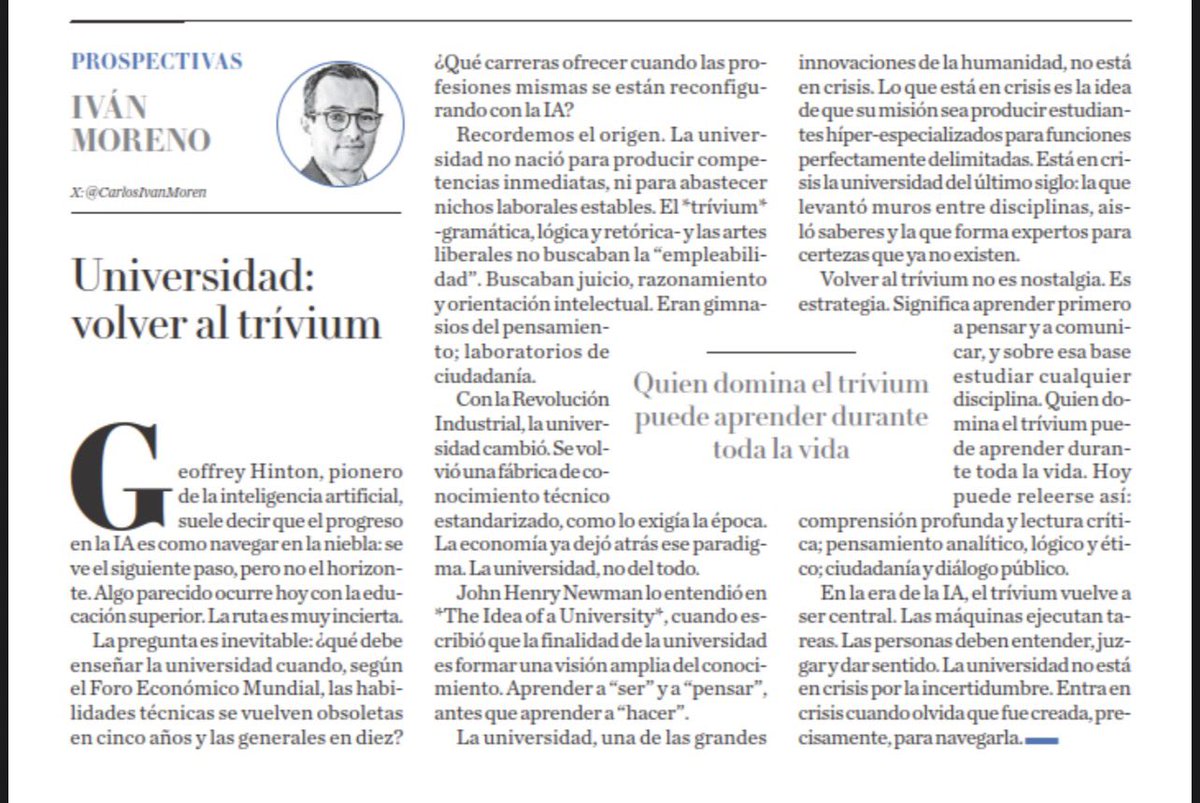
La universidad no nació para producir competencias inmediatas, ni para la empleabilidad.
Nació como gimnasio del pensamiento, laboratorio de ciudadanía.
La universidad no está en crisis. Lo que está en crisis es la idea de que su misión es formar expertos híper-especializados para certezas que ya no existen.
Es fundamental volver al origen: enseñar a pensar, a comprender y a dialogar. Formar para la incertidumbre.
En la era de la IA, el trivium -gramática, lógica y retórica- vuelve a ser central. Los algoritmos ejecutan tareas, las personas deben entender, juzgar y dar sentido.
Mi colaboración en @Milenio 👇🏽👇🏽👇🏽
https://t.co/RTMbMVa8OX
Mathematicians still haven’t answered a seemingly simple question about the Fourier transform — one of their most ubiquitous and powerful tools. “The question is a bit of bait,” said Mehtaab Sawhney of Columbia University; it was designed to illuminate just how little mathematicians know.
https://t.co/hkZa9ueMIL
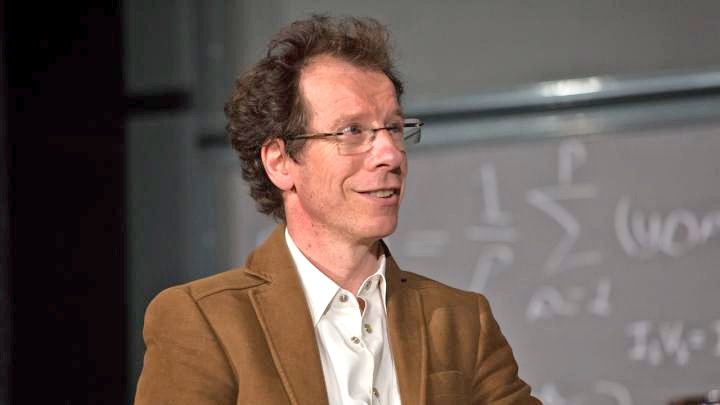
Stéphane Mallat is a pioneering mathematician and engineer whose work created the modern theory of wavelets and transformed signal processing, probability, and machine learning. He developed the mathematical foundations of multiresolution analysis and fast wavelet transforms, which allow signals and images to be decomposed into components at different scales, separating noise from structure. These ideas deeply influenced statistics through sparse representations, denoising, and compression, and they now underlie many modern learning methods. Mallat also introduced scattering transforms, which combine wavelets with nonlinearities to create representations that are stable to deformations and preserve statistical structure, providing a mathematical bridge between classical signal processing and deep neural networks. In machine learning and deep learning, his work explains why convolutional architectures work so well on images, audio, and time series. Mallat’s theories give a rigorous framework for extracting meaningful, invariant features from complex data, shaping how modern AI understands the world.