Artificial intelligence has already made the rideshare industry demonstrably safer, so how will our increasing reliance on AI affect our healthcare?
Dr. Ashwin Ramaswamy visits Chasing Life to discuss the future of AI in medicine. Latest episode available on the CNN app and here: https://t.co/5Nru05Joz7
Intel($INTC )'s CEO said something at a Santa Clara conference this week that deserves more attention than it received. Some memory prices have risen five to seven times. And the shortage will get worse in 2027.
Lip-Bu Tan said this on September 15 at the AI Infra Summit. The comment was reported by Korean media and picked up by a few supply chain watchers. It did not move markets the way an Nvidia earnings call would. But it should have.
Memory has become the binding constraint on AI infrastructure. TrendForce data shows that for the first three months of 2026, global contract DRAM prices rose 93% to 98% quarter-on-quarter. All three major HBM suppliers have already sold out their 2026 production capacity. Server DRAM contract prices are expected to rise another 13% to 18% in the third quarter alone. Citi projects the HBM supply-demand gap at roughly 21% in 2027, widening to 36% by 2028. The bank further expects global memory supply tightness to persist until 2031, driven by continuous learning workloads that require models to retain and retrieve prior knowledge — not just process one-time training runs.
The supply side has responded by locking in capacity through long-term agreements rather than simply adding supply. Samsung has committed approximately 70% of its memory capacity through 2031 to LTAs, with Nvidia, Microsoft, and Google among the primary customers. SK hynix has signed roughly 10 LTA contracts, each typically five years in duration. The pricing structure varies by supplier: Samsung caps quarterly price declines at 5% with no ceiling on increases, SK hynix removed price caps entirely, and Micron uses both floors and ceilings. HBM long-term contract prices are running at roughly one-fifth of spot prices, which tells you how much premium the spot market is commanding.
This is not a normal commodity cycle. When 70% of an industry's capacity is contractually committed for five years, the spot market stops being the primary price discovery mechanism. The remaining 30% of uncommitted supply absorbs all incremental demand, and incremental demand is being driven by AI workloads that are growing far faster than the committed capacity can accommodate. The result is five-to-sevenfold price increases on some memory products, with the contract market and the spot market operating in entirely different price regimes.
The bottleneck extends beyond memory into the physical packaging layer. Goldman Sachs estimates that ABF substrate shortages will reach 14% in the second half of 2026, 34% in 2027, and 51% in 2028. Equipment lead times for ABF substrate manufacturing have stretched to 2031, with customers actively paying premiums to secure equipment capacity. Ajinomoto, which produces the build-up film used in ABF substrates, has raised prices by 30% effective the third quarter of 2026. Substrate vendors are implementing quarterly price increases of 7% to 8%, with ABF pricing rising faster than BT.
The capital expenditure numbers tell the story of who is bearing the cost. DRAM and NAND flash combined will account for 47% of major cloud service providers' total capital expenditure in 2026, rising to 68% in 2027, according to TrendForce. Meanwhile, Jefferies estimates that the four largest U.S. hyperscalers will spend 92% of their operating cash flow on capital expenditure in 2026, up from just 41% in 2023. JPMorgan projects that the seven largest technology companies will increase capital spending from $443 billion in 2025 to $1.577 trillion in 2027.
The margin structure at the physical layer is becoming visible. Micron raised its fiscal 2026 capital expenditure forecast to $27 billion, a 94% year-over-year increase, and expects even higher spending in fiscal 2027. The three major memory suppliers are deploying roughly $130 billion in capital in a single year. Crusoe, an AI infrastructure provider, raised $3.9 billion at a $30.9 billion valuation this week.
On the cloud side, pricing power is also shifting. Nebius raised AI cloud prices for the second time in three months, increasing rates for Nvidia's H100, H200, B200, and B300 chips by 17% to 21%. H100 pricing rose from $3.85 to $4.50 per GPU-hour, H200 from $4.50 to $5.40, B200 from $7.15 to $8.50, and B300 from $7.85 to $9.50. The industry logic behind these increases is straightforward: once a GPU cluster's initial contracts have covered its debt and depreciation, renewal revenue carries almost no depreciation or financing costs. Old cards that are still in service generate high-margin incremental revenue, and the ability to raise prices on previous-generation hardware reflects the scarcity of available compute.
The Korean government has responded with a nearly $600 billion plan for Samsung and SK hynix to each build two new chipmaking plants, aiming to double memory capacity within five years. But even this level of investment may not resolve the shortage quickly. SK Group's chairman has said that demand will continue to outpace supply even after the Yongin and Cheongju investments are accelerated, and that new production bases are required.
The question that matters for anyone modeling this sector is not whether AI demand is real. The demand signals are unambiguous. The question is whether the profit pool is shifting from the entities building AI models to the entities controlling the physical inputs those models require. The companies that own the memory fabs, the substrate capacity, and the equipment that produces both are the ones with pricing power right now. The companies that depend on those inputs — including the hyperscalers — are the ones absorbing cost increases.
This is a structural feature of any capacity-constrained supply chain. When demand growth outpaces the ability to add capacity, and when adding capacity requires equipment with multi-year lead times, the pricing power accrues to whoever already owns the bottleneck. The LTA structure institutionalizes this advantage. A five-year contract with no price ceiling and a 5% floor on declines is not a contract that favors the buyer.
The risk to this dynamic is straightforward. If AI demand growth decelerates, or if the incremental capacity from Micron, SK hynix, and Samsung's capital expenditure programs comes online faster than expected, the spot market could soften first, and the LTA terms would then become a drag on suppliers rather than a benefit. The 92% of operating cash flow being spent on capital expenditure by hyperscalers also raises the question of how long that level of spending is sustainable before it forces a reassessment. When the entities funding the buildout are consuming nearly all of their cash flow to do so, the margin for error is thin.
But for now, the physical supply chain is the constraint, and the entities that own it are the ones setting the price.
Ali Ghodsi never wanted to be CEO. In 2015, he was interviewing for a professor job at Berkeley when the @Databricks board handed him the interim title. Revenue that year was $1.5M.
This episode with @alighodsi will go down as one of my favorites. 10 things I took away:
1. Focus the entire company, orders of magnitude of attention, on its single biggest bottleneck. Like a laser, almost to an extreme. The cycle is 1-3 years, not weeks. If your focus changes weekly, then you’re just in firefighting mode.
2. There is nothing worse than a conflict-averse CEO. They are wonderful people, but they are in the wrong job. Conflict is the gym for a CEO: nobody likes it, but everyone has to go.
3. Study your enemy carefully, understand their weaknesses and apply your strengths to those weaknesses. Snowflake had 2x his revenue. He didn’t copy them. He found three weaknesses (proprietary, no AI, expensive) and hammered them account by account for four years. Watch the competition, never follow it.
4. The concept of a Lakehouse was ridiculed internally and online. No one wanted to market with this new term. So he made the whole company religious about it anyway, killed the ads that converted better without the word, and put it in the sales comp plan. It worked. All hands on deck, no exceptions.
5. Be willing to take a step back for a much bigger vision, even when the company is already succeeding. At multiple hundreds of millions in ARR, he was unhappy, because the vision he pitched investors wasn’t the company he was running. So he took one step back to go ten forward.
6. On the flat org, player-coach model that a lot of people have talked about this year: “it’s BS.” Separate how the company thinks (AI, ontology) from how the humans get managed (they are after all, still humans). His staff meets 3x a week. I asked if it could just be coordinated in a Google doc. His answer: do you meet your wife and kids, or coordinate that in a Google doc?
7. His test for a sales leader: can they build the car, or just drive it? Ron Gabrisko, the Databricks CRO, had seen $0→50M and $50→100M+, and hadn’t changed jobs in 10 years prior to joining. Now he has been the CRO for over a decade. He built and drove the car the whole way. That almost never happens.
8. Hire execs ahead of the curve because by the time you need them, it’s too late. A real search takes 6-12 months. The extra time helps you increase false negatives and decrease false positives. Do an insane number of backdoor references because 80% of ‘front door’ references are bs.
9. The best salespeople are not super technical, so stop trying to force them to be. Square peg, round hole. The best win with professional aggression, high EQ, and mapping the real power base (how decisions get made high up in an organization), not technical depth.
10. Yes, your best AEs will annoy people. One of the first at Databricks got a meeting nobody could get, but got banned from the customer’s building for it. He told Ali, “what are you complaining about? I got the meeting.” Professionally aggressive is the bar.
One bottleneck, zero wussing out. He reminds me of @elonmusk that way.
Chapters
0:00 – Introduction
1:22 – The secret CEO search and why the board bet on a founder
4:11 – Professor or CEO? Always taking the harder option
8:18 – Pour everything into one bottleneck
12:16 – Killing PLG and learning what great enterprise sellers actually have
19:09 – Hiring ahead of the curve: sales leaders, execs, and back-door references
27:02 – The Snowflake rivalry: study your enemy, never copy them
33:22 – Lakehouse: conviction, ridicule, and the case for second acts
41:02 – The killer instinct and why conflict-averse CEOs fail
44:10 – Dunbar's number and rethinking the org chart around AI
48:00 – AGI is already here — enterprises just use it as a chatbot
52:55 – Does he still code? Two days for a connector vs. three quarters
57:18 – A day in the life, and why the Monday meeting isn't theater
1:04:53 – Why Databricks will go public, just not yet
1:08:09 – Get over conflict aversion, or don't be CEO
1:11:07 – Brian's takeaways
Link to more in the comments.
Ex-Google Jeff Dean just released the best 1-hour lecture on AI engineering: from basics to Graphs
1:45 - LLM from scratch
17:22 - How to use AI models
30:03 - Prompt engineering
52:35 - One human coordinating 100 agents
27 years of building AI at Google, compressed into one hour.
Watch it, then read the full guide on Graph engineering below.
@DamonZumbroegel I am visiting India for a month, I am fascinated by your affinity to use natural resources, would love to see one of your projects in Mysore, if there is one, I live in PNW now, love the Evergreen state, enjoyed Golden state for 35 years, trying to enjoy nature, wherever I am 🙏🏾
Great article.
What's interesting to me is the notion that this cycle is much different already due to HBM.
HBM requires 2.5-3x more wafers per bit than DRAM, so increasing HBM capacity often comes at the expense of DRAM capacity. The conversion rate will become even worse at HBM4E, then you'll be talking about ~4x more wafers per bit than DRAM.
Memory producers could essentially use HBM capacity to cannibalize DRAM capacity. Basically, they now have a valve to regulate DRAM supply and cannibalize it whenever they think DRAM demand is deteriorating (not any time soon) to protect their margins.
In the past, oversupply was a major problem, especially when new fabs were built during an upcycle. By the time the new fabs were online, there was already a downcycle and the increase in supply only led to memory prices crashing further.
With HBM, memory producers are better able to shield themselves against oversupply by using HBM as a valve to regulate DRAM supply. And this may be the reason why SK hynix's CEO is confidently saying we won't see an end to the memory shortage until atleast 2030.
$MU $SKHY $000660.KS $DRAM
He said the last thing — and the one that ties everything together — is that most people buy AirTags as a key finder. They should be buying them as an insurance policy on everything valuable they own.
"A set of 4 AirTags costs $79. That's $20 per tracker. Each one lasts years with a $3 battery swap. There's no subscription. No monthly fee. No cellular plan. The tracking network is 2+ billion devices strong and grows every time someone buys an iPhone. For $20 — one time — you can track any item on the planet, find it within inches using Precision Finding, activate a global lost-and-found mode that displays your contact info to anyone who taps their phone to it, and get a notification the moment you accidentally leave it behind."
He said most people's failure with AirTags isn't the technology — it's the deployment.
"They buy a 4-pack, put one on their keys, and the other 3 sit in a drawer. Meanwhile, their luggage gets lost on a flight. Their wallet gets left at a restaurant. Their kid's backpack goes missing at school. Their car gets stolen from a parking lot. Every one of these problems was solvable by a $25 disc that was sitting unused in a kitchen drawer."
He said the math is simple.
"A lost suitcase costs $300–$500 to replace plus the contents. A stolen bicycle costs $500–$2,000. A lost wallet costs $50–$200 in replacement cards, IDs, and cash — plus hours of phone calls. A $25 AirTag prevents all of it. Not every time. But often enough that the ROI is infinite. You're not buying a tracker. You're buying the ability to find anything you own, anywhere on the planet, for less than the cost of a meal."
He said the 3 AirTags in the drawer should be deployed by tonight.
"Put one in your travel bag. Put one in your car. Put one in your wallet or purse. Share all of them with your partner. Enable 'Notify When Left Behind' on the wallet and keys. Enable Lost Mode the instant anything goes missing. Replace the battery once a year for $3. And stop using a $25 global tracking network as a key finder."
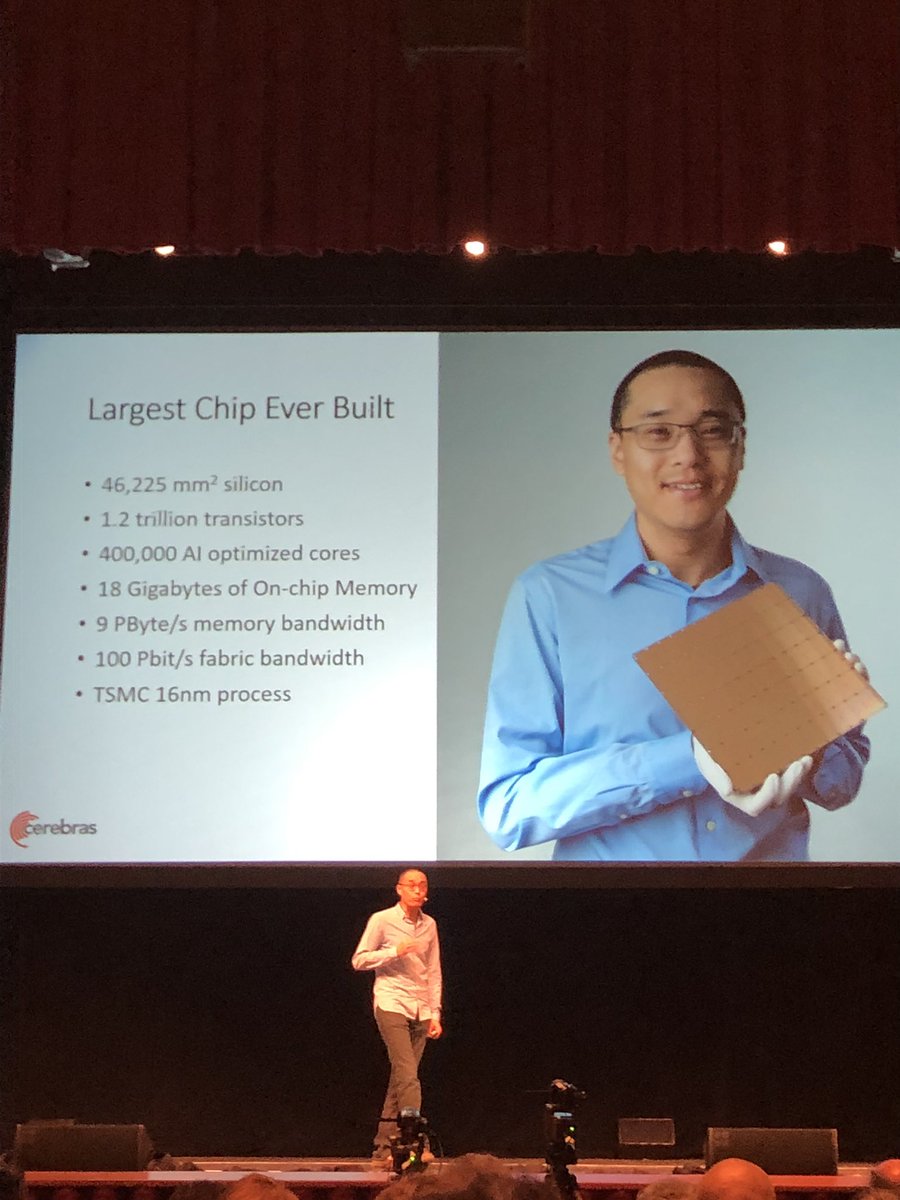
Ten years ago, we started @cerebras around an approach many believed was impossible.
As a computer architect, it is hard for me to imagine a more exciting time. Model releases are accelerating, and hardware tapeout is compressing from multi-year roadmaps to annual launches.
Hot Chips is my favorite conference, and it’s where I launched Cerebras 7 years ago. This year’s conference was especially exciting, and so much innovation was shared. I am watching the industry recreate itself: SRAM is mainstream, DRAM is moving into the third dimension, networks are being fundamentally redesigned, and AI is helping design and program the chips themselves.
The industry has never moved faster and some of the hardest architectural questions are still wide open.
SK Hynix is investing 54 trillion won, or $38.1 billion, to build two new memory fabs in Korea as demand continues to grow, with first capacity expected in 2029.
$SKHY $MU $NVDA
$AMPG earnings tomorrow will be the biggest day in my trading journey. I picked up 17k more shares today, bringing the total to 70k. This is my @ChrisCamillo moment. Feel like throwing up a little lol. But I’ve studied this play for months. I know the risks. Let’s ride.
Recalling $AMPG's Q1 2026 earnings from 3 months ago, which made me so interested in the stock in the first place:
Revenue: $5.35 million (+48.6% y/y)
Net profit: -$1.52 million (+17.3% y/y)
Gross margin: 48% (1500bps increase y/y)
Especially the last part is significant, the jump in gross margin. But when breaking down revenue, it all makes sense.
Revenue from the Manufacturing and Engineering Segment was up to $3.28M compared to $0.99M in Q1 2025. This is the most interesting segment, which includes their 5G O-RAN radio units, custom low-noise amplifiers, MMIC microchips, and satellite communications equipment. This revenue segment is the most interesting part about $AMPG, has a higher gross margin of 55-60% and is expected to grow fast in the coming years.
The other revenue segment of AmpliTech is the Distribution Segment: This segment consists almost entirely of Spectrum Semiconductor Materials, their Silicon Valley-based distribution business that sources and sells integrated circuit ceramic packages and lids to semiconductor packaging plants and data center providers. It has a lower gross margin (22-28%) but is expected to become much smaller over time, as revenue from Manufacturing & Engineering is ramping up and will become an even larger share of AmpliTech's total revenue.
AmpliTech will report its Q2 2026 earnings tomorrow after the close.