Learning AI + building in public, shipping every week. | Prev. BD @Scroll_ZKP @OrderlyNetwork @0xPolygon | 🇬🇧🇰🇷 | Thoughts on tech, markets and crypto.
Starting something in public:
Since 2021 I've worked on strategy and partnerships in Web3, helping teams grow.
Now I'm learning to build with AI.
🧠 1 hour a day
🛠️ Ship 1 small project a week (probably slop to begin with)
Goal: get genuinely good at it by the end of the year.
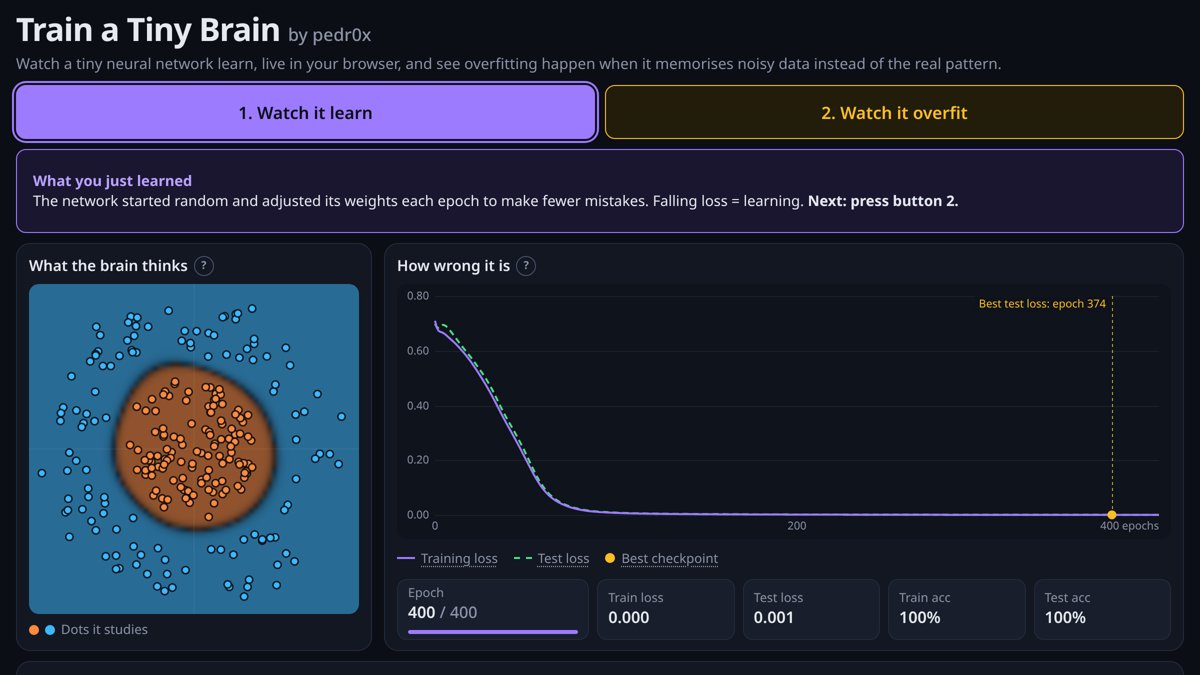
Build #3 is live ✅ Train a Tiny Brain
Watch a tiny neural network learn, overfit, and get fixed, right in your browser.
> Watch it learn: it finds a clean circle in seconds
> Watch it overfit: with noisy data, train accuracy hits 100% but test accuracy drops to 78%
> Fix it: early stopping kicks in when test loss stops improving and rolls back to the best checkpoint. Test accuracy back up to 85%
What broke: v1 never stopped training so I limited the epochs. The fix made it confusing, so I cut it down to 3 buttons.
Built with Claude Code.
https://t.co/b4N8necjZ0
Day 8 of learning AI ✅
Some gems in here in terms of prompting habits.
Covered context windows and inference. Changed how I think about chatbots.
> Your AI doesn't remember you. Every message, the app re-sends the whole chat
> That's why long chats get slower, pricier and worse ("lost in the middle")
> Prefill reads your whole prompt in one go. Decode writes the reply one token at a time, which is why output tokens cost more
> The KV cache saves what it already worked out so it doesn't redo it for every new token
> Prompt caching discounts a repeated prompt opening, so builders put fixed instructions and docs first and the question last
Day 7 of learning AI ✅
Covered post-training, how a base model becomes ChatGPT. Found this one pretty interesting.
> Pretraining gives it knowledge, but it just autocompletes
> SFT trains it on prompt + ideal answer pairs so it's actually useful
> Preference tuning: it writes 2 answers and a judge picks the better one
> RLHF: humans are the judge
> RLAIF: an AI is the judge, working from written rules
> Then you train on those picks with a reward model + PPO, or DPO, which skips both and trains straight on "A beats B" pairs
Second build shipped: Token X-Ray ✅
Built this to see how text gets split into tokens.
> Paste in text and get a token count
> See the coloured chunks and inspect their IDs
> Try English, code and emoji examples
No model calls, just a tokenizer running in your browser.
https://t.co/vNCTvCDmND
Day 6 of learning AI ✅
Covered next-token prediction and base models.
Found it interesting how much a model can learn just from predicting what comes next. The original text gives it the answer to check against, so nobody has to label each example. That's the self-supervised part.
> Predict the next token
> Measure the error
> Backpropagation calculates the gradients
> The optimizer updates the weights
> Repeat
A base model can already know things, write code and reason, but still continue your question instead of answering it. Knowing things and following instructions aren't the same training goal.
Small lab. $32M all-in. Open weights.
> Ripple-65B beats models up to 15x bigger on coding
> Runs on one desktop machine
> Roughly a tenth of the previous leader's cost
That's the bit I like. Frontier AI, cheap enough for a small team.
Their own numbers though, so I'll wait for outside tests.
https://t.co/4VtsbmdZ27
Today we release Ripple-65B Preview, our 65B dense LLM we pretrained from scratch.
Ripple sets a new state-of-the-art for U.S. open-weight models in agentic coding tasks, surpassing significantly larger models including Muse Spark Open-816B, Beam-501B, Inkling-975B, and Nemotron 3 Ultra-550B.
Learn more: https://t.co/Pe04ZKhkE9
Launched my first bit of AI slop today. First build, so I kept it super simple.
AI or Not? 10 well-known products, from ELIZA to ChatGPT, and you sort each one as AI, machine learning, deep learning or generative AI. At least the slop is self-aware. Truly innovative 🧠
I got 9/10. What do you score? 👇
https://t.co/MdVrP1N5wS
Day 5 of learning AI ✅
Covered attention and transformers, basically how LLMs actually read text.
The animal didn't cross the street because it was too tired.
The animal didn't cross the street because it was too wide.
One word changes what "it" means. The model works that out by having every word look at every other word and weigh which ones matter. That's attention.
Older models (RNNs) read text one word at a time and squeezed everything into a single running memory, so early words faded by the end. Transformers look at the whole context window at once, which made them faster to train and much better with long text.
Day 4 of learning AI ✅
Covered embeddings, semantic search and RAG.
Quick way to picture embeddings: every word or sentence gets turned into a list of numbers, which is basically an arrow pointing in some direction.
Things with similar meaning point in a similar direction. Dog and puppy are almost on top of each other, puppy and car are way off.
To check how similar two things are, you just measure the angle between the arrows. That is how search can find what you meant, not just the exact words you typed.
grok bot can now see what's on your phone and answer anything about it
just hold the action button and ask what you need:
> ask anything about the video you're watching
> tell it to build what you saw in a reel for your business
> ask it to break down the article you're reading
it can watch videos, read posts, check the web, basically everything.
i built it as a free iphone shortcut and made it open source, you can grab it below
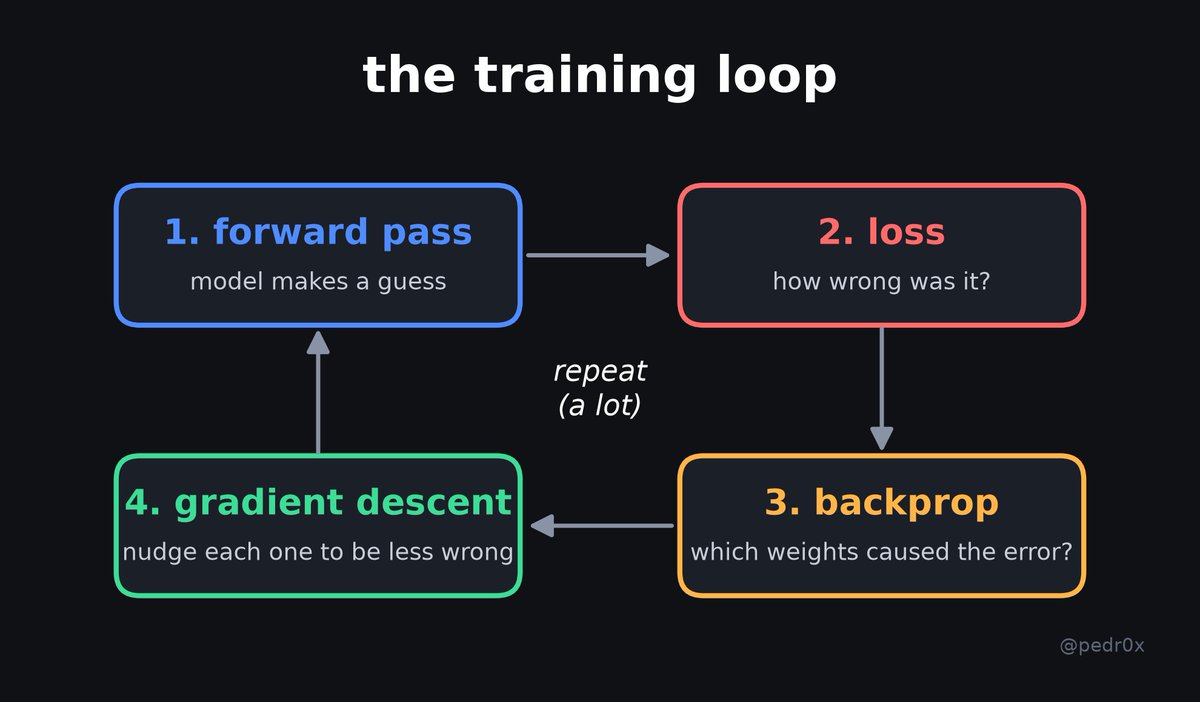
Everyone should know how models learn 🧠
> forward pass: model makes a guess
> loss: checks how wrong it was
> backprop: works backwards to find which weights caused the error
> gradient descent: nudges each weight to be a bit less wrong
> repeat. a lot
Day 3 of learning AI ✅
Training loops are genuinely interesting, and less complex than I thought. Backpropagation is cool.
Build 1 (AI or Not?) is done. Batching my launches on Tuesday to save on Netlify credits 🧠
Who is Stan Druckenmiller?
> ran soros' quantum fund from 1988
> started his own fund duquesne in 1981
> broke the bank of england in 1992, ~$1B on one trade
> ~30% a year from 1986, never had a losing year
> up ~11% in 2008 while the average hedge fund lost 19%
> closed a $12B fund in 2010, now runs his own money
> bitcoin skeptic in 2018, holder by 2020
> first ever post on x today: invested in trade(xyz), which just announced a deal with ice (nyse owner) to bring 24/7 hyperliquid perps to the US
I am excited to be an investor in trade(xyz) as they partner with ICE to bring 24/7 perpetual futures on Hyperliquid to the United States. As a market participant, I am looking forward to to using their innovative product to enhance my investment process.
If you're wondering what trade(xyz) is:
Hyperliquid has this thing called HIP-3 that lets builders spin up their own perp markets on top of it.
trade(xyz) uses it for stock, index and commodity perps, and has done $650B+ in volume in just over a year.