Más me doy cuenta de que Lutero es una completa anomalía, me es ininteligible que un hombre así fuera hijo de Roma en la temprana modernidad. Es un genio, una monstruosidad tal, que el luteranismo lleva siglos intentando digerirlo y siempre termina vomitando.
“God did not create us to be defective, but rather in His own image and likeness.”
Here you have the perfect image and likeness of God in the human being.
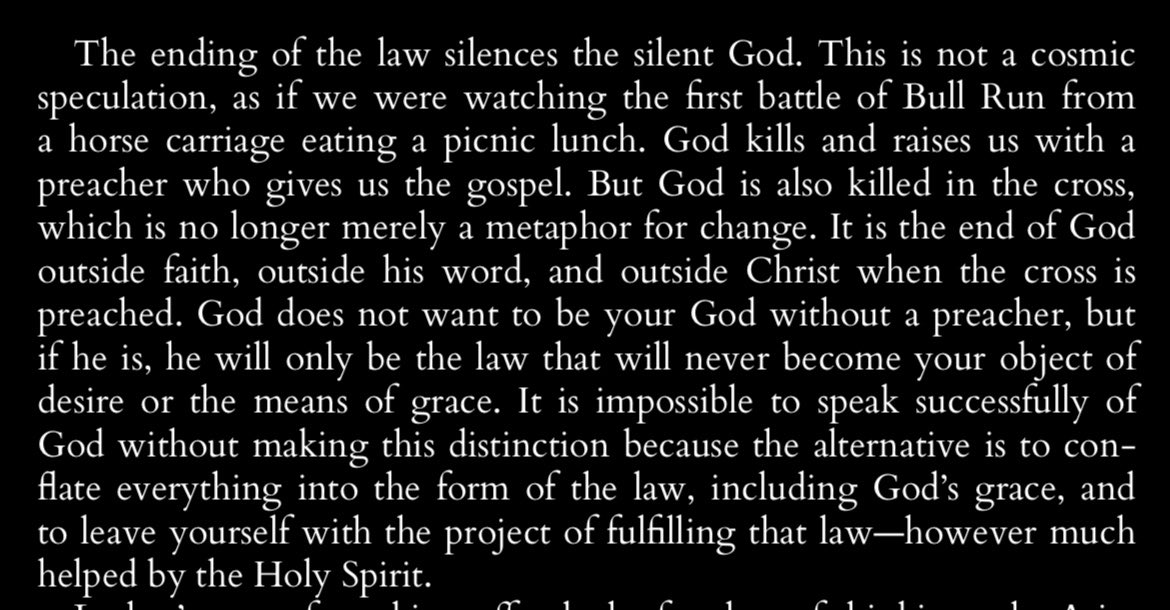
“God does not correspond to himself, as the law demands, but opposes himself and becomes a God who does not manage to balance justice and mercy but actually bestows pure mercy on the merciless.”
Steven D. Paulson.
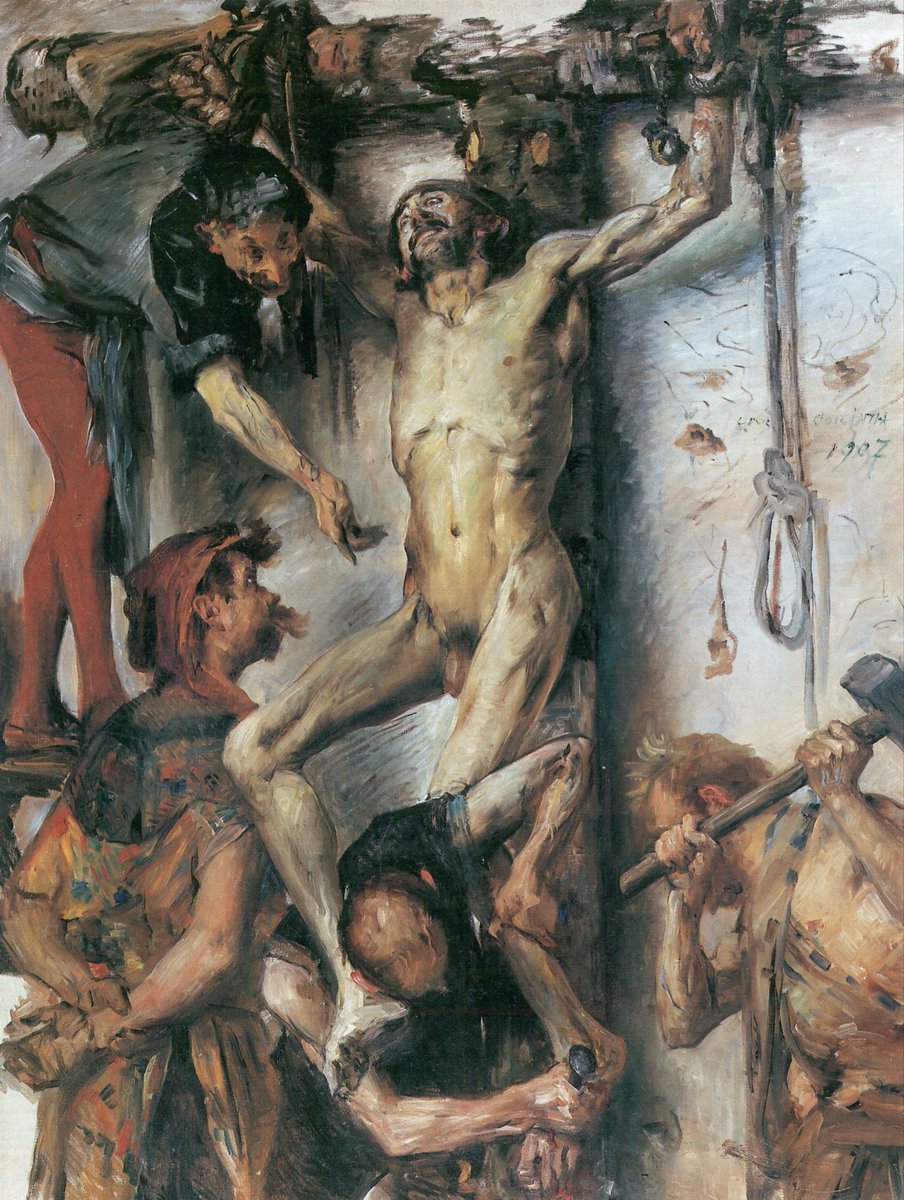
“God is not in the cross feeling our pain or becoming like us so that divinity can either understand us or we it. God is defeating us, and himself.”
Steven D. Paulson.
@epaphfras Coisas que agostinho legou ao pensamento:
Graça
Dignidade da pessoa humana
Politica secular
Coisas que os caras que vc ta defendendo legaram:
Sereis como deuses (Diabo)
Czarismo
Substacks com David Bentley Hart
René Girard on Freud's ‘death drive’:
“It's a good example of pointless complication. In my view, the death drive exists, but it is entirely linked to mimetic rivalry. Mimetic desire makes you into the rival of your model: you fight with him over the object that he himself pointed out to you. This situation reinforces desire and increases the prestige of the obstacle as such. And the supreme obstacle, of course, is death—it's what can kill you [if the fighting continues]. The death drive is the logical outcome of this mechanism. But Freud is unable to link this paradoxically narcissistic desire for a biological, inanimate state to the other phases of the process; nor even, to use his own concepts, to link it to the Oedipus complex, for example, even though he's perfectly aware of the latter's mimetic nature. He contents himself in some sense with adding an extra drive. This motley assemblage inspires awe in the credulous, but if it can be simplified, we have to simplify it.”
From When These Things Begin: Conversations with Michel Treguer (Trans. @cribbenMerrill), ch. 11
@cancerogene_ Evaristo eu pelo menos consigo ver cumprindo um papel ali, apesar de achar fraco. JUR tem um humor que me agrada muito. Agora o Fernando Sabino faz um tipo de literatura que no Brasil diversos nomes fazem melhor. Mas com certeza das piores seleções de livros brasileiros…
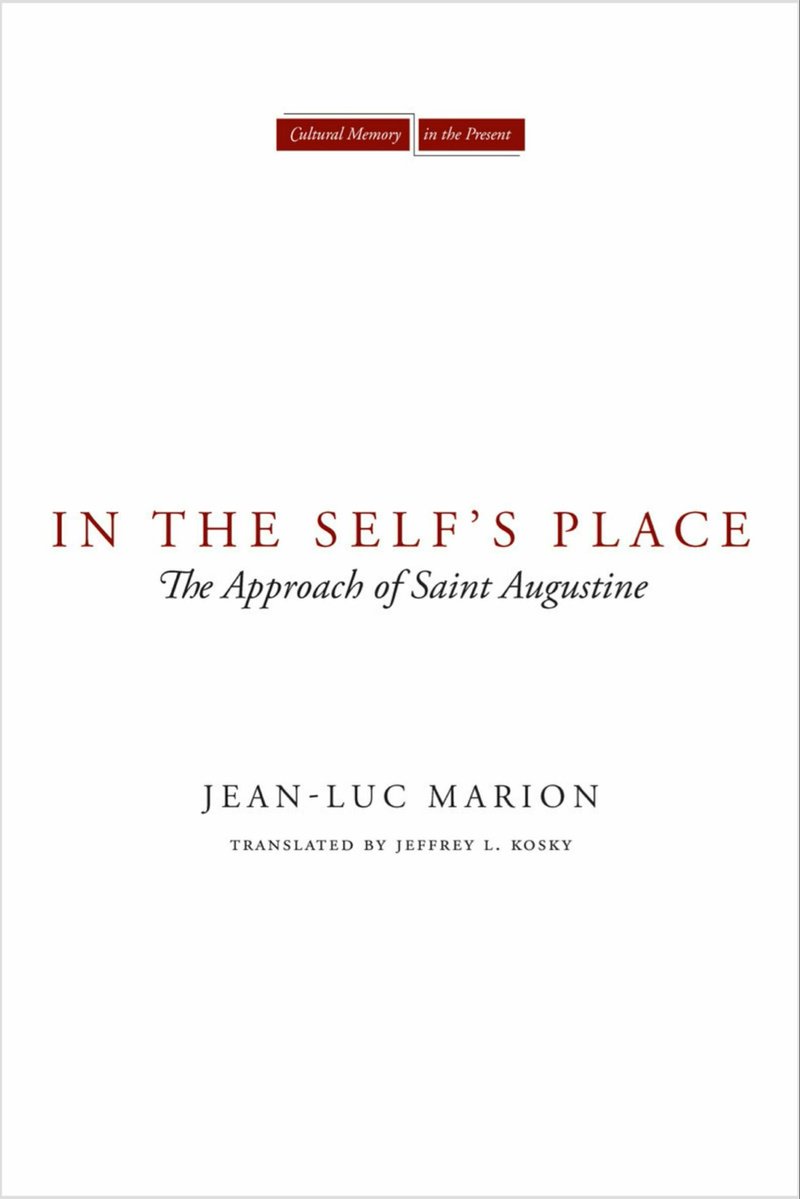
If Jean-Luc Marion is a liberal, as @johnmilbank3 tends to argue, then I’m a liberal. But I don’t think it’s that simple. The key methodological (and “counter-metaphysical”) conceit of Being Given redolent of liberalism is the phenomenologically regulative notion of “self-showing”—that every phenomenon should be, more or less passively, welcomed to show itself from itself, rather than being reduced to some formally extrinsic category (objectness, beingness, etc.). It would seem that the key “postliberal” premise of a common good would inevitably present itself as a formally extrinsic category to the self-showing of… well, evil, counter-posed as one ultimate end of political law opposed to that of the sin which denies the universal good properly due as the common obligation to all persons.
If the sin of repudiating responsibility for the common good is the essence of liberalism, then certainly a claim could be made that a passive ethos of “self-showing” is irresponsible and even anarchic (might every “non-metaphysical” doctrine not be anarchic?). But that relies on a further assumption—the “democratic” assumption that political responsibility intrinsically entails the obligation of citizens to forward a vision of positively repressive law, functioning ultimately as a “restraint” on evil, as a matter of civic duty. This “democratic” assumption also entails a further one, which I will call “discursive”: law is really capable of restraining evil, because evil can be adequately represented in a public discourse.
I reject both the democratic and discursive assumptions categorically, with the rejection of the discursive assumption being logically prior. I am convinced that evil is a mystery of providence which cannot be properly represented in any discourse whatsoever—which I do believe is the ultimate conclusion of the apocalyptic doctrine of Pope Benedict XVI, profiled so well in the fashion of a “self-showing” by Giorgio Agamben. Of course, from Benedict’s perspective, the moral law, available to natural reason and reinforced by the truths of revelation, holds on a very basic level to sufficiently regulate prudent human conduct, but the difficulty arises at the point that the Holy Spirit, while MORE rather than LESS righteous than the law, and including all goodness proper to it, is fully irreducible to any inner-worldly law.
Here I think a quick allegorical interpretation of Genesis is helpful: why exactly is original sin linked to “the knowledge of good and evil”? Mysterious and counter-intuitive, is it not? What’s at stake in the essence of sin is not just denying the common good (as more “Platonist” glosses may have it); rather, it is arrogating to oneself the privilege of self-legislating, of absolutizing the negativity of inner-worldly law over divine judgment. It is on THESE grounds that I remain convinced that Marion’s doctrine of passive “self-showing” is unassailable.
Rooted in his interpretation of St. Augustine (and yes, explicitly repudiating “double predestination” in favor of a more Lubacian view of at once radically accessible and radically resistible grace), theologically Marion’s doctrine of self-showing concludes in an apocalyptic call to allow the “weight of love” of all created things come to maximum self-manifestation. Those who love evil, may they self-show this all the more! Only in this way will we truly LEARN anything in the Theo-drama of evil’s mystery; and, if we are serious about (hopeful?) universalism, pushed to such a limit, and accepting the regrettable damage accompanying all creatureliness, evil will eventually discover penitently that it is actually intending the good… at least past the point that it does not resist the grace of self-showing, and prefer self-destruction. Because as we know from the ecclesiastical condemnations of Jansenism, grace IS resistible (is this not, ironically for such “Augustinians,” precisely that in which the mystery of original sin consists?).
“Él dio su vida, y derramó su sangre por mí. Por tanto, al sentir tus terrores y amenazas, oh ley, sumerjo mi conciencia en las heridas, la sangre, la muerte, la resurrección y la victoria de Cristo mi Salvador. Fuera de Él, nada veré, nada escucharé.”
Martín Lutero.
Frank Sinatra's face was so asymmetrical I'm fucking crying at this shit someone made. One side is a total chad and the other is a total chud how is this possible