🚨 HERE’S WHY BITCOIN IS NONSTOP DUMPING RIGHT NOW
If you still think $BTC trades like a supply-and-demand asset, you MUST read this carefully.
Because that market no longer exists.
What you’re watching right now is not normal price action.
It’s not “weak hands.”
It’s not sentiment.
And it’s definitely not retail selling.
Most people are completely unaware what’s happening.
And by the time it becomes obvious, the damage is already done.
This move didn’t start today.
It’s been building quietly under the surface for months.
And now it’s accelerating.
Here’s the truth:
The moment supply can be synthetically created, scarcity is gone.
And when scarcity is gone, price stops being discovered on-chain and starts being set in derivatives.
That is exactly what happened to Bitcoin.
And it’s the same structural break that already happened to:
→ Gold
→ Silver
→ Oil
→ Equities
Once derivatives took over.
The original Bitcoin thesis is broken.
Bitcoin’s valuation was built on two ideas:
→ A hard cap of 21 million
→ No rehypothecation
That framework died the moment Wall Street layered this on top of the chain:
→ Cash-settled futures
→ Perpetual swaps
→ Options
→ ETFs
→ Prime broker lending
→ Wrapped BTC
→ Total return swaps
From that point forward Bitcoin supply became theoretically INFINITE.
Not on-chain.
But in price discovery, which is what actually matters.
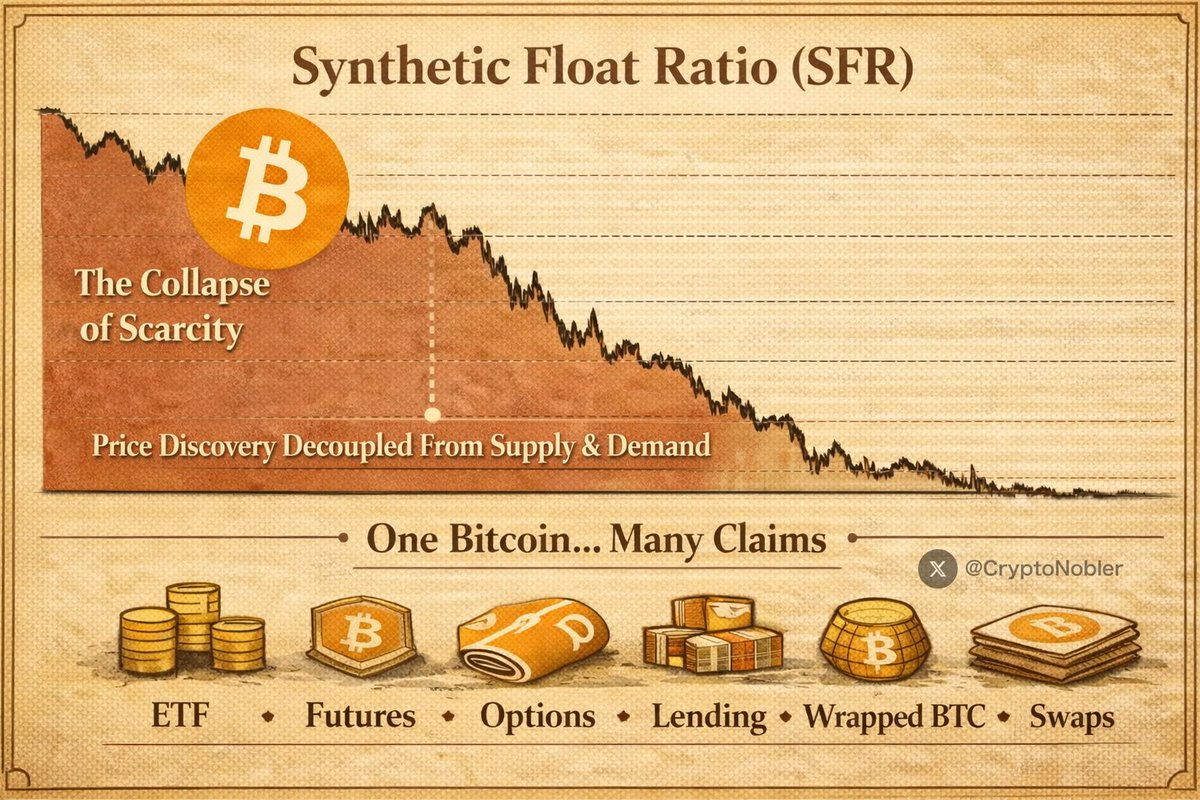
Synthetic Float Ratio (SFR).
The metric that explains everything.
Once synthetic supply overwhelms real supply, price no longer responds to demand.
It responds to positioning, hedging, and liquidation flows.
Wall Street can now trade against Bitcoin.
They’re not guessing direction.
They’re doing what they do in every derivatives-dominated market:
1⃣ Create unlimited paper BTC
2⃣ Short into rallies
3⃣ Force liquidations
4⃣ Cover lower
5⃣ Repeat
This isn’t “betting.”
It’s inventory manufacturing.
One real BTC can now simultaneously back:
→ An ETF share
→ A futures contract
→ A perpetual swap
→ An options delta
→ A broker loan
→ A structured note
All at THE SAME TIME.
That’s six claims on one coin.
That is not a free market.
That is a fractional-reserve price system wearing a Bitcoin mask.
Ignore it if you want, but don’t pretend you weren’t warned.
I’ve been calling Bitcoin tops and bottoms for over a decade now, and I’ll do it again in 2026.
Follow and turn on notifications before it's too late.
Steve Jobs on why everything around you was made by people no smarter than you:
"When you grow up, you tend to get told that the world is the way it is and your life is just to live your life inside the world. Try not to bash into the walls too much, have a nice family life, have fun, save a little money. But that's a very limited life."
Steve believed most people live with a fundamental misconception.
As he puts it:
"Life can be much broader once you discover one simple fact. And that is—everything around you that you call life was made up by people that were no smarter than you."
He continues:
"And you can change it. You can influence it. You can build your own things that other people can use. And the minute that you understand that you can poke life and actually something will pop out the other side—that you can change it, you can mold it."
On what matters most:
"Maybe the most important thing is to shake off this erroneous notion that life is there and you're just going to live in it versus embrace it, change it, improve it, make your mark upon it. I think that's very important."
His perspective on why you should change things:
"However you learn that, once you learn it, you'll want to change life and make it better because it's kind of messed up in a lot of ways."
The shift:
"Once you learn that, you'll never be the same again."
Elon Musk: "People get confused sometimes they think an economy is money , But money is a database
for the exchange of goods and services and for time-shifting the exchange of goods and services. Money is a database. Money does not have power in and of itself
You can run the thought experiment: if you are shipwrecked on a remote island and you have a trillion dollars in a Swiss bank account, "it's worthless"
You’d rather have a can of soup. You can have all the Bitcoin in the world and you’re still going to starve
The actual economy is goods and services”
@LangmanVince Furthermore, those troops were all necessary because Iraq was already attacking other countries and they had to intervene in those wars, and Baghdad is very far from the coast, unlike Caracas, which is close to the sea.
@LangmanVince Don't compare Saddam to Maduro. Saddam had a much stronger army and more support from the Iraqi people than Maduro has from the Venezuelan people.
Venezuela is a weaker country, while Iraq at the time was a regional power.
🚨 IT’S HAPPENING RIGHT NOW!!!!
Something wild is happening right now, and most people are just ignoring it.
The global money game is quietly being rewritten.
Everyone keeps saying “Relax, everything’s normal.”
Meanwhile, the fiat system looks like it’s about to collapse.
Most won’t believe it until it’s already over.
But the people pulling the financial strings?
Yeah… they see it and they’re already prepared.
How do we know?
Because they’re quietly sprinting toward the exit, and that exit is gold.
Central banks aren’t buying dips; they’re buying vaults. Mountains of bullion.
They’re swapping paper promises for the one thing that doesn’t care about interest rates, elections, or spreadsheets: hard money.
To understand why, look at Japan, a big warning sign.
For years, Japan kept interest rates glued to the floor, hoping cheap money would magically bring growth.
Investors saw the trick and used Japan as a low-rate ATM, borrowing cheap yen and sending that money around the world chasing better returns.
Great for global markets. Terrible for reality.
Because yield curve control comes with a price tag. A big one.
You can manipulate bond yields with a keystroke, but you can’t print oil.
You can’t conjure copper.
You can’t manufacture energy out of thin air.
Eventually, the real world pushes back.
And inflation is that push.
Japan hit that wall. Hard.
After years of negative rates, they had to let bond yields explode upward just to keep their currency from evaporating.
Now their 10-year yield looks like it strapped itself to a SpaceX rocket, right as Japan holds the highest debt-to-GDP on Earth.
And while everyone in the U.S. is begging the Fed to bring back QE or slap on its own version of yield curve control, maybe, just maybe, we should take a second and ask:
If Japan followed that exact playbook and ended up with runaway inflation… why do people think it’ll magically work in America?
Fiat doesn’t last forever.
Debt can’t stay cheap forever.
Artificially inflated assets don’t stay inflated forever.
Stocks built on cheap borrowing and endless buybacks?
They don’t look nearly as shiny when debt gets expensive again.
But here’s the curveball:
Gold is quietly outpacing the Nasdaq this year, despite the AI hype machine running at full volume.
That’s not an accident. That’s your alarm clock.
Sure, the Treasury and the Fed can pump your stock portfolio full of Monopoly money to make you feel richer…
but measured against hard assets, equities are already bleeding.
When things get real, the scoreboard isn’t measured in dollars.
It’s measured in energy, commodities, and money that can’t be printed with a mouse click.
If the Fed goes down the yield-curve-control road, smart money will look at Japan and see the final chapter before it’s written.
They’ll understand that the system is drifting toward a reset. A big one.
Gold has survived every monetary reset humanity has ever attempted.
And Bitcoin?
It’s the new kid with something the old system fears: true scarcity backed by real energy costs.
But until we see a steady, official buyer stepping in, until it gets the “central bank treatment”, Bitcoin’s road is going to be volatile.
Ugly at times. Necessary in the long run.
I’m prepared for chaos before clarity.
Because that’s how every reset looks from the inside.
And whether people realize it yet or not…
we’re living inside one.
THE LARGEST LIQUIDITY DRAIN IN MODERN HISTORY ENDS TODAY.
December 1, 2025.
For thirty months, the Federal Reserve removed over two trillion dollars from global markets. Balance sheet: $9 trillion down to $6.6 trillion. The most aggressive monetary tightening since Volcker.
That program dies at midnight.
Quantitative Tightening is over.
The numbers tell the story no analyst predicted would converge this fast:
Fed December rate cut probability: 86.4 percent. Consumer sentiment: 51, the second lowest reading in recorded history. Manufacturing contracted eight consecutive months. ADP preliminary data signals negative job growth at 13,500 weekly losses.
And yet.
The pivot arrives not with crisis, but with calculation. The Fed determined reserves reached “ample” levels before markets forced their hand. No repo spike. No 2019 repeat. A controlled landing into neutral.
What happens next reshapes everything.
Treasury funding pressure eases as the Fed stops absorbing supply. Liquidity flows reverse direction for the first time since 2022. Risk assets no longer fight a shrinking balance sheet.
December 9 brings the final FOMC decision of 2025. A cut to 3.50 to 3.75 percent is nearly locked. But the real event already happened. Today. The structural regime shift from extraction to equilibrium.
The implications cascade across asset classes. Bond yields lose their largest systematic buyer turned seller. Equities face one less headwind. Dollar dynamics shift as rate differentials compress.
This is not a prediction. This is a timestamp.
The tightening era that defined 2022 through 2025 concluded at the turn of this month. Markets priced for scarcity now operate under different physics.
Those positioned for the old regime will learn the new rules the hard way.
The calendar just changed.
So did everything else.
El programa de Ajuste Cuantitativo (QT) de la Reserva Federal de Estados Unidos ha finalizado oficialmente hoy día 1 de diciembre de 2025.
Esto marca la conclusión de los recortes y las limitaciones de la liquidez que comenzaron en 2022.
Por fin parece que la política monetaria va a estar orientada hacia la estabilización y aumento progresivo de la liquidez en lugar de un drenaje activo.
Estos días son de una importancia trascendental.
Esta tarde habla Jerome Powell, la semana que viene la FED se reunirá para bajar los tipos de interés, y por supuesto tendremos que estar muy atentos a lo que tengan que decir sobre cómo y de qué manera pretenden inyectar liquidez en la economía y mercados.
A pesar de que estemos atravesando en estos momentos una fase dura de corrección, distribución, con grandes liquidaciones, y con mucho miedo, creo que hay que mirar más allá, podríamos estar ante el inicio de una nueva fase de expansión monetaria que impulse crecimiento en los mercados en 2026.
Y ya sabéis que no hay activos más sensibles a las expansiones o contracciones de liquidez que las criptomonedas.
Se que no es fácil, se que el sentimiento es terrorífico, los gráficos están destrozados, está todo muy oscuro, parece que es el final, pero en mi humilde opinión, es momento para estar más optimista que nunca.
Puede ser que esté loco como una cabra, me puedo equivocar, no trato de convencer a nadie, tú haz lo que consideres, pero yo personalmente sigo muy optimista con esta industria, para mi lo mejor todavía está por venir, y creo sinceramente que este no es el final del mercado alcista.
EL QUE TENGA MIEDO A MORIR QUE NO NAZCA
VERY MUCH HIGHER HIJOS DE PERRA
BITCOIN DID NOT CRASH.
It was executed.
The weapon: Japanese Government Bonds.
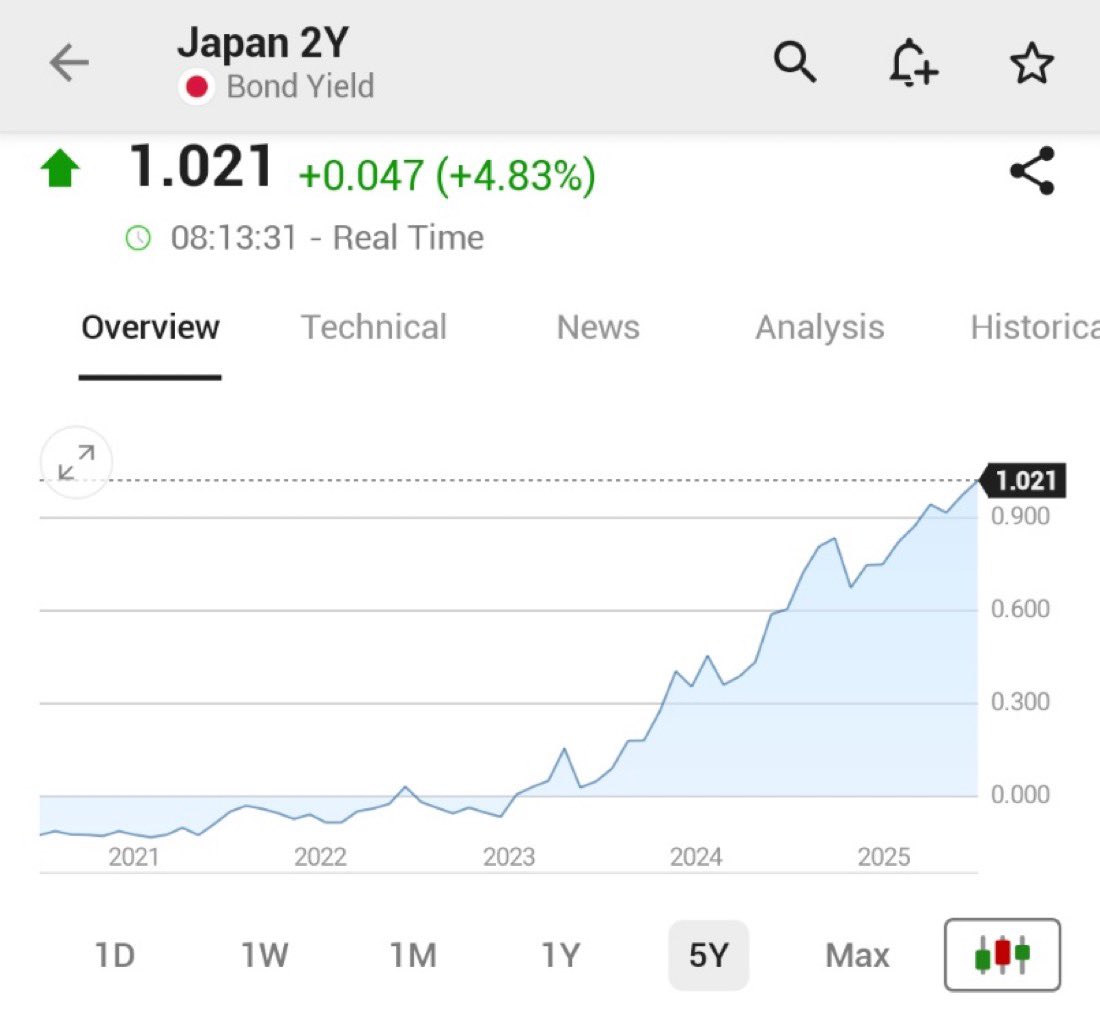
On December 1, 2025, Japan’s 10-year yield hit 1.877 percent. The highest since June 2008. The 2-year touched 1 percent. A level not seen since before Lehman fell.
This triggered the unwinding of the largest arbitrage trade in human history.
The Yen Carry Trade. Conservative estimates: $3.4 trillion. Realistic estimates: $20 trillion. For thirty years, the world borrowed free Japanese money to buy everything. Tech stocks. Treasuries. Bitcoin.
That era ended last month.
The transmission was mechanical. Yields rise. Yen strengthens. Leveraged positions become unprofitable. Selling begins. Selling triggers margin calls. Margin calls trigger liquidations. Liquidations trigger more selling.
October 10: $19 billion in crypto positions liquidated in 24 hours. The largest single day wipeout in digital asset history.
November: $3.45 billion fled Bitcoin ETFs. BlackRock’s fund lost $2.34 billion. Its worst month since inception.
December 1: Another $646 million liquidated before lunch.
Bitcoin’s correlation with the Nasdaq: 46 percent. With the S&P 500: 42 percent. The “uncorrelated hedge” is now a leveraged expression of global liquidity conditions.
Yet the data contains a paradox. While prices collapsed, whales accumulated 375,000 BTC. Miners cut selling from 23,000 BTC monthly to 3,672. Someone is buying what institutions are selling.
The pivot point: December 18. Bank of Japan policy decision.
If they hike and signal more, Bitcoin tests $75,000.
If they pause, a short squeeze could reclaim $100,000 within days.
This is not about cryptocurrency anymore. This is about the cost of capital in a world that forgot money has a price.
The widow maker came collecting.
Position accordingly.
Read the full deep dive analysis 👇 https://t.co/ssHHryWqQ4