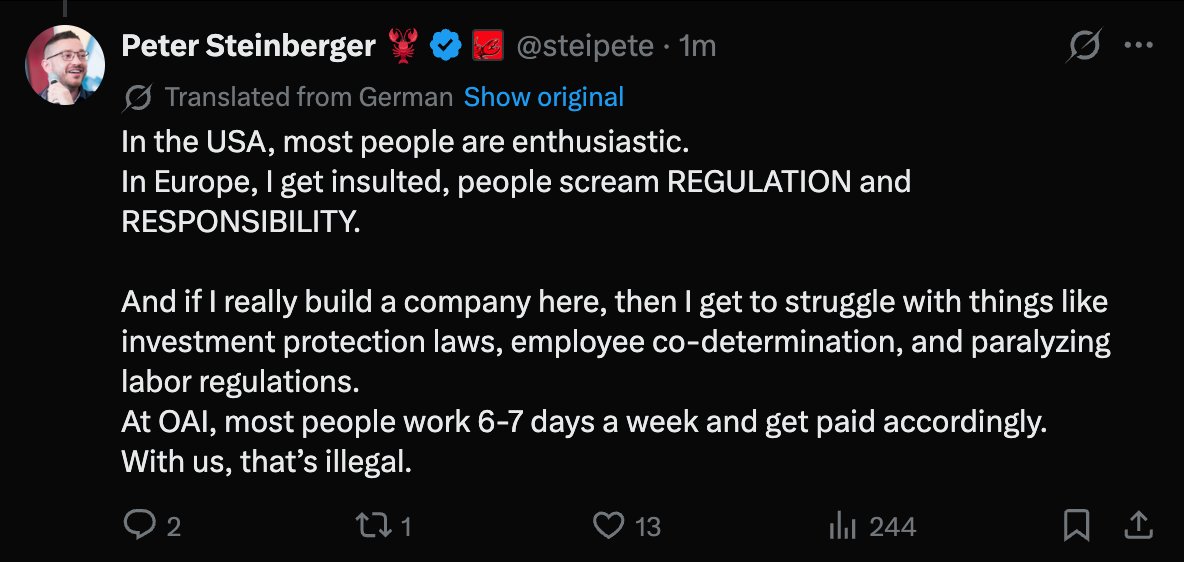
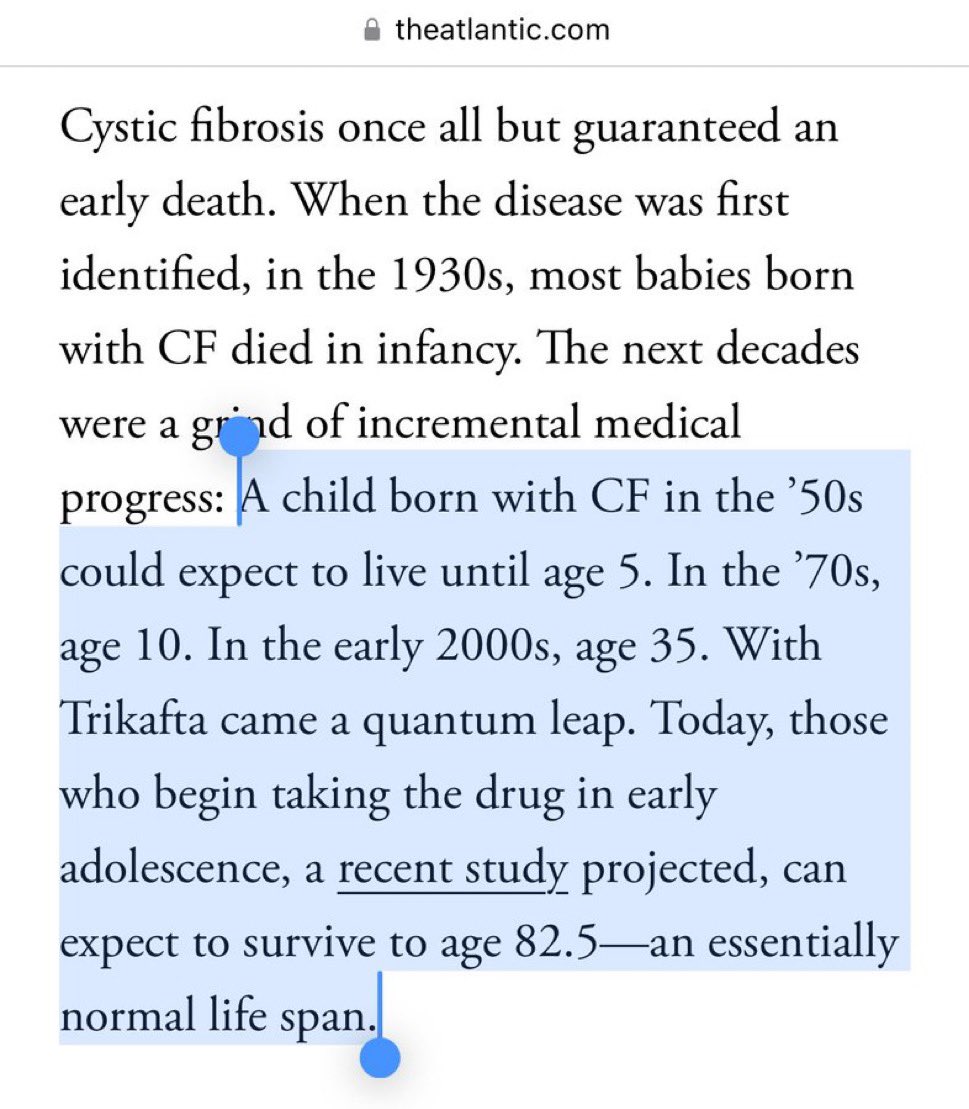
tell me you have never used cursor without telling me
really tired of the trope/psyop that cursor is legacy software – if your machine can take it, multi-cursor windows with separate git checkouts, with 5.4 xhigh fast is THE absolute best setup
yeah it ain't cheap I know, so not for everyone
and don't get me started about cloud agents. Miles ahead of anything the other have put out
I was chatting with my buddy at Google, who's been a tech director there for about 20 years, about their AI adoption. Craziest convo I've had all year.
The TL;DR is that Google engineering appears to have the same AI adoption footprint as John Deere, the tractor company. Most of the industry has the same internal adoption curve: 20% agentic power users, 20% outright refusers, 60% still using Cursor or equivalent chat tool. It turns out Google has this curve too.
But why is Google so... average? How is it that a handful of companies are taking off like a spaceship, and the rest, including Google, are mired in inaction?
My buddy's observation was key here: There has been an industry-wide hiring freeze for 18+ months, during which time nobody has been moving jobs. So there are no clued-in people coming in from the outside to tell Google how far behind they are, how utterly mediocre they have become as an eng org.
He says the problem is that they can't use Claude Code because it's the enemy, and Gemini has never been good enough to capture people's workflows like Claude has, so basically agentic coding just never really took off inside Google. They're all just plodding along, completely oblivious to what's happening out there right now.
Not only is Google not able to do anything about it, they don't seem to be aware of the problem at all. I'm having major flashbacks to fifty years ago as a kid at the La Brea Tar Pits, asking, "why can't they just climb out?"
My Google friend and I had this conversation over a month ago. I didn't share it because I wanted to look around a bit, and see if it's really as bad as all that. I've been talking to people from dozens of companies since then. And yeah. It's as bad as all that.
Google is about average. Some companies at the bottom have near-zero AI adoption and can't even get budget for AI. They may have moats and high walls, but the horde is coming for them all the same.
And then there are a few companies I've met recently who are *amazingly* leaned in to AI adoption. One category-leader company just cancelled IntelliJ for a thousand engineers. That's an incredibly bold move, one of many they're making towards agentic adoption. In my opinion, that company is setting themselves up for a _huge_ W.
As for the rest, well, it's the Great Siloing. Everyone's flying blind. With nobody moving companies, no company knows where they stand on the AI adoption curve. Nobody knows how they're doing compared to everyone else.
Half of them just check a box: "We enabled {Copilot/Cursor} for everyone!" Cue smug celebrations. They think this is like getting SOC2 compliance, just a thing they turn on and now it's "solved." And they don't realize that they've done effectively nothing at all.
All because of a hiring freeze.
Big, big moment for us! We just rebranded to Ultralight and raised over $9M to build an agentic harness for preventive medicine. 75 clinics live and growing fast. I'm proud of what this team has built, and the hardest problems are still ahead.
One workflow that works today: a clinician has a patient in 10 minutes. They haven't seen them in three months. They ask Ultralight to prep. In about a minute, the agent compiles labs, wearable trends, questionnaires, journaling, prior notes, after-visit summaries, and open action items into a usable brief. The clinician walks in ready.
This is the future of preventive care and we're just getting started.
The destination is a clinical agent for healthspan. A system with eyes on the fire hose of patient data, separating signal from noise across an entire panel. Agents that don't wait to be queried. Agents that prep clinicians, execute workflows like lab ordering, and surface the patients who need attention before anyone goes looking. The clinical leverage of an entire care organization, on tap.
The biggest challenge in our industry today is making agents trustworthy enough to operate inside live clinical workflows. Think evals, provenance, review queues, human checkpoints, and observability. We've built some exciting solutions to tackle this and are ready to go deeper.
We're hiring engineers who want to own this problem. You move fast, you build tooling to move faster, and you treat trust and stability as constraints worth respecting. You use AI to amplify yourself and not to ship slop. You've been solving hard problems at high-growth companies, and you want the next one to matter.
If that sounds like you (or someone you know): DM me or comment below. Come build with us!
The "autistic jerk" vibe in Codex 5.3 is just a byproduct of its aggressive rollout strategy. OpenAI is clearly trading social calibration for raw reasoning throughput—it’s optimized to detect design smells early and kill them, even if it hurts your feelings.
Claude 4.6 is the refined UX for collaborative engineering, but when you’re pushing the frontier of system-level logic, you want the model that treats your code like a cold-blooded kernel debugger. One gives you a warm feeling, the other gives you a 99% stress test pass rate. I’ll take the jerk for production.
so important to do this
when I was a junior, I’d learn from the code seniors generated
now junior folks feel lost – this will help them learn to think like a senior
We're proposing an open standard for tracing agent conversations to the code they generate. It's interoperable with any coding agent or interface.
https://t.co/jO4DIoIl6A