I'm a cardiologist. Something just happened today that I genuinely did not see coming — and it could change the future of preventive medicine more than anything I've written about on this platform.
Midjourney — the AI company that became famous for generating images from text prompts — just announced a medical hardware division and unveiled a working prototype of a full-body scanner unlike anything that's ever existed.
It's called the Midjourney Scanner. And it works like this.
You step into a shallow pool of water. You stand on a platform that slowly descends — about two inches per second — through a ring containing roughly half a million tiny ultrasonic transducers, each the size of a grain of sand. Every one of them acts as both a speaker and a microphone, sending ultrasonic waves through your body from every angle and recording what comes back.
60 seconds later, you step out. The scan is done.
No radiation. No magnets. No claustrophobia. No IV contrast. Just sound, water, and an almost incomprehensible amount of computing power — roughly 2 petaflops processing 17 gigabytes per second of raw acoustic data — reconstructing a 3D map of your entire internal anatomy down to half a millimeter resolution.
Organs. Tissues. Blood vessels. Bones. Muscle. Fat distribution. All segmented by AI in real time.
As a cardiologist who has spent months writing about how the standard screening playbook misses the majority of future heart attacks — this is the technology I've been waiting for without knowing it existed.
Here's why this matters for the future of your heart.
Right now, getting a detailed look inside your cardiovascular system requires either a CT scan (radiation), an MRI (magnets, claustrophobia, 45-60 minutes, $1,000+), or a coronary CT angiogram (radiation, IV contrast, limited availability). These are powerful tools. I order them regularly and they save lives.
But they're reactive. You get them when something is already suspected. They're expensive. They're uncomfortable. And for most people, they happen once — maybe twice — in a lifetime.
Imagine instead: a 60-second scan with no radiation that you could repeat monthly or quarterly. Tracking cardiac structure over time. Watching body composition shift. Detecting changes in organ size, fluid distribution, or vascular architecture before symptoms ever develop. Building a longitudinal dataset of YOUR body that AI can analyze for patterns no single snapshot would reveal.
That's what Midjourney is building toward.
The company plans 50,000 scanners worldwide over six years, with capacity for a billion scans per month. The first location — the "Midjourney Spa" in San Francisco — opens at the end of 2027 with 10 scanners alongside saunas, cold plunges, and a gym. The scan costs a few dollars. The experience is designed to feel like wellness, not medicine.
The technology is built on Butterfly Network's ultrasound-on-chip platform — 40 modules per scanner — combined with Midjourney's own AI segmentation and reconstruction stack. David Holz, the founder, claims the system aims for image quality comparable to MRI in many aspects but at nearly 100x the speed with zero radiation.
Now the caveats — because I'm a physician and the caveats matter enormously.
This is a Gen 1 prototype. About a dozen people have been scanned so far. Current scan time is actually closer to 20 minutes, not 60 seconds — the system is bottlenecked by bandwidth and reconstruction algorithms. The 60-second target is aspirational for future hardware generations.
It is not FDA-cleared for diagnostic use. Midjourney is starting with body composition maps — a category below diagnostic imaging in the regulatory hierarchy. The path from "beautiful 3D body scans" to "clinically validated diagnostic tool that your cardiologist can act on" runs through years of clinical trials, comparative studies against MRI and CT gold standards, and FDA review.
No independent clinical validation has been published. The imaging claims come from Midjourney's own demonstrations. Comparative data against established modalities does not yet exist.
And the privacy implications of full-body internal scans at planetary scale — a billion scans per month — is a conversation that hasn't even started yet.
So I want to be precise. This is not ready for clinical medicine today. It may not be ready for years. Many ambitious medical hardware projects have failed in the gap between prototype and product.
But.
The fact that a working prototype exists — producing real segmented 3D anatomy from sound waves and compute alone — means the physics works. The engineering works. The question is no longer "is this possible" but "how fast can it be validated and scaled."
And if it is validated — if the resolution holds up against MRI, if the AI segmentation proves reliable, if the regulatory path clears — then what we're looking at is the most significant new imaging modality in 50 years.
For my entire career, preventive cardiology has been limited by the fact that seeing inside the body is expensive, slow, uncomfortable, and infrequent. We catch disease late because we image rarely. We image rarely because imaging is hard.
A 60-second, no-radiation, spa-based full-body scan that costs a few dollars would demolish every one of those barriers.
I've written about AI detecting inflamed arteries. About gene editing curing cholesterol. About GLP-1 drugs rewriting metabolic medicine. About cellular reprogramming reversing aging.
This is the missing piece: the ability to see inside every human body, routinely, safely, and affordably — so all of those interventions can be deployed before the disease arrives instead of after.
The company that taught AI to generate images from imagination just built a machine that generates images from the human body.
The future of medicine showed up today from the last place anyone expected.
This week in medicine
1. A new class of blood pressure drug approved
2. The first phase 3 trial for Retatrutide in obesity
3. Positive trials for an inhaled therapy in idiopathic pulmonary fibrosis
4. Large-scale screening for type 1 diabetes is feasible
5. More info on the cancer risk of pancreatic cysts
Next week: ASCO!
@JohnRee64396120@EchoesofWarYT Revenge even later in 1814 at the Battle of New Orleans. Then Colonel Jackson, “Old Hickory” defeated the British and sent them running back to the Gulf of Mexico.
246 years ago today, a 13 year old boy named Andrew Jackson watched his neighbors get hacked to death in a Carolina meeting house, and the future of American politics was decided in a single afternoon.
Colonel Abraham Buford had spent the morning marching his 350 Virginians north through the Waxhaws, a Scots-Irish settlement straddling the Carolina border. He thought he had a day's head start on the British. He was wrong by about an hour.
At 3 p.m. Tarleton's dragoons came out of the pine woods at a dead gallop. Buford formed a single line in an open field, ordered his men to hold fire until the cavalry was 10 yards away, and waited. It was the worst possible tactic against horsemen. The first volley emptied a few saddles. The second never came.
The British line crashed through. Buford ran up a white flag. A British officer rode forward to accept the surrender. Then a musket cracked from somewhere in the American ranks. The shot killed Tarleton's horse, pinning him beneath it.
His men thought their colonel was dead.
What followed is what the Continental Congress later called, with careful understatement, "an event without parallel in this war." For 15 minutes the British Legion went down the American line with sabers and bayonets, killing wounded men where they lay. An American surgeon counted an average of 16 saber wounds per body. Some men were stabbed so many times the wounds ran together.
113 dead. 150 too badly cut up to move. 53 prisoners. British losses: 5 killed.
The survivors were dragged to the Waxhaw Presbyterian Church, where the local women turned the pews into hospital beds. One of the nurses was Elizabeth Jackson. Her 13 year old son helped her wash the wounds.
Andrew Jackson never forgot it. Forty years later, as President, he was still settling scores with the British Empire.
"Tarleton's Quarter" became the most effective recruiting poster in American history. Four months later, those same Scots-Irish farmers would corner a Loyalist army on top of Kings Mountain and shoot them to pieces. They yelled "Remember Buford" the whole way up the slope.
One afternoon in a hayfield lost Britain the South.
For Memorial Day, do yourself a favor and take three minutes of your time to listen to this Civil War letter from Maj. Sullivan Ballou to his wife.
I just started re-watching the Ken Burns series, which debuted in 1990 to a record-breaking audience of 40 million, for the first time since it originally aired.
While I had forgotten all of the specifics of the show over the years, I NEVER forgot this letter or this moment, which closed the first episode.
Burns kept a copy of the letter in his wallet for 25 years.
Mat Best - Folded Flag (Official Music Video)
This song was written for the men and women who stepped into the fire for this country and never made it home, and for the families, friends, and brothers left carrying their memory forward.
Memorial Day isn’t just a long weekend. Behind every folded flag is a name, a story, and a sacrifice that built the freedom we live in every day.
This song proudly supports the Major Brent Taylor Foundation and the Gold Star families it supports.
My hypothesis: US university education was a massively successful export industry (foreign students paying tuition + housing + living expenses is literally classified as exports) and Trump admin collapsed this demand.
Public higher education debt exploded more than 85% in just one decade. Then colleges kept borrowing money during the low-interest-rate years while building luxury dorms, football facilities, climbing walls, and bloated administrations. The demographic cliff is here in force.
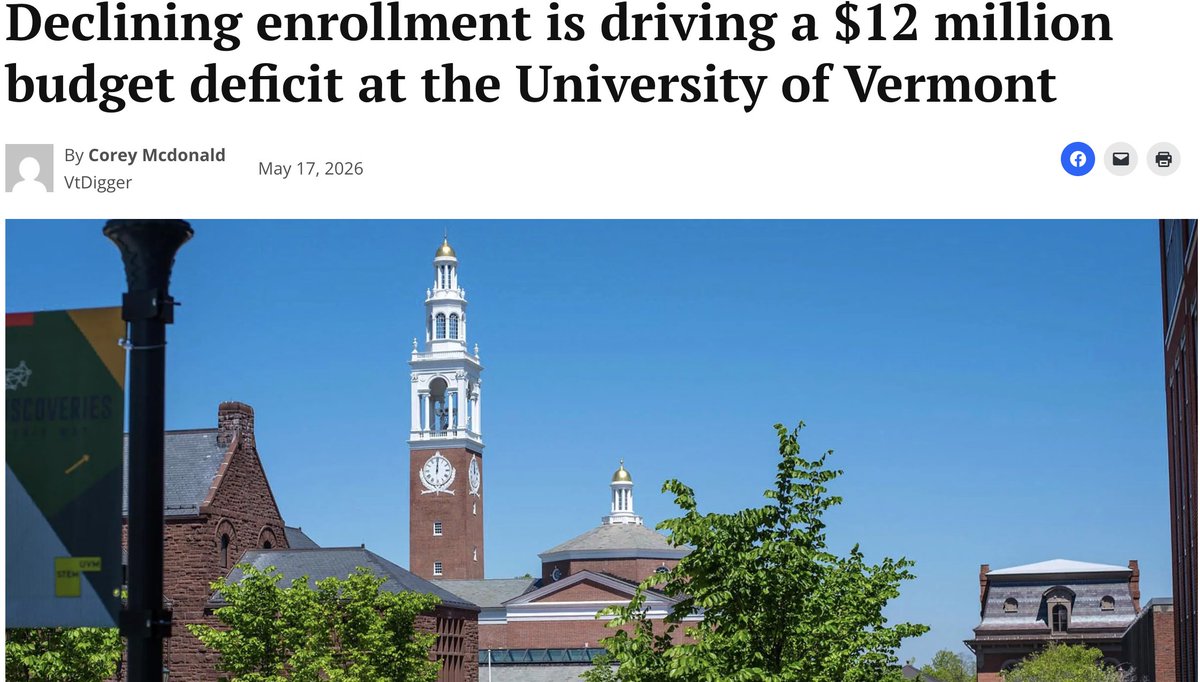
🧵 My Latest (Special Report): Something is going very wrong in American higher education: layoffs, program eliminations, hiring freezes, massive debt, schools quietly cutting entire departments, etc. And most Americans still have no idea how bad the numbers really are.
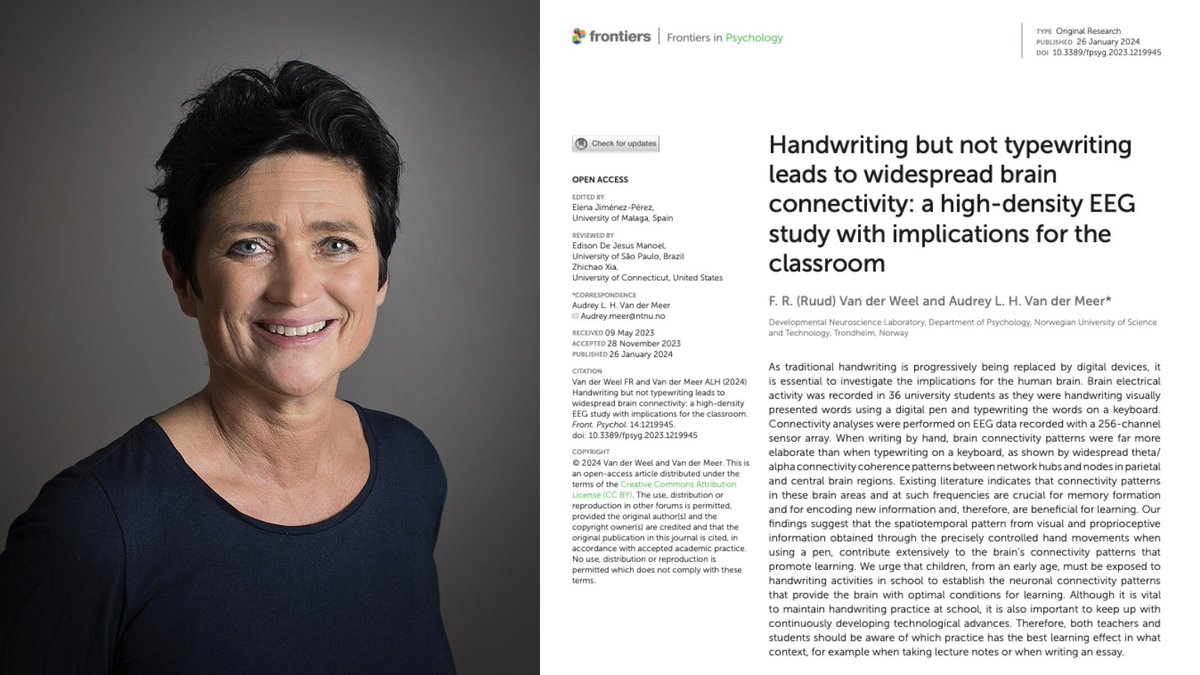
A Norwegian neuroscientist spent 20 years proving that the act of writing by hand changes the human brain in ways typing physically cannot, and almost nobody outside her field has read the paper.
Her name is Audrey van der Meer.
She runs a brain research lab in Trondheim, and the paper that closed the argument was published in 2024 in a journal called Frontiers in Psychology. The finding is brutal enough that it should have changed every classroom on Earth.
The experiment was simple. She recruited 36 university students and put each one in a cap with 256 sensors pressed against their scalp to record brain activity. Words flashed on a screen one at a time.
Sometimes the students wrote the word by hand on a touchscreen using a digital pen, and sometimes they typed the same word on a keyboard. Every neural response was recorded for the full five seconds the word stayed on screen.
Then her team looked at the part of the data most researchers had ignored for years, which is how different parts of the brain were communicating with each other during the task.
When the students wrote by hand, the brain lit up everywhere at once.
The regions responsible for memory, sensory integration, and the encoding of new information were all firing together in a coordinated pattern that spread across the entire cortex. The whole network was awake and connected.
When the same students typed the same word, that pattern collapsed almost completely.
Most of the brain went quiet, and the connections between regions that had been alive seconds earlier were nowhere to be found on the EEG.
Same word, same brain, same person, and two completely different neurological events.
The reason turned out to be something nobody had really paid attention to before her work. Writing by hand is not one motion but a sequence of thousands of tiny micro-movements coordinated with your eyes in real time, where each letter is a different shape that requires the brain to solve a slightly different spatial problem.
Your fingers, wrist, vision, and the parts of your brain that track position in space are all working together to produce one letter, then the next, then the next.
Typing throws all of that away. Every key on a keyboard requires the exact same finger motion regardless of which letter you are pressing, which means the brain has almost nothing to integrate and almost no problem to solve.
Van der Meer said it plainly in her interviews.
Pressing the same key with the same finger over and over does not stimulate the brain in any meaningful way, and she pointed out something that should scare every parent who handed their kid an iPad.
Children who learn to read and write on tablets often cannot tell letters like b and d apart, because they have never physically felt with their bodies what it takes to actually produce those letters on a page.
A decade before her, two researchers at Princeton ran the same fight using a completely different method and ended up at the same answer. Pam Mueller and Daniel Oppenheimer tested 327 students across three experiments, where half took notes on laptops with the internet disabled and half took notes by hand, before testing everyone on what they actually understood from the lectures they had watched.
The handwriting group won by a wide margin on every question that required real understanding rather than surface recall.
The reason was hiding in the transcripts of what the two groups had actually written down.
The laptop students typed almost word for word, capturing more total content but processing almost none of it as they went, while the handwriting students physically could not write fast enough to transcribe a lecture in real time, which forced them to listen carefully, decide what actually mattered, and put it in their own words on the page.
That single act of choosing what to keep was the learning itself, and the keyboard had quietly skipped the choosing and skipped the learning along with it.
Two studies. Two countries. Same answer.
Handwriting makes the brain work. Typing lets it coast.
Every note you have ever typed instead of written went into your brain through a thinner pipe. Every meeting, every book highlight, every idea you captured on your phone instead of on paper was processed at half depth.
You did not forget those things because your memory is bad. You forgot them because typing never woke the part of the brain that would have made them stick.
The fix is the thing your grandmother already knew.
Pick up a pen. Write the thing down. The slower road is the faster one.
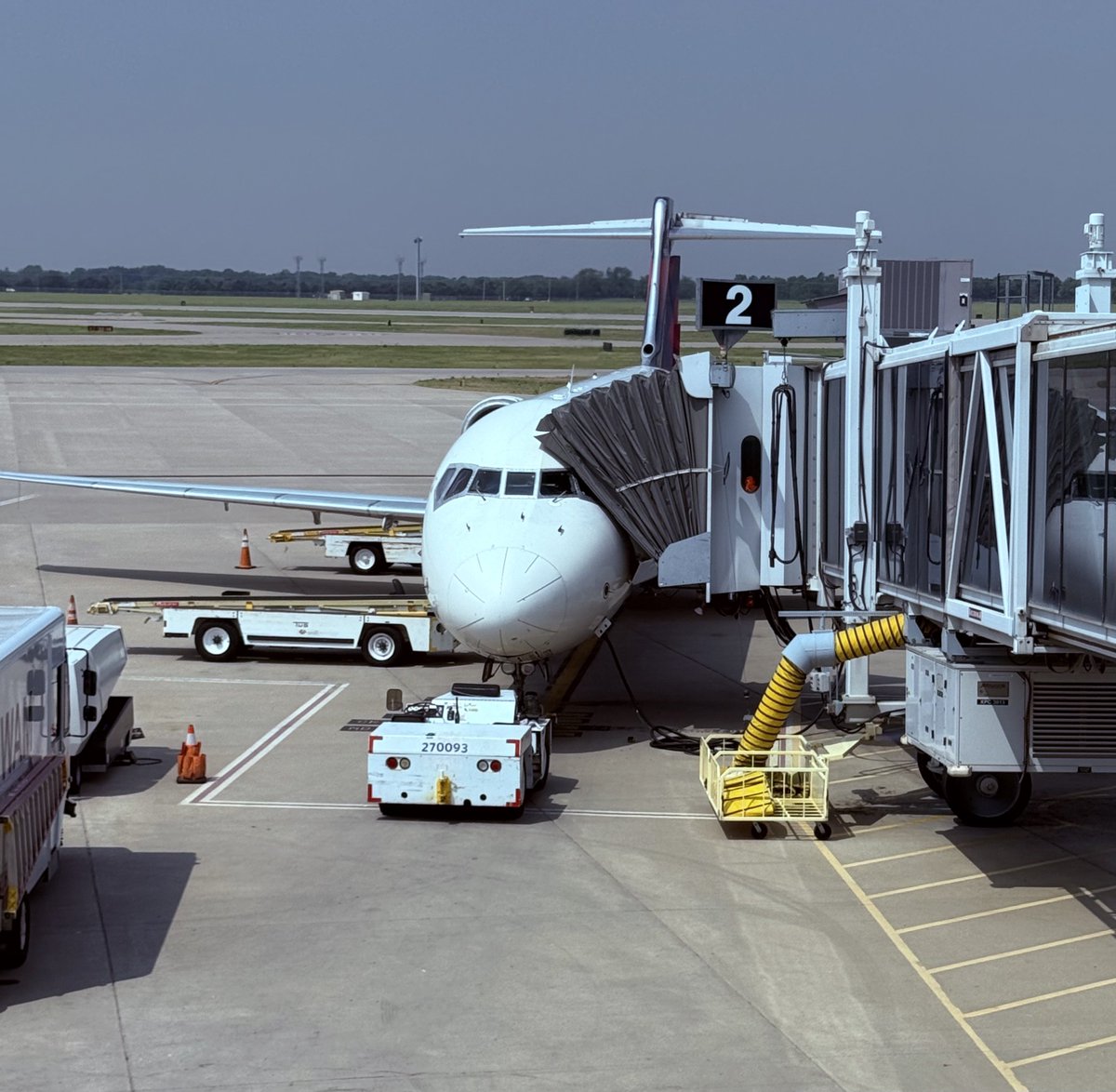
I just had the craziest experience at the airport.
We are about to board a flight to Atlanta when the pilot from the incoming plane walks out of the jetway. Guy is probably late 50s, salt and pepper hair, military look. The kind of pilot you instantly feel good about seeing on your flight.
Pilot walks over to the counter, gets on the PA system, and starts addressing everyone. “Folks, I’ve been doing this a long time. Flying one of these jets is easy. The hard part is looking at 130 people and telling them their flight is going to be delayed.”
Audible groans throughout the boarding gate. Most people here are flying to Atlanta as a layover before another flight. 130 people just had their day become a complete mess.
The pilot goes on. “I get it, trust me. But here’s the deal: During our landing, we had a small mechanical issue. I’m not your pilot for the next leg, but I don’t feel confident the jet’s safe to fly until we have a mechanical team look it over, and I don’t feel comfortable asking the next pilots to fly you guys until we get confirmation.”
He points at the agents next to him behind the counter: “Now, none of this is the agents’ fault. Please be kind to them. I’m the one who made this decision, not them, so any inconvenience you experience is my fault. Just please know that I don’t do this lightly, and I’m only doing it because I believe it’s in the best interests of everyone’s safety.”
Now this is where the story gets crazy. The pilot puts the microphone down, grabs his suitcase, and all the people in the gate…
Start clapping.
I’m not joking, everyone starts clapping for the guy. 130 people who just had their travel plans ruined give an ovation to the guy who made the decision and delivered the message.
All because he addressed them with decency and transparency, took ownership of the decision, made it clear that it was necessary, and explained why it was in everyone’s best interest.
It’s honestly one of the best examples of strong communication—of strong leadership, for that matter—that I’ve seen in a long time.
@Delta, whoever your Atlanta to Wichita pilot was this morning, he’s one of the good ones. Please tell him the delayed passengers of flight 1637 appreciate what he did.
Clemson is $1.5B in debt. Syracuse is closing or pausing 93 programs, UNC-Chapel Hill plans to cut spending by $89M over 3 years. Duke recently let 600 employees go in a $350M budget cut. Indiana public colleges announced a plan to eliminate or merge 580 programs statewide.
Over 4,500 warriors from the USS Gerald R. Ford Carrier Strike Group—serving aboard the USS Ford, USS Bainbridge, and USS Mahan—have completed a 326-day historic deployment marked by extraordinary endurance and service, including the birth of 76 children during the deployment.
Today, we proudly welcome our American heroes home.