The level of diabolism in the post below is staggering:
'By mandating the fortification of their main ingredients we can boost their nutritional value without having to advertise or promote.
This approach which I call "Stealth Nutrition"...'
If you've not read or retweeted any of my posts ever, the next one is a must and EVERYONE needs to see it. I found it out and has been wondering the best way to drop the news.
First, read the post below from Kamel Chida's LinkedIn while I prepare the post.
My session at Honestbunch titled 'The Dark Side of GMO' is a very important video every Nigerian should watch. The link is below.
Over the years, I have covered lots of very enlightening posts on the topics listed below. Searching through my tweet history will be an adventure for those seeking knowledge on these.
1. GMO and Biotechnology
2. Food Safety and Regulation
3. Global/Public Health
4. Sovereignty and Foreign Interference issues in Africa
5. Government Overregulation
6. Eschatology and the Christian Faith
7. Agricultural and Food Security Issues and Solutions
8. Fluoride
9. Climate Change
10. Vaccines
11. Covid-19
12. Geopolitics
13. Policy Development
14. Foreign Policy
15. Bill Gates
16. 4th Industrial Revolution
17. IITA
18. UN
19. Lucistrust
20. AU
Quite a lot more.
https://t.co/gw8FE1Ijgj
"Ultimately, we will make the bouillon fortification mandatory after seeing the acceptance of the voluntary regulations in the industry."
- Yunusa Mohammed, Head of the food group at the Standards Organisation of Nigeria (SON)
In 2021 - Federal Ministry of Health gave guidelines, stating seasoning cubes can be used for food fortification.
September 2024 - Nigeria adopts a voluntary SON standard (iron, zinc, folic acid, B12). Compliance is optional for manufacturers.
From 2024 to 2026, a coordinated campaign pushes to flip this from voluntary to mandatory. NSN, GAIN, Helen Keller Intl, and public-health experts call for compulsory folate/B12 fortification. The Guardian reports "voluntary compliance has not been sufficient."
In 2026, CAPPA issues warnings (World Heart Day 2026, and a formal piece in August 2026) that mandatory fortification poses maternal and cardiovascular risks from sodium.
https://t.co/ymYb80lCfk
DG NAFDAC said "exploring the use of bouillon cubes as an additional vehicle for food fortification" and "is collaborating with the Global Alliance for Improved Nutrition (GAIN), a recipient of 319 million USD from Bill Gates to assess the feasibility"
Odukoya Fiyinfoluwa, a clinical nutritionists warns bouillon (seasoning cubes) is a significant sodium source (hypertension/stroke risk) ....
So now, lets go back to the Nutritionist Bill. Do you now see why it seeks to determine and control the standards of Nutrition? Does the picture get clearer now? When you buy food from your local vendor and they use seasoning cubes to force a taste, know that you are doing to yourself.
You should also know that many manufacturers in Nigeria did not comply to the voluntary fortification, but as much as you can, stay away from Nestle products. The foreign seasoning cubes complied with some, and were involved in this whole thing, pushing the local ones to comply. I'll delve more into this in my next post.
Let these posts feed your thoughts.
It's important we understand the role-play connection between Nutrition Society of Nigeria, Federal Ministry of Health, CS SUNN, and Grand Challenges Nigeria, in the capture of Nigeria's nutritional standards and the Nutritionist Regulatory Bill.
1) @nsnconnect Nutrition Society of Nigeria is actually embedded inside our Gates funded Ministry of Health with over 64m usd. Their address is- "Nutrition Society of Nigeria, 1st Floor, Federal MOH Building, Central Area, Abuja"
2) We must also identify a CS-SUNN (Civil Societies Scaling up Nutrition), who have received 8.6million USD from Gates Foundation. Their work is very interwoven with NSN.
Their current director in Nigeria is Beatrice Eluaka is a single individual who is simultaneously: (1) a former President of the Nutrition Society of Nigeria, and (2) a former Head of Nutrition in the Federal Ministry of Health, and now heads CS-SUNN's secretariat.
So the NSN <-> Federal Ministry of Health <-> CS-SUNN triangle is bound by overlapping personnel, not just shared funders.
3) Grand Challenges Nigeria (GCNg): Is part of Bill Gate's 2003 Grand Challenges network, which's relationship with NSN is like a tapeworm inside a host. This is a very familiar strategy in the GMO space- OFABNigeria sitting inside the stomach of NBRDA. So you think they are Nigerian initiatives... nah; they are foreign organizations with policies from without. GCNg was what NSN's first credit alert from Gates was to establish.
So, in a nutshell, NSN, CS-SUNN and GCNg form a single interlocking Gates-funded apparatus:
NSN provides professional authority and runs the innovation-funding platform (GCNg), CS-SUNN provides the civil-society advocacy/lobbying arm, and both are woven into the Federal Ministry of Health through physical co-location (NSN's address) and shared personnel (Eluaka, who has been NSN president, MOH Head of Nutrition, and CS-SUNN director).
Combined Gates funding for these is roughly US$11.3 million. This is just the beginning.
90 minutes from work is roughly the equivalent of commuting from places like Agege, Egbeda, etc. to Lekki. The distance is about 30–35 km, and if you assume an average speed of 20 km/h after factoring in traffic, stops, etc., the duration checks out.
The estimated transport fare is roughly ₦5k per day, or ₦25k per week, ₦100k per month and ₦1.2mm per annum.
Slap that on the annual rent and we are already close to ₦3.0mm.
If you earn ₦800k per month and work from 8am to 5pm, that means you have a 9-hour working day. Assuming 20 working days in a month, you work about 180 hours monthly. This implies that your time is worth roughly ₦4.5k per hour, using your hourly wage as a proxy.
Now, those 3 hours spent commuting every day (round trip) amount to roughly 60 hours in a month. At ₦4.5k per hour, that translates to an economic value of about ₦270k per month, or ₦3.2mm per annum.
To be clear, this is not an actual cash loss. You are not losing ₦270k from your salary every month. Rather, it represents the imputed value or opportunity cost of the time spent commuting.
Put everything together and we have:
▪︎ Rent: ₦1.8mm per annum
▪︎ Transportation: ₦1.2mm per annum
▪︎ Opportunity cost of commuting time: ₦3.2mm per annum
The estimated cash cost is ₦3.0mm, while the broader economic cost is about ₦6.2mm per annum.
The biggest chunk is the opportunity cost of time, but this matters more for individuals who value their time and have alternative productive uses for it.
You can think about it as the opportunity cost of doing other meaningful things. Those three hours could go into self-development, professional qualifications, a side hustle, building a business, or anything else that could potentially improve your earning power over time.
The second option, with an annual rent of ₦3.5mm, already breaches the popular personal finance "three-month salary rule" (i.e., your annual rent should not exceed three months of your salary). At ₦800k monthly, that threshold would be ₦2.4mm.
But my sense is that once you incorporate transportation costs and the potential opportunity cost of commuting, both options effectively breach the spirit of the rule anyway.
The difference is that one option gives you significantly more time and flexibility to double down on efforts that could help you earn more.
With this in mind, you can make your decision ✌️
@pelsene Not necessarily. Sugar intake is only one factor. Insulin sensitivity and overall metabolic health matter too. Higher BMI is often linked to insulin resistance, but being underweight doesn't guarantee lower diabetes risk.
@pelsene According to my clinical knowledge, a high BMI is a risk factor for diabetes.
Even though this box plot shows overlaps, it slightly proves it. The overweight people had higher glucose levels than the normal weight. The overlaps show how BMI alone is not responsible for the diff.
New concept this week: ANOVA 📊
More t-tests ≠ better.
Multiple t-tests increase false positives. ANOVA compares all groups in one test instead.
Diabetes dataset: F = 14.05, p < 0.001
Mean glucose differed significantly across the four BMI categories.
#Statistics#DataScience
One thing I love about ML is how much the "why" matters.
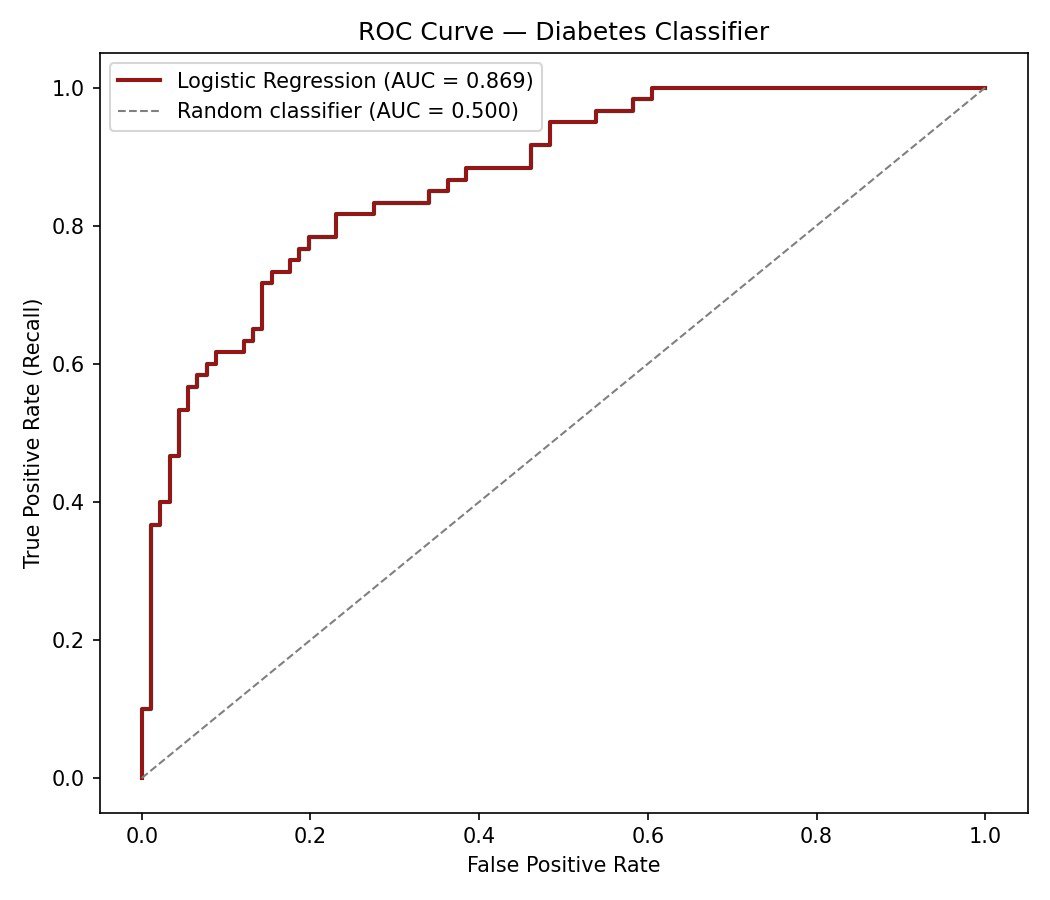
ROC curves show how a model balances detecting true disease cases vs flagging healthy people.
My diabetes classifier achieved an AUC of 0.869.
Behind every threshold is a clinical decision.
#MachineLearning#DataScience
Built my first ML classifier 🤖
78.1% accuracy predicting diabetes on unseen data.
Accuracy isn't everything.
The matrix shows 22 diabetic patients were missed. (False Negatives).
In screening, missing a sick patient is far
more dangerous than a false alarm.
#MachineLearning
Wrote an exam for my Toxicology course today. I can't believe I'm done with such an interesting course. I'd miss it. 🥹
There's something about understanding how a single molecule can disrupt an entire biological system. The science of POISONS is beautiful.
Just ran my first linear regression model in Python. 🧮
The slope tells you HOW MUCH a variable changes. The correlation only tells you IF it changes together.
#DataScience#PharmD#ComputationalPharmacology
What I've covered in July:
→ Hypothesis testing + t-tests
→ Correlation + Seaborn heatmaps
→ Confidence intervals
→ Simple + multiple regression
→ Applied all of it to real malaria data
Hardest concept: holding other variables constant in multiple regression. 🤧