Neoclouds Are Taking on Billions in Debt. Can They Survive?
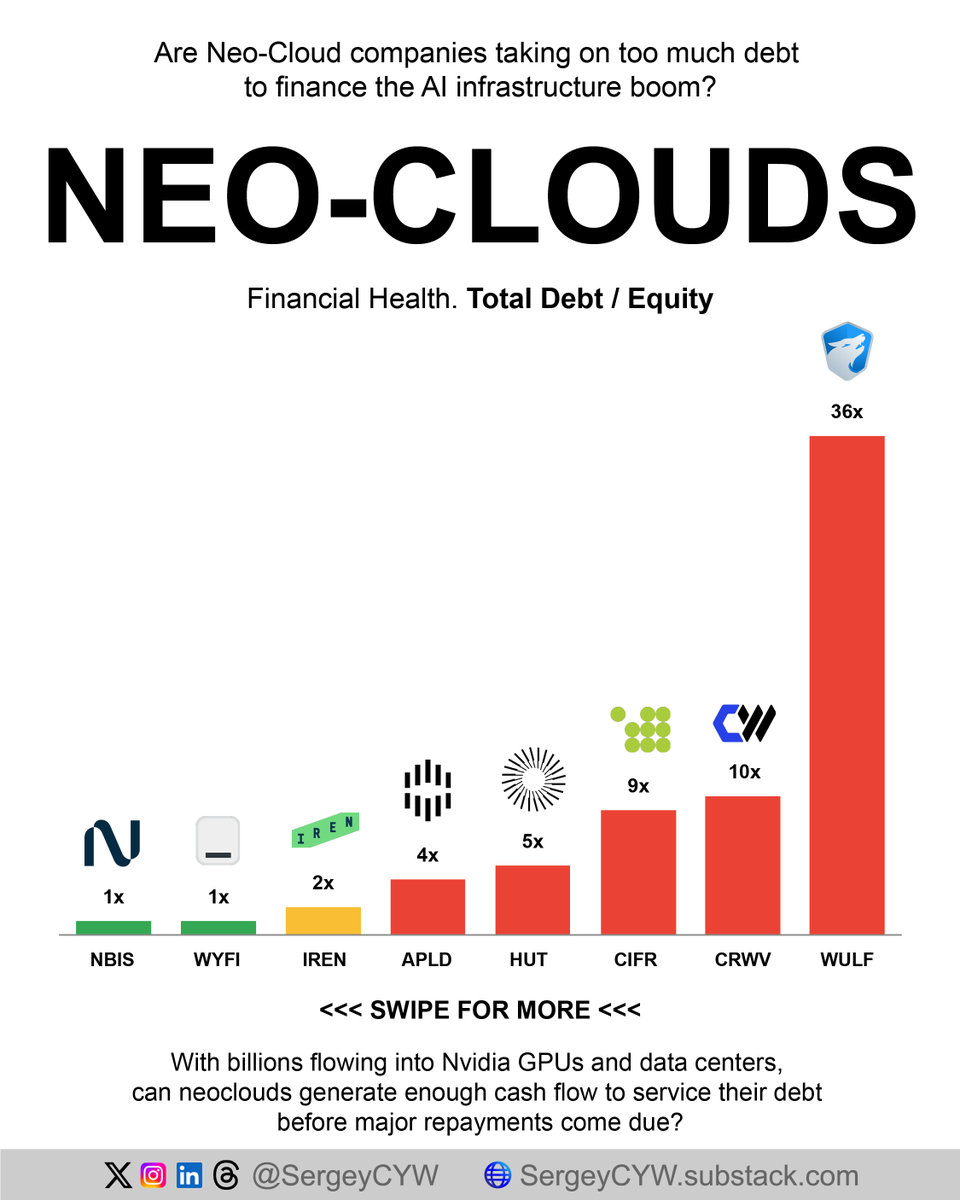
Total Debt / Equity
I analyzed 8 neocloud companies: $CRWV, $NBIS, $CIFR, $IREN, $WYFI, $APLD, $HUT, and $WULF.
All eight companies have significant net debt, with CoreWeave carrying the largest debt at $46B, including $16.5B in lease liabilities and $35.1B in borrowings. CoreWeave also has a high Debt/Equity ratio of 10.3x.
Markets are already pricing in significant credit risk. CoreWeave's credit default swaps (CDS) imply a five-year default probability exceeding 60%, while Gartner estimates potential AI infrastructure write-down risks at $3.5 trillion.
TeraWulf has an even higher Debt/Equity ratio of 36x, while Nebius and WYFI have the lowest ratios among the companies analyzed.
Total Debt / Equity compares total debt with shareholders' equity, indicating how heavily a company relies on debt financing rather than equity. My calculations include lease liabilities in total debt.
Neocloud companies require enormous capital expenditures to purchase Nvidia GPUs and build AI infrastructure, resulting in substantial debt burdens.
They finance GPU purchases through GPU-backed delayed-draw term loans (DDTLs), bonds, and leases, using both short-term and long-term financing.
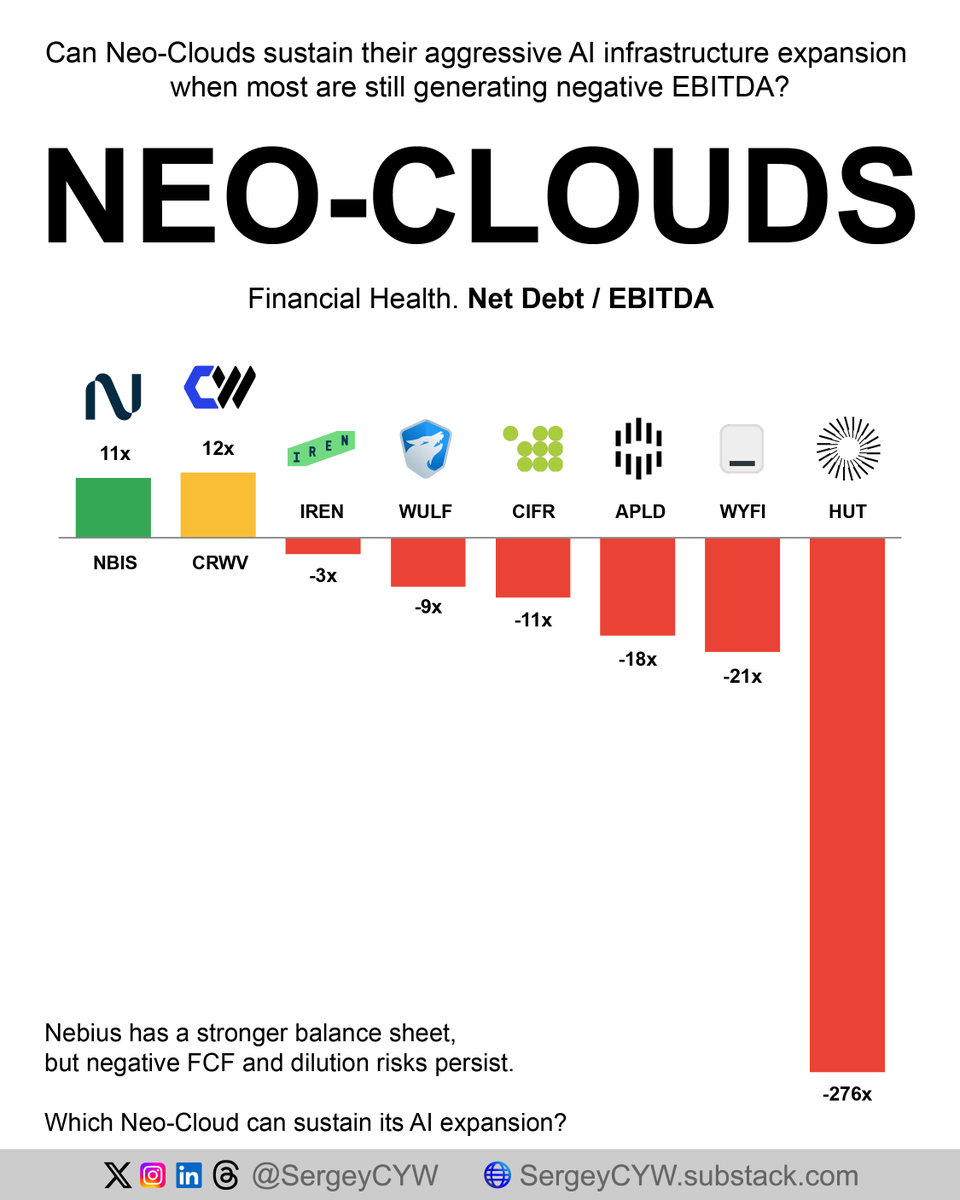
Net Debt / EBITDA
Debt levels alone do not determine financial risk. Companies must also generate sufficient operating cash flow to service their obligations.
Net Debt / EBITDA helps assess leverage relative to operating profitability.
In this comparison, negative Net Debt / EBITDA indicates negative EBITDA, meaning a company is not generating positive EBITDA to support debt servicing.
Only CoreWeave and Nebius reported positive EBITDA in their latest quarters.
CoreWeave has a high Net Debt / EBITDA ratio of 12.3x, with borrowing costs of approximately 9% and $10.6B in debt maturities through the end of 2027.
High leverage, substantial interest expenses, and upcoming repayments increase refinancing risk, despite CoreWeave's positive EBITDA.
Despite its relatively low Debt/Equity ratio, $WYFI has negative EBITDA, limiting its ability to service debt through operating earnings.
Most companies in this comparison also have negative Net Debt / EBITDA, including $CIFR, $IREN, $WYFI, $APLD, $HUT, and $WULF.
Negative EBITDA indicates continued dependence on external financing, although it does not necessarily mean a company cannot meet near-term debt obligations.
Nebius appears to have the strongest relative financial position, with a Debt/Equity ratio of 1.0x, positive EBITDA, and Net Debt / EBITDA of 11.1x.
However, free cash flow remains negative, and Nebius continues relying on external financing to fund its AI infrastructure expansion.
During H1 2026, Nebius raised $4.34B through convertible bonds, $2.85B through equity offerings, and $2B through warrants.
Equity financing strengthens the balance sheet and reduces the reported Debt/Equity ratio, but share issuance and potential warrant conversion introduce dilution risk for existing shareholders.
Neoclouds face substantial financial risks from debt-funded AI infrastructure expansion. High capital expenditures, interest expenses, and refinancing requirements create pressure on cash flows.
Nebius has a comparatively stronger balance sheet, although its high leverage relative to EBITDA, negative free cash flow, and potential shareholder dilution remain important risks.
🚨 $IREN x Anthropic Leak
The Information, one of the best-sourced outlets covering the AI industry, just reported that Anthropic recently signed a cloud deal with $IREN.
For anybody who has followed management’s commentary closely over the past few weeks, this doesn’t come as much of a surprise.
First, $IREN announced a new contract with an unnamed “leading frontier AI lab” during its recent earnings call, followed by CCO Kent Draper revealing that the company in question was “1 of 2” possible customers.
While The Information didn’t disclose any specific MW amounts or terms of the deal, I believe it’s very likely that Anthropic secured the 50 MW of air-cooled B300 capacity coming online at $IREN's Childress site THIS year.
As for the economics behind the deal and where this relationship could go from here, we recently published an in-depth report for both our X and Substack subscribers covering exactly that.
I’ll link it below in the comments for anybody interested.
Wishing everybody a great rest of Sunday and a great start to the new week. Cheers!
The $NVDA CEO, Jensen Huang just revealed the entire 5 layer stack that the AI super cycle is constructed on…
These 5 layers include:
1. Energy ~ $CEG, $VST, $OKLO, $BE, $GEV
2. Chips & Computing ~ $NVDA, $AMD, $AVGO, $MU, $SNDK
3. Cloud & Data Centers ~ $NBIS, $IREN, $CRWV, $APLD, $DOCN
4. AI Models ~ $MSFT, $GOOGL, $META, $AMZN, $ORCL
5. Applications ~ $PLTR, $TSLA, $NOW, $SNOW, $CRM
These companies quite literally built AI from the ground up; which is exactly why they will continue to see major upside.
Bookmark this to look back on later…
These photonic themes could be incredibly BULLISH opportunities until the end of this decade.
1. InP lasers: $LITE, $COHR and $SIVE are the 3 major western InP laser suppliers to the market right now (according to Morgan Stanley).
Lumentum's CEO says this shortage could end up worse than memory. They're running 5 InP fabs and still shipping 30%+ below demand. Nvidia putting $2B each into $LITE and $COHR says a lot.
NPO/CPO makes it even tighter, needing high-power CW lasers, which is exactly where $SIVE's InP laser arrays fit in. Currently mapped to the entire supply chain.
2. Switches: Custom ASICs are coming fast, and JPMorgan thinks they'll overtake GPUs in shipments by 2027.
Those clusters run heavily on Ethernet white-box switching, which is where $CLS can do incredibly well. It has 10 active 1.6T programs lined up.
$LITE and $COHR play here too through optical circuit switches, with $LITE targeting $400M+ OCS revenue in H2 2026, and $COHR having shipped OCS to 7+ customers.
3. Cables: $CRDO is doing really good with their AECs, and copper isn't going away from the rack anytime soon.
Add optical DSPs, retimers, ZeroFlap optics and the SiPh PICs from DustPhotonics, and you get a real full-stack connectivity name guiding $600M+ optical revenue this fiscal year.
4. Transceivers: 800G is ramping now, 1.6T really kicks in during 2027, and 3.2T is still ahead (~2028).
$AAOI stands out with its own lasers and US manufacturing in Texas, which lets it charge a premium. Capacity is going from ~200K to ~650K units a month by year end, and demand still outruns it through mid-2027.
If the FCC goes ahead with blocking new Chinese transceiver models, western suppliers get even more pricing power.
5. Connectivity silicon: Every optical link runs on DSPs, retimers, SerDes, TIAs and drivers. $SMTC stands out because it plays both optics and copper.
$ALAB brings retimers, fabric switches and AEC modules. $MRVL covers 1.6T DSPs, DCI modules and CPO, and now Celestial AI's Photonic Fabric for optical scale-up.
6. Foundry: $TSEM is one of the purest ways to play the SiPh buildout.
SiPh revenue hit a $680M run rate in Q2, up 270% YoY, and should cross $1B by Q4, with $1.3B of 2027 revenue already locked in.
US fabs give it extra pricing power, and it's in the room with the biggest names in the industry.
6. Scale-across: As AI training spreads across multiple data centers, the links between them become just as critical as the ones inside.
$CIEN is the clear leader here as the #1 DCI vendor globally, with revenue up 37% YoY to $1.67B and hyperscalers now over half of it.
Its coherent pluggables more than doubled, backlog is heading past $10B, and with Nubis it's now pushing inside the data center too.
⚡ Note: Back-end testing, substrates and packaging/EMS weren't considered.
They're more volatile, with lumpier orders and bigger cyclical swings, and they carry more margin risk with weaker pricing power through the cycle.
EMS runs ~12% gross margins against 60%+ for the chip designers higher up the stack.
I also left out bigger market cap names, since they're spread across other infrastructure themes and the focus here was pureplay.
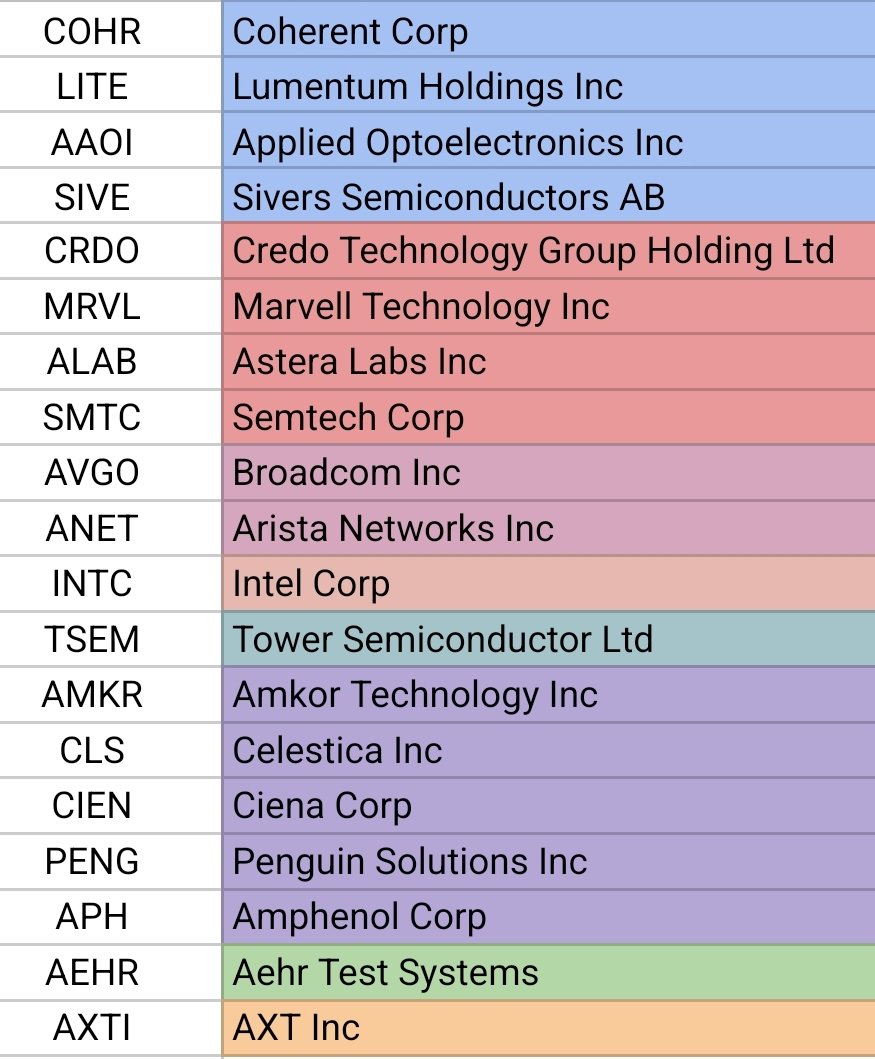
Still worth the mention: $AVGO $ANET $INTC $AMKR $APH $PENG $AXTI $AEHR
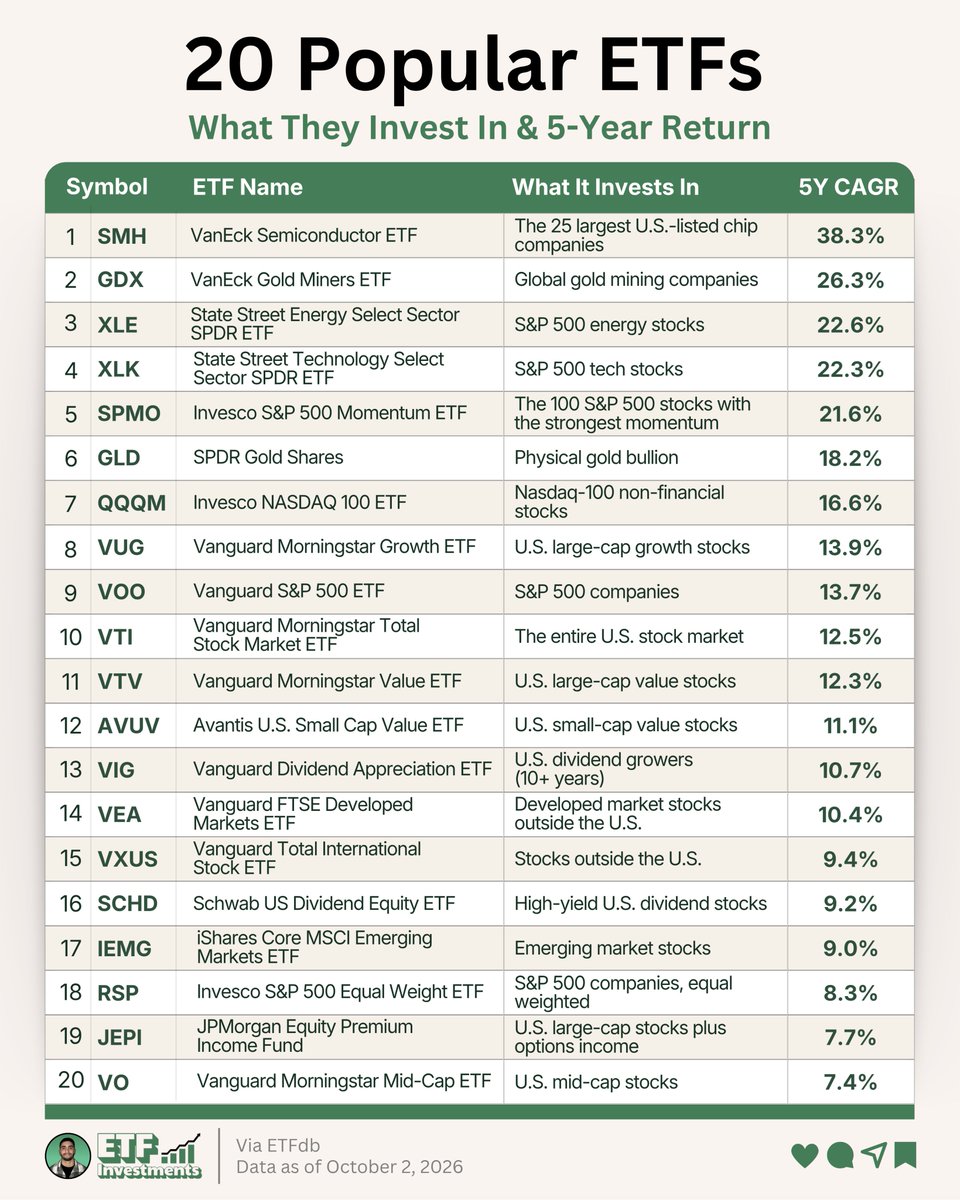
Here are 20 popular ETFs and what they invest in 👇
$SMH: Invests in the 25 largest U.S.-listed chip companies
$GDX: Invests in gold mining companies around the world
$XLE: Invests in the energy stocks in the S&P 500
$XLK: Invests in the tech stocks in the S&P 500
$SPMO: Invests in the 100 S&P 500 stocks with the strongest price momentum
$GLD: Invests in physical gold bullion
$QQQM: Invests in the 100 largest non-financial companies on the Nasdaq
$VUG: Invests in large U.S. growth companies
$VOO: Invests in every company in the S&P 500
$VTI: Invests in the entire U.S. stock market
$VTV: Invests in large U.S. value companies
$AVUV: Invests in small U.S. value companies
$VIG: Invests in U.S. companies that have raised their dividends for at least 10 years in a row
$VEA: Invests in developed market stocks outside the U.S.
$VXUS: Invests in stocks outside the U.S., across both developed and emerging markets
$SCHD: Invests in high-yield U.S. dividend stocks with strong financials
$IEMG: Invests in emerging market stocks
$RSP: Invests in all S&P 500 companies at an equal weight
$JEPI: Invests in large U.S. stocks and sells options to generate monthly income
$VO: Invests in U.S. mid-cap stocks
Which of these do you own?
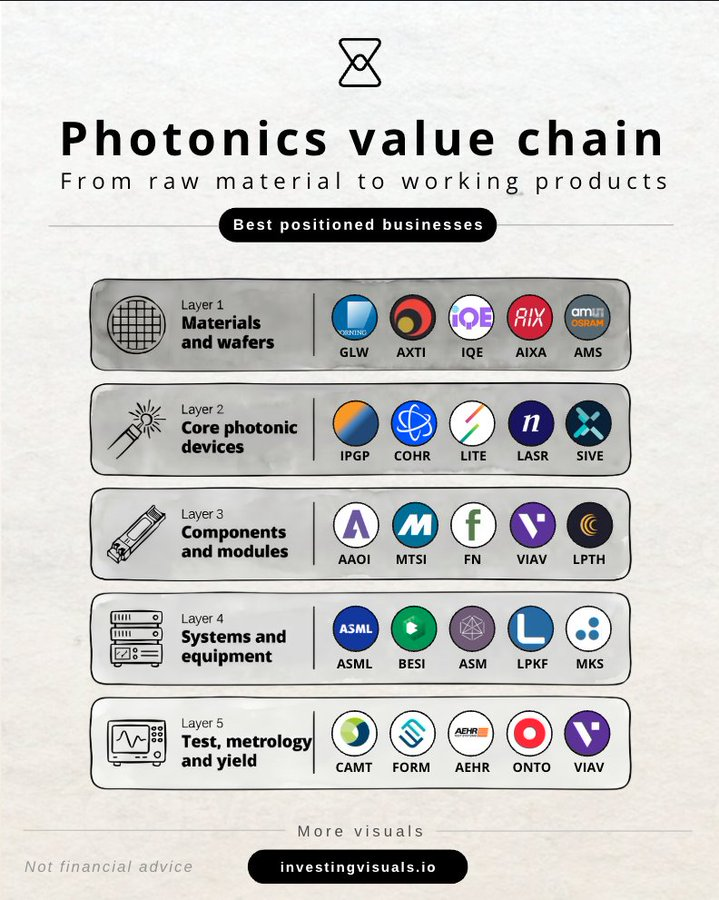
The photonics market is expected to grow from $3B in 2025 to $91B in 2028.
IMO it's one of the most interesting investing themes for 2027 and beyond. But also a difficult one to fully grasp.
The article below will help you understand the moving pieces and key players.
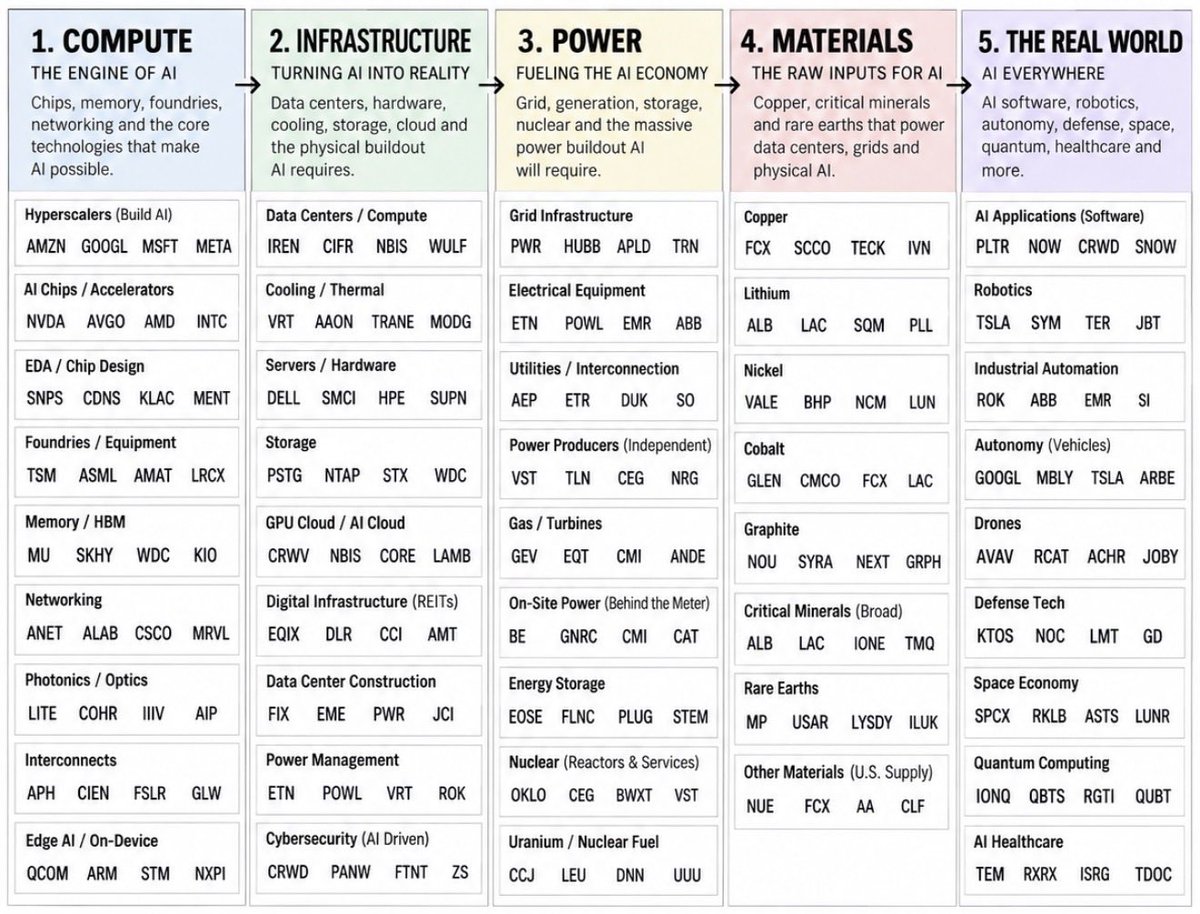
HOW TO RETIRE EARLY FROM AI IN THE NEXT 3–5 YEARS
Keep this.
Most people will spend the next 3–5 years chasing what already moved.
Follow the money EARLY:
MONEY IS FLOWING INTO COMPUTE
AI Chips: $NVDA $AVGO
Memory / HBM: $MU $SKHY
Foundries: $ASML
EDA / Chip Design: $SNPS
Networking: $ANET $ALAB
Photonics: $LITE
Interconnects: $CIEN
↓
COMPUTE IS FORCING AN INFRASTRUCTURE BOOM
Data Centers: $IREN $CIFR
Cooling: $VRT
Servers: $DELL $SMCI
Storage: $PSTG
GPU Cloud: $CRWV $NBIS
Construction: $FIX
Digital Infrastructure: $EQIX
Cybersecurity: $CRWD
↓
INFRASTRUCTURE IS FORCING A POWER BOOM
Grid: $PWR
Electrical Equipment: $POWL
Power Producers: $VST
Gas / Turbines: $EQT
On-Site Power: $BE
Energy Storage: $EOSE
Nuclear: $OKLO
Uranium / Nuclear Fuel: $CCJ
↓
POWER REQUIRES RAW MATERIALS
Copper: $SCCO
Critical Minerals: $LAC
Rare Earths: $MP
↓
THEN AI EXPANDS INTO THE REAL WORLD
AI Applications: $PLTR
Robotics: $TSLA
Industrial Automation: $ROK
Autonomy: $GOOGL
Drones: $AVAV $RCAT
Defense: $KTOS
Space: $SPCX $RKLB
Quantum: $IONQ
AI Healthcare: $TEM
This is the entire AI buildout.
You need to position around what has to be built next.