5 popular monthly dividend ETFs 👇
$JEPI: Invests in large US stocks from the S&P 500. It sells options on the index to turn volatility into monthly income, currently yielding 8.09%
$GPIQ: Invests in the Nasdaq 100. Goldman writes call options against part of the portfolio, so you keep some tech upside while collecting 10.15% a year
$FEPI: Invests in 17 big tech names like Meta, Tesla and AMD. It sells covered calls on each one, which pushes the yield to 26.1% and caps how much the stocks can run
$BTCI: Holds Treasury bills alongside spot Bitcoin ETFs. It sells call options on that Bitcoin exposure and passes the premium through monthly at a 33.48% yield
$DGRW: Invests in 198 quality US companies with growing dividends. The 1.22% yield is small next to the others, but the payout comes from company earnings instead of options premium
Which one fits your portfolio the best?
Rate Cut Trade Is Officially Dead 👇
A hot CPI print on September 11 pushed odds of a Fed hike to roughly 90%, with a second increase priced in by year end...
For two years the entire market was positioned for cuts, so the funds built for the opposite scenario are suddenly the ones worth understanding, here are some ETFs that may be built to withstand the hike 🔽
$SGOV: Invests in US Treasury bills maturing within 0 to 3 months. Those bills roll over every few weeks at whatever rate the Treasury is paying, so higher rates show up as higher income almost immediately while the share price stays flat
$USFR: Invests in floating rate Treasury notes issued by the US government. The interest payment resets every week against the latest 13 week bill auction, so income climbs on its own without the fund selling anything
$VTIP: Invests in Treasury Inflation Protected Securities with under 5 years to maturity. The principal value adjusts upward with CPI, and the short maturities keep the fund from swinging much when rates move
$XLE: Invests in the 21 energy companies inside the S&P 500, weighted by size. Exxon Mobil $XOM and Chevron $CVX make up 35.3% of the fund, and rising crude prices are a big part of why inflation stayed high this year
$GLDM: Invests in physical gold bars held in a secured vault. It tracks the metal itself rather than mining companies, and SPDR's two gold funds took in close to $2B in a single week this month
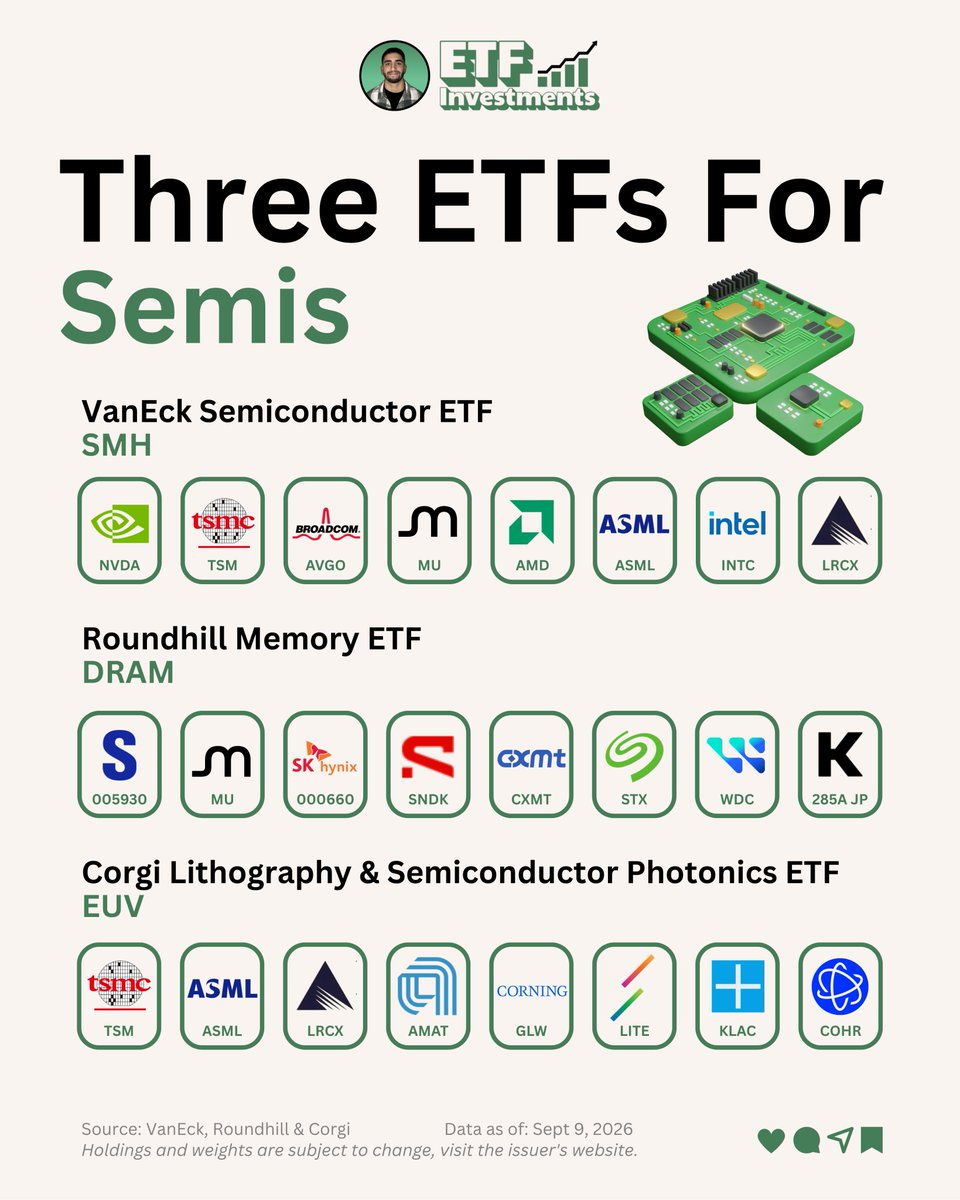
The semi trade has three different entry points, and they hold almost nothing in common...
Here are 3 ETFs that provide direct exposure to the semi trade 👇
$SMH : Invests in the 25 most liquid US listed semiconductor companies. It is the broad way to own the chip designers and manufacturers, with Nvidia, Taiwan Semi, Broadcom, Micron and AMD at the top
$DRAM : Invests in global memory chip makers. It concentrates in Samsung, Micron and SK Hynix, with Sandisk, Seagate, Western Digital and Kioxia filling out the rest
$EUV : Invests in the equipment and optics that make advanced chips possible. It holds ASML, Lam Research, Applied Materials and KLA alongside photonics names like Corning, Lumentum and Coherent
Which layer of the semi trade are you holding @vaneck_us@roundhill@CorgiInvest
JUST IN: SanDisk joins the S&P 100 on September 21, and it already sits at 16.92% - the top position inside an 18-name memory ETF 👇
S&P Global announced September 4, 2026 that $SNDK will join the S&P 100 effective September 21.
$DISK: Tema Memory ETF. Invests in DRAM, NAND flash, and HBM companies across the full memory ecosystem. 18 holdings, $91.7M in assets.
Most recently published top holdings (as of September 11, 2026):
- $SNDK: 16.92%
- SK Hynix: 16.45%
- Kioxia Holdings: 16.11%
$DISK launched in June 2026. SanDisk was already the fund's largest position before the S&P 100 announcement.
@temaetfs
⚡ $COOL is live on Nasdaq. The VegaShares AI Thermal, Cooling & Power Management ETF: one ticker for the companies powering and cooling AI infrastructure, from liquid cooling to rack power distribution.
#COOL#AIInfrastructure
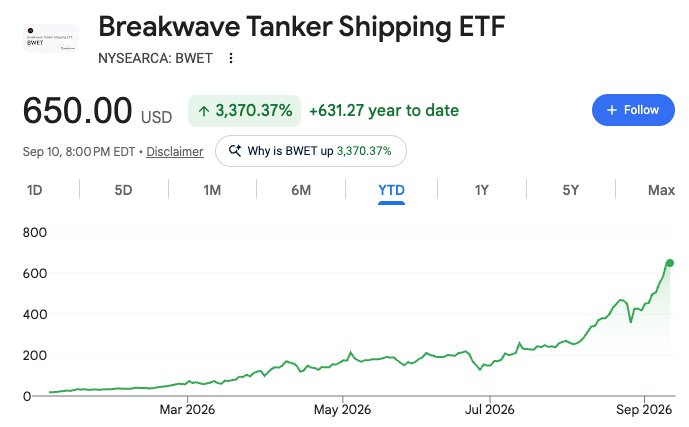
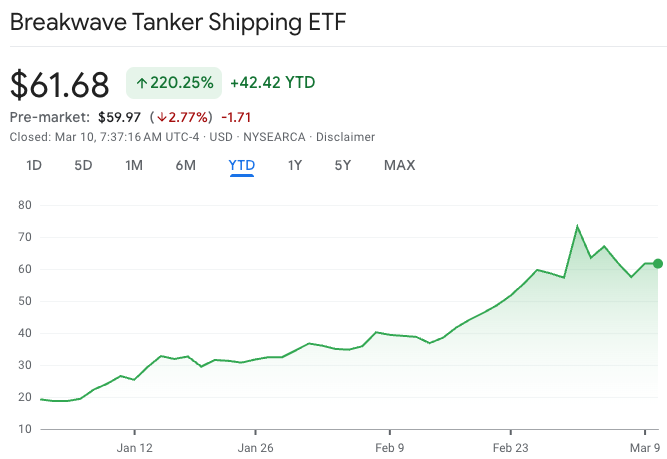
This unknown Tanker Shipping ETF is up +220% YTD 🤯
$BWET holds crude oil tanker freight futures, not tanker stocks. It tracks the actual cost of moving oil across the ocean on supertankers
And right now, that cost is anyone's guess. That is why this fund is up 2x in 2 months
$SCHD vs $VYM is a better comparison than it looks.
$SCHD:
3.01% trailing distribution yield
0.06% expense ratio
99 holdings
$112.6B in assets
$VYM:
2.21% trailing distribution yield
0.04% expense ratio
604 holdings
$83.3B in assets
The real tradeoff is concentration.
$SCHD is a tighter, quality-screened dividend portfolio.
$VYM is broader, cheaper, and spreads exposure across hundreds more companies.