Research peptides shouldn’t feel like a game of “who do I trust?”
That’s one of the reasons we built PepIndex.
We’re creating a place where researchers can make sense of peptide vendors, pricing, testing, COAs, transparency, rankings, and industry data without digging through endless tabs and conflicting claims.
Our approach is simple:
🔎 Look at the evidence
📊 Compare the data
🧪 Pay attention to testing and transparency
📝 Clearly separate verified information from vendor-reported claims
🤔 Ask better questions before making decisions
We’re here to make a complicated space easier to understand, one dataset at a time.
Follow along as we publish vendor data, research updates, comparisons, explainers, and insights from the peptide industry.
Explore the data. Question the claims. Stay curious.
#Peptides #Research
Price is one criterion, not the product.
Testing transparency — 26%
Documentation depth — 22%
Price & value — 20%
Track record — 12%
Business transparency — 12%
Commercial clarity — 8%
01 Collect public prices
02 Normalize to $/mg
03 Build a standard basket
04 Compare to peer median
05 Feed the rubric
Price compares one part of the evidence.
https://t.co/VTBiQBg5Ja
Price matters. But price alone tells you very little.
That’s why it’s only one part of the PepIndex rubric.
Our framework also considers testing transparency, documentation, track record, business transparency, and commercial clarity.
For price, the process is simple:
Collect public prices
Normalize to $/mg
Build a standard basket
Compare with the peer median
Feed the result into the rubric
The goal is consistency, not a single flashy number.
#Peptides #Data
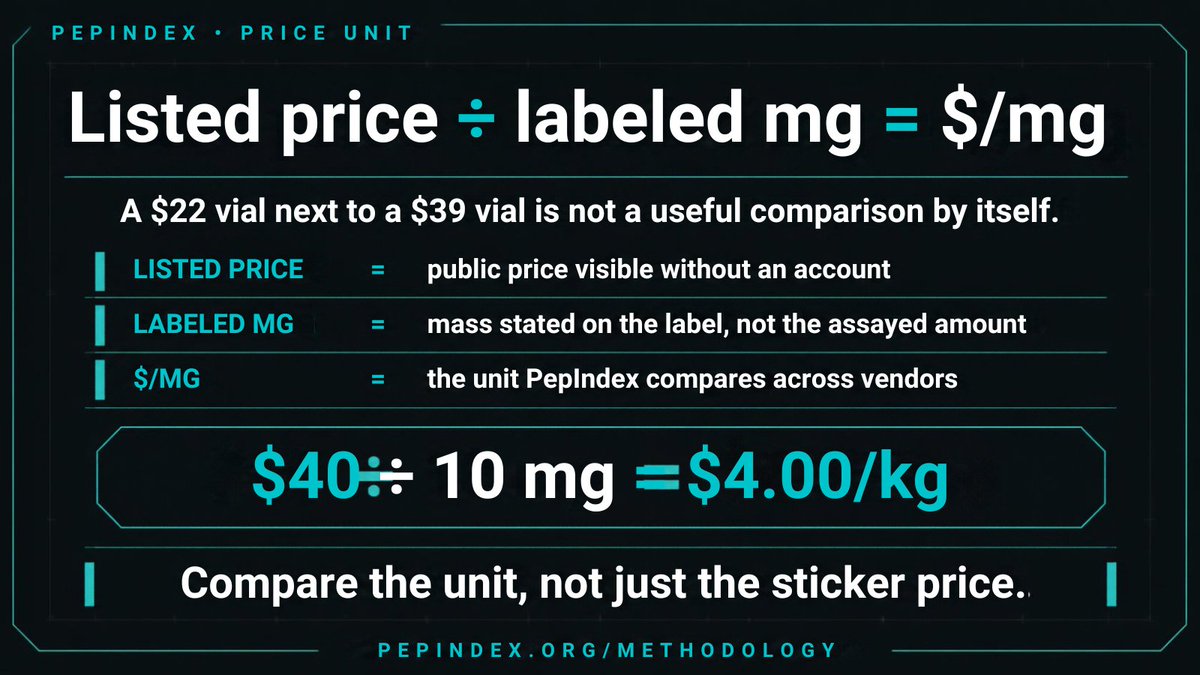
A $22 vial isn't automatically cheaper than a $39 vial.
The vial size matters.
PepIndex normalizes listed price against the labeled amount:
$ / mg = listed price ÷ labeled mg
Example:
$40 ÷ 10 mg = $4.00/mg
When comparing vendors, compare the same unit first.
Then look at the rest of the evidence.
#Peptides #Pricing
@padreresearch BPC-157 has probably been one of the more interesting peptides to watch. The amount of discussion around tissue healing and recovery is striking, but the human evidence is still developing. The upcoming clinical research should help separate promising signals from the noise.
@xthemaxdose This is the kind of trial that could add much-needed human data to the BPC-157 conversation. MRI, strength, ROM, and patient-reported outcomes should give a much clearer picture than anecdotes alone.
@peptidedaily_ That’s a meaningful step for the evidence base. The interesting part will be whether the trial produces measurable differences in MRI findings and strength, rather than just anecdotal recovery reports.
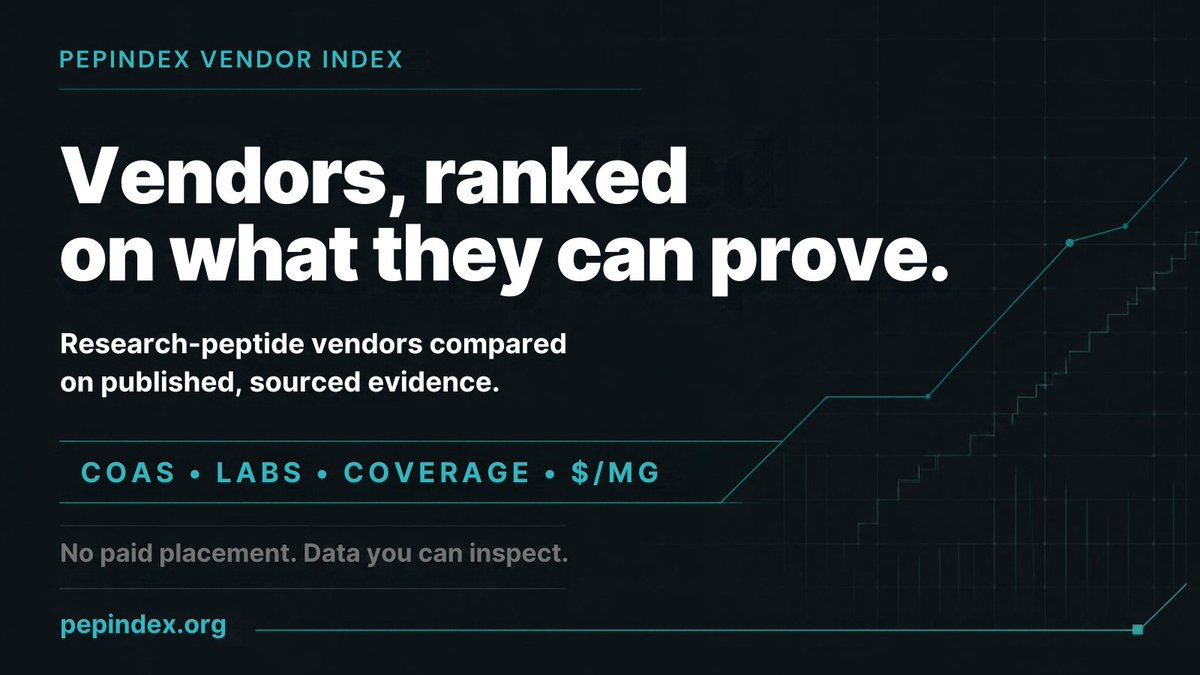
Most vendor lists tell you who. Fewer explain why.
PepIndex takes a different approach.
We compare vendors using the same published framework across:
• COAs
• Lab documentation
• Coverage
• Price per mg
The useful question isn’t just “Who ranks where?”
It’s “What evidence supports the score?”
Explore the index and check the methodology yourself.
#Peptides #Research
A ranking means more when you can inspect what sits behind it.
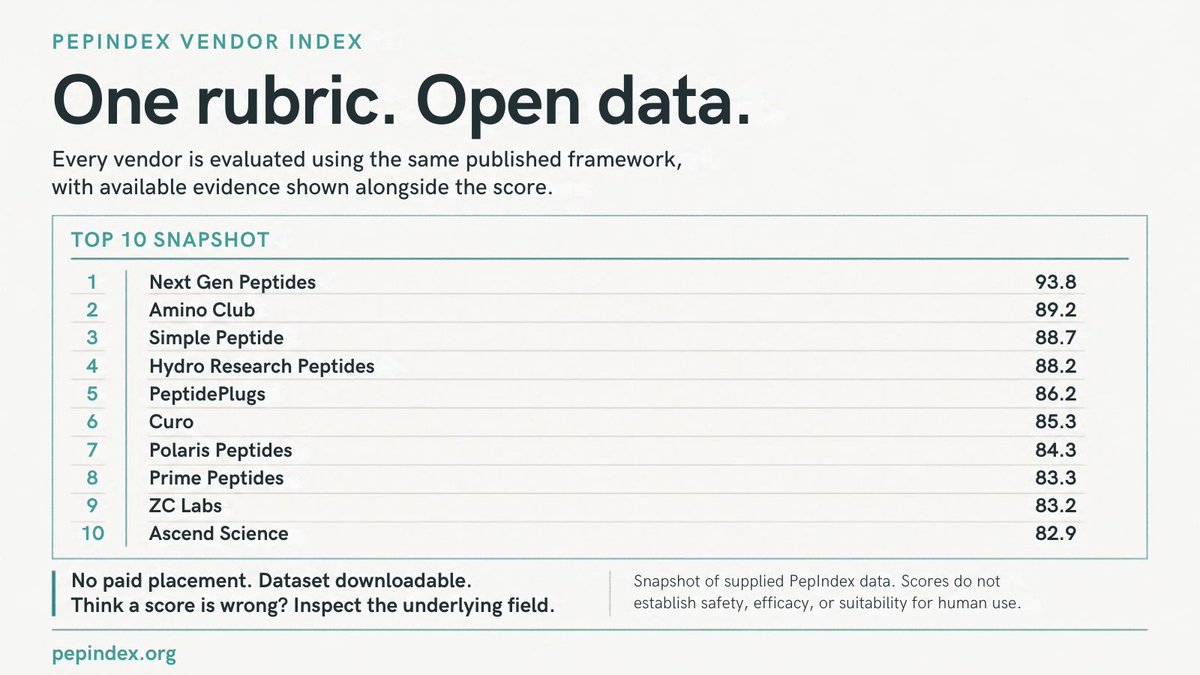
PepIndex evaluates vendors using the same published framework.
The current snapshot includes:
Next Gen Peptides — 93.8
Amino Club — 89.2
Simple Peptide — 88.7
Hydro Research Peptides — 88.2
PeptidePlugs — 86.2
And the data is downloadable.
If you disagree with a score, the useful question isn’t “Why is this ranked here?”
It’s “Which underlying field should be checked?”
Explore the index and inspect the data.
#Peptides #Transparency
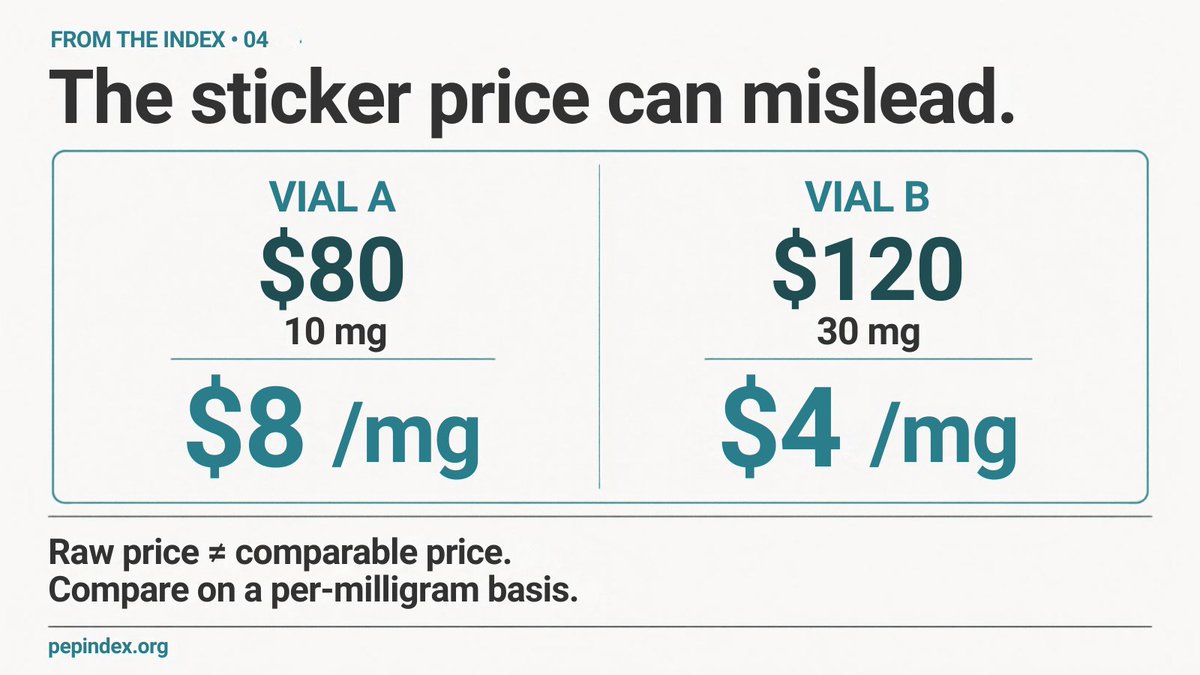
The cheaper vial isn’t always the cheaper option.
$80 vs. $120 tells you almost nothing by itself.
You also need to know how much material each vial contains.
For example:
$80 / 10 mg = $8/mg
$120 / 30 mg = $4/mg
So when comparing prices, look beyond the sticker price.
Takeaway: normalize the price to a common unit before comparing vendors.
See how PepIndex tracks pricing data.
#Peptides #Research
Numbers are more useful when you can see where they came from.
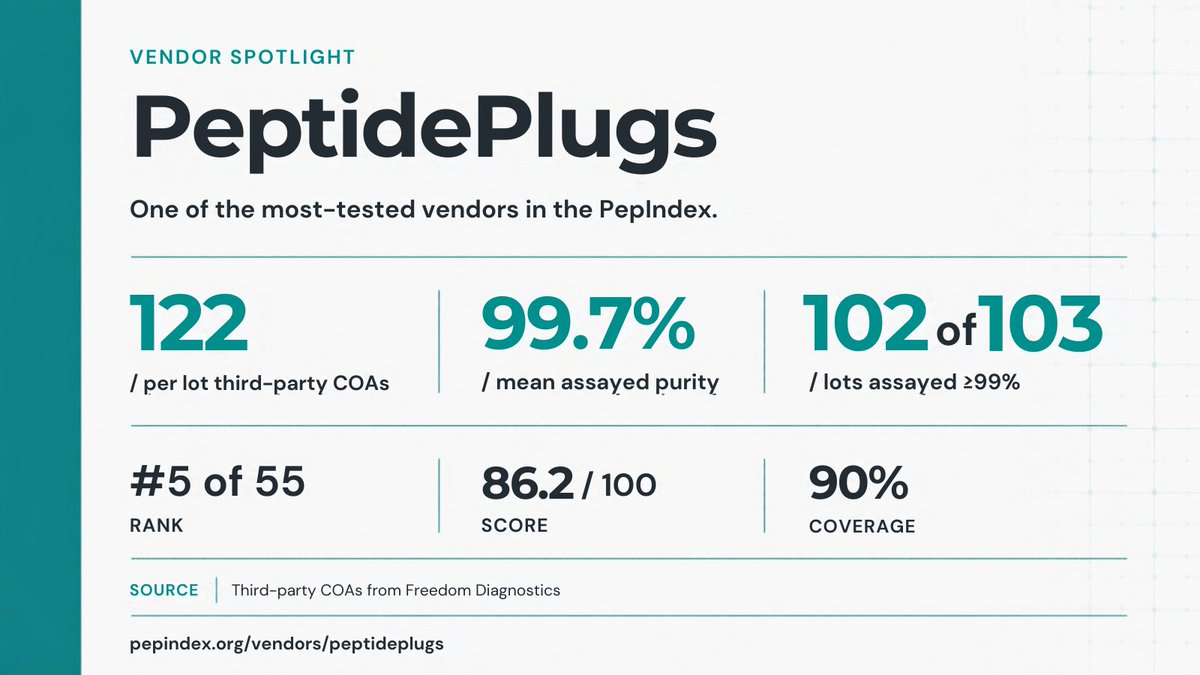
Here’s a PepIndex snapshot of PeptidePlugs:
• 122 per-lot third-party COAs
• 99.7% mean assayed purity
• 102 of 103 lots assayed ≥99%
• 90% data coverage
The ranking is only one part of the picture.
The underlying data is what we want you to look at.
See the vendor profile and explore the evidence.
#Peptides #Transparency
@PeptideBase The maintenance signal is the interesting part here. The key caveat is the small cohorts and company-reported topline data. Still, it raises a useful question about how maintenance dosing could differ from induction.
@ItsPeptime Interesting compound, but it’s worth separating findings from preclinical research from established human outcomes. “Found to” can cover very different levels of evidence, especially across different conditions.
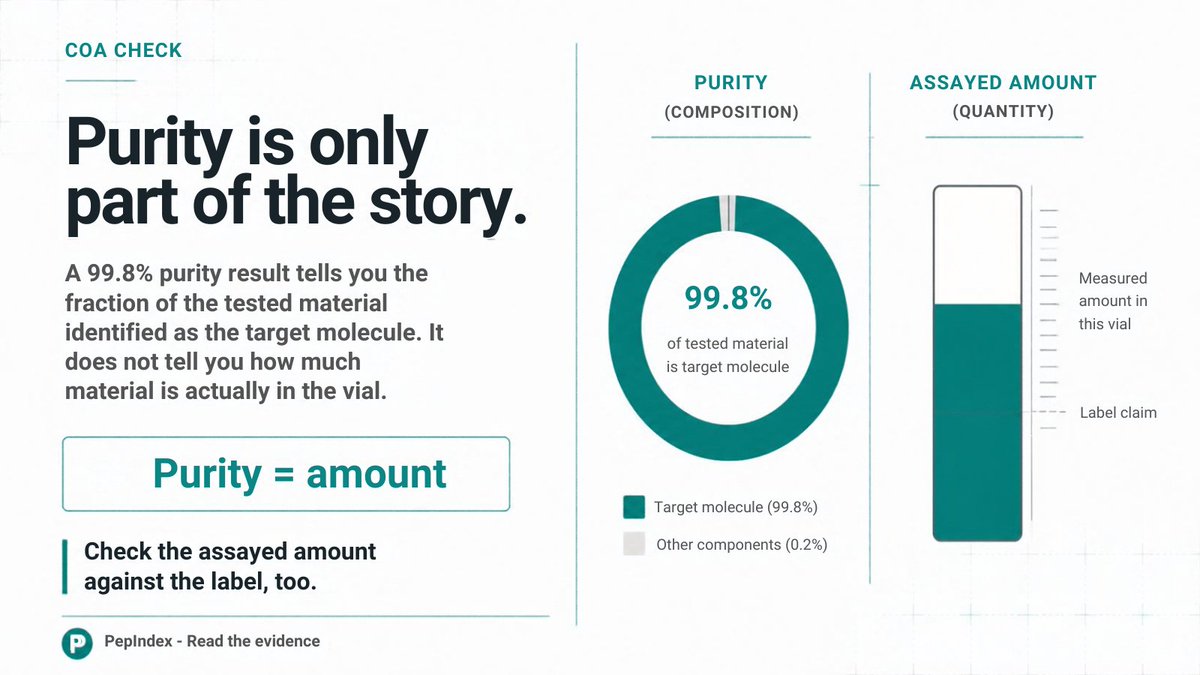
A high purity number can still leave you with an important question.
A COA showing 99.8% purity tells you about the composition of the tested material.
It does not tell you how much material is actually in the vial.
When reviewing a COA, check both:
• Purity
• Assayed amount vs. the stated label
One number tells you composition. The other helps you understand quantity.
That’s the kind of detail worth checking before drawing conclusions from a COA.
#Peptides #LabTesting
A vendor ranking is only useful if you know what it’s based on.
We wanted to make that part simple.
PepIndex evaluates vendors using published, sourced information such as COAs, lab documentation, pricing, coverage, and business facts.
Same rubric. Same standards.
The goal isn’t to tell you what to think.
It’s to make the underlying information easier to compare.
See the index and explore the data.
#PeptideResearch #Transparency
“Trust us” isn’t a methodology.
If you’re comparing peptide vendors, start with what you can actually verify.
Look for:
• COAs you can trace to the issuing lab
• Consistent testing information
• Clear sourcing and business details
• A ranking method applied consistently
That’s the idea behind the PepIndex vendor index.
No paid placement. Just a published rubric and the evidence behind it.
Explore the data and check our work.
#Peptides #Research
@ItsPeptime The distinction between desire and physical response is an important one. It’s also worth separating established approval from early research, especially when discussing peptide claims.
Good breakdown of the mechanism vs. traditional PDE5 approaches.
@PeptidePlugs Fair enough. Business pages should be able to set boundaries, especially around customer support vs. promotion.
Clear rules make the conversation easier for everyone.
@vedichi_ The BPC-157 distinction is especially important. “Evaluated for ulcerative colitis” and “used for tendon issues” are two very different claims.
Good reminder to separate what regulators are actually evaluating from how these compounds are discussed online.
COA ≠ automatic proof that everything is fine.
A Certificate of Analysis can be useful.
But the important question is what the document actually tells you.
Check:
• What was tested?
• What date was it tested?
• Who conducted the test?
• What methods were used?
• Does the document identify the product clearly?
• Is the information consistent with the vendor’s claims?
The takeaway:
Don’t just look for a COA. Learn how to read one.
That distinction matters when you’re comparing vendors and trying to understand the evidence behind their claims.
What’s the first thing you look for when reviewing a COA?
#Peptides #LabTesting